The price of Tesla stock closed on Friday, October 16, at $354.72. Only a day earlier, investors had watched a Roadster leap over a row of Tesla cars. They are still waiting for Tesla’s most important number.
The fact is that Tesla kept only 1.4% of its revenue as operating profit last quarter. Even so, the market still places its value at around $1.4 trillion.
🔗What Is Market Capitalization?
That gap defines the week ahead. The third-quarter results are due on Wednesday, October 21, once the market closes. The Roadster demonstration took place at a SpaceX test site and ran on SpaceX thrusters.
It also arrived amid open talk of a merger. In our view, the car matters less than the signal. Tesla now presents itself as one piece of a wider Musk ecosystem. Wednesday will test whether the numbers support that story.
🔗SpaceX Stock: What Investors Actually Own After the IPO
The Setup for the Tesla Stock Price Into October 21
Expectations sit low after a painful July. However, when Tesla released its Q2 earnings report on July 22, its revenues reached an all-time high of $28.24 billion, representing 26% growth. Its profit was a completely different tale.
Non-GAAP diluted EPS came in at $0.33 against an estimate of $0.53. However, its FCF was negative $1.09 billion. The stock fell about 14% the next day.
🔗Tesla Earnings Reports 2026: The Autopsy of an Automaker
Q3 2026 Earnings Setup & Valuation Benchmarks
| Q3 2026 Earnings Setup Metric | Figure & Benchmark Comparison |
|---|---|
| Earnings Report Date & Timing | Wednesday, October 21, 2026 (after market close) |
| Consensus Adjusted EPS (Zacks) | About $0.43 per share |
| Year-Ago Adjusted EPS (Q3) | About $0.50 per share |
| Consensus Revenue Estimate (Zacks) | About $27.8 billion |
| Actual vs. Consensus Q3 Deliveries | 486,532 delivered (vs. 461,974 consensus) |
| Options-Implied Post-Earnings Move | About ±7.5% |
| Share Price Last Close (October 16) | $354.72 per share |
| 52-Week Trading Range | $297.38 to $498.83 |
Deliveries did beat estimates. However, the consensus for revenue and earnings still sits below last year’s third quarter.
The delivery beat came with production of only 464,391 vehicles, so Tesla sold down about 22,000 units of inventory. That flatters revenue but says little about demand strength.
🔗How to Read an Earnings Report
Investment Takeaway: The bar is low on earnings but high on narrative. Margin and capex guidance will move the TSLA stock price more than the headline EPS.
What the Roadster Demo Actually Showed
Tesla livestreamed the event on October 15 from SpaceX’s rocket test facility in McGregor, Texas. The car drove up a curved ramp and launched.
It rolled 180 degrees on bursts of compressed air and landed on its wheels. It then jumped over a line of Tesla vehicles. No one was on board during the stunts, and the car ran without a driver.
Next-Generation Roadster Model Variations
| Roadster Version & Tier | Key Feature & Engineering Design | Reservation Deposit & Access Terms |
|---|---|---|
| Performance Version | Fan-driven suction technology and active aerodynamic control systems | $50,000 reservation deposit |
| Thrust Package Version | Rear cold-gas thruster integration enabling sub-one-second 0 to 60 mph acceleration | $250,000 reservation deposit |
| Rocket Specification Version | 10 cold-gas thrusters, brief hover/flight capability, single-seat configuration | Invitation-only access |
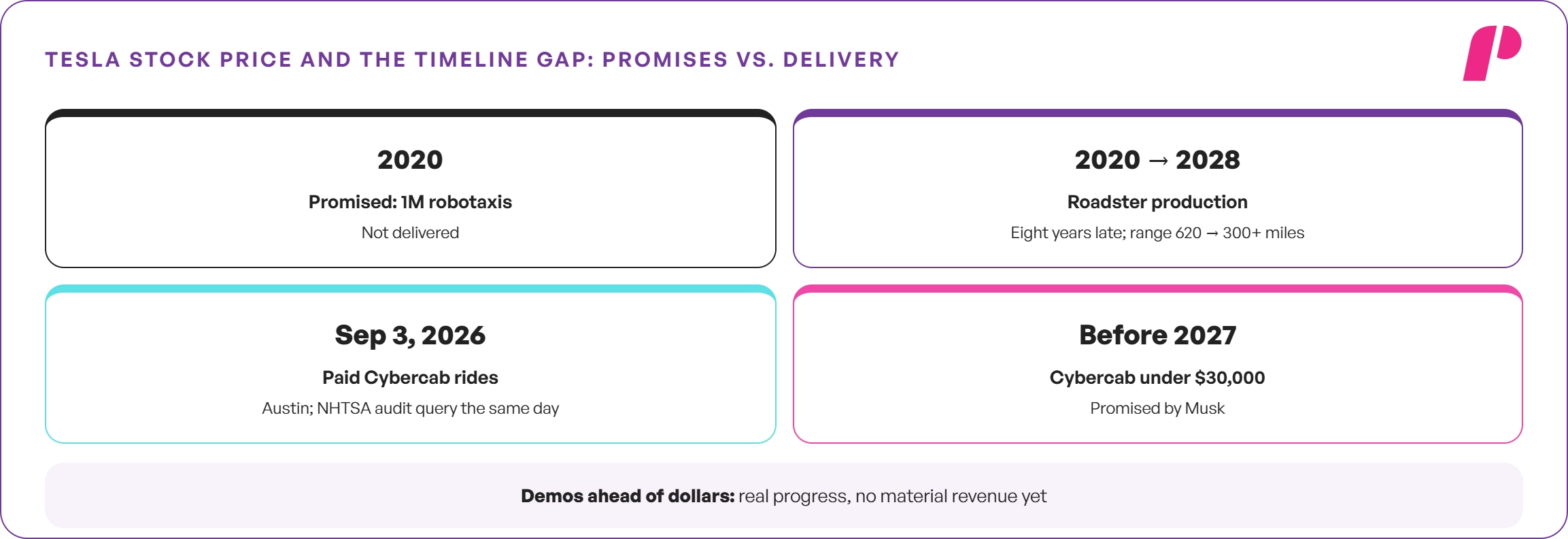
Tesla now promises more than 300 miles of range, down from the 620 miles it advertised in 2017. Production starts in 2028, eight years after the original target.
As for regulators, the Federal Aviation Administration stated that the Roadster falls outside its definition of an aircraft.
Analysts kept their expectations grounded. Dan Ives of Yorkville Ives wrote that the Roadster “will not move the volume or revenue needle.”
The Roadster is a halo product. What it really tells investors is how much engineering Tesla and SpaceX now share.
Investment Takeaway: Do not model Roadster revenue. Treat the demo as evidence of deepening Tesla and SpaceX integration.
The Car Business Beneath the Halo
On the contrary, the real business of the company is slowly being pressured out. Tesla sold 1,636,129 cars in 2025. Meanwhile, during the same year, BYD was ranked as the number one battery electric car maker in the world. More surprisingly, Gigafactory Shanghai accounted for over half of those sales made in 2025.
Quarterly Vehicle Delivery Volumes
| Vehicle Delivery Metric & Category | Q3 2025 | Q1 2026 | Q2 2026 | Q3 2026 |
|---|---|---|---|---|
| Total Vehicle Deliveries | 497,099 | 358,023 | 480,126 | 486,532 |
| Model 3 and Model Y Deliveries | 481,166 | n/a | n/a | 478,237 |
| Other Vehicle Models (S/X/Cybertruck) | 15,933 | n/a | n/a | 8,295 |
Deliveries through September rose 8.8% year over year. Other models fell 48%, however. Tesla has decommissioned the Model S and Model X lines at Fremont to install Optimus production. Tesla is turning car capacity into robot capacity before the robots earn any revenue.
Annual Financial Performance ($ Billions)
| Financial Metric ($ Billions) | FY2023 | FY2024 | FY2025 |
|---|---|---|---|
| Total Annual Revenue | $96.77B | $97.69B | $94.83B |
| Operating Income | $8.89B | $7.08B | $4.36B |
| Operating Margin (%) | 9.2% | 7.2% | 4.6% |
| Automotive Regulatory Credits | $1.79B | $2.76B | $1.99B |
| Free Cash Flow (FCF) | $4.36B | $3.58B | $6.22B |
🔗Cyclical Stocks in 2026: The Complete Prop Trader’s Guide
Regulatory Credits: The Vanishing Cushion
For years, rivals paid Tesla for emissions compliance. Those sales carry almost pure margin. In 2025, credits equaled about 46% of operating income, by our calculation.
That same year, Congress removed federal fuel-economy penalties, causing demand for credits to drop sharply. Tesla subsequently booked only $146 million in credits during the second quarter.
A year earlier, the figure was $439 million, so the decline reached 67%. In simpler terms, with the cushion gone, the thin operating margin shows what Tesla’s car business really earns. Wednesday’s report will show whether any credit revenue remains.
Investment Takeaway: Regulatory Credits are to be considered the last resort and not an avenue of repeated income generation. Gains will be made through pricing, efficiencies, or software.
A Massive Capex Year: Terafab and the Cash Burn
Tesla is spending as if the future has already arrived. CFO Vaibhav Taneja guided 2026 capital spending above $25 billion. Musk called 2026 “a massive capex year.”
Tesla spent $8.28 billion in the first half. That implies at least $16.7 billion in the second half, or roughly $8.4 billion per quarter, by our calculation.
Much of that money targets compute. In March, Tesla, SpaceX and xAI unveiled Terafab, a planned chip complex in Austin. Its stated goal is one terawatt of computing capacity a year.
Elon Musk said on April 22 that Terafab would make use of the Intel 14A process technology. Intel, in turn, predicts that the 14A process will come by 2027, while full-scale production can start between 2028 and 2029. Bernstein estimated the cost of one terawatt of production capacity at $5-13 trillion.
🔗Intel Earnings Reports: The Intel SHIELD Contract Explained

Put differently, Tesla is spending 2026 cash on a payoff that may only come in 2028. All this while, its car margins keep shrinking. The $43.52 billion of cash and short-term investments gives Tesla room to maneuver; nevertheless, that room is not unlimited.
Investment Takeaway: Watch for any capex increase on Wednesday. A higher guide without a clear revenue timeline would pressure the TSLA stock price.
The SpaceX Convergence and the Merger Question
The Roadster arrived during intense merger speculation. On October 14, Barclays analyst Dan Levy said a combination could come before Tesla’s annual meeting.
That meeting must take place by December 6. Levy estimated each Tesla share might convert into about 0.7 SpaceX shares. Neither company has proposed any ratio.
The ties already run deep. Tesla converted a $2 billion xAI investment into SpaceX equity after SpaceX merged with xAI in February.
In the second quarter, Tesla recorded a $763 million after-tax unrealized gain on that stake. The two companies also share the Terafab project.
Corporate Merger Analysis & Strategic Assessment
| Merger Dimension & Factor | Bull Case (Strategic Advantage) | Bear Case (Risk & Governance Concern) |
|---|---|---|
| Strategic Logic & Synergies | Deep vertical integration across advanced semiconductors, autonomous robotics, and space infrastructure | Potential related-party conflicts and resource allocation disputes in shared enterprise projects |
| Valuation & Shareholder Impact | Access to high-growth private space enterprise value (recent private valuations near $2.07 trillion) | Public equity holders dilute pure-play focus and lose standalone exposure |
| Announcement Timing & Market Odds | Strategic announcement window anticipated before December 2026 | Prediction market probabilities indicating muted likelihood (~24% odds by year-end) |
| Corporate Governance & Approvals | Combined balance sheet scale and unified capital access | Rigorous independent board reviews, special committees, and shareholder approval votes required |
In our view, the merger debate props up the Tesla stock price. Fundamentals alone would not support that floor. If no deal appears by December, Tesla will face judgment on its own margins.
Investment Takeaway: Mergers represent optionality, not a catalyst with a time frame. Traders should not size positions around an unannounced deal.
Robotaxi, Cybercab and Optimus: Milestones Versus Revenue
Well, Tesla’s valuation is largely a bet on autonomy and robotics. The record shows real progress, but no material revenue yet.
Advanced Autonomy & Robotics Program Status
| Innovation Program & Initiative | Operational Status (per Q2 2026 Corporate Update) | Current Revenue Contribution |
|---|---|---|
| Robotaxi Network Program | Active across 7 metropolitan markets; 6 ramping unsupervised operations, Bay Area operating with safety drivers | Small initial contribution |
| Cybercab Dedicated Vehicle | Initial production initiated at Giga Texas; employee testing rides commenced in July 2026 | None disclosed (Pre-commercial) |
| Optimus Humanoid Robot | First-generation assembly lines installing at Fremont; broader production expected later in 2026 | None (Developmental stage) |
Musk has said Cybercab will sell for under $30,000 before 2027. His track record on timelines remains mixed. For instance, he promised a million robotaxis by 2020, and the Roadster itself will arrive eight years late.
More recently, paid Cybercab rides started in Austin on September 3, and NHTSA opened an audit query that same day.
While demos are ahead of the dollars, every update of the timeline can influence the price of TSLA stock.
Investment Takeaway: On Wednesday, expect unit numbers, not dreams. Cybercab output and Optimus start dates matter most.
What Tesla Actually Owns
A look at Tesla’s patents shows where its engineering edge really lies. For example, US Patent 11,816,585, granted in November 2023, describes machine learning models that run at different frequencies.
One fast model follows objects at the camera’s frame rate. In contrast, a heavier model classifies them less often. This design helps vision-only driving fit within onboard chip limits.
🔗Nvidia Stock Analysis: Can NVDA Own AI, Robotics and Quantum?
Similarly, US Patent 11,749,842 filed in September 2023 provides protection for the tableless electrode found in Tesla’s 4680 cell.
In addition, Tesla’s Automation division filed an application for an automated mRNA bioreactor jointly with CureVac. This application was made public in 2020.
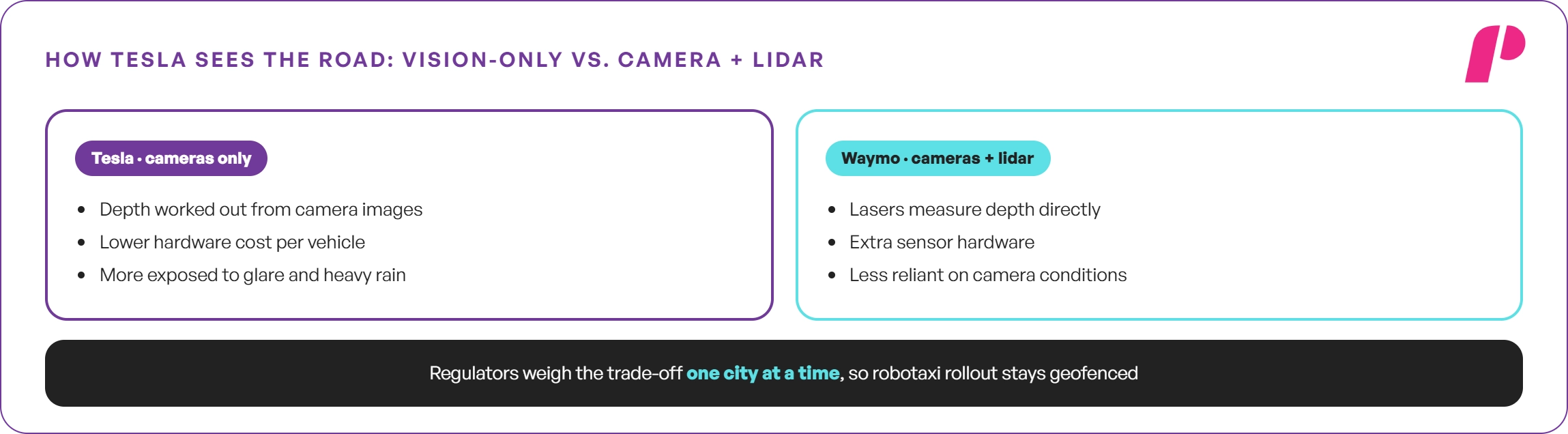
There is always a price to pay for the use of vision alone. Waymo uses a combination of cameras and lidar, which is a depth sensor that uses lasers.
Tesla, on the other hand, works out depth from camera images and nothing else. That choice lowers hardware cost per vehicle.
Nevertheless, it leaves Tesla more exposed to glare, heavy rain and other situations where cameras struggle. Regulators will weigh that trade-off one city at a time. Consequently, the robotaxi rollout has been slow and limited to geofenced areas.
These patents do protect real know-how. However, they are no guarantee of unsupervised autonomy or of low-cost cells at scale.
Investment Takeaway: Tesla’s intellectual property supports its cost advantage. It fails to address the regulatory barrier between FSD and paying passengers in the driverless cars.
Energy: A Quiet Wobble
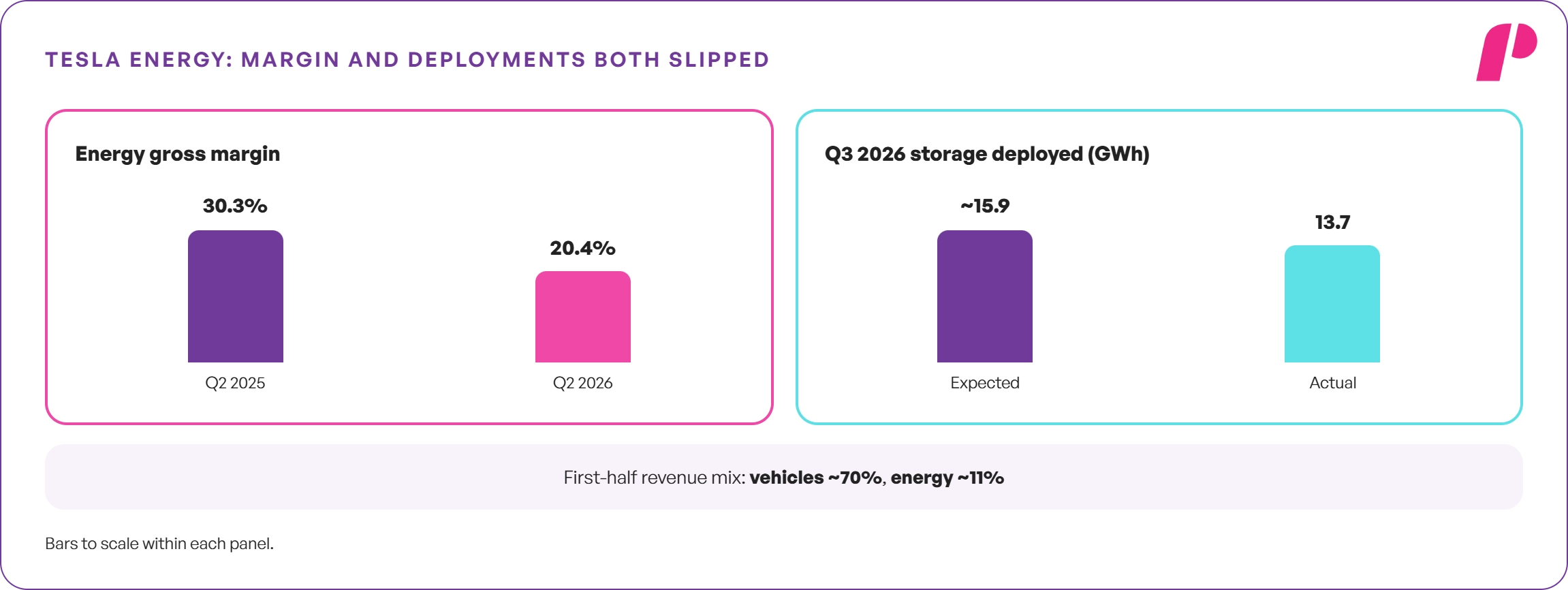
Energy storage once offset automotive weakness. In the third quarter, it fell short of expectations. Tesla deployed 13.7 gigawatt-hours, while analysts had expected roughly 15.9.
Before that, energy gross margin in the second quarter dropped to 20.4%, against 30.3% a year earlier. On October 15, the Wall Street Journal reported that Mike Snyder, vice president of energy and charging, had stepped down.
Scale explains why this matters. In the first half, energy brought in about 11% of revenue, compared with roughly 70% from vehicles. Even so, storage earned higher margins than cars for most of 2025.
Therefore, when the higher-margin segment weakens together with autos, the overall margin has little to lean on.
Investment Takeaway: Energy margin now matters as much as automotive margin. A second weak energy quarter would remove a key support.
China, Tariffs and the Supply Chain
Tesla’s cheapest factory sits in its most sensitive market. Over 50% of Tesla’s deliveries for 2025 were produced in Shanghai, which is also its major export base.
In addition to that, Chinese processors account for the majority of battery graphite and rare earth magnets used in electric motors. A trade shock between Washington and Beijing would therefore hit Tesla’s lowest-cost output first.
🔗Tariffs and Stocks
Competition adds pressure from the same direction. BYD, Geely and Xiaomi keep cutting prices in China and Europe. Tesla’s margin problem and its geopolitical exposure share a single address: China.
Trading the Report: A Framework
Options imply a move of about 7.5% for the TSLA stock price after the report. At the $354.72 close, that equals about $26.60 per share.

🔗Options Expected Move Explained
Accordingly, an estimated range would be between $328.12 and $381.32. As the implied volatility varies each day, traders are advised to input their values using the latest option prices prior to the announcement.
Earnings Scenario Analysis & Price Action Framework
| Market Scenario | Fundamental Catalyst & Trigger | Anticipated Price Reaction & Technical Result |
|---|---|---|
| Bull Scenario | Operating margin recovery, disciplined capital expenditures, and firm commercial dates for Cybercab and Optimus | Upside breakout above the current consolidation trading range |
| Base Scenario | Earnings per share (EPS) printing near $0.43 consensus with low single-digit operating margins | Neutral sideways movement contained within the established range |
| Bear Scenario | Sub-consensus earnings miss, accelerated capital expenditure growth, and negative free cash flow generation | Downside breakdown below the established 52-week trading range |
The risk budget should determine position size rather than conviction. Given that there is a risk of 1% per trade with an equity of $100,000, then the risk budget will amount to $1,000. If the stop is one expected move away, then the position size will be 37 shares. These figures are illustrative only.
🔗Position Sizing in Forex & Stocks
The Risks That Matter for the Tesla Stock Price
- Margin Compression. Operating margin fell to 1.4% in the second quarter, which weighs on the TSLA stock price.
- Credit Erosion. Regulatory credit revenue fell 67% year over year.
- Cash Burn. Second-half capex implies continued negative free cash flow.
- China Concentration. A single plant in Shanghai handled over half of last year’s deliveries.
- Timeline Risk. Robotaxi, Cybercab, and Optimus remain pre-revenue at scale.
- Merger Uncertainty. Speculation can reverse quickly if no deal appears.
- Cyber Exposure. At Pwn2Own Automotive in January 2026, researchers managed to break into Tesla’s infotainment system.
- Key-Person Risk. Musk’s attention spans Tesla, SpaceX, and xAI.
🔗Risk Management in Stocks: A Complete Guide 2026
Closing Thoughts
Tesla now trades as a bet on convergence. The flying Roadster, Terafab, and the SpaceX stake all point to one thing.
Collectively, they create an ecosystem under Musk for cars, microchips, robots, and space. At the same time, the auto industry is making low margins without the protection of regulations anymore.
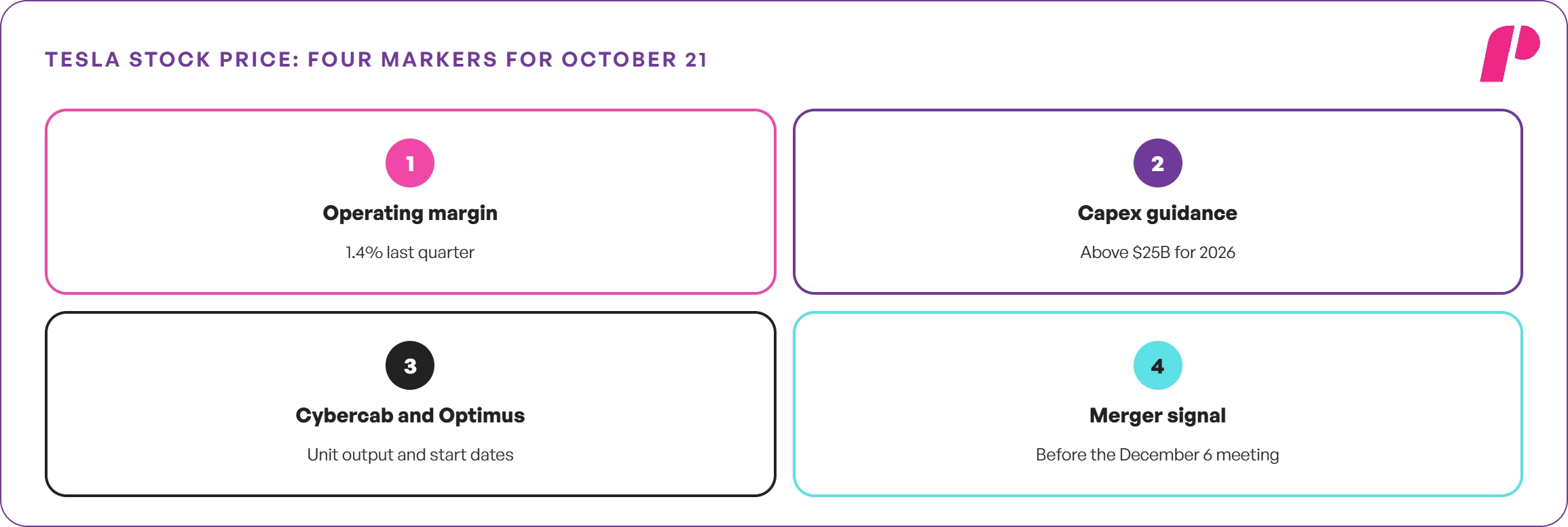
Wednesday’s report will tell us which of the two narratives is fueling the Tesla stock. Watch four markers: operating margin, capex guidance, Cybercab and Optimus output, and any merger signal before December 6.
In our view, Tesla’s valuation now leans more on the ecosystem than on the car itself. As a result, both the upside and the risk are larger than before.
NFA. DYOR. This analysis is meant for information only and should not be read as investment advice.
If you liked this post make sure to share it!