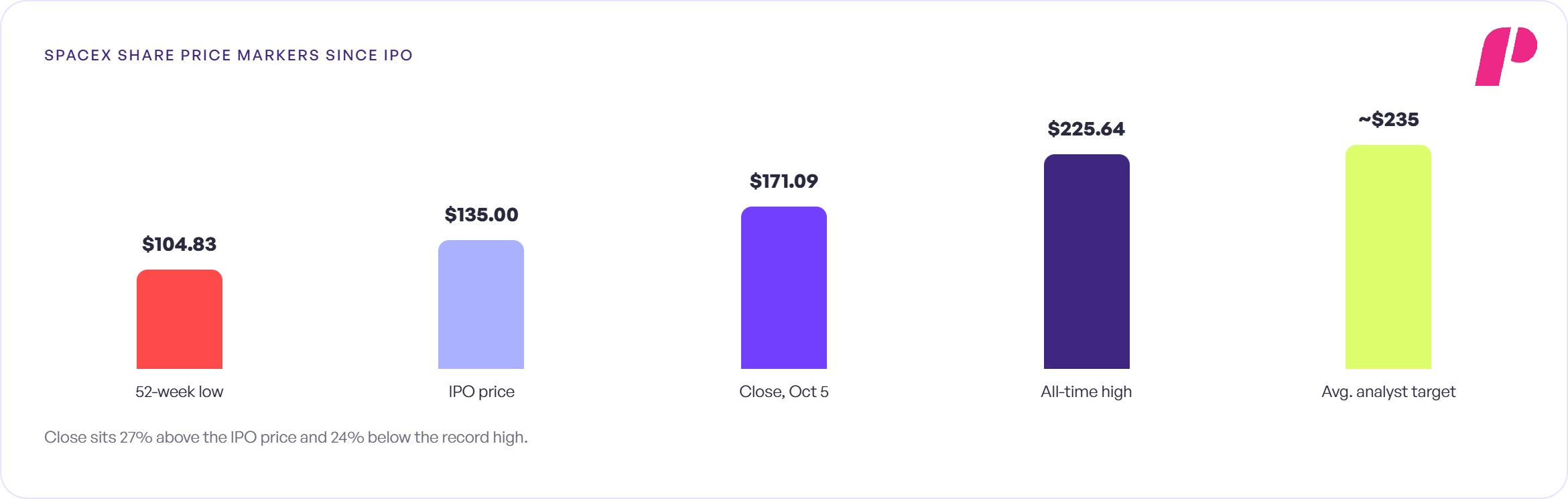
SpaceX stock has been trading at $171.09 as of October 5, up around 27% from the $135 share price during its initial public offering and 24% off its $225.64 all-time high.
🔗Can SpaceX Justify a $1.8 Trillion IPO?
Then two days later, the company’s stock tumbles amid news that a major measure of its credit risk is at an all-time high due to the Financial Times report claiming SpaceX intends to borrow an additional $40 billion for Nvidia hardware. A 328.4 million share unlock follows on October 9.
In our view, SpaceX now operates as a sovereign technology monolith that presents itself as an aerospace company.
It owns the world’s dominant launch business, the largest satellite constellation ever built, a classified spy satellite program and, since February, an artificial intelligence company that loses billions. Only one of those businesses makes money. This analysis examines what investors actually own.
The Numbers Behind SpaceX Stock
Begin with the S-1 filing, since that changed the perception of the firm.
SpaceX has submitted its registration statement on May 20. Furthermore, SpaceX has restated its 2025 earnings by incorporating xAI after SpaceX made an acquisition of this company in February in a completely stock transaction where SpaceX was worth $1 trillion, and xAI was worth $250 billion.
🔗IPO Explained: How Initial Public Offerings Work
Consolidated revenues have increased by 33% to $18.7 billion; however, the company has moved from making profits to suffering losses.
Corporate Segment Performance: 2025 Revenue, Operating Results & Consolidated Totals (2026 Reference)
| Business Segment (2025) | Segment Revenue | Operating Result & Margin |
|---|---|---|
| Connectivity (Starlink) | $11.4 billion (61% of total revenue) | Profit of $4.42 billion (39% operating margin) |
| AI (xAI and X) | $3.2 billion | Loss of $6.36 billion |
| Space (Launch & Starship) | About $4.1 billion | Loss of $657 million |
| Consolidated Total | $18.7 billion (up 33% Year-over-Year) | Net loss of $4.94 billion |
Adjusted EBITDA reached $6.58 billion, and the AI segment consumed $12.7 billion of the company’s $20.7 billion capital budget.
Starlink is the only segment that makes money. The launch business, often described as a profit machine, lost money as Starship development absorbed its gains.
The pattern held after listing. Second-quarter revenue rose 92% to $7.8 billion, yet Starlink’s $1.656 billion operating profit had to cover a $1.257 billion AI loss and a $542 million space loss.
🔗How to Read an Earnings Report
Investment Takeaway: Starlink funds everything else. Any thesis on SpaceX stock rests on whether satellite broadband can keep financing an AI build-out that consumes most of the capital.
The Bond Market Sends the Bill
The financing story moved from equity to debt within two weeks of the IPO.
SpaceX raised about $86 billion in its June IPO, the largest on record, then priced a $25 billion debut bond deal on June 22. It drew nearly $90 billion of orders and grew from an initial $20 billion target.
Corporate Senior Notes Offering: Maturity Schedules, Principal Amounts & Coupon Rates (2026 Reference)
| Senior Notes Maturity Year | Principal Amount Issued | Coupon Rate |
|---|---|---|
| Due 2031 Notes | $7.0 billion | 5.35% |
| Due 2033 Notes | $6.0 billion | 5.65% |
| Due 2036 Notes | $6.0 billion | 5.875% |
| Due 2046 Notes | $2.5 billion | 6.60% |
| Due 2056 Notes | $3.5 billion | 6.65% |
Fitch rates the notes BBB+ and Moody’s rates them Baa1. Demand did not translate into comfort. Investors crowded into the shorter maturities, the 10-year tranche priced at 140 basis points over Treasuries, and the bonds traded poorly in the secondary market. S&P expects SpaceX’s cash drain to persist at least through 2030.
On October 6, the FT reported that SpaceX is in early talks to raise $40 billion more, about $10 billion from banks and $30 billion in investment-grade bonds, to buy Nvidia chips. Apollo is leading the effort, which may not close until 2027 and could still fall apart.
🔗Nvidia Stock Analysis: Can NVDA Own AI, Robotics and Quantum?
Credit markets reacted on October 7. The 2056 bond premium expanded by 12 basis points to 238 from 175 in June when the bond was sold, and the five-year credit default swap is now around 195 basis points, its highest point ever. Billionaire investor David Einhorn has criticized the IPO price and investment grade.
Investor Takeaway: Debt doesn’t immediately dilute ownership, but creates a long-term liability. The bond market’s skepticism is the clearest warning sign in the capital structure.
The Lock-Up Calendar for SpaceX Stock
Share supply is the mechanical force acting on SpaceX stock, and SpaceX staged its schedule unusually.
Insiders did not wait until October to gain liquidity. SpaceX staggered its lock-up across nine tranches, and the first opened on August 6, when up to 911.5 million shares became eligible to trade. That single release more than doubled the public float.
Share Unlock Schedule & Lock-Up Expiry Timeline: Dates, Eligible Share Volumes & Milestone Tranches (2026 Reference)
| Unlock Date / Expiry Milestone | Shares Eligible for Release & Volume Details |
|---|---|
| August 6, 2026 | Up to 911.5 million shares eligible |
| August 20 and September 9, 2026 | Up to 319.0 million shares each tranche |
| September 24, 2026 | Up to 328.4 million shares eligible |
| October 9, 2026 | Up to 328.4 million shares eligible |
| October 24, 2026 | Up to 328.4 million shares eligible |
| Post-Third-Quarter Results | Up to 1.3 billion shares eligible |
| December 8, 2026 | Main 180-day lock-up expiry milestone |
| June 12, 2027 | Elon Musk’s insider shares release date |
The stock has absorbed earlier releases better than feared. It rose 6% on the August unlock and slipped just 0.2% on September 24.
Investment Takeaway: Supply keeps arriving through December, with the largest test after third-quarter results. Musk’s own stake stays locked until June 2027.
Control: One Man, Most of the Votes
The governance structure leaves no doubt about who decides.
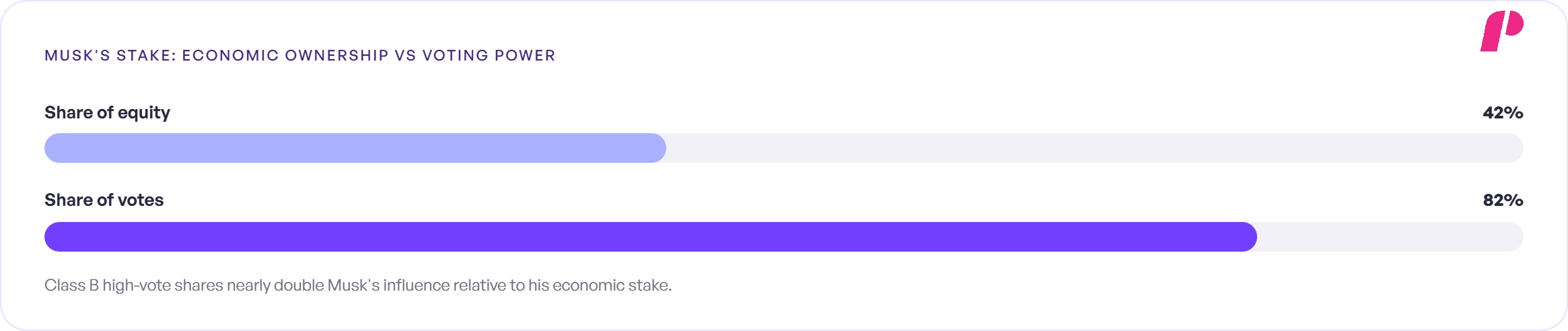
After the IPO, Musk has 42% of the stock of SpaceX, but 82% of the voting rights owing to the fact that he holds Class B stock with high voting rights.
This has made SpaceX a Controlled Company by Nasdaq standards, thus qualifying SpaceX for an exemption in some Board Independence standards.
While Gwynne Shotwell is the President & COO who controls the operations at SpaceX, Bret Johnsen is the CFO of SpaceX.
Investment Implication: Control brings speed, but it also brings risk concentration.
Starshield and the Defense Advantage
The defense business is where SpaceX’s strategic weight is clearest.
The company’s Starshield division manufactures satellites for national security purposes, such as a constellation of reconnaissance satellites through a reported $1.8 billion contract from the National Reconnaissance Office.
A former commander at NORAD, General Terrence O’Shaughnessy is a vice president at SpaceX.
National Reconnaissance Office (NRO) Mission Manifest: Launch Schedule & Timeline (2026 Reference)
| NRO Mission Identifier | Launch Date & Execution Timeline |
|---|---|
| NROL-146 Mission | May 22, 2024 |
| NROL-186 Mission | June 2024 |
| NROL-113 Mission | September 2024 |
| NROL-57 Mission | March 21, 2025 |
As reported by NPR, SpaceX has already won contracts worth more than $8 billion from the US defense establishment in 2026 alone.
The Pentagon also deploys the Grok chatbot. In addition, on September 30, the Defense Secretary Pete Hegseth tapped Musk, Anduril’s Palmer Luckey, and Newt Gingrich to lead Project Meridian – a 120-day study of AI-enabled warfare that MITRE is to conduct.
Ethics experts, including the former White House ethics lawyer Richard Painter, see it as a conflict of interest.
🔗Is It Ethical to Invest in Defense Stocks?
We believe that Starshield is an illustration of how SpaceX is able to get around the 10-year-long procurement processes that characterized legacy spy satellites.
Hundreds of small satellites, which are quickly replaced in low orbit, are much harder to disrupt than a few large ones in high orbit. This approach puts direct pressure on traditional primes such as Lockheed Martin and Boeing.
Investment Takeaway: Defense is a source of reliable and trusted revenue.
Launch Dominance and the Optical Mesh
Reusable rockets made SpaceX the price setter in launch.
SpaceX is currently conducting in excess of 100 launches of satellite payloads each year, with reuse of its first-stage boosters and autonomous drone landing.
Competing expendables such as United Launch Alliance and Arianespace cannot compete price-wise with SpaceX.
🔗Rocket Lab Stock (RKLB): Q2 2026 Earnings & Neutron Risk
The network edge of SpaceX lies in the optical links in space. According to SpaceX, there were over 9,000 optical links in orbit by early 2024, transporting in excess of 42 PB of customer data every day.
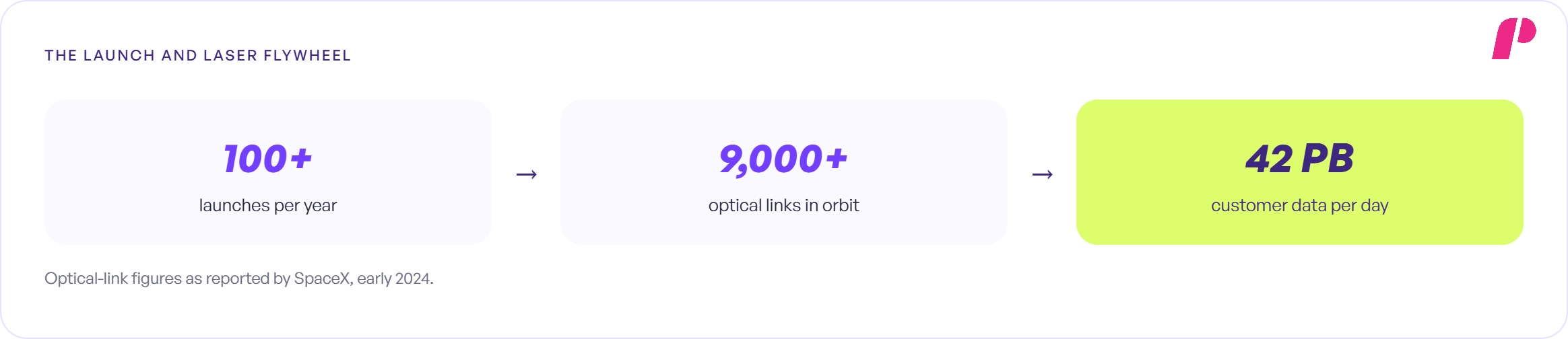
The links transfer data between satellites, thus avoiding ground-based transfers that can be jammed.
The Space Development Agency has standardized the optical links for use by the government networks, giving an edge to those with experience in the area.
Investment Takeaway: Cost of launch and laser networking are mutually reinforcing. Each successive launch adds to a network that would take years for competitors to match.
Direct to Cell and the Spectrum Fight
The next battleground is your smartphone.
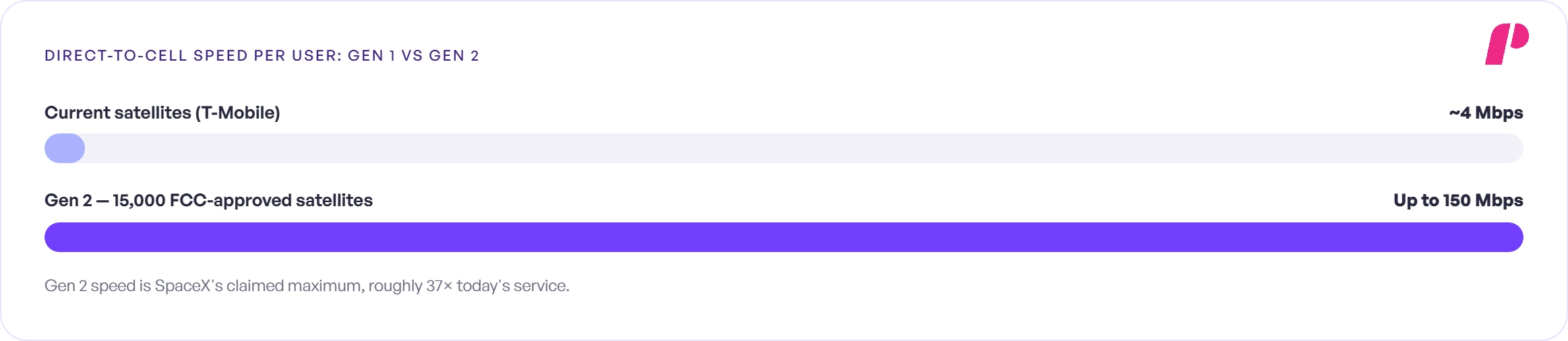
SpaceX launched a direct-to-cell system via its partnership with T-Mobile, whose current satellites have speeds of around 4 Mbps, and then acquired 65 MHz of national spectrum from EchoStar at $17 billion.
On October 6, the FCC approved its plans for 15,000 second-generation direct-to-cell satellites, which SpaceX claims can provide up to 150 Mbps speed per user.
In addition, it will allow SpaceX to start mobile services without a carrier partner but use the EchoStar spectrum for testing purposes until its second phase ends in November 2027.
GlobalStar, Viasat, Iridium, SES, Eutelsat, and the astronomy community in the US have been against the application.
Starlink managed to take a share in aviation and maritime communications by making a deal with United Airlines in September 2024 and by concluding agreements with cruise companies like Royal Caribbean and Carnival.
Investment Takeaway: FCC approval has made Starlink Mobile not only an accessory for T-Mobile but a fourth carrier in the US. The EchoStar closing in 2027 sets the pace.
The Vision Disconnect
Here the story moves from numbers to intent.
The purpose of SpaceX is to make humans multiplanetary, and Mars motivates the engineers who make its rockets.
We think the story also serves as an excellent recruitment and public relations device. Colonizing Mars does not need any gigawatt AI data centers in Memphis, yet SpaceX acquired xAI and intends to raise tens of billions of dollars for Nvidia hardware.
🔗AI Infrastructure and Semiconductor Stocks in 2026
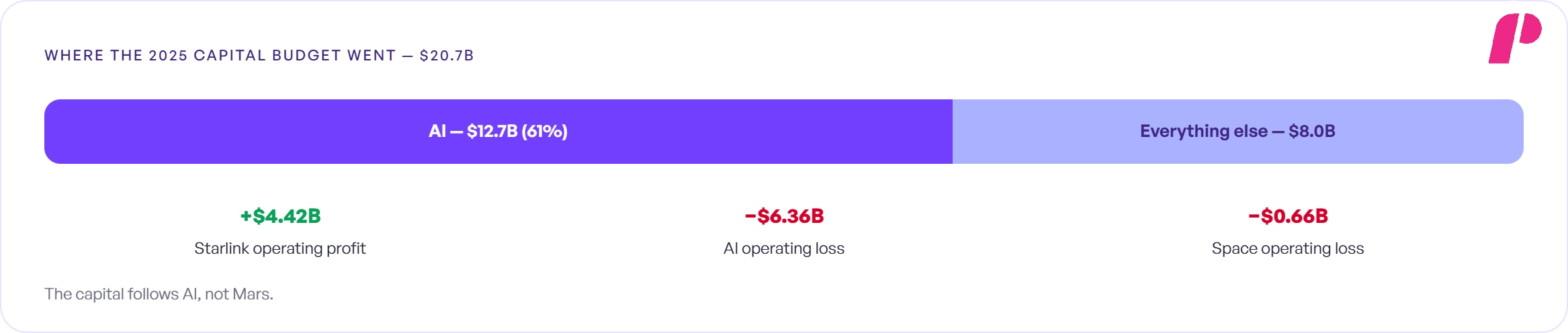
It appears to us that the true aim is domination of Earth’s data, communications, and logistics: a planetary operating system underwritten by both government contracts and retail subscriptions. The xAI merger makes that ambition explicit.
Investment Takeaway: Investors buying SpaceX stock for Mars may be buying something else. The capital allocation says the company’s priority is AI and data, not exploration.
Patents: What SpaceX Actually Owns
A widely shared analysis credited SpaceX with US Patent 10,170,843 on parabolic deployable antennas.
Patent records show the California Institute of Technology owns it, from a team behind NASA’s RainCube CubeSat antenna.
SpaceX’s own filings tell a clearer story. The US Patent 11,834,205 relates to a chassis for a spacecraft where heat-producing components are mounted onto the chassis body and released into outer space.
🔗Broadcom Q3 2026 Earnings Preview: Can Patents Power a $100B AI Bet?
This design allows for the stacking of multiple flat satellites in one launch. In regard to launch recovery, SpaceX filed an opposition with the Patent Trial and Appeal Board to the sea landing technology owned by Blue Origin in 2014 and secures landed boosters using a robot named Octagrabber.
Regarding Investment: Most of the competitive advantage of SpaceX is protected via manufacturing and trade secrets. Its patent estate matters less than its production speed.
Space Science and Pharmaceuticals
Microgravity research is real, but coverage often overstates the commercial link.
Merck has run pembrolizumab crystallization experiments on the International Space Station since 2014. Keytruda Qlex, a subcutaneous formulation of the cancer medicine, was approved by the FDA on
September 19, 2025. The formulation makes use of hyaluronidase alfa, which is an enzyme produced by Alteogen.
The ISS work informed Merck’s formulation research, but space-grown crystals did not create the approved product.
Varda Space Industries, which launched its first drug-processing capsule on a Falcon 9, shows the opportunity.
However, most of the cargo is carried by SpaceX, though it is not the sole player, because Northrop Grumman’s Cygnus also supplies the station.
Investment Takeaway: Space-based pharma is a niche solution, not an immediate source of revenue for SpaceX.
Orbital Traffic and Collision Risk
The constellation’s size creates its own hazard.
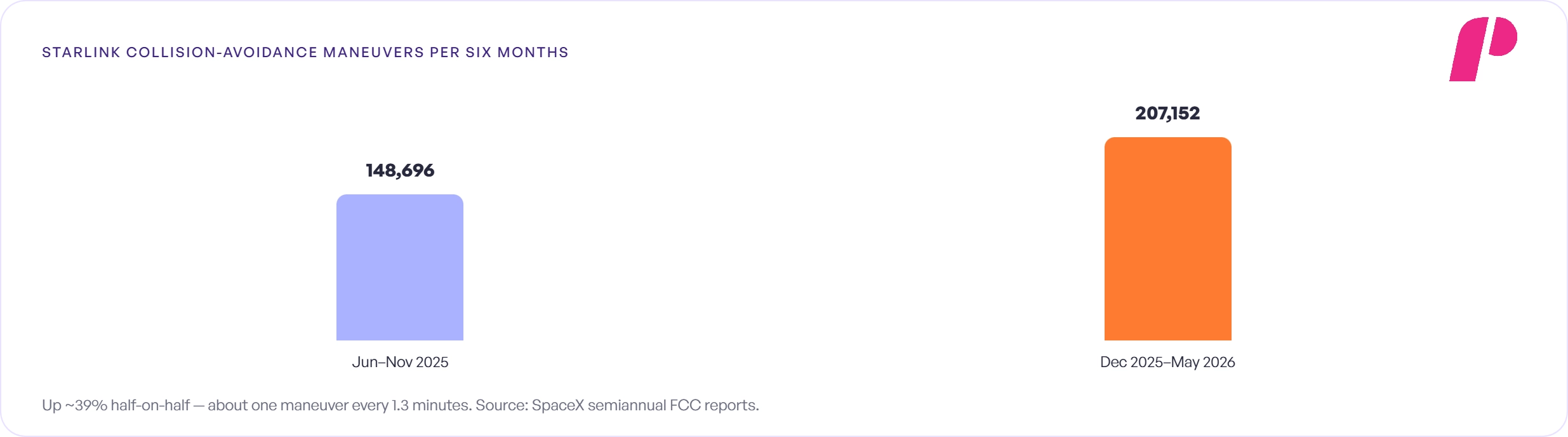
The Starlink satellites, as stated by SpaceX, conducted 207,152 avoidance maneuvers between December 2025 to May 2026.
This was up from 148,696 maneuvers conducted in the previous six months. During the year ending in May, they had performed more than 355,000 maneuvers, conducting more than 40 maneuvers per satellite as they exceeded 10,000 satellites in their fleet. This translates to about one maneuver every 1.3 minutes.
University of Birmingham professor Hugh Lewis warned that a collision involving an operational Starlink satellite appears likely despite the maneuvers.
SpaceX plans to increase the number of satellites in its constellation to 100,000. As far as mitigation is concerned, SpaceX builds satellites that completely burn up on reentry and also operates them at low altitudes, where failed satellites decay fast.
Investor Note: Orbital congestion is an operational and regulatory risk that increases with each launch. A single major collision could bring tighter rules.
Valuing SpaceX Stock
Valuation Markers & Market Benchmarks: Closing Price, IPO History, Price Targets & Lock-Up Expiries (2026 Reference)
| Valuation Marker & Financial Parameter | Figure & Market Data |
|---|---|
| Closing Price (as of October 5) | $171.09 per share |
| Initial Public Offering (IPO) Price | $135.00 per share |
| All-Time Record High Price | $225.64 per share |
| 52-Week Price Low | $104.83 per share |
| Average Analyst Price Target | About $235.00 (Strong Buy consensus) |
| Next Major Share Unlock | October 9 — 328.4 million shares eligible |
The bull case is the world’s dominant launch business, a profitable Starlink growing fast, a defense franchise with deep government trust, and an AI platform that could compound in value.
The bear case is a $4.94 billion annual loss, an AI segment that consumes most of the capital, a bond market that has turned skeptical, $40 billion of new borrowing under discussion, and steady insider supply through December.
Investment Takeaway: SpaceX stock prices in success across launch, broadband, defense, and AI at once. Only one of those currently pays for itself.
The Risks That Matter for SpaceX Stock
- AI funding burn rate. In 2025, AI burnt $6.36 billion and continues to lose more than a billion dollars every quarter.
- Rising leverage. The $25 billion bond sale and the proposed $40 billion financing add decades of obligations, and credit default swaps just hit a record.
- Share supply. Staged unlocks continue through December 8, with Musk’s stake following in June 2027.
- Key-person risk. Musk controls about 82% of the vote.
- Starship execution. The space segment still loses money while Starship matures.
- Regulation. Spectrum fights and orbital congestion rules could slow growth.
- Political risk. Government contracts, licensing, and Musk’s Project Meridian make this company vulnerable to political changes and ethical concerns.
Concluding Remarks
SpaceX has invested in capabilities that cannot be matched by its competitors: reusable rockets which control global launch expenses, a satellite constellation linked through lasers, a project for national security named Starshield, and an AI initiative with grand ambitions. Starlink alone earned $4.42 billion of operating profit last year.
The verdict rests on one question: can Starlink’s profits and the bond market keep funding an AI build-out that consumes most of the company’s capital? Watch four markers: the October 9 and October 24 unlocks, the terms of the $40 billion financing, third-quarter segment results, and any Starship progress that turns the space segment profitable. In our view, SpaceX is the ultimate sovereign tech play. The open question is whether investors are paying for the parts that work or the parts that burn.
🔗AI Stocks in 2026: How to Evaluate, Choose, and Trade
NFA. DYOR. This analysis is for informational purposes only and is not investment advice. Sources include SpaceX’s Form S-1 filed May 20, 2026, its second-quarter 2026 results, its semiannual FCC constellation reports, the Financial Times, CNBC, Yahoo Finance, Fitch and Moody’s ratings as reported, FDA approval records, and TipRanks and Investing.com coverage.
If you liked this post make sure to share it!