AMD has signed two of the largest chip supply agreements in the industry’s history. OpenAI and Meta each committed to deploying up to 6 gigawatts of AMD Instinct GPUs.
🔗AMD Stock Forecast 2026: Inside the AI Strategy That Just Beat Wall Street by $400M
The stock of AMD has already increased by more than 100% this year, and the company’s shares are trading at $560.26 on Tuesday, October 27. Each gigawatt depends entirely on the chips that have been manufactured in Taiwan.
🔗AI Infrastructure and Semiconductor Stocks in 2026
The question for traders is not whether demand exists. This is whether AMD will be able to deliver on time and at acceptable margins.
Its supply chain runs through a single island. Third-quarter results on Tuesday, November 3, will provide the first hard evidence.

Where the AMD Stock Price Stands Before November 3
The shares hit a record close of $649.42 on October 6. They then fell about 20% in mid-October as chip stocks sold off and a report questioned OpenAI’s revenue figures. A 5.5% jump on October 27 followed news of a deeper Meta partnership.
Meta Platforms, Inc. (META) Stock Price Markers & Technical Performance Benchmarks
| Meta Platforms Stock Price Marker / Technical Metric | Figure / Market Value |
|---|---|
| Closing Share Price (October 27, 2026) | $560.26 per share |
| Record Closing High (October 6, 2026) | $649.42 per share |
| 52-Week Intraday High | $658.52 per share |
| Market Capitalization (As of October 27) | About $915.0 Billion |
| First Close Above $1 Trillion Milestone | September 21, 2026 |
| Q3 2026 Earnings Report Schedule | November 3, 2026 (After Market Close) |
🔗What Is Market Capitalization?
Analysts are still quite optimistic. 24/7 Wall St. gives 44 “Buy” or “Strong Buy” recommendations without any “Sells,” with the average target at $636. The stock trades about 14% below its record, on a story analysts still broadly support.
🔗Analyst Price Targets Explained
Trader Takeaway: The AMD stock price swings 5% to 10% on single headlines. That volatility will likely persist through the November 3 report.
For traders, the $636 consensus target and the $649.42 record close are therefore the upside references a strong report would bring into play.
🔗12 Trade Management Golden Tips For Day Traders
From Turnaround to AI Supplier: The Numbers
AMD’s financial profile has changed quickly. Revenue for fiscal 2025 rose by 34%, and 2026 was even better.
Advanced Micro Devices, Inc. (AMD) Annual Financial Results
| Annual Financial Metric / Business Segment | FY2024 Results | FY2025 Results |
|---|---|---|
| Total Annual Revenue | $25.8 Billion | $34.6 Billion (+34% YoY) |
| Data Center Segment Revenue | $12.6 Billion | $16.6 Billion (+32% YoY) |
| Client and Gaming Segment Revenue | $9.6 Billion | $14.6 Billion (+52% YoY) |
| Embedded Segment Revenue | $3.6 Billion | $3.5 Billion (-3% YoY) |
| GAAP Operating Income | $1.9 Billion | $3.7 Billion (+94% YoY) |
| GAAP Diluted Earnings Per Share (EPS) | $1.00 per share | $2.65 per share (+165% YoY) |
| Non-GAAP Diluted Earnings Per Share (EPS) | $3.31 per share | $4.17 per share (+26% YoY) |
| Free Cash Flow | $2.4 Billion | $5.5 Billion to $6.7 Billion |
🔗Earnings Per Share (EPS) Explained
The second quarter of 2026 showed the AI ramp in full.
Advanced Micro Devices, Inc. (AMD) Fiscal Q2 Financial Performance
| Financial Metric & Performance Indicator | Q2 2025 Results | Q2 2026 Results | Year-Over-Year Change |
|---|---|---|---|
| Total Net Revenue | $7.69 Billion | $11.54 Billion | +50.0% YoY |
| Data Center Segment Revenue | $3.24 Billion | $6.72 Billion | +107.0% YoY |
| GAAP Gross Margin Percentage | 40.0% | 54.0% | +14.0 percentage points |
| Non-GAAP Diluted Earnings Per Share (EPS) | $0.48 per share | $1.66 per share | +246.0% YoY |
| Free Cash Flow Generation | $1.18 Billion | $1.56 Billion | +32.0% YoY |
The year-ago comparison flatters the margin jump. Q2 2025 included $800 million of charges tied to US export controls on the MI308 chip for China.
🔗AMD Stock Before Q2 Earnings: Is It the True King of the AI Era?
Even so, Data Center revenue more than doubled and now makes up about 58% of sales. The other segments tell a mixed story.
Client revenue rose 23% to $3.06 billion as Ryzen processors gained share in PCs. Gaming fell 31% to $779 million, reflecting an aging console cycle.
Embedded, the former Xilinx business, returned to growth at 19%. AMD now reports Client and Gaming as one segment, which smooths the console swings.
🔗AMD Stock Earnings Report: Solid Q4 Earnings, Not Enough for Investors
AMD has become a data center company that also sells PC chips, not the other way around.
Trader Takeaway: Data Center growth above 100% sets a high bar. Any slowdown in that segment would weigh on the AMD stock price more than PC strength could offset.
Twelve Gigawatts: The OpenAI and Meta Deals
Two agreements anchor AMD’s AI outlook. Both follow the same template.
Advanced Micro Devices (AMD) Strategic Hyperscaler Partnerships
| Partnership Term / Structural Pillar | OpenAI Strategic Agreement | Meta Platforms Strategic Agreement |
|---|---|---|
| Agreement Announcement Date | October 6, 2025 | February 24, 2026 |
| Total Planned Infrastructure Scale | Up to 6.0 Gigawatts (GW) of Instinct GPU capacity | Up to 6.0 Gigawatts (GW) across global data centers |
| Initial Deployment & Hardware Tier | 1.0 GW initial rollout utilizing AMD Instinct MI450 Series GPUs, beginning 2H 2026 | 1.0 GW initial rollout utilizing custom MI450-based architecture, beginning 2H 2026 |
| Equity Warrant Structure & Scale | Performance-based warrants for up to 160 million shares of AMD common stock | Performance-based warrants for up to 160 Million shares of AMD common stock |
| Vesting Triggers & Conditions | Tied directly to progressive deployment milestones and rising AMD share-price targets | Tied to Instinct GPU shipment milestones, execution phases, and stock price thresholds |
AMD’s CFO said the OpenAI deal alone should bring “tens of billions of dollars” in revenue. Gigazine reported the Meta agreement at over $100 billion; AMD did not disclose a value.
🔗AI Stocks in 2026: How to Evaluate, Choose, and Trade
The Dilution Math
The warrants pay customers in AMD stock as they buy AMD chips. That aligns incentives but carries a cost for shareholders.

That assumes both warrants vest in full, which requires all 12 gigawatts and the price targets. OpenAI’s final tranche carries a $600 share-price target, according to TIKR.
The stock traded above that level in early October. Delivery, not the share price, now governs most of the vesting.
🔗Secondary Offerings and Stock Dilution Explained
Meta Deepens the Tie
On October 27, AMD said it would invest $1 billion in Meta’s new equity offering. Initial Helios rack-scale systems are already running at Meta. Nvidia committed $3 billion to the same offering.
🔗Nvidia Stock Analysis: Can NVDA Own AI, Robotics and Quantum?
The flow of money now runs both ways. Meta buys AMD GPUs and holds a warrant on AMD stock. AMD buys Meta shares.
The structure deepens the partnership, but it also links AMD’s fortunes to Meta’s capital spending more tightly.
Trader Takeaway: The two deals give AMD multi-year visibility. They also concentrate risk in two customers that are both raising outside capital to fund AI spending.
As a result, funding headlines from OpenAI or Meta can move the AMD stock price even on days without AMD news.
Why Chiplets Built AMD’s Edge
AMD’s comeback rests on a manufacturing insight. Large single chips suffer more defects, so fewer of them work.
AMD split its processors into smaller “chiplets” that TSMC can produce with higher yields. It then joined them in one package.
A standard yield model shows why. Under a Poisson defect assumption:

Here D is the defect density per square centimeter, and A is the die area. The example below uses a hypothetical defect density of 0.1 per square centimeter. It is an illustration, not TSMC data.
Semiconductor Manufacturing Economics
| Architectural Approach & Design Strategy | Surface Die Area ($cm^2$) | Estimated Wafer Fabrication Yield (%) |
|---|---|---|
| Hypothetical Large Monolithic Die Design | 6.00 $cm^2$ (Single continuous silicon substrate) | About 55.0% (Higher defect vulnerability per die) |
| Modular Compute Chiplet Approach | 0.75 $cm^2$ (Disaggregated smaller die size) | About 93.0% (Exponential defect reduction advantage) |
Smaller dies waste less silicon when a defect strikes. That lets AMD offer high core counts in EPYC server chips at lower cost than Intel’s monolithic designs.
🔗Intel Stock Price 2026: SHIELD, AI, and INTC’s New Floor
The same technology is behind the MI300 and MI450 accelerators, which combine computing chiplets with stacks of high-bandwidth memory.
The trade-off comes with the packaging. Chiplets require reliable packaging to be effective, and the company has that from TSMC in Taiwan.
The design choice that built AMD’s cost advantage also deepened its dependence on one supplier.
Trader Takeaway: Chiplets give AMD better economics per wafer. They also make TSMC’s packaging capacity a direct limit on AMD’s growth.
The Taiwan Concentration
AMD owns no fabs. TSMC manufactures its EPYC server chips, Instinct GPUs, and leading Ryzen processors. The newest products push that dependence further.
In May, AMD said its 6th Gen EPYC “Venice” entered production on TSMC’s 2nm process. AMD called it the first high-performance computing product to do so.
That ramp is happening in Taiwan. AMD plans to ramp Venice at TSMC’s Arizona fab “in the future,” without a date.
Advanced Micro Devices (AMD) Global Supply Chain Architecture
| Supply Chain Layer / Operational Tier | Primary Main Location & Foundry Partner | Geopolitical Risk Exposure & Concentration Vulnerability |
|---|---|---|
| Leading-Edge Wafer Fabrication (2nm, 3nm Nodes) | Taiwan — Taiwan Semiconductor Manufacturing Co. (TSMC) | Extreme single-foundry and single-island geopolitical concentration exposure |
| Advanced Packaging (CoWoS, SoIC Technologies) | Taiwan — TSMC Specialized Packaging Hubs | Critical bottleneck infrastructure required for high-performance Instinct AI GPUs |
| Domestic US Wafer Capacity | Arizona, United States — TSMC Fab 21 Facility | Earlier-generation EPYC server chips fully validated; next-gen Venice nodes slated later |
| Final Assembly & Semiconductor Testing | Malaysia, Mainland China, and Global Hubs | Diversified footprint operated partly through the TF-AMD joint venture partnership |
Packaging is the narrower bottleneck. Instinct GPUs need TSMC’s advanced packaging to join compute dies and high-bandwidth memory.
🔗Nvidia Earnings Reports: The Power Play Behind Vera Rubin
Nvidia competes for the same capacity, and its larger volumes give it scale advantages. A disruption in the Taiwan Strait would halt AMD’s most valuable products.
The same is true for Nvidia, Apple, Qualcomm, and Broadcom. AMD’s Taiwan risk is a sector risk, but AMD’s valuation now prices in flawless delivery.
Trader Takeaway: Arizona reduces Taiwan exposure only gradually. For the gigawatt deals, TSMC’s Taiwanese packaging lines remain the binding constraint.
For traders, however, Taiwan tends to appear as sudden headline risk across the whole chip sector, rather than as an AMD-only factor.
Export Controls and China
Washington’s chip rules have already cost AMD money. The MI308 was a China-specific accelerator.
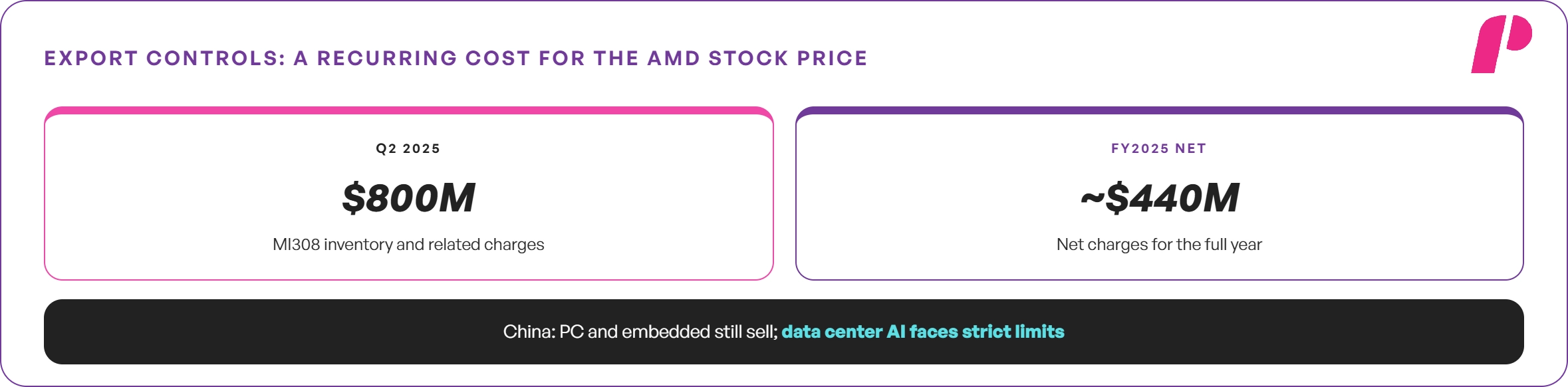
US export controls on it forced $800 million of inventory and related charges in Q2 2025. Net charges for fiscal 2025 came to about $440 million.
China remains a large market for AMD’s PC and embedded chips. Its data center AI business there, however, faces strict limits.
Any tightening of rules, or retaliation from Beijing on critical minerals, would raise costs. Export policy has become a recurring line item rather than a one-time shock.
🔗Export Controls and Chip Stocks Explained
CUDA, ROCm and the Competitive Field
Nvidia continues to rule in the AI accelerator space due to its CUDA software system. AMD, on the other hand, relies on memory capabilities, pricing, and software freedom in its competition.
Its ROCm stack now runs mainstream models through PyTorch, Triton, and vLLM. Specialized workloads still favor Nvidia’s tools, so AMD concentrates engineering support on its largest customers.
Hyperscalers also build their own chips, such as Google’s TPUs and Amazon’s Trainium. The OpenAI and Meta deals show AMD has become the leading merchant alternative to Nvidia.
🔗Stock in Focus: Broadcom Stock (AVGO)
AMD also holds a strong position in government supercomputing. The Frontier system at Oak Ridge National Laboratory runs on AMD EPYC CPUs and Instinct accelerators.
El Capitan at Lawrence Livermore uses AMD’s MI300A, which combines CPU and GPU in one package. These systems show AMD’s hardware can handle the most demanding scientific workloads.
Software maturity in commercial AI still lags, however. Winning two flagship customers does not yet mean winning the broader developer base.
Trader Takeaway: AMD’s AI growth depends on a few very large buyers. Broader adoption of ROCm would reduce that concentration over time.
What Options Imply for November 3
AMD forecasted revenue of around $13 billion ±$300 million for the third quarter. It expects a non-GAAP gross margin near 56%.
The key disclosure will be whether MI450 shipments toward the first OpenAI and Meta gigawatts have begun.
Valuation leaves little room for error. TIKR puts the forward P/E at 68 times 2026 estimates and about 33 times 2027 estimates at $516.79. At $560.26, those multiples rise to about 74 and 36 times, by our calculation.

Applying a hypothetical 8% implied movement, $560.26 * 0.08 = $44.82. Therefore, the implied range would be around $515-$605. Live options pricing will differ.
Position size can follow the same logic. For example, if a trader has a $100,000 account and risks 1% of it, the amount at risk is $1,000.
🔗Options Expected Move Explained
In case the stop sits one expected move away, the position would be $1,000 ÷ $44.82, which is about 22 shares. This is an illustration, not a trade plan.
🔗Position Sizing in Forex & Stocks
Advanced Micro Devices, Inc. (AMD) Earnings Scenario Planning & Stock Price Action Triggers
| Market Scenario | Forward Guidance & Fundamental Signal | Likely Effect on Stock Price Action & Technical Levels |
|---|---|---|
| Constructive Scenario | MI450 GPU volume shipments confirmed on schedule; Q4 guidance tracking well above Q3 actuals with strong enterprise adoption | Bullish upside momentum pushing the equity toward the $605.00 resistance area |
| Base Case Scenario | Financial results tracking near consensus guidance; previous deployment timelines reaffirmed by executive management | Range-bound technical consolidation within established trading bands |
| Pressured Scenario | Unanticipated MI450 production or delivery delays; gross margins slipping below the 55.0% threshold | Post-earnings profit-taking pullback triggering a retest of the $515.00 support area |
These thresholds reflect our judgment, not company guidance. The gigawatt timeline matters more than the quarter’s revenue figure.
Trader Takeaway: At more than 70 times this year’s earnings, AMD trades on 2027 delivery. Any change to the MI450 schedule would likely drive the reaction.
The Risks That Matter for the AMD Stock Price
Each of the risks below can show up in Tuesday’s numbers, in the guidance, or on the call itself.
- Taiwan Concentration. TSMC fabricates and packages AMD’s most advanced chips in Taiwan.
- Packaging Capacity. AMD competes with Nvidia for TSMC’s advanced packaging lines.
- Customer Concentration. OpenAI and Meta anchor most of the AI growth story.
- Dilution. Warrants could add up to about 320 million shares.
- Export Controls. China restrictions already cost hundreds of millions of dollars.
- Software Gap. CUDA still dominates outside mainstream models.
- Valuation. Forward multiples above 70 times leave little margin for delay.
🔗Risk Management in Stocks: A Complete Guide 2026
Closing Thoughts
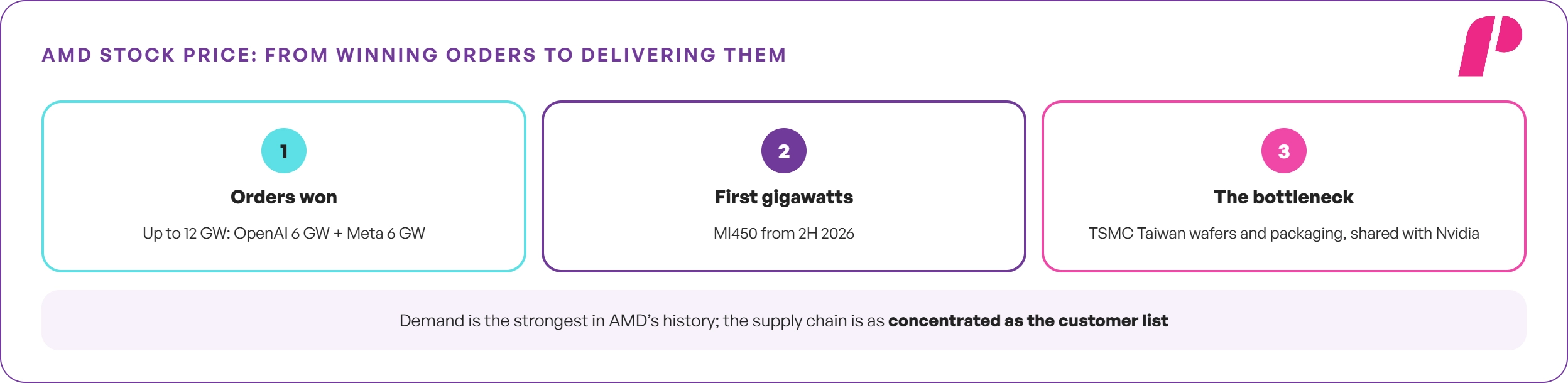
AMD has completed one of the sharpest transformations in the chip industry. It broke Intel’s server dominance and has now signed two flagship AI customers for up to 12 gigawatts.
Data Center revenue more than doubled, and the stock briefly crossed $1 trillion. The execution test arrives now. The first gigawatts must ship in the second half of 2026.
They must pass through TSMC lines in Taiwan that Nvidia also needs. The AMD stock price reflects a company that has won the orders.
🔗AI Infrastructure Stocks: Power Players to Watch in 2026
It now has to prove it can deliver them. In our view, AMD’s demand case is stronger than at any point in its history. Its supply chain, however, remains as concentrated as its customer list.
NFA. DYOR. This analysis is for informational purposes only and is not investment advice.
If you liked this post make sure to share it!