Nvidia closed at $233.95 on Friday, a useful starting point for any Nvidia stock analysis. This means that the firm’s valuation has reached almost $5.6 trillion, while the stock itself has approached its 52-week peak.
Moreover, the company has increased its buyback by another $150 billion, making the total amount $235 billion.
Chips are still the product on the invoice. What customers really pay for, though, is something closer to the operating system of the AI economy.
Whether Nvidia can repeat that in robotics, personal AI, and quantum computing is the open question for the stock.

Macroeconomics and Economics: A Printing Press on Steroids
NVIDIA’s figures far surpass the growth rate in the overall economy. For example, the revenue for Q2 FY2027 is $96.2 billion, which represents a growth rate of 106% year on year.
Data center revenues alone are $89 billion. Meanwhile, management guided third-quarter revenue to $108 billion.
🔗 AI Infrastructure and Semiconductor Stocks in 2026
In fact, Nvidia now grows faster, at $400 billion in annual revenue, than most startups do at $40 million.
Corporate Financial Metrics: Quarterly Revenue, Guidance, Buyback Authorization & Market Valuation (2026 Reference)
| Financial Metric | Reported Figure & Performance Data |
|---|---|
| Q2 FY2027 Revenue | $96.2 billion (+106% Year-over-Year growth) |
| Q2 Data Center Revenue | $89.0 billion |
| Q3 Revenue Guidance | $108.0 billion projected |
| Remaining Buyback Authorization | $235.0 billion available |
| Market Valuation (as of October 2) | About $5.6 trillion |
In Nvidia stock analysis, the macro background is not as important as it ought to be. Rising bond yields would normally compress tech valuations.
Yet hyperscaler and sovereign capex keep flowing into Nvidia’s order book. Furthermore, Nvidia expects to execute its total buyback program through fiscal 2028, signaling confidence in years of cash generation.
Investment Takeaway: Nvidia’s growth now funds both innovation and massive shareholder returns. Watch the $108 billion Q3 guide as the next proof point.
Business Model: From GPU Vendor to Platform Owner
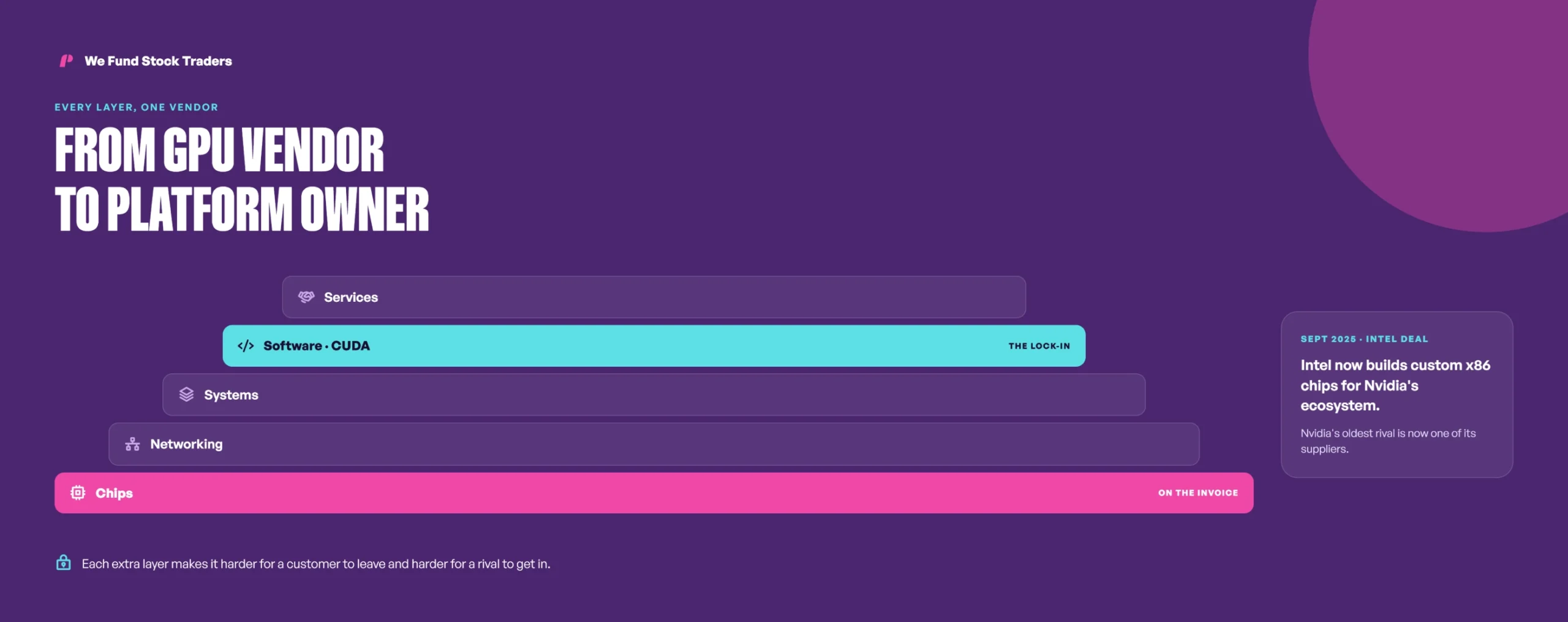
Nvidia’s most strategic move last year reshaped the x86 world. In September 2025, Nvidia and Intel agreed to co-develop multiple generations of custom data center and PC products.
Intel manufactures Nvidia-tailored x86 processors for Nvidia’s AI ecosystem. Intel also offers x86 processors with Nvidia RTX GPU chiplets.
🔗 Intel (INTC) Stock: Q1 2026 Earnings
In other words, Nvidia turned its oldest rival into a supplier for its own ecosystem.
Strategic Partnership Framework: Nvidia-Intel Deal Terms, Custom Hardware & Equity Investment (2026 Reference)
| Nvidia-Intel Deal Term | Strategic Detail & Implementation Scope |
|---|---|
| Announcement Date | September 18, 2025 |
| Data Center Collaboration | Intel builds Nvidia-custom x86 CPUs for enterprise datacenters |
| PC & Client Computing | Advanced x86 SoCs integrated with Nvidia RTX GPU chiplets |
| Interconnect Technology | Proprietary Nvidia NVLink high-speed architecture |
| Equity Investment Stake | $5.0 billion equity stake executed at $23.28 per share |
The business model now spans every layer. NVIDIA makes chips, networking, systems, software, and services.
In addition, the company’s CUDA platform keeps developers within its ecosystem. Each extra layer makes it harder for a customer to walk away, and harder for a rival to get in.
Trends in the Industry: AI on the Desktop
The next growth wave targets local AI. Nvidia will offer the DGX Spark with 64GB of unified memory from October 23 through Acer, ASUS, Dell, Gigabyte, HP, and MSI.
As a result, developers can run models of up to 100 billion parameters fully on device. Nvidia now competes for the developer’s desk, not just the data center.
DGX Spark 64GB Hardware Specifications: Availability, Model Capacity, Superchip Architecture & Clustered Performance (2026 Reference)
| DGX Spark 64GB Specification | Technical Detail & Performance Parameter |
|---|---|
| Market Availability | Launching October 23 via six primary PC hardware manufacturers |
| Maximum Model Size | Supports local deployment of models up to 100 billion parameters |
| Core Processor Chip | GB10 Grace Blackwell Superchip architecture |
| Two-Unit Cluster Capacity | 128GB of combined unified memory |
| Clustered Speedup Multiplier | Up to 1.7x performance speedup compared to a single standalone system |
Scaling stays simple. Two clustered 64GB systems delivered up to 1.7 times the performance of a single system in Nvidia’s testing. In short, that near-linear scaling turns a desktop box into a small AI cluster.
Science and High-Tech: The Quantum Hedge
Quantum computing poses a long-term question for every chipmaker. However, Nvidia answers it differently than most.
🔗 Quantum Leaps’ Impact on Stock Prices
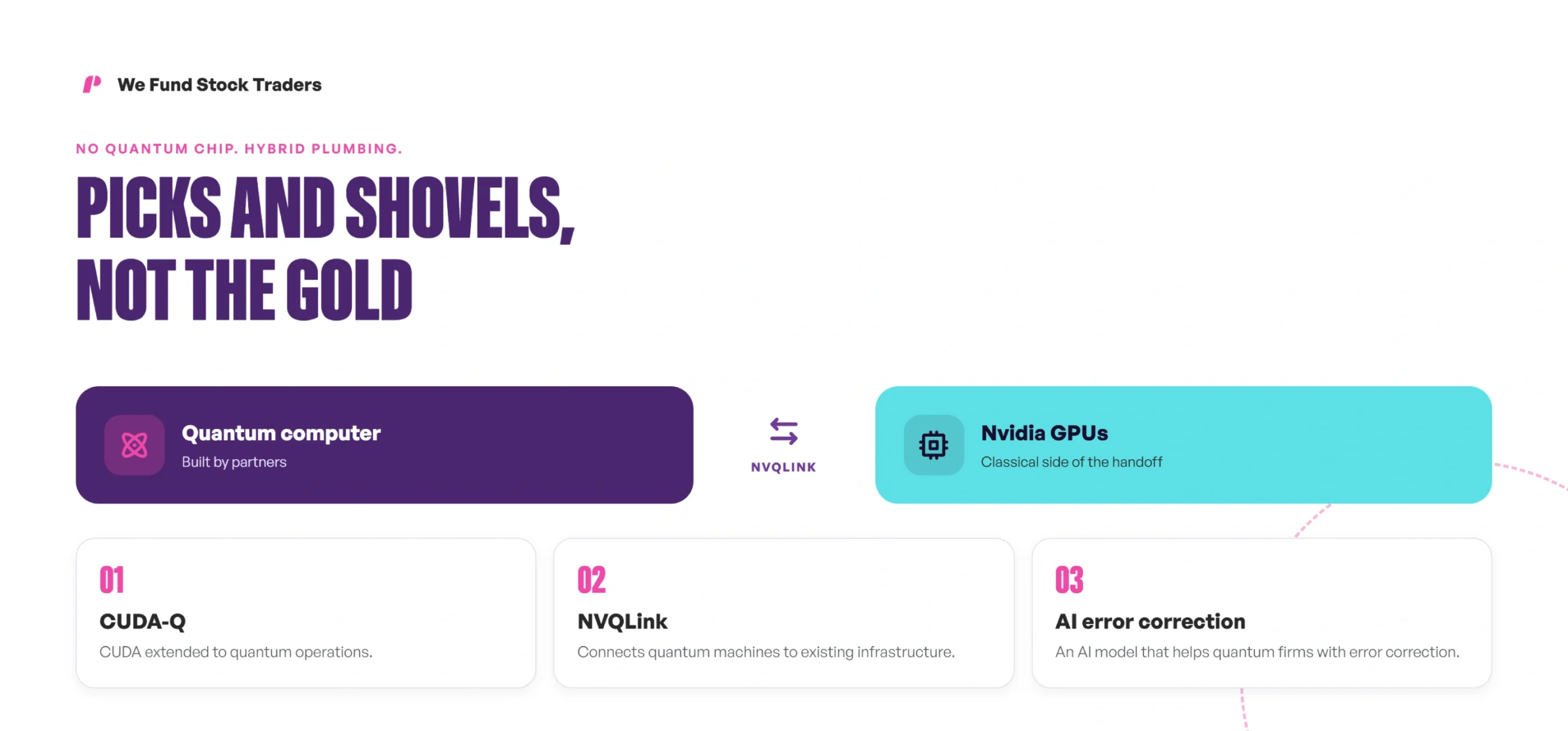
It has told investors it is not developing a quantum processing unit. Instead, it bets on a hybrid future where quantum and classical systems hand off calculations. Nvidia plans to sell the picks and shovels for quantum, not the gold.
Nvidia built three tools for that hybrid world. First, it extended CUDA into CUDA-Q for quantum operations. Then it launched NVQLink to plug quantum computers into existing infrastructure.
It also released an AI model that helps quantum firms with error correction.
Rivals are reaching AI developers directly, too. D-Wave made available an open-source software development kit in October last year that allows users to use their quantum annealer with PyTorch.
That move shows quantum vendors want a seat inside AI workflows. By contrast, Nvidia’s CUDA-Q strategy aims to keep those workflows anchored to its GPUs.
Quantum Computing Strategies: Hardware Approaches, Software Ecosystems & AI Integration (2026 Reference)
| Quantum Strategy Dimension | Nvidia | D-Wave Systems |
|---|---|---|
| Quantum Hardware Development | No (hardware-agnostic platform approach) | Yes (specialized quantum annealers) |
| Core Software Ecosystem | CUDA-Q hybrid quantum-classical platform | Ocean developer tool suite |
| AI & Hybrid Integration | NVQLink and direct GPU-QPU accelerated bridging | PyTorch machine learning integration toolkit |
| Overall Strategic Objective | Universal software platform supporting all quantum hardware vendors | Direct enterprise quantum AI training and optimization |
Innovation and Company Culture: AI Building AI
Nvidia’s culture shows in how it builds its own hardware. For instance, Nvidia and Hon Hai deployed robots to assemble GB300 compute module tester trays.
🔗 AI and Robotics in Manufacturing
Busbar assembly success already exceeds 95%, with multi-connector insertion between 90% and 95%.
However, the target is 99.5%. Nvidia uses its own AI to train the robots that assemble its own AI servers.
GB300 Robotics Assembly Metrics: Current Performance Benchmarks vs. Production Targets (2026 Reference)
| GB300 Robotics Assembly Metric | Current Performance | Production Target |
|---|---|---|
| Busbar Assembly Success Rate | Above 95.0% | 99.5% |
| Connector Insertion Success Rate | 90.0% to 95.0% | 99.5% |
| Busbar Assembly Cycle Time | About 160 seconds | 124 seconds |
The work came from Nvidia’s Seattle Robotics Lab and Isaac engineering team.
The team stopped using end-to-end learning for inserting the connector and switched back to pose estimation for it. It is such pragmatism that characterizes the engineering culture at Nvidia.
Management and Leadership: Bold Statements from Huang
CEO Jensen Huang leads with conviction and spectacle. In September, he declared that AGI had arrived, congratulating OpenAI.
🔗 AI Stocks in 2026: How to Evaluate
He said GPT-6 Astra was trained on more than 100,000 Grace Blackwell NVLink72 systems. He also added that 400,000 more GPUs will come online.
Huang’s message to investors is simple: frontier AI needs ever more Nvidia compute.
However, investors doing their own Nvidia stock analysis should read these claims carefully. After all, no single agreed definition of AGI exists. Huang also benefits directly from the narrative. Still, his compute figures signal the scale of demand ahead.
Geopolitics and Geostrategy: Three Points of Pressure
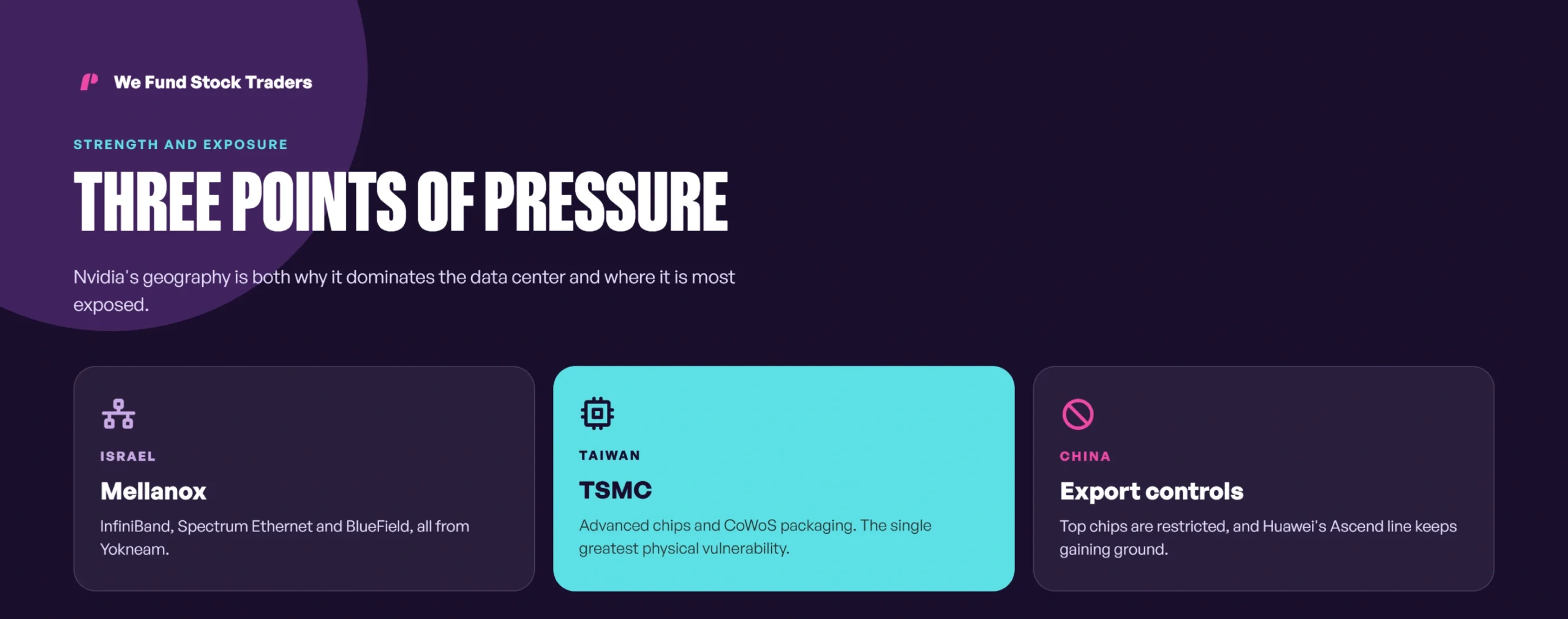
Nvidia’s geography creates both strength and exposure. First, the network backbone used is from Mellanox, which was acquired in 2020 and is headquartered in Yokneam, Israel.
Mellanox products include the InfiniBand, Spectrum Ethernet, and BlueField processors. Israel is therefore central to Nvidia’s data center dominance.
Second, manufacturing is concentrated in Taiwan. The advanced chips and CoWoS packaging used by Nvidia are from TSMC.
🔗 Intel’s Sovereign Chipmaker Pivot
Upstream pressure in packaging, substrates, and cooling is also an important pressure point. Taiwan is Nvidia’s single greatest physical vulnerability.
Finally, China remains the third pressure point. U.S. export controls restrict Nvidia’s most advanced chips there. At the same time, domestic Chinese alternatives, led by Huawei’s Ascend line, continue to gain ground.
Cybersecurity: Securing the Agent Era
AI agents create new attack surfaces. On September 28, Nvidia launched its Open Agent Safety Platform.
🔗 AI Agent Security
OpenShell decides what an agent can touch. Sentry runs separately on BlueField-4 processors and keeps watch over what the agent does.
Anthropic, Microsoft, CrowdStrike and Palo Alto Networks have signed on as backers. Nvidia now sells security for the agents running on its own hardware.
Patent Analysis: Hardware Moats and Rival IP
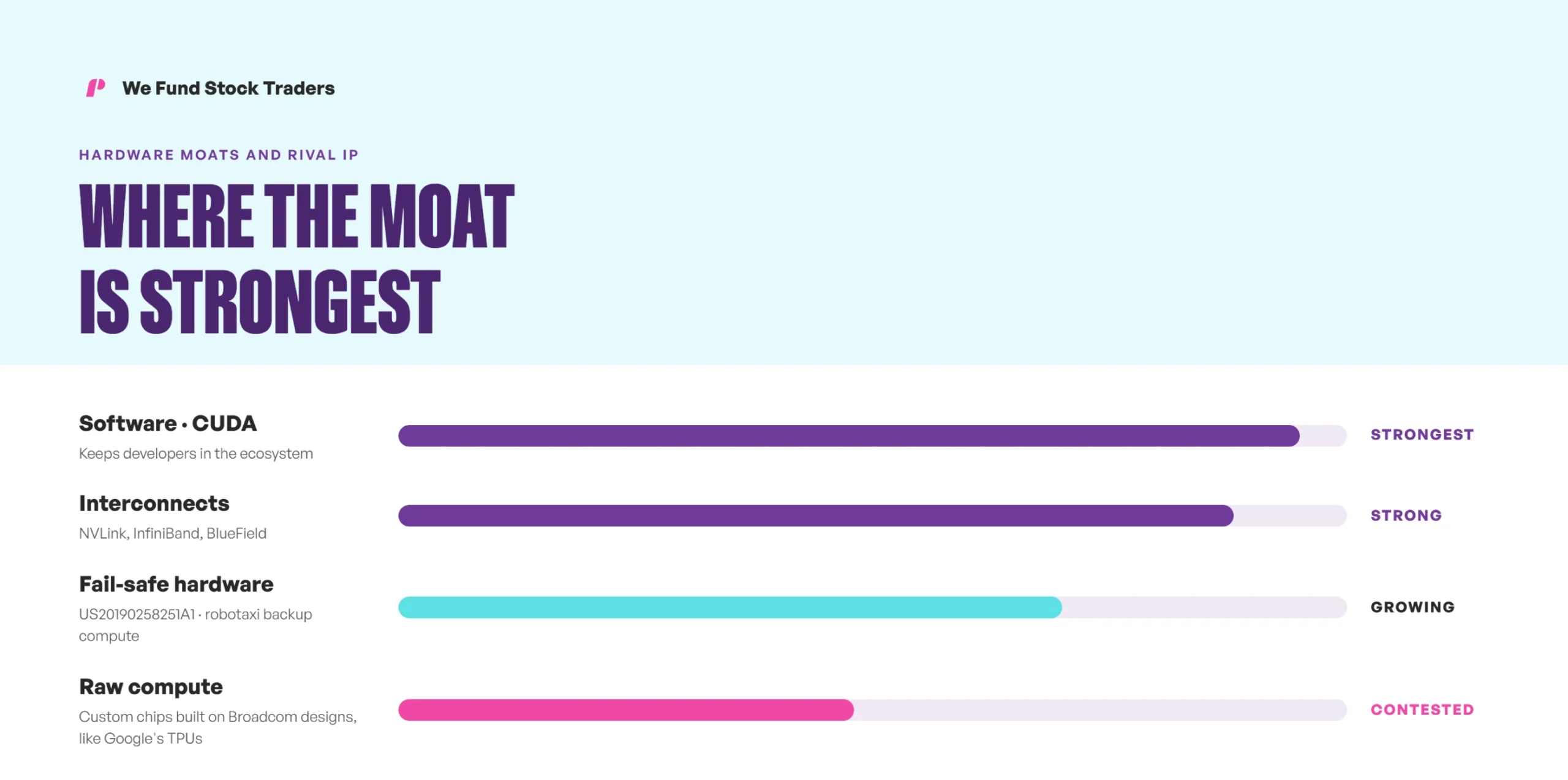
Nvidia’s patent strategy reaches beyond the data center. Its autonomous driving application US20190258251A1 is a good example.
It doesn’t cover an algorithm. Instead, it covers backup hardware that keeps the car computing when one part fails. That approach protects the fail-safe compute pipeline that robotaxis need.
Rivals hold their own IP weapons. Broadcom’s systolic array designs underpin custom chips like Google’s TPUs.
These chips let hyperscalers bypass Nvidia’s architecture for specific workloads. Therefore, Nvidia’s moat is strongest in software and interconnects, not in raw compute alone.
The Pharmaceutical Connection
Nvidia’s link to pharma runs through computational science. Its BioNeMo platform supports AI drug discovery for protein structure and molecule design.
🔗 AI in Drug Discovery
Quantum chemistry adds a newer channel. Through CUDA-Q, Nvidia’s hybrid tools support quantum simulations of molecules.
Drug developers need both AI and quantum methods to model complex chemistry. Nvidia aims to supply the computing layer for both.
Key Risks
- Taiwan Concentration: If TSMC goes down, Nvidia’s most advanced products stop shipping with it.
- Supply Constraint: Demand isn’t the problem. CoWoS substrates and liquid cooling are, and they cap how fast shipments can grow.
- China Degeneration: China export restrictions speed up development of domestic Chinese products like Huawei Ascend.
- Custom Silicon: Hyperscaler chips that leverage Broadcom chip technology can cut back on GPU needs.
- Narrative Risk: Assertions around AGI would become meaningless if the progress on models stops.
Nvidia Stock Analysis: It’s a Win-Win for the Platform
Nvidia has carved out a must-have role in the world of AI, robotics, and hybrid quantum computing.
Overall, this Nvidia stock analysis shows that the company’s buyback, growth rate, and partnerships cement its position. Regardless of whether AGI is here or quantum computing reaches the next level, Nvidia wants to cash in on it.
If you liked this post make sure to share it!