In early 2026, retail and institutional traders shifted capital decisively away from AI and tech growth names. They rotated into cyclical stocks — particularly energy, materials, and industrials — driven by sticky inflation, geopolitical tension, and a maturing sector rotation playbook. This rotation marks a clear behavioral shift: macro-aware positioning has replaced the reactive meme-stock impulse of prior market cycles.
What are the best cyclical stocks to buy right now in 2026, as inflation persists, Middle East risk reshapes energy markets, and sector rotation accelerates? This guide answers that question by examining sector leaders, consumer cyclical stocks, energy geopolitics, risk frameworks, and practical allocation tools for traders at every level.
What You Will Learn In This Guide
- How cyclical stocks work and why they dominate 2026 portfolio positioning
- Which S&P 500 sectors are cyclical — and which sectors lead today
- How the Middle East conflict reshapes oil stocks and gas stocks through the Strait of Hormuz
- The best cyclical stocks and ETFs for prop and retail traders in 2026
- How to time entries and manage risk using the 3-5-7 rule
- How to build a professional cyclical watchlist from scratch
What Are Cyclical Stocks? Definitions, Drivers, and Categories
Cyclical vs. Non-Cyclical: The Core Distinction
Cyclical stocks are equities whose earnings and prices move closely with the broader economic cycle. They outperform during economic expansions and underperform sharply during contractions. Cyclical industries include energy, consumer discretionary, materials, industrials, and financials. Non-cyclical sectors — utilities, healthcare, and consumer staples — maintain stable demand regardless of economic phase.
The difference between cyclical and non-cyclical stocks determines portfolio behavior across market phases. Understanding this distinction is the foundation of every effective sector rotation strategy. Coca-Cola is not a cyclical stock — it belongs to Consumer Staples, a defensive category. Nike and Lululemon, by contrast, carry cyclical traits because premium discretionary spending contracts when consumer budgets tighten.
Cyclical vs. Defensive Stocks at a Glance
Sector Classification: Cyclical vs. Defensive Profiles
| Feature | Cyclical Stocks | Deep Cyclicals | Defensive Stocks | 2026 Leader |
|---|---|---|---|---|
| Earnings Driver | Economic growth | Commodity prices | Stable demand | Energy / XLE |
| Drawdown Risk | 20–40% | 40–60% | 5–15% | +22% YTD |
| Best Entry | Early recovery | At trough | Late cycle | PMI > 50 |
| Key ETF | XLE, XLB, XLI | XLE, XLB | XLP, XLV | XLE |
| Dividend Profile | Variable | Cyclical | Consistent | XOM ~3.5% |
Deep Cyclical Stocks vs. Broad Cyclicals
Not all cyclicals behave identically. Deep cyclical stocks — including oil drillers, steel producers, and mining companies — experience the sharpest peak-to-trough swings, regularly exceeding 40–60% drawdowns in recessions. Broad cyclicals, including consumer discretionary and industrial names, follow a smoother but still pronounced cycle.
A highly cyclical industry is one where revenue directly tracks commodity prices, construction activity, or consumer confidence. Oil production, auto manufacturing, and home building all qualify. Stocks for beginners entering the cyclical space typically start with large-cap names — ExxonMobil, Caterpillar, or Home Depot — which offer cyclical upside while maintaining balance-sheet durability.
Which S&P 500 Sectors Are Cyclical in 2026?
Six major S&P 500 sectors qualify as cyclical: Energy, Consumer Discretionary, Materials, Industrials, Financials, and Information Technology. Each sector responds at a different phase of the economic cycle, creating distinct entry and exit windows for active traders.
S&P 500 Cyclical Sector Performance Tracker (2026 YTD)
Sector Performance: 2026 YTD Returns & Allocation View
| Sector | ETF | 2026 YTD Return | Primary Driver | Prop Trade View |
|---|---|---|---|---|
| ⚡ Energy | XLE | +22% | Oil prices, inflation hedge, Hormuz | STRONG BUY |
| ⛏ Materials | XLB | +15% | Commodity demand, infrastructure | BUY |
| 🏭 Industrials | XLI | +7% | Defense capex, AI infrastructure | OVERWEIGHT |
| 🛒 Cons. Staples | XLP | +12.3% | Safety trade, inflation hedge | DEFENSIVE |
| 🛍 Cons. Disc. | XLY | −2% | Consumer confidence, rates | UNDERWEIGHT |
In early 2026, Energy leads all S&P 500 cyclical sectors with approximately +22% year-to-date gains, followed by Materials at approximately +15%. Consumer Discretionary lags near –2%, reflecting the K-shaped recovery that pressures mid-income households while upper-income spending stays resilient.
Is Apple, Tesla, or Netflix a Cyclical Stock?
Tesla is a consumer cyclical stock, classified within the S&P 500 Consumer Discretionary sector. As a high-ticket purchase, EV demand is acutely sensitive to consumer confidence and interest rates — both of which face headwinds in 2026’s uneven recovery.
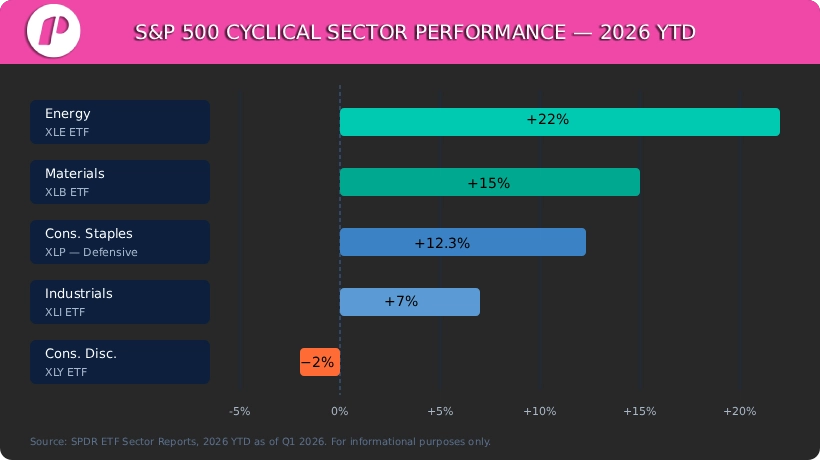
S&P 500 Cyclical Sector Performance 2026 YTD. Source: SPDR ETF Reports.
Apple carries cyclical characteristics in hardware demand, but its services revenue provides a defensive cushion that pure cyclicals lack. Netflix is largely non-cyclical — streaming subscriptions hold firm during downturns. Amazon occupies a hybrid position: its retail arm is consumer cyclical, but AWS cloud behaves more defensively. Is Amazon a cyclical stock? Partially — and that nuance matters when sizing positions.
Consumer Cyclical Stocks: 2026 Leaders and Laggards
The Best Consumer Discretionary Stocks in the Current Cycle
The consumer cyclical sector faces structural headwinds in 2026. Rising household debt and persistent inflation suppress mid-income discretionary spending. The best consumer discretionary stocks in the current environment serve upper-income consumers or capitalize on housing market activity. Home Depot and Lowe’s stand out as preferred rotation targets, directly tied to renovation spending and housing market resilience.
Top Consumer Cyclical Stocks S&P 500 (2026 Analysis)
Consumer Discretionary Watchlist: 2026 Investment Thesis
| Company (Ticker) | Sub-Sector | 2026 Investment Thesis | Key Risk | Cyclical Class |
|---|---|---|---|---|
| Amazon (AMZN) | E-Commerce + Cloud | Upper-income spend + AWS defensive revenue. | Regulation, valuation. | Hybrid Cyclical |
| Home Depot (HD) | Home Improvement | Housing renovation spending, upper-income resilience. | Rate sensitivity. | Preferred |
| Lowe’s (LOW) | Home Improvement | Housing market momentum, renovation cycle. | Consumer credit risk. | Preferred |
| McDonald’s (MCD) | QSR Restaurants | Inflation trade-down, value meal demand surge. | Margin, labor costs. | Semi-Defensive |
| Tesla (TSLA) | Electric Vehicles | Long-term EV adoption — near-term rate headwind. | Confidence, rates. | Rate Sensitive |
McDonald’s offers a hybrid cyclical profile — it attracts value-seeking consumers during inflationary periods, giving it semi-defensive characteristics. These distinctions prevent the most common retail trader error: buying the wrong consumer cyclical at the wrong stage of the cycle.
Target, Nike, and the K-Shaped Recovery
Target is a consumer cyclical stock that reflects the K-shaped recovery with unusual clarity. Its mid-income customer base faces the most acute pressure from inflation and tightening credit. Nike and Lululemon share a similar exposure — premium athletic apparel carries cyclical risk when discretionary budgets compress.
Both Target and Nike require timing frameworks tied to consumer sentiment data, not just earnings momentum. The key to trading consumer cyclicals profitably is aligning entry points with early signs of consumer confidence recovery — not buying on brand strength alone.
Energy Cyclicals and the Middle East: The 2026 Catalyst
How Geopolitical Risk Reshapes Oil Stocks and Gas Stocks
Energy cyclicals in 2026 function simultaneously as a growth play and an inflation hedge — a dual dynamic that makes this sector uniquely positioned within the current cycle. The Middle East remains the dominant geopolitical variable for oil markets. Ongoing tensions in the region create persistent risk premiums embedded in crude oil futures and energy stock valuations.
Energy Cyclical Stocks: Middle East Exposure & Dividend Profile
Energy Allocation: Geopolitical Exposure & Risk Profiles
| Energy Stock (Ticker) | 2026 Role | Middle East Exposure | Div. Yield | Risk Profile |
|---|---|---|---|---|
| ExxonMobil (XOM) | Large-cap core holding | HIGH — global crude, Hormuz | ~3.5% | Medium — blue-chip |
| Chevron (CVX) | Large-cap core holding | HIGH — global LNG + crude routes | ~4.1% | Medium — blue-chip |
| ConocoPhillips (COP) | Pure-play E&P | MODERATE — diversified global | Growing | Medium-High |
| Kinder Morgan (KMI) | Midstream infra. | LOW — domestic gas transport | High yield | Low — domestic |
| UEC (Uranium) | Energy transition | LOW — nuclear / AI power demand | None | +55% YTD |
The Strait of Hormuz is the world’s most critical oil chokepoint. According to the U.S. Energy Information Administration, approximately 20% of global oil supply transits the Strait of Hormuz daily. Any escalation threatening Hormuz transit capacity sends immediate shockwaves through crude prices and energy equity premiums. Prop traders using a trading program focused on energy cyclicals must price Hormuz risk as a permanent position parameter — not a tail event.
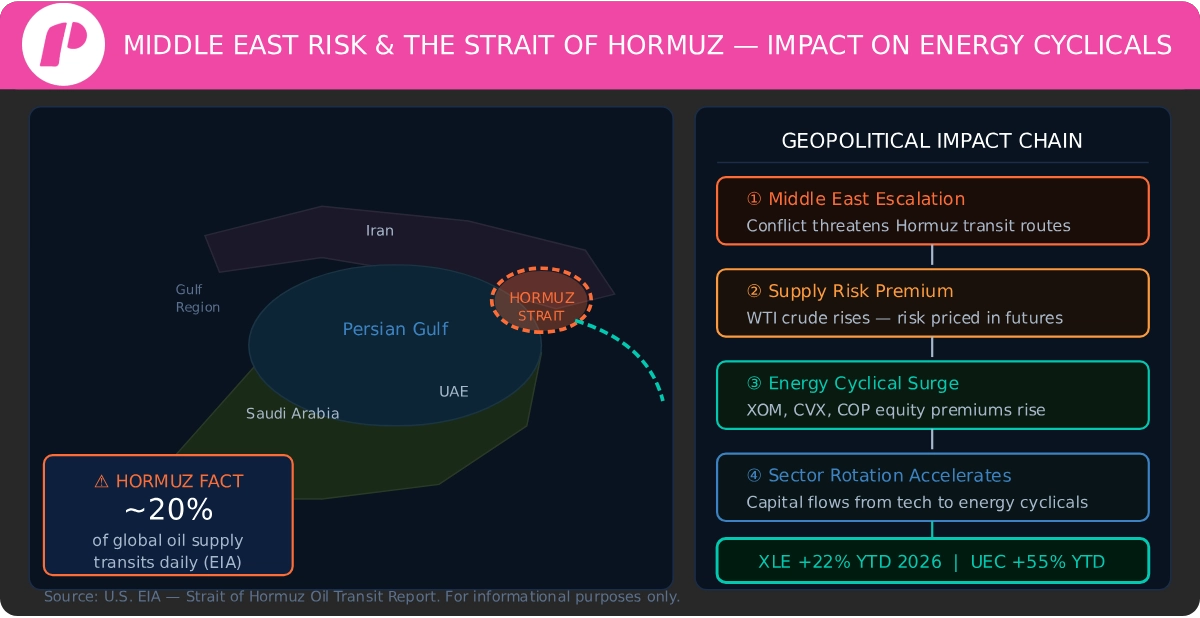
Middle East / Strait of Hormuz Impact Chain on Energy Cyclicals. Source: EIA.
Uranium and the Energy Transition Cyclical
Beyond oil stocks and gas stocks, the energy transition has created a new deep cyclical sub-category: uranium. UEC (Uranium Energy Corp) has gained approximately +55% YTD in 2026, reflecting growing conviction that nuclear energy anchors both the low-carbon grid and AI infrastructure power demand.
A tiered energy cyclical structure captures multiple return drivers without concentrating risk in a single commodity. Large-cap oil stocks — XOM and CVX — provide stability and dividend income. Uranium names like UEC add high-growth thematic exposure. Midstream gas stocks like Kinder Morgan contribute yield. This three-layer energy position is the core inflation-hedging architecture used by sophisticated prop traders in 2026.
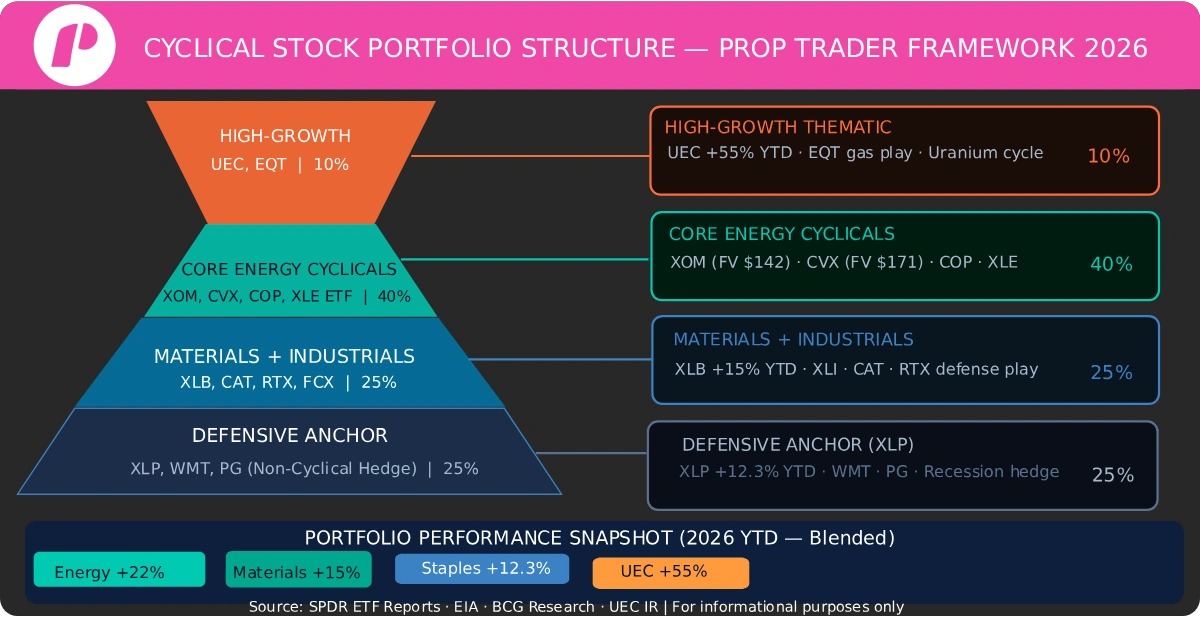
Tiered Cyclical Portfolio Structure for Prop Traders 2026. Source: TTP Research.
How to Identify and Time Cyclical Stocks: A Practical Framework
Signals That Predict Sector Rotation Before It Happens
Identifying cyclical stocks before a rotation begins requires reading leading economic indicators simultaneously. PMI (Purchasing Managers’ Index) expansion above 50 is one of the earliest and most reliable signals of an accelerating cyclical rotation. A steepening yield curve, rising commodity prices, and unusual call options flow into sector ETFs — XLE, XLB, XLI — confirm the institutional move is underway.
In early 2026, prop traders using options flow tools identified institutional accumulation in XLE calls weeks before mainstream financial media announced the energy rally. This pre-positioning advantage — entering before headlines confirm the move — defines the edge that disciplined cyclical traders maintain over reactive participants.
Key Buy Signals — Cyclical Rotation Checklist
- PMI above 50 and expanding month-over-month
- Yield curve steepening from inversion toward a positive slope
- Rising WTI crude oil and broad commodity indices (CRB)
- Unusual call volume in XLE, XLB, and XLI sector ETFs
- Institutional sector ETF inflows confirmed by flow data
- Negative market headlines still dominating (early recovery signal)
When to Buy Cyclical Stocks: The BCG Framework
The optimal entry point for cyclical stocks is during early economic recovery — when leading indicators improve, but market sentiment remains cautious. BCG’s 30-year research confirms that high-performing cyclical investors consistently buy at trough profitability, not at peak earnings momentum when multiples are already compressed.
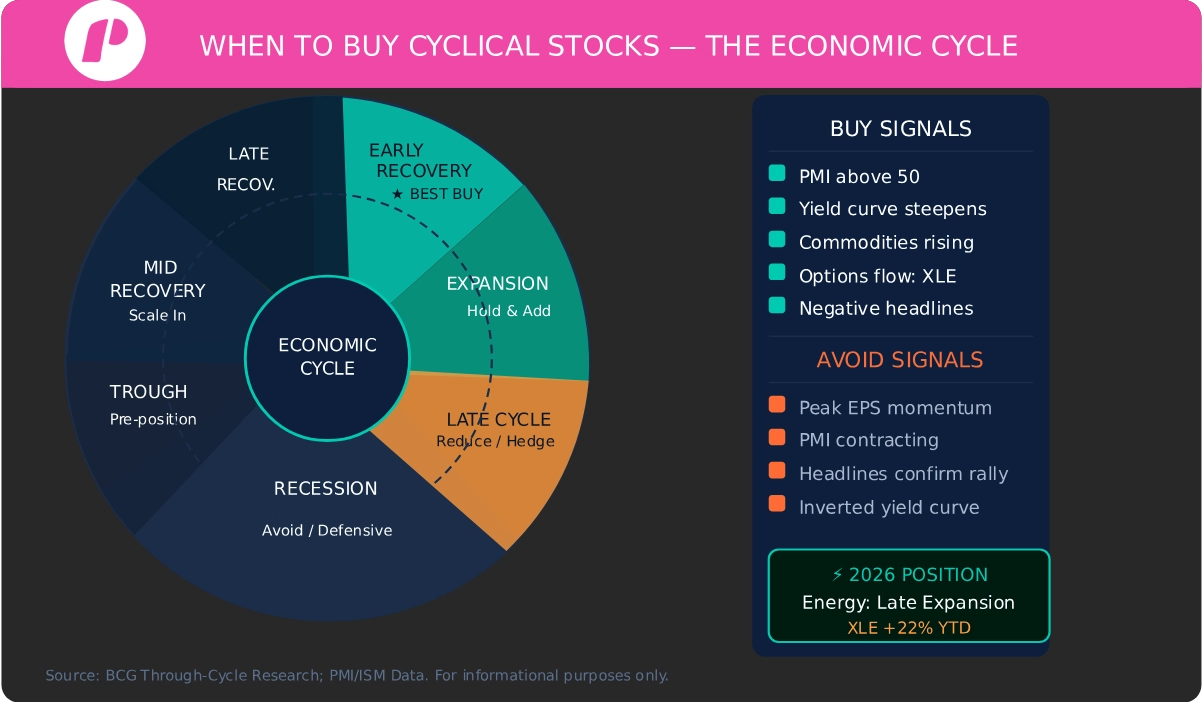
Economic Cycle Timing Wheel for Cyclical Stocks. Source: BCG 30-Year Research; PMI/ISM Data.
The valuation anchor is normalized mid-cycle earnings, not trailing twelve-month EPS. When a cyclical stock’s P/E appears elevated because earnings are depressed at the trough — not because the stock is overvalued — that is the buy signal. This counterintuitive framework separates professional cyclical traders from those who consistently buy tops and sell bottoms.
Risk Management: The 3-5-7 Rule and Position Sizing
Applying the 3-5-7 Rule to Cyclical Stock Trading
Are cyclical stocks risky? Yes — peak-to-trough drawdowns regularly exceed 40–60% during recessions, making risk management non-negotiable. The 3-5-7 rule provides a clear framework: risk no more than 3% of capital per individual trade, no more than 5% across correlated cyclical positions, and target a minimum 7% return per trade to maintain a positive risk/reward ratio. This framework prevents the over-concentration that eliminates cyclical gains during volatile rotation windows.
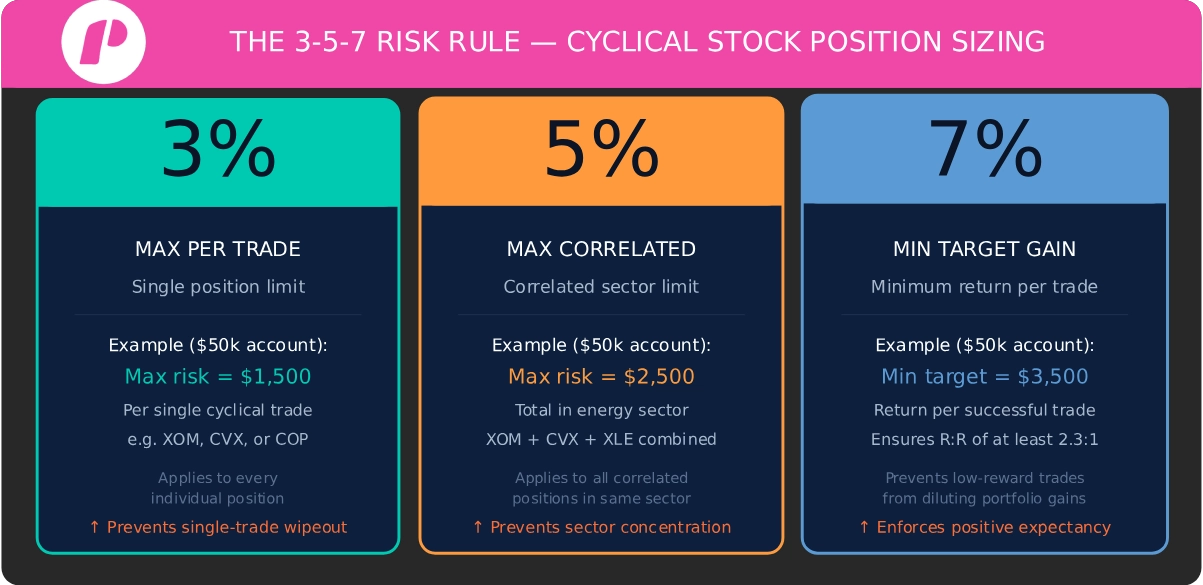
The 3-5-7 Risk Rule Applied to Cyclical Stock Trading. Source: TTP Risk Framework.
Applying the 5% correlated limit requires explicit position mapping. A trader holding ConocoPhillips, ExxonMobil, and an XLE position simultaneously carries correlated energy exposure across three positions. Each position counts against the 5% correlated cap, not individual 3% limits. Failing to apply this correlation discipline is among the most common risk management failures in prop trading programs focused on cyclical sectors.
Warren Buffett’s 70/30 Framework and Through-Cycle Allocation
Warren Buffett’s 70/30 allocation philosophy — 70% in high-conviction core holdings, 30% in opportunistic positions — translates directly into cyclical portfolio construction. The 70% core holds large-cap cyclicals with through-cycle dividend records: XOM, CVX, and Caterpillar. The 30% opportunistic sleeve holds higher-risk thematic plays: UEC, EQT, and emerging energy names.
Companies that maintained dividends through the 2020 recession and reduced net debt from 2021 to 2023 delivered approximately 18% average 10-year total shareholder return — versus approximately 5% for median cyclical performers. This through-cycle capital discipline screen is the highest-quality filter for long-term cyclical stock selection inside any serious trading program.
ETFs, Diversification, and Prop Trading Tools for 2026
Is There an ETF for Cyclical Stocks?
XLE (Energy Select Sector SPDR) is the dominant vehicle for energy cyclical exposure, holding ExxonMobil, Chevron, and ConocoPhillips as its largest positions. XLB covers materials cyclicals, XLI covers industrials, and XLY tracks consumer discretionary names, including Amazon, Tesla, and Home Depot.
For prop traders expressing cyclical views through a structured trading program, these ETFs offer deep liquidity, active options markets, and defined-risk trade structures. Using call spreads on XLE instead of outright long positions defines maximum downside while preserving full upside participation during sector rotations — a structural advantage that outright stock positions cannot replicate.
Cyclical Sector ETF Guide for Prop Traders (2026)
ETF Landscape: Sector Vehicles & Prop Trading Use Cases
| ETF | Sector | 2026 Performance | Top Holdings | Liquidity | Prop Trading Use Case |
|---|---|---|---|---|---|
| XLE | Energy | +22% YTD | XOM, CVX, COP, SLB | Very High | Core inflation hedge + call spreads |
| XLB | Materials | +15% YTD | LIN, APD, FCX, NEM | High | Commodity cycle + infrastructure play |
| XLI | Industrials | +7% YTD | CAT, RTX, HON, UNP | High | Defense + AI capex cycle |
| XLY | Cons. Disc. | −2% YTD | AMZN, TSLA, HD, MCD | Very High | Contrarian recovery watch |
| XLP | Cons. Staples | +12.3% YTD | PG, KO, WMT, COST | High | Defensive anchor / portfolio hedge |
Building a Cyclical Watchlist: Practical Steps for 2026
Building a high-quality cyclical watchlist requires systematic screening, not headline chasing. Filter first for companies that maintained dividends through the 2020 recession and actively reduced net debt between 2021 and 2023. These through-cycle quality signals historically identify cyclical outperformers by approximately 10 percentage points on 10-year total shareholder return versus median sector peers.
Next, compare current valuations against normalized mid-cycle earnings — not trailing EPS — to identify trough-cycle entry windows before institutional accumulation becomes visible. Confirm the macro environment before building position size: PMI above 50, commodities trending higher, and unusual call volume in target sector ETFs together confirm that institutional rotation is already underway.
Professional Cyclical Stock Screener (6-Point Quality Filter)
Execution Checklist: Cyclical Quality & Confirmation Screening
| # | Screening Criterion | What to Look For | Red Flag | Signal Quality |
|---|---|---|---|---|
| 1 | Dividend maintained (2020) | Uninterrupted dividend 2019–2021. | Dividend cut or suspended in 2020. | ★★★★★ |
| 2 | Net debt reduced | Debt-to-equity falling at cycle peak. | Debt rising at cycle peak = risk signal. | ★★★★★ |
| 3 | Normalized P/E multiple | Current P/E < 10-year avg cycle P/E. | P/E compressed at peak earnings = sell. | ★★★★★ |
| 4 | PMI > 50 & expanding | ISM Manufacturing PMI > 50 MoM. | PMI contracting = avoid cyclicals. | ★★★★★ |
| 5 | Options flow confirmation | Unusual call volume: XLE, XLB, XLI. | No flow or put dominance = wait. | ★★★★★ |
| 6 | Commodity trend | WTI crude + CRB index rising. | Commodity downtrend breaks thesis. | ★★★★★ |
Conclusion: Cyclical Stocks As A Structured Prop Trading Framework
Cyclical stocks represent one of the most powerful — and most misused — categories in active prop trading. The traders who consistently generate alpha treat cyclicals as macro-positioning tools tied to economic cycle phases, inflation data, and geopolitical catalysts — not as momentum plays entered after headlines confirm the move. In 2026, energy cyclicals carry a unique dual mandate: capturing growth in a recovering economy while hedging sticky inflation amplified by persistent Middle East geopolitical risk.
The frameworks in this guide — sector rotation signals, through-cycle quality screening, the 3-5-7 risk rule, ETF-based diversification, and mid-cycle valuation anchoring — create a structured, repeatable approach for prop traders at every skill level. Markets evolve, but the economic cycle endures. Traders who correctly identify their position in the cycle and align their cyclical sub-sector exposure to the prevailing macro thesis position themselves for consistent, measurable alpha across every market environment.
Disclaimer: This article is for informational and educational purposes only. It does not constitute financial advice, investment recommendations, or an offer to buy or sell any security. Past performance is not indicative of future results. Always conduct independent research and consult a qualified financial professional before making investment decisions.
If you liked this post make sure to share it!