Meta reported the best revenue quarter in its history on October 21. The stock rose about 3% after hours.
By Thursday’s close, the Meta stock price had fallen 7% to $648.85. It slipped another 1% on Friday to $642.62.
Investors looked past record revenue and focused on Meta’s first negative free cash flow quarter in years.
That reversal captures the central tension. Meta’s advertising engine is accelerating, yet its spending on AI infrastructure now exceeds the cash that engine produces.
This analysis weighs the two sides and examines how Meta plans to fund the gap.
Where the Meta Stock Price Stands After Earnings
Because of the stock market’s sell-off on October 22, Meta ended up losing roughly $124 billion of its market value. In fact, this is the fourth-biggest loss in dollars experienced in the S&P 500 that day. Volume ran more than double the normal level.
🔗What Is Market Capitalization?
Microsoft (MSFT) Stock Price Markers & Technical Performance Benchmarks
| Microsoft Stock Price Marker / Technical Metric | Figure / Market Value |
|---|---|
| Closing Share Price (October 21, 2026 — Pre-Results) | $697.52 per share |
| Closing Share Price (October 22, 2026 — Post-Results Reaction) | $648.85 per share (-7.0% single-day pullback) |
| Closing Share Price (October 23, 2026 — Follow-Through) | $642.62 per share (-1.0% extension) |
| 52-Week Trading Range | $520.26 to $779.82 per share |
| Moving Averages (50-Day / 200-Day As of October 22, 2026) | $662.27 (50-Day) / $629.10 (200-Day) per share |
| Wall Street Consensus Price Target (MarketBeat) | About $833.00 per share |
At the moment, the stock is trading under its 50-day average but above its 200-day average. As compared to the stock’s 52-week high, it is about 18% under. For traders, that places the price between two references: $662.27 above and $629.10 below.
🔗6 Simple RSI Trading Strategies You Can Use Today
On the contrary, the analysts remain positive, with 50 Buys/Strong Buys and 8 Holds. To put it simply, the gap between the targets and the price is a function of the cash flow problem, not the fundamentals.
🔗Analyst Price Targets Explained
Trader Takeaway: Part of the cash-flow risk is already reflected in the META stock price. From a technical point of view, the next level to watch is the 200-day average near $629. A close below it would suggest sellers still control the post-earnings move.
🔗12 Trade Management Golden Tips For Day Traders
Q3 2026: A Record Quarter and a Large Legal Charge
Revenue increased by 26% to $64.60 billion, which is more than the $63.3 billion or so that analysts were expecting. A $9.89 billion legal charge, however, distorted every profit line.
Meta Platforms (META) Third-Quarter Financial Performance
| Q3 Financial & Operational Metric | Q3 2025 Results | Q3 2026 Results | Year-Over-Year Change |
|---|---|---|---|
| Total Quarterly Revenue | $51.24 Billion | $64.60 Billion | +26.1% YoY |
| Family of Apps Ad Revenue | $50.08 Billion | $63.06 Billion | +26.0% YoY |
| Total Costs and Operating Expenses | $30.71 Billion | $51.61 Billion | +68.0% YoY |
| Operating Income (GAAP) | $20.54 Billion | $12.99 Billion | -37.0% YoY |
| Operating Income Excluding Legal Charge | $20.54 Billion | $22.88 Billion | +11.4% YoY |
| Reported Diluted EPS (GAAP) | $1.05 per share | $3.83 per share | +265.0% YoY |
| Adjusted Diluted EPS (Excluding Charges) | $7.25 per share | $7.40 per share | +2.1% YoY |
The adjusted EPS line deserves attention. Last year’s quarter carried a one-time non-cash tax charge that cut GAAP EPS to $1.05.
🔗How to Read an Earnings Report
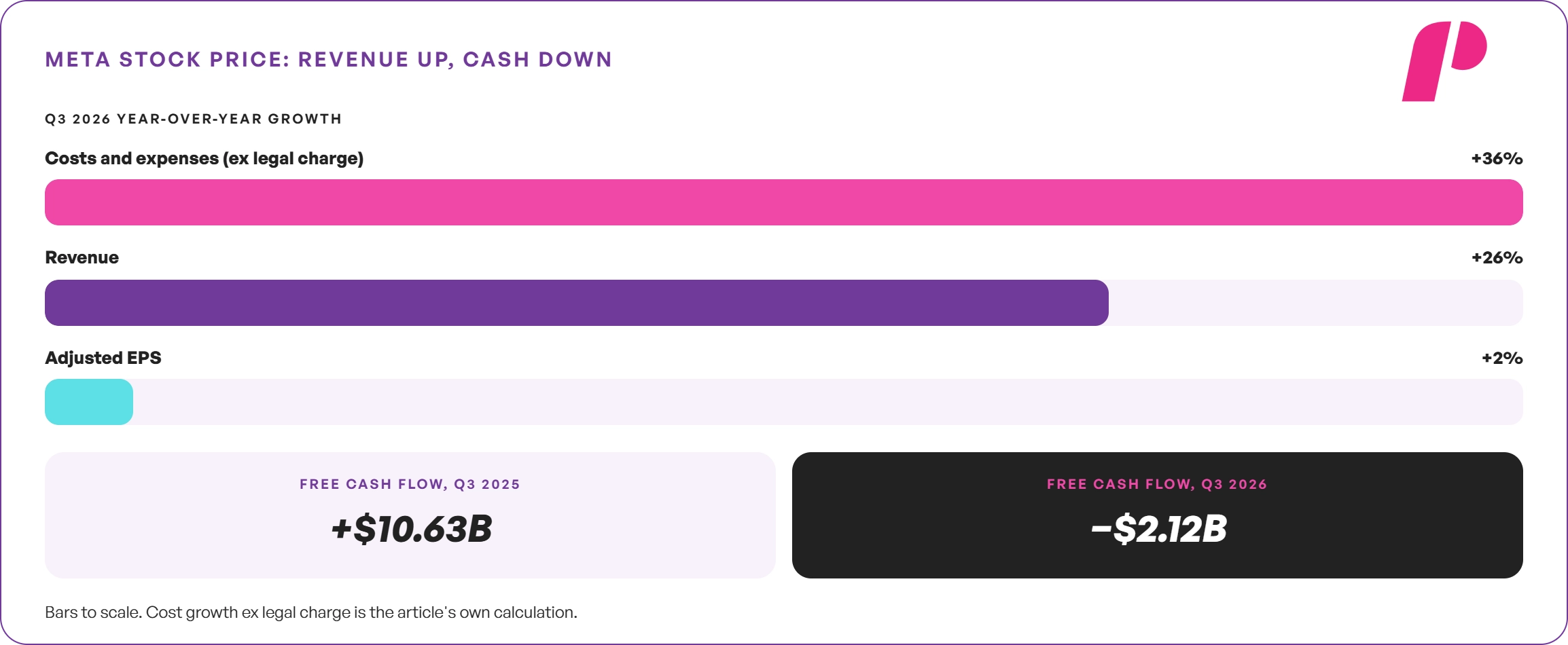
Excluding that charge, Meta earned $7.25. This year’s $7.40 excludes the legal charge. Therefore, when the two years are compared in the same way, earnings per share grew only about 2%. Revenue, in contrast, was up 26%.
🔗Earnings Per Share (EPS) Explained
Costs explain the gap. Excluding the legal charge, costs and expenses rose about 36%, by our calculation. That outpaced revenue growth by ten points.
Meta raised its 2026 total expense outlook to $175 billion to $179 billion, including the legal charge.
Trader Takeaway: Revenue growth is strong, but cost growth consumes it. Margin direction now matters more than the top line. That explains why a revenue beat was not enough to hold the after-hours gain.
The Ad Engine: Volume and Price Rising Together
Meta’s core business remains exceptional. The number of ad impressions went up by 10%, while the average price per ad increased by 14%.
When both of them rise together, it usually means demand from advertisers is strong, and the targeting works better. The combination matters for traders.
Impression growth alone can mean more ad slots of lower value. Price growth alone can mean scarcity that drives advertisers away.
Rising together, they suggest AI ranking makes each ad more effective, so advertisers pay more for more inventory.
🔗Market Share in Focus: Driving Trends and Business Success
Daily active people across Meta’s apps reached 3.64 billion, up 3%. Family of Apps other revenue, driven largely by WhatsApp paid messaging, rose about 59% to $1.1 billion.
Meta Platforms (META) Ad Engine Performance & Q4 Revenue Guidance
| Ad Engine / Monetization Metric | Q3 2026 Result / Q4 2026 Guidance |
|---|---|
| Ad Impressions Volume Growth (YoY) | +10.0% year-over-year increase across Family of Apps |
| Average Price Per Ad Growth (YoY) | +14.0% year-over-year pricing expansion |
| Family Daily Active People (DAP) | 3.64 Billion active users (+3.0% YoY) |
| Family of Apps Other Revenue | $1.10 Billion (+59.0% YoY) |
| Q4 2026 Total Revenue Guidance Range | $73.0 Billion to $76.0 Billion |
One structural exposure persists. Meta earned $18.35 billion from China-based advertisers in 2024, mostly from Temu and Shein.
That equals about 11% of 2024 revenue, by our calculation. The US ended the de minimis exemption for Chinese goods in 2025.
Meta then said those exporters cut ad spending. Well, the strong growth since then shows that Meta was able to handle that hit.
Nevertheless, the risk of depending on these advertisers has not gone away.
🔗Tariffs and Stocks
Trader Takeaway: Thanks to higher prices and more volume, the ad business is the strongest part of the Meta story. The Q4 guidance of up to $76B also points in the same direction. For the stock, however, ad strength is already priced in, so it adds little surprise on its own.
Capex, Commitments and the First Cash Burn
The cash flow statement drove the sell-off. Capital spending, including finance leases, reached $34.91 billion, up about 80%. Operating cash flow of $32.79 billion could not cover it.
Meta Platforms (META) Cash Position, Balance Sheet Structure & Capital Outlays
| Cash & Balance Sheet Metric | Figure / Financial Value (Q3 2026 Reference) |
|---|---|
| Q3 Capital Expenditures (Including Finance Leases) | $34.91 Billion |
| Q3 Free Cash Flow Generation | -$2.12 Billion (compared to +$10.63 Billion a year ago) |
| Full-Year 2026 CapEx Guidance Range | $135.00 Billion to $145.00 Billion (narrowed from prior $130B–$145B) |
| Long-Term Debt (As of September 30, 2026) | $80.92 Billion (compared to $58.74 Billion at end of FY2025) |
| Cash, Cash Equivalents & Marketable Securities | $82.45 Billion |
| Non-Cancelable Contractual Commitments | $454.52 Billion |
| Leases Not Yet Commenced (Future Obligations) | $355.73 Billion |
Year-to-date capex reached about $85.8 billion. That implies $49 billion to $59 billion in the fourth quarter, by our calculation.
Meta also halted buybacks this year. It repurchased no Class A shares in the first nine months of 2026, against $26.2 billion a year earlier.
🔗Stock Buybacks Explained
The commitments line is the real story. Combined with leases not yet started, future obligations exceed $810 billion.
Much of that covers cloud capacity, data center energy, and servers. Meta’s subsea cable program adds to the bill. Its Petal cable will carry 1 petabit per second between the US and France from 2029.
🔗AMD Stock Forecast 2026: Inside the AI Strategy That Just Beat Wall Street by $400M
Project Waterworth, announced in 2025, will stretch about 50,000 kilometers. The trend over two quarters shows how quickly the cushion thinned.
Meta Platforms (META) Sequential Financial Performance
| Fiscal Quarter | Total Revenue (YoY Growth) | GAAP Operating Income (YoY Growth) | Free Cash Flow Generation |
|---|---|---|---|
| Q2 2026 Results | $60.80 Billion (+28.0% YoY) | $18.78 Billion (-8.0% YoY) | $0.78 Billion |
| Q3 2026 Results | $64.60 Billion (+26.0% YoY) | $12.99 Billion (-37.0% YoY) | -$2.12 Billion (Negative FCF) |
The mechanism behind the margin squeeze is simple:

Servers and GPUs depreciate over a few years. Each quarter of heavy spending therefore feeds costs for several quarters after. That explains why margin pressure can persist even if capex levels off in 2027.
🔗Capex vs Depreciation: How Tech Spending Hits Margins
Meta has shifted from a cash-rich buyer of its own stock to a net borrower funding infrastructure.
Trader Takeaway: Fourth-quarter capex implies another heavy cash outflow. Free cash flow is now the metric that drives the stock. Any update on it is likely to move the shares more than revenue headlines.
Funding the Buildout: Debt, Class C and a Possible Equity Raise
Meta has already borrowed. It raised a net $24.9 billion in long-term debt during the first nine months of 2026. The next step looks structural.
The board approved a new non-voting Class C stock, effective around January 19, 2027. Every Class A and Class B holder will receive one Class C share per share held.
Meta expects Class A shares to trade as if a two-for-one split occurred. Voting power stays unchanged, so Mark Zuckerberg keeps control.
🔗Dual-Class Shares and Controlled Companies Explained
Meta tied the change partly to funding growth and AI investment. A special committee of independent directors recommended it.
Zuckerberg also signed a Founder Alignment Agreement that governs his future sales of Class C shares. Meta intends to list the new class on Nasdaq alongside Class A.
Barron’s reported on October 23 that Meta could raise more than $40 billion in equity. The report described about $20 billion soon and roughly $20 billion more after Class C begins trading.
Meta has not confirmed it. CFO Susan Li said, “We don’t have any specific financing plans to announce at this time.”
The dilution math is straightforward:

Microsoft (MSFT) Hypothetical Equity Capital Raise Scenarios
| Hypothetical Capital Raise Scenario (At $642.62 Per Share) | New Shares Issued (Approximate) | Resulting Equity Dilution (Approximate) |
|---|---|---|
| $20.0 Billion Hypothetical Equity Raise | About 31.1 Million new shares | About 1.2% equity dilution |
| $40.0 Billion Hypothetical Equity Raise | About 62.2 million new shares | About 2.4% equity dilution |
These figures assume about 2.54 billion shares outstanding, derived from MarketBeat’s $1.65 trillion market value.
They are illustrations, not company guidance. The dilution itself is modest; the signal that internal cash no longer covers spending is what matters.
🔗Secondary Offerings and Stock Dilution Explained
Trader Takeaway: Class C gives Meta a currency to raise capital without diluting control. An equity raise, if it comes, may weigh on the stock in the short term. Therefore, any offering headline is a near-term volatility event to track.
Muse, Superintelligence and Reality Labs
Meta’s answer to the spending question is Muse. The AI agent launched in August for adults in the US and Canada.
More than 10 million people have set it up. Zuckerberg said about 25% of them use it on any given day. The market rewarded the launch early.
According to XTB, Meta shares rose nearly 20% in the month after Muse’s release. Meta Superintelligence Labs released Muse Wonder on October 12.
Meta calls it its first frontier-class model, trained at the Prometheus data center in Ohio. Zuckerberg told analysts that “Muse will be highly profitable over multiple years.”
🔗AI Stocks in 2026: How to Evaluate, Choose, and Trade
He tied that view to steady gains in AI compute efficiency. Meta also said Superintelligence Labs returns will come more slowly than core returns.
Reality Labs keeps losing money, though less of it.
Meta Platforms (META) Reality Labs Segment Performance
| Reality Labs Metric / Financial Period | Figure / Financial Value (October 2026 Reference) |
|---|---|
| Q3 2026 Segment Revenue | $443 Million (-6.0% year-over-year decrease) |
| Q3 2026 Operating Loss | $4.13 Billion (compared to $4.43 Billion in Q3 2025) |
| Full-Year 2026 Expected Operating Loss Range | $18.0 Billion to $19.0 Billion |
| Full-Year 2027 Projected Operating Loss Outlook | About $15.0 Billion (narrowing trend) |
Muse gives investors a monetization story, but its revenue is not yet visible in the numbers.
Trader Takeaway: Narrowing Reality Labs losses frees up some cash. Muse remains a promise until Meta discloses revenue from it. Until then, Muse headlines can drive sentiment more than earnings estimates.
🔗Stock in Focus: Broadcom Stock (AVGO)
The Legal Scorecard
Meta’s legal picture improved on antitrust and worsened on consumer protection.
Meta Platforms (META) Legal, Regulatory & Antitrust Proceedings
| Legal Case / Antitrust Matter | Litigation Status, Settlement Terms & Regulatory Penalty Detail |
|---|---|
| FTC v. Meta (Instagram & WhatsApp Antitrust Case) | Meta won dismissal in November 2025; FTC appeal currently pending at the D.C. Circuit |
| Multistate Youth Safety Settlement | Agreed in August 2026; up to ~$18.59 Billion total, with $9.89 Billion charged in Q3 |
| New Mexico State Privacy & Child Safety Case | $25.0 Billion penalty ordered on October 21, 2026; Meta plans formal appeal |
| Upcoming Youth-Related Civil Trials | Several additional state and private coordinated trials scheduled in coming months |
The youth settlement pays 70% in annual installments over a decade. The remaining 30% depends on YouTube and TikTok reaching similar deals.
The New Mexico ruling came on earnings day and carries 15% annual interest until paid. Meta’s chief legal officer called business in the state “all but impossible” under the ruling.
🔗How Lawsuits and Regulatory Fines Move Stocks
The New Mexico penalty sits outside the youth settlement. The press release did not report a charge for it. Any future accrual would hit a later quarter.
A $25 billion penalty from one state shows how fast legal costs can scale.
Trader Takeaway: Breakup risk has faded, but penalty risk has grown. Upcoming youth trials could add further charges. Each new ruling can act as a single-day catalyst for the shares.
Scenarios for the Next Three Months
The next catalysts are a possible equity raise, the Class C distribution, and fourth-quarter results in late January.
| Market Scenario | Scenario Trigger & Fundamental Catalyst | Likely Effect on Stock Price Action |
|---|---|---|
| Constructive Scenario | Q4 revenue hitting near $76.0 Billion top-end guidance; 2027 capex explicitly framed around tangible Muse AI monetization | Recovery rally moving back toward the 50-day moving average |
| Base Case Scenario | Moderate equity raise executed near $20.0 Billion; capital expenditure guidance held relatively steady | Range-bound consolidation hovering near the 200-day moving average |
| Pressured Scenario | Larger equity raise required, escalating 2027 capex outlook, and additional legal settlement charges | Downside break below established support at the 200-day moving average |
These scenarios reflect our judgment, not company guidance.
Position size can follow the same levels. With a $100,000 account risking 1%, the amount at risk is $1,000. A stop just below the 200-day average, near $629.10, sits about $13.52 below $642.62. That equals $1,000 ÷ $13.52, or about 74 shares. This is an illustration, not a trade plan.
The Risks That Matter for the Meta Stock Price
Each risk below can reach the stock through a headline, a filing, or the January report.
- Negative Free Cash Flow. Capex exceeded operating cash flow in Q3.
- Dilution. Class C creates a ready tool for equity issuance.
- Rising Leverage. Long-term debt rose about $22 billion this year.
- Legal Penalties. New Mexico’s $25 billion order and pending youth trials.
- Antitrust Appeal. The FTC still seeks to revive its breakup case.
- Advertiser Concentration. China-based advertisers remain a meaningful revenue source.
- AI Payback. Muse revenue remains undisclosed.
🔗Risk Management in Stocks: A Complete Guide 2026
Closing Thoughts
Meta’s advertising business has rarely looked stronger. Prices and volumes both rose, and fourth-quarter guidance points to more growth.
The problem lies below the revenue line. Adjusted earnings barely grew, free cash flow turned negative, and debt climbed.
The Meta stock price now depends on one race: AI revenue against rising funding needs. In our view, the ad engine can carry the buildout, but not without outside capital.
🔗Magnificent 7 Stocks: Where Investors Are Finding Growth in 2026
The Class C structure and a possible equity raise show Meta reached the same conclusion. Fourth-quarter results and 2027 guidance in January will show how large that gap has become.
NFA. DYOR. This analysis is for informational purposes only and is not investment advice.
If you liked this post make sure to share it!