Google DeepMind released a map of every possible single-letter change in the human genome on September 8.
The data set encompasses 9 billion variants and is roughly 1 petabyte. This disparity defines the key dilemma facing the stakeholders.
Alphabet has built the most advanced AI toolkit in biology; however, it has not built a pharmaceutical business yet.
🔗Magnificent 7 Stocks: Where Investors Are Finding Growth in 2026
In this article, we will separate the two. We will also look at which one is more likely to move the Alphabet stock price into tonight’s report.
Where the Alphabet Stock Price Stands Before October 28
The shares fell in four of the last five sessions before the weekend. On October 22, a broad tech sell-off cut GOOGL by 3.1% as worries over AI spending came back. Meta and Amazon fell even harder that day.
🔗Amazon Stock Price: Growth Strategies for Investors
Alphabet (Google) Stock Price Markers & Technical Performance Benchmarks
| Google Stock Price Marker / Technical Metric | Figure / Market Value |
|---|---|
| Closing Share Price (October 23, 2026) | $320.21 per share |
| October Monthly High Close (October 13, 2026) | $353.78 per share |
| 52-Week Trading Range | $251.85 to $408.61 per share |
| 50-Day Moving Average (As of October 21, 2026) | $343.31 per share |
| 200-Day Moving Average (As of October 21, 2026) | $353.04 per share |
| Wall Street Consensus Price Target (MarketBeat) | About $425.00 per share |
| Q3 2026 Earnings Report Schedule | October 28, 2026 (After Market Close) |
Therefore, where is GOOGL stock currently priced? Lower than the 50-day average and the 200-day average price.
🔗6 Simple RSI Trading Strategies You Can Use Today
For traders, $343.31 and $353.04 are the first levels a post-earnings bounce would need to reclaim.
Based on the statistics provided by Trefis, the share price declined 21.1% between May 13 and July 23.
They then dropped another 8.5% over the two days around the second-quarter report. Analysts remain bullish; nevertheless, the price action has moved the other way since spring.
🔗Analyst Price Targets Explained
As a result, the GOOGL stock price enters earnings in a downtrend, below key moving averages. Positioning looks less crowded than the analyst consensus suggests.
That can make a positive surprise travel further than usual.
From Protein Folding to a Genome Atlas
Alphabet’s biology story started with AlphaFold, a system that predicted structures for more than 200 million proteins.
They both shared the 2024 Nobel Prize in Chemistry for that research. After that came AlphaFold 3 in May 2024, which is capable of modeling protein interactions with DNA, RNA, and drugs.
DeepMind then turned to the genome itself. The human body contains only around 2% of DNA coding for proteins, while the other part is responsible for the regulation of the process of gene expression.
🔗AI Stocks in 2026: How to Evaluate, Choose, and Trade
AlphaGenome, presented in June 2025, identifies the impact of point mutations in this DNA on gene expression.
The AlphaGenome Atlas takes that idea to the whole genome. It scores all three possible substitutions at each of roughly 3 billion positions.
A new AlphaGenome Variant Impact score then condenses each prediction into a single number.
Researchers can use it for free in noncommercial work, and DeepMind plans commercial access through Google Cloud.
Google DeepMind Biology & AI Platforms
| Biology Platform & Release Year | Functional Capabilities & Modeling Scope | Commercial Status & Access Model |
|---|---|---|
| AlphaFold (Released 2020 onward) | Predicts 3D protein structures with atomic accuracy | Free open-access database; foundational research tool |
| AlphaFold 3 (Released 2024) | Models protein, DNA, RNA, chemical modifications, and ligand interactions | Academic research server; commercial access via Isomorphic Labs |
| AlphaGenome (Released 2025) | Predicts functional effects of non-coding and regulatory DNA mutations | API access for scientific research |
| AlphaGenome Atlas (Released 2026) | Comprehensive variant scoring covering approximately 9 billion genetic variants | Free for research use; enterprise cloud access planned |
Is AlphaGenome ready for clinical use? Not yet: DeepMind states plainly that the model is “not validated or approved for clinical use.”
🔗AI Drug Discovery Stocks Explained
An outside expert told Nature that the predictions would not take the place of lab work. Put more simply, while these models reduce the hunt for drug targets, they do not reduce the trials, factories or regulators involved.
Alphabet leads AI biology on the science side. The planned Google Cloud access is the first direct revenue path, although its size is still unknown. For tonight’s report, therefore, the biology story is context rather than a price driver.
Isomorphic Labs: Where the Science Meets a Business Model
Isomorphic Labs is the vehicle meant to turn that science into medicines. DeepMind spun it out in 2021, and Hassabis serves as its chief executive. The company signed its first pharma partnerships in January 2024.
Isomorphic Labs Corporate & Financial Milestones
| Isomorphic Labs Corporate Milestone | Transaction Details, Financial Terms & Strategic Status |
|---|---|
| Eli Lilly Strategic Collaboration (January 2024) | $45.0 Million upfront payment; potential milestone payments totaling $1.7 Billion |
| Novartis Strategic Collaboration (January 2024) | $37.5 Million upfront payment; potential milestone payments totaling $1.2 Billion |
| First External Financing Round (2025) | $600.0 Million primary financing, led by Thrive Capital |
| Series B Financing Round (May 2026) | $2.1 Billion capital raise, led by Thrive Capital; Alphabet and GV participating |
| New Financing Discussions (October 2026) | Targeting at least $40.0 Billion valuation per Bloomberg reports; terms not finalized |
| First Clinical Trial Advancement | Expected by end of 2026 (revised timeline relative to earlier targets) |
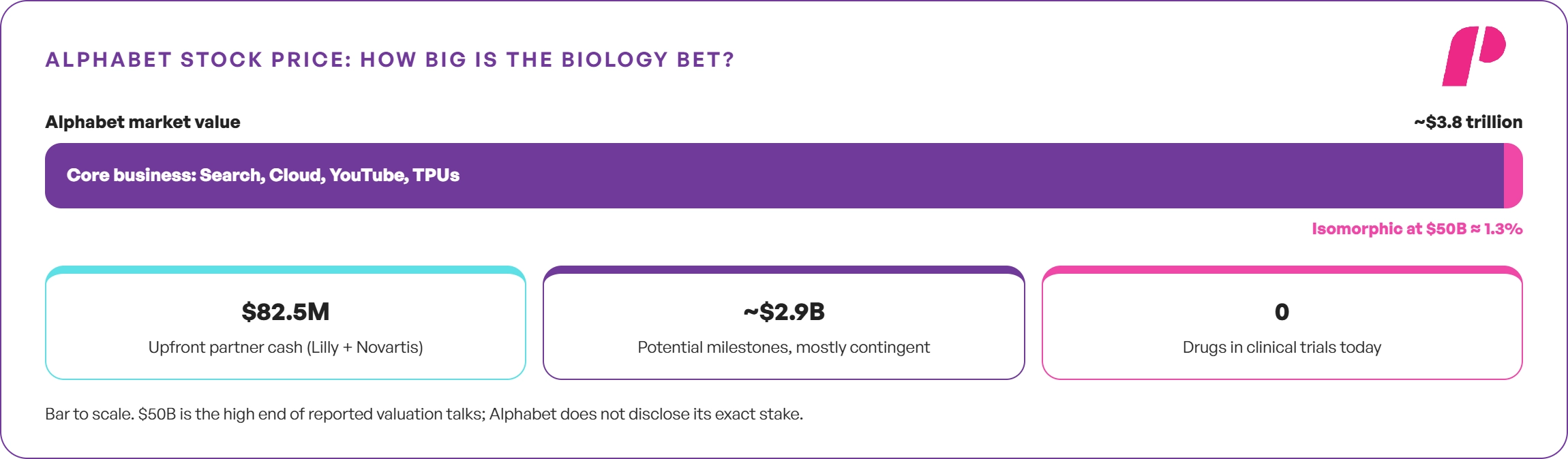
The partnership headline of about $3 billion sounds large; however, most of it is contingent on milestones.
Upfront cash totaled only $82.5 million. The trial timeline has also slipped. Isomorphic was once hoping to run AI-designed drugs in trials by the end of 2025, and its first drugs will be aimed at treating cancer.
How much is Isomorphic worth to Alphabet shareholders? Not much, at least for now. Take the high end of the reported talks, $50 billion.
That figure equals about 1.3% of Alphabet’s market value of roughly $3.8 trillion. Alphabet does not disclose its exact stake after the outside funding rounds.
🔗What Is Market Capitalization?
Therefore, even a successful Isomorphic barely registers against the size of Google’s core business.
Therefore, Isomorphic provides long-dated optionality. Dosing of the first candidate would prove the model right; however, it wouldn’t affect near-term earnings.
For traders, Isomorphic news is a long-term catalyst, not an earnings-week one.
The Machinery Under the Science
The biology work runs on the same foundation as Google’s commercial AI. Google holds US Patent 10,452,978, titled “Attention-based sequence transduction neural networks.
The 2017 filing relates to the Transformer model underlying current language models. A patent for Google related to decoder-only models is Patent 11,886,998, which expires in 2038.
🔗Patent Portfolios and IP Moats
Google pairs that intellectual property with its own chips. Its Tensor Processing Units (TPUs) handle training and inference across Google’s services.
🔗Stock in Focus: Broadcom Stock (AVGO)
In the second quarter, Alphabet recognized revenue from TPU systems delivered to customer data centers for the first time.
Meanwhile, reports in February said Meta agreed to rent TPUs through Google Cloud. Anthropic, for its part, has committed to at least five gigawatts of Google Cloud capacity.
Alphabet (Google) Infrastructure Assets & Strategic Defensibility
| Infrastructure Asset / Intellectual Property | Strategic Advantage & Operational Benefit | Key Constraint & Limiting Factor |
|---|---|---|
| Transformer Patent Family | Defensive moat and cross-licensing leverage across the AI sector | Estimated patent expiry around 2038 |
| Tensor Processing Units (TPUs) | Avoids paying third-party merchant GPU and Nvidia margins | Manufacturing relies entirely on TSMC capacity |
| Optical Circuit Switching (Jupiter Network) | 41% lower network power and 30% lower capex (per 2022 research paper) | Efficiency benefits are already fully captured in current cost base |
| External TPU Sales & Enterprise Distribution | Emerging high-margin cloud hardware revenue stream | Substantial revenue realization weighted toward 2027 |
Google’s 2022 SIGCOMM paper reported those network savings from optical circuit switches. They show how Alphabet lowers its cost of compute.
🔗Nvidia Stock Analysis: Can NVDA Own AI, Robotics and Quantum?
The same infrastructure that powers AlphaFold is also sold to rivals, and that’s where the money is today.
TPU sales turn an internal cost advantage into revenue. From this angle, they likely matter more to the stock than any drug program over the next two years.
On tonight’s call, any update on external TPU demand is the infrastructure detail most likely to register.
The Numbers That Move the GOOGL Stock Price
Alphabet’s 2025 results showed a business in strong shape. The capex line, however, nearly doubled.
Alphabet (Google) Full-Year Financial Performance & Capital Allocation Metrics
| Financial & Operational Metric | FY2024 Results | FY2025 Results |
|---|---|---|
| Total Annual Revenue | $350.0 Billion | $402.8 Billion |
| Total Operating Income | $112.4 Billion | $129.0 Billion |
| Net Income Attributable to Shareholders | $100.1 Billion | $132.2 Billion |
| Diluted Earnings Per Share (EPS) | $8.04 per share | $10.81 per share |
| Capital Expenditures (CapEx) | $52.5 Billion | $91.4 Billion |
| Free Cash Flow Generation | $72.8 Billion | $73.3 Billion |
| Cash & Marketable Securities (Year-End) | $95.7 Billion | $126.8 Billion |
Growth then picked up speed in 2026. Google Cloud revenue rose 48% in the fourth quarter of 2025. After that, growth was 63% for the first quarter and 82% for the second quarter.
Additionally, Cloud backlog amounted to $514 billion, while the Gemini app acquired 950 million users per month.
Alphabet (Google) Quarterly Financial Performance
| Financial & Operational Metric (2026 Quarters) | Q1 2026 Results | Q2 2026 Results |
|---|---|---|
| Total Quarterly Revenue | $109.9 Billion (+22% YoY) | $119.8 Billion (+24% YoY) |
| Google Cloud Segment Revenue | $20.0 Billion (+63% YoY) | $24.8 Billion (+82% YoY) |
| Google Cloud Operating Income | $6.6 Billion | $8.8 Billion |
| Cash Capital Expenditures (CapEx) | $35.7 Billion | $44.9 Billion |
| Free Cash Flow Generation | $10.1 Billion | $(5.9) Billion (Negative FCF) |
| Reported Diluted Earnings Per Share (EPS) | $5.11 per share | $9.11 per share |
| EPS Contribution from Investment Gains | $2.35 per share | $6.26 per share |
| Core EPS Excluding Investment Gains* | $2.76 per share | $2.85 per share |
*Calculated as reported EPS minus the gain contribution Alphabet disclosed.
Why does Alphabet’s reported EPS look so high? The short answer: paper gains. In the second quarter, gains on stakes in SpaceX and Anthropic added $6.26 per share.
🔗SpaceX Stock: What Investors Actually Own After the IPO
Core earnings of about $2.85 landed close to the $2.89 consensus. As a result, headline P/E ratios near 16 flatter the stock, since they count those gains. Therefore, in tonight’s print, core earnings matter more than the headline EPS figure.
Spending, on the other hand, is the bigger shift. Alphabet increased the capex outlook for 2026 to between $195 billion and $205 billion, up from between $180 billion and $190 billion.
🔗Earnings Per Share (EPS) Explained
The total capex spent during the first half was $80.6 billion. If the guidance is met, the capex spending would be around $57 billion to $62 billion each quarter during the second half.
🔗Capex vs Depreciation: How Tech Spending Hits Margins
Cloud growth is real and accelerating. Free cash flow, however, turned negative, and the capex guidance points to heavier second-half spending. That gap between growth and cash is what the market will price after the close.
An $80 Billion Equity Raise
The cash squeeze also explains Alphabet’s most unusual move of the year. On June 1, the company announced equity offerings of about $80 billion.
Alphabet (Google) June 2026 Equity Capital Raise & Strategic Financing Tranches
| Equity Raise Component & Financing Tranche (June 2026) | Target Raise Amount / Transaction Detail |
|---|---|
| Class A & Class C Common Stock Public Offering | $15.0 Billion underwritten offering (upsized to $18.0B at pricing) |
| Mandatory Convertible Preferred Stock (Two Series) | $15.0 Billion depositary shares (upsized to $16.75B) |
| At-the-Market (ATM) Program (Commencing Q3 2026) | $40.0 Billion flexible equity issuance program |
| Berkshire Hathaway Strategic Private Placement | $10.0 Billion direct private placement |
| Berkshire Hathaway Class A Placement Price Benchmark | $351.81 per share equivalent |
Alphabet earmarked the proceeds for AI infrastructure. About $30 billion of the at-the-market program covers 2026 employee equity tax obligations. The preferred shares convert into common stock around May 2029.
🔗Secondary Offerings and Stock Dilution Explained
Berkshire’s entry price offers a useful reference point. At $320.21, the Alphabet stock price sits about 9% below what Berkshire paid for Class A shares. For traders, $351.81 sits close to the 200-day average, which makes that zone a visible overhead level.
In contrast to its long history of large buybacks, the company now issues stock to fund the AI buildout.
Dilution is now part of the story. At-the-market sales were set to start in the third quarter, adding a steady supply of shares. Tonight’s report may show how much stock Alphabet has already sold.
Control, Courts and Leadership
The founders, Larry Page and Sergey Brin, had 52.7% of the total voting power on April 6, 2026. That control allows management to fund long-horizon research such as DeepMind and Isomorphic.
On the other hand, it also limits outside shareholders’ influence over capital allocation.
The board carries real biomedical depth. The director, Frances Arnold, was awarded the 2018 Nobel Prize in Chemistry.
The CFO, Anat Ashkenazi, worked for 23 years at Eli Lilly before joining Alphabet. Meanwhile, former Fed Vice Chair Roger Ferguson chairs the audit committee.
Alphabet (Google) Legal, Antitrust & Corporate Development Milestones
| Legal Item / Antitrust Proceeding | Litigation Status, Remedy Terms & Transaction Detail |
|---|---|
| Search Monopoly Antitrust Case | Cross-appeals active in the D.C. Circuit; Department of Justice pursuing stiffer structural sentences |
| Ad Tech Antitrust Case | September 2026 remedies ordered: AdX divestiture avoided, subject to six years of mandatory conduct rules |
| Wiz Cloud Security Acquisition | Successfully closed on March 11, 2026, for a total cash consideration of $32.0 Billion |
Judge Leonie Brinkema rejected the government’s demand to sell AdX. Instead, she ordered behavioral changes and a compliance monitor.
Google plans to appeal the liability ruling. The worst-case breakup scenarios have faded; nevertheless, the search appeal keeps legal risk alive.
🔗Google Stock Prices: What Will Happen if Chrome is Sold?
In short, legal risk has shifted from structural to behavioral. The D.C. Circuit appeal remains the main open question. For the October 28 report, legal items are background risk rather than an earnings driver.
What Options Imply for October 28
Third quarter revenue estimated by InsiderFinance is $127.4 billion to $131.8 billion. The EPS estimates are between $3.04 and $3.10. The CFO has also warned that third-party capacity will pressure Cloud margins this quarter.
How much could GOOGL move after earnings? Options prices give a rough guide to the expected move, and the formula is simple:

🔗Options Expected Move Explained
For example, for a hypothetical implied move of 5%, the amount is $320.21 * 0.05 = $16.01. The range will be between $304 and $336.
There could be changes in options pricing using live data; thus, it is advisable that you confirm the pricing before the report.
🔗Swing Trading Risk Management
Position size can follow the same logic. With a $100,000 account risking 1%, the amount at risk is $1,000. If the stop sits one expected move away, that equals $1,000 ÷ $16.01, or about 62 shares.
Earnings Scenario Planning & Price Action Triggers
| Market Scenario | Cloud Growth Trigger | CapEx Guidance Signal | Likely Price Reaction |
|---|---|---|---|
| Bullish Scenario | Cloud growth above 80.0%, operating margins remaining steady | 2027 CapEx outlook explicitly framed around tangible investment returns | Upside move toward the top of the trading range |
| Base Case Scenario | Cloud growth tracking between 70.0% and 80.0%, slight margin dip | CapEx guidance held firmly at $195.0 Billion to $205.0 Billion | Muted reaction, hovering near current levels |
| Bearish Scenario | Cloud growth dropping below 70.0% | Full-year capital expenditure guidance raised higher again | Downside break below established support range |
It is an editorial call rather than guidance from the company. But in either case, Cloud margins and the capex story will carry more weight than any biology story.
The article, accordingly, becomes dependent upon cash flow. Beating revenue numbers might not be as important as the spending story for 2027.
The Risks That Matter for the Alphabet Stock Price
Each risk below can surface in tonight’s numbers or on the earnings call.
- Capex outpacing cash. Free cash flow turned negative in the second quarter.
- Dilution. The $40 billion at-the-market program adds share supply.
- Earnings quality. Paper gains on SpaceX and Anthropic swing reported EPS.
- Legal appeals. The D.C. Circuit could revive tougher search remedies.
- Supply chain. TPUs depend on TSMC manufacturing.
- Biotech timelines. Isomorphic has already pushed back its first trials.
🔗Risk Management in Stocks: A Complete Guide 2026
Closing Thoughts
Alphabet has built the most proficient AI system for biology. AlphaFold revolutionized structural biology, and the Genome Atlas can revolutionize the prioritization of disease mutations by biologists. Isomorphic Labs then gives those tools a commercial path.
None of that makes Google a pharmaceutical company yet. Isomorphic has no drug in trials, and its potential value equals about 1% of Alphabet.
The Alphabet stock price still depends on whether cloud growth can pay for a $200 billion buildout. From this perspective, the biology program looks like a long-dated option that investors receive almost for free.
Tonight’s report will show how much the core business must spend to keep it.
Traders who follow earnings setups in stocks like GOOGL can apply that analysis through Trade The Pool. The prop firm offers funded accounts for US stocks and ETFs, under defined risk rules.
NFA. DYOR. This analysis is for informational purposes only and is not investment advice.
If you liked this post make sure to share it!