The word “stonks” became one of the most recognizable phrases in modern financial culture. It started as a deliberate internet joke but ended up reflecting something real about how retail traders think, behave, and sometimes lose money. Understanding what “stonks” means and why it resonated so deeply helps any trader separate cultural noise from genuine market opportunity. The stonks meme did not create irrationality in markets. It simply gave that irrationality a face and a name.
What does stonks mean for traders today, and what should they actually consider before opening any position in stocks? This article answers that question honestly, without hype and without dismissing the cultural context that made stonks relevant in the first place. It explains what meme stocks are, what went wrong with the most famous examples, and what responsible traders evaluate before putting real capital at risk. The goal is clarity, not to glorify meme trading, but to help traders think more precisely about where genuine opportunity lives.
The Article Will Cover:
-
- The stonks definition, origin, and cultural meaning
- Why meme stocks attracted retail traders, and what the consequences were
- The contrast between meme culture and disciplined stock analysis
- What serious traders evaluate before entering any position
- Stock categories worth understanding for structured, responsible trading
- How prop trading programs approach stock selection and risk
What Does Stonks Mean? The Definition, Origin, and Cultural Context
The stonks slang is a deliberate, humorous misspelling of the word “stocks.” Merriam-Webster officially recognizes it as internet slang used to comment on financial decisions, particularly poor or irrational ones. Dictionary.com places it inside meme culture as a phrase representing ironic optimism about market behavior. Wiktionary also lists “stonk” as a noun meaning a profitable thing or scheme, extending the word beyond pure comedy into actual trader vocabulary. The stonks’ meaning in the stock market is both literal and satirical.
Traders use stonks to describe price action driven by emotion, hype, or social coordination rather than company fundamentals. When someone says “stonks go up,” they acknowledge, ironically, that markets sometimes reward behavior that analysis cannot justify. That self-aware irony is central to the meme’s power. What does stonking mean in English slang? The word originally meant large or powerful. The internet repurposed it to mean financially absurd in a strangely triumphant way. Both meanings overlap in meme stock trading culture.
STONK Definition and Meaning in Plain Terms
At its core, stonks functions as shorthand for the irrational side of market behavior. What does stonks mean in slang beyond finance? It describes any situation where something succeeds through luck, social momentum, or sheer collective belief rather than logic. For traders, the word signals a category of market event that requires caution, not imitation. Understanding the definition helps traders recognize when social sentiment, not fundamentals, is driving a price move, which is one of the most important signals a serious trader can read.
Who Created the Stonks Meme? Meme Man Explained
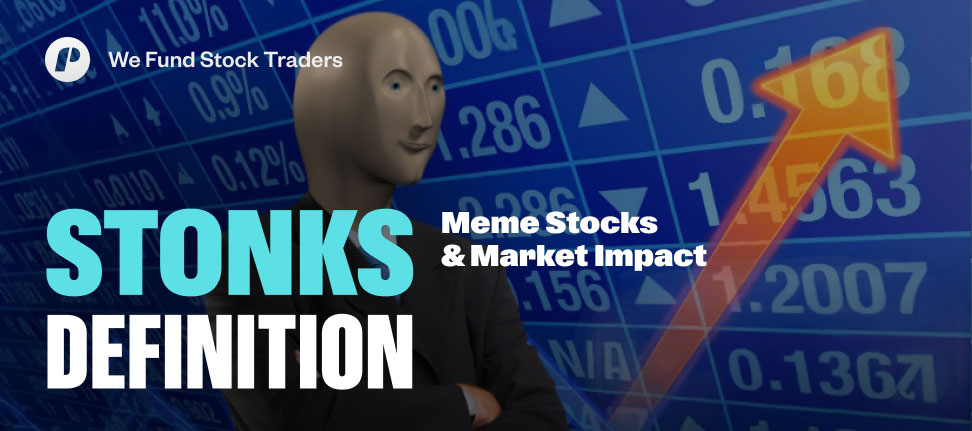
The stonks meme features a character called Meme Man, a 3D-rendered, smooth-headed humanoid figure typically placed in front of a green stock chart. According to Know Your Meme and the Surreal Memes Wiki, Meme Man is widely associated with the Surreal Memes genre of internet art and the Facebook page Special Meme Fresh, which adapted an anonymous 4chan /3dcg/ render into a recurring mascot and posted the original “Stonks” image on June 5, 2017. The character’s blank expression, combined with obvious confidence, made him the perfect symbol for ironic financial optimism. When were stonks created? The image first appeared in 2017 on Facebook and spread rapidly through Reddit communities.
Why is the stonks meme funny? The humor comes from layers. Meme Man looks completely serious while making an obviously absurd decision. That combination, total confidence in something logically questionable, mirrors the real psychology of traders who buy assets for no fundamental reason and sometimes profit anyway. The meme resonated because it told a truth. Markets are not always rational. Prices do not always reflect value. And sometimes, collective belief alone moves prices significantly, at least temporarily.
Why Stonks Resonated: Retail Trading, Social Media, and the Anti-Institution Mood
The stonks phenomenon did not emerge in a vacuum. It grew from a specific set of conditions: the rise of zero-commission trading apps, the COVID-19 lockdown period that gave retail investors time and stimulus money, and a growing distrust of institutional financial players. Reddit communities, particularly WallStreetBets, became gathering points for retail traders who saw markets as rigged in favor of hedge funds. The stonks meme gave that sentiment a visual identity that spread instantly.
Why do people buy meme stocks? The motivations divide clearly into four overlapping categories. First, the pursuit of explosive short-term gains that traditional investing rarely delivers. Second, a genuine anti-institutional impulse; the desire to “beat” hedge funds at their own game by targeting heavily shorted stocks. Third, community participation; trading as a social act rather than a financial one. Fourth, and arguably most defining, the self-aware ironic culture of WallStreetBets itself; users deliberately called themselves “degenerates” and “apes,” wore financial illiteracy as a badge with phrases like “apes together strong,” and built a subculture that openly mocked the pretensions of traditional investing. The stonks meme worked precisely because participants understood it was a joke about their own behavior. These motivations are understandable. However, they are not a substitute for analysis. And the outcomes, in most documented cases, ultimately reflected that gap.
Gamestonk and the Moment Stonks Entered Market History
The single most defining event in meme stock history occurred in January 2021. Reddit’s WallStreetBets community identified GameStop as a heavily shorted stock and began buying aggressively, driving the price from roughly $17 at the start of the month to an intraday high of $483 on January 28, 2021, one of the most dramatic short squeezes in market history. Elon Musk amplified the move on January 26 with a single tweet: “Gamestonk!!”; which sent the price surging further. Two days later, several brokerages, including Robinhood, restricted retail buying of GameStop and other meme stocks (while allowing selling), triggering congressional hearings and regulatory reviews.
Is the stonks meme still relevant? Yes, because the structural conditions that created it still exist. Social media, zero-commission trading, and retail coordination remain powerful forces. However, the GameStop story is most instructive not for the traders who entered early and profited, but for the far larger group who entered at peak and absorbed significant losses. That is the lesson the stonks era actually teaches: social momentum creates windows, not guarantees. For every trader who rode the wave, many more were underwater by the time mainstream coverage peaked.
What Are Meme Stocks? Real Examples and Real Consequences
A meme stock is an equity whose price moves primarily because of social media attention and retail coordination, not because of changes in the company’s business fundamentals. The distinction matters enormously: when price action decouples from business reality, the position carries no analytical foundation; only the expectation that others will keep buying. Why do they call it meme stocks? Because the price behavior mirrors how internet memes spread: quickly, emotionally, and often without lasting substance. Meme stocks capture attention, generate momentum, and fade when the next thing arrives.
Are meme stocks risky? The documented evidence gives a clear answer. The most prominent meme stocks of the 2021 cycle, GameStop, AMC Entertainment, and BlackBerry, all collapsed to fractions of their peak prices within months. Bed Bath & Beyond, another widely discussed meme stock, eventually filed for bankruptcy in April 2023. Are meme stocks considered gambling? Many professional analysts classify them as such, and with good reason. When investment logic rests entirely on predicting other people’s social behavior, the outcome resembles chance more than analysis.
GME and AMC as Cautionary Examples; Not Trading Templates
GameStop and AMC are frequently cited as meme stock success stories. However, they are more accurately understood as narrow windows where a specific mechanical condition, extreme short interest, created a temporary price spike that benefited a small group of early entrants. The majority of retail traders who bought during media coverage, at or near the peak, experienced significant losses. That asymmetry is the core lesson. Meme stock events are not repeatable strategies. They are rare mechanical anomalies that look obvious only in hindsight.
Meme Stock Risk Profile: What Actually Happened
| Stock | Peak Price (Approx.) | Pre-Meme Price | Current Price (May 2026) | Primary Outcome |
|---|---|---|---|---|
| GameStop (GME) | $483 (pre-split) | ~$17 | ~$22.20 | Maintained baseline; periodic retail speculation |
| AMC Entertainment (AMC) | $72.62 | ~$2 | ~$1.42 | Significant dilution; capital structure shifts |
| BlackBerry (BB) | $28.77 | ~$6 | ~$6.30 | Returned to historical trading range |
| Bed Bath & Beyond | ~$53 | ~$5 | $0 (Bankrupt) | Liquidated; brand assets transitioned |
| Nokia (NOK) | $6.55 | ~$3.87 | ~$13.90 | Corporate growth decoupled from meme status |
* GameStop completed a 4-for-1 stock split on July 22, 2022. The $483 January 2021 intraday high translates to roughly $120.75 on a split-adjusted basis. An additional 11-for-10 split occurred in October 2025.
** AMC’s all-time intraday high of $72.62 occurred during its second short squeeze on June 2, 2021. The January 2021 squeeze peak was lower (roughly $20).
† BBBY had two distinct meme peaks: ~$53 during the January 2021 cycle (its all-time meme high) and ~$30 during the August 2022 Ryan Cohen-driven rally before bankruptcy.
Stonks Culture vs. Disciplined Trading: Understanding the Core Contrast
The stonks mindset and disciplined trading are not simply different approaches; they operate on fundamentally different assumptions. Stonks culture assumes price will rise because enough people believe it will rise. Disciplined trading assumes price reflects value over time, and that edge comes from identifying gaps between the current price and underlying reality. Neither approach is morally superior. However, only one of them produces consistent, repeatable results across different market conditions and timeframes.
Is meme trading legal? Yes, trading meme stocks is entirely legal. However, deliberately coordinating to manipulate a stock’s price can constitute securities fraud under SEC rules. The legal line between collective enthusiasm and coordinated manipulation is real, and traders operating inside prop trading programs must understand it clearly. Furthermore, even purely legal meme trading carries structural disadvantages for most participants: thin exit windows, emotional decision-making, and a payoff structure that rewards early entrants almost exclusively.
Stonks Mindset vs. Disciplined Trading Mindset: A Direct Comparison
| Dimension | Stonks / Meme Culture | Disciplined Stock Trading |
|---|---|---|
| Price driver | Social media sentiment and collective belief | Earnings, fundamentals, and market structure |
| Research method | Reddit threads, Twitter trends, social alerts | Financial statements, sector analysis, technicals |
| Time horizon | Minutes to days; event-driven | Weeks to years; thesis-driven |
| Entry logic | Others are buying; the price is moving | Price below assessed value, or valid setup |
| Exit logic | Sell when sentiment peaks or panic sets in | Sell when thesis is invalidated or target met |
| Risk management | Often absent; position sized by excitement | Predefined stop-loss; position sized by risk % |
| Consistency | Depends on catching rare events early | Repeatable across different conditions |
| Who benefits most | Early entrants only | Disciplined traders across entry points |
What Serious Traders Evaluate Before Opening Any Stock Position
The stonks era highlighted how many retail traders enter positions with no analytical framework at all. Responsible traders, whether investing independently or operating through a prop trading program, apply a consistent evaluation process before committing capital to any position. This process does not need to be complex. However, it must exist. The difference between meme trading and structured trading is not intelligence; it is the presence or absence of a repeatable decision-making framework.
What does stonk mean in trading, practically speaking? It describes a trade made without this framework. Before opening any real stock position, traders should evaluate the company’s fundamentals, the broader sector context, the technical structure of the chart, and the specific risk parameters of the trade. Each of these dimensions contributes information that meme culture completely ignores. However, together they create a basis for decisions that can be reviewed, improved, and repeated. The following checklist represents the minimum evaluation every trader should complete.
Pre-Position Evaluation Checklist: What to Assess Before Every Trade
| Evaluation Area | Key Questions to Answer | Why It Matters |
|---|---|---|
| Business fundamentals | Is revenue growing? Is the company profitable? What is the debt level? | Ensures price has an underlying anchor beyond social sentiment |
| Valuation | Is the current price justified by earnings or growth projections? | Identifies whether you are buying value or chasing hype |
| Sector context | Is the sector in a growth phase or under pressure? What are peers doing? | Stock picks succeed or fail partly based on sector momentum |
| Technical structure | Is the chart showing a clear setup, support, trend, or breakout pattern? | Provides entry timing logic beyond guesswork |
| Risk definition | Where is the stop-loss? What is the maximum loss if the trade fails? | Defines the cost of being wrong before entering |
| Position size | What percentage of capital does this trade represent? | Prevents any single trade from damaging the overall account |
| Catalyst or thesis | Why should the price move in the expected direction and when? | Distinguishes a reasoned thesis from a hope-based entry |
Stock Categories Every Trader Should Understand Before Investing
One of the most practical steps any trader can take is developing a clear understanding of stock categories. Different types of stocks behave differently across market cycles, interest rate environments, and economic conditions, and understanding these categories is fundamental to building a rational investment or trading approach. Meme stocks do not fit cleanly into any recognized category, which is itself informative. Structured trading involves selecting positions from categories with predictable behavioral patterns and documented historical performance characteristics.
What are the best stocks for beginners? The honest answer starts with category understanding rather than specific names. A beginner trader who understands what cyclical stocks, growth stocks, dividend stocks, and value stocks are, and when each tends to perform, is far better positioned than one who simply follows social media recommendations. Stock rotation, the movement of capital between categories as conditions change, is one of the most reliable patterns in equity markets. Recognizing it requires category knowledge first.
Stock Categories Traders Should Know: Characteristics and Context
| Category | What It Describes | When It Tends to Perform | Risk Level | Example Sectors |
|---|---|---|---|---|
| Growth stocks | Companies growing revenue/earnings faster than the market | Low interest rate environments; economic expansion | High | Technology, biotech, clean energy |
| Value stocks | Companies trading below their assessed intrinsic value | Market recoveries; rotation out of growth | Medium | Financials, industrials, consumer staples |
| Cyclical stocks | Companies whose performance tracks the economic cycle closely | Economic expansion and recovery phases | Medium-High | Automotive, construction, materials |
| Dividend stocks | Companies that distribute regular income to shareholders | Uncertain or declining markets; income-focused periods | Low-Medium | Utilities, REITs, established consumer brands |
| Oil and gas stocks | Energy sector companies are tied to commodity price movements | Supply shocks, inflation cycles, geopolitical tension | Medium-High | Integrated majors, exploration companies |
| Penny stocks | Low-price, small-cap stocks with thin liquidity | Speculative environments; rarely a reliable cycle | Very High | Micro-cap across all sectors |
| Meme stocks | Social-sentiment-driven equities; no fundamental basis | Unpredictable; social event-driven only | Extreme | No consistent sector pattern |
Why Stock Rotation Matters for Traders Choosing Positions
Stock rotation refers to the movement of capital from one sector or category to another as macroeconomic conditions change. Traders who understand rotation can position themselves in the categories likely to benefit next, rather than chasing categories that have already moved. For example, when interest rates rise, growth stocks typically underperform while value stocks and dividend-paying stocks often hold up better. When the economy enters an expansion phase, cyclical stocks and energy names, including oil stocks and gas stocks, frequently outperform. This rotation is not guaranteed, but it is historically consistent and analytically grounded.
Meme stocks do not participate in rotation logic. Their movement is event-driven and disconnected from macroeconomic cycles, which means they cannot be reliably included in any rotation-based investment framework. For traders building a sustainable approach, category awareness and rotation recognition represent two of the most transferable skills available. They apply across timeframes, account sizes, and market conditions; unlike the narrow event-driven window that meme trading depends on.
How Prop Trading Programs Approach Stock Selection and Risk Management
For traders operating inside a prop trading program, such as those funded through Trade The Pool, stock selection follows a structured, rules-based process that differs fundamentally from meme-driven trading. A stock prop firm provides traders with funded capital, which means every trade decision operates within defined risk parameters designed to protect both the trader and the firm’s capital. This structure is not a constraint; it is a framework that builds the habits responsible for long-term trading success. Prop trading environments enforce the behaviors that produce consistent results.
Who are meme traders versus prop traders? The distinction lies in process, not personality. Prop traders apply defined entry criteria, position sizing rules, stop-loss requirements, and post-trade review processes to every position, regardless of whether the trade feels exciting. Meme traders often operate on social momentum alone. The former approach is scalable and improvable. The latter depends on being lucky enough to be early in rare, unpredictable events. For traders serious about sustainable performance, the prop trading framework represents the more rational model.
Prop Trading Standards vs. Meme Trading Behavior; Side by Side
| Trading Dimension | Prop Trading Program (e.g., Trade The Pool) | Meme / Stonks Trading |
|---|---|---|
| Entry basis | Technical setup + fundamental context + risk/reward ratio | Social media signal or community recommendation |
| Position sizing | Fixed % of allocated capital; never exceeds risk rule | Often sized by excitement or FOMO, not by risk |
| Stop-loss | Defined before entry; never adjusted upward under pressure | Often absent; traders hold through losses, hoping for a reversal |
| Exit strategy | Target defined before entry; exit rule exists regardless of emotion | Exit when sentiment peaks or panic forces your hand |
| Trade review | Every trade is documented and reviewed for improvement | Rarely reviewed; outcomes attributed to luck or timing |
| Capital protection | Firm-enforced daily loss limits; drawdown controls in place | No external enforcement; full capital at risk |
| Scalability | Process improves over time; results compound | Depends on rare events; not scalable systematically |
| Suitable stock types | Growth, value, cyclical, momentum; any with a valid setup | Primarily meme-driven; no category consistency |
What Prop Traders Consider Before Any Position: A Practical Framework
Inside a structured prop trading program, every potential trade passes through a consistent evaluation before execution. This discipline, applied uniformly to all positions, whether exciting or routine, is what separates traders who grow their accounts from those who deplete them chasing momentum. The following steps reflect the minimum process a prop trader at a stock prop firm applies before committing to any position. They apply equally to growth stocks, cyclical stocks, oil stocks, gas stocks, and any other category a trader might consider.
- Define the thesis first. What specific condition makes this stock a valid trade right now?
- Assess the sector context. Is the broader category supportive of this move at this time?
- Read the technical structure. Does the chart confirm or contradict the fundamental thesis?
- Set the stop-loss before entry. Define the exact price level that invalidates the trade.
- Calculate the position size from the stop. Risk a fixed percentage of capital; never adjust this for conviction.
- Set a realistic target. The risk-reward ratio should justify the trade before entering it.
- Document the trade immediately. Record thesis, entry, stop, and target for post-trade review.
Building a Rational Stock Watchlist: From Stonks Awareness to Real Trading Discipline
The stonks phenomenon taught the financial world something genuinely useful; retail traders are a real market force, and social sentiment is a real price driver. However, the most important lesson from the stonks era is not how to catch a meme stock early. It is how to recognize the difference between a social event and a trading opportunity. That distinction requires analytical tools that meme culture does not provide: fundamental evaluation, sector awareness, technical structure, and risk definition.
Building a rational watchlist starts with category clarity. Traders should identify which stock categories align with current macroeconomic conditions, screen within those categories for valid technical setups, and evaluate fundamentals to confirm the thesis. This process is slower than following Reddit threads, but it is repeatable, improvable, and capable of producing consistent results across different market environments. Stonks made markets feel accessible to a generation of new traders. That accessibility is valuable. The next step is converting that enthusiasm into the structured habits that actually sustain a trading career.
Is investing in “stonks” a good idea?
For most traders, the answer is no, not as a primary strategy. However, understanding what stonks is, why it happened, and what it reveals about market psychology is genuinely valuable. The traders who benefit most from the stonks era are not those who bought GME at $20 and sold at $400. They are the ones who studied what happened, identified the structural conditions that created it, and built frameworks to trade more rational opportunities with greater consistency. That is what disciplined trading, through a prop trading program or independently, ultimately requires.
Disclaimer: This article is for informational/educational purposes only and is not financial advice or a guarantee of results. Trade The Pool uses simulated funds for evaluation; becoming a funded trader depends on performance and is not guaranteed. Trading involves risk of loss, and past performance does not indicate future results. Services may be restricted in certain jurisdictions. Always conduct independent research and consult a professional before trading.
If you liked this post make sure to share it!