The stock market has always rewarded those who understand momentum. In 2021, a new force reshaped modern investing entirely. Meme stocks emerged as one of the most disruptive phenomena in modern financial history. Retail traders organized through Reddit communities like r/WallStreetBets drove explosive price surges in heavily shorted companies. GameStop surged over 1,700% in January 2021, stunning hedge funds and regulators alike. These events forced even seasoned prop traders to reassess how social sentiment drives short-term price action.
The meme stock craze proved that collective retail buying power could overwhelm even the largest institutional short positions. What are the best meme stocks to buy right now in 2026, and how do geopolitical pressures like the Middle East conflict amplify this volatility? This article evaluates meme stock definitions, historical examples, prop trading strategies, and practical risk frameworks. It covers the top 10 meme stocks list, current 2026 names, and how professional traders extract value from retail-driven volatility.
What You Will Learn in This Article:
-
- What a meme stock is and how they work in the market
- Top 10 most popular — the verified all-time list
- Current meme stocks and 2026 watchlist candidates
- Who buys and why — from retail investors to prop trading desks
- Legal framework, risk management, ETF alternatives, and identification tools
What Is a Meme Stock? A Clear Market Definition
Meme Stock Meaning: When Social Media Moves Markets
Traders frequently ask what a meme stock means, especially those entering retail-driven markets. A meme stock is a share whose price rises sharply due to social media hype, not fundamental business value. The term combines “meme”, a viral cultural reference, with equity market dynamics. These stocks typically carry high short interest, low institutional ownership, and a passionate retail following. Reddit, Twitter/X, and Discord communities amplify buying signals with remarkable speed.
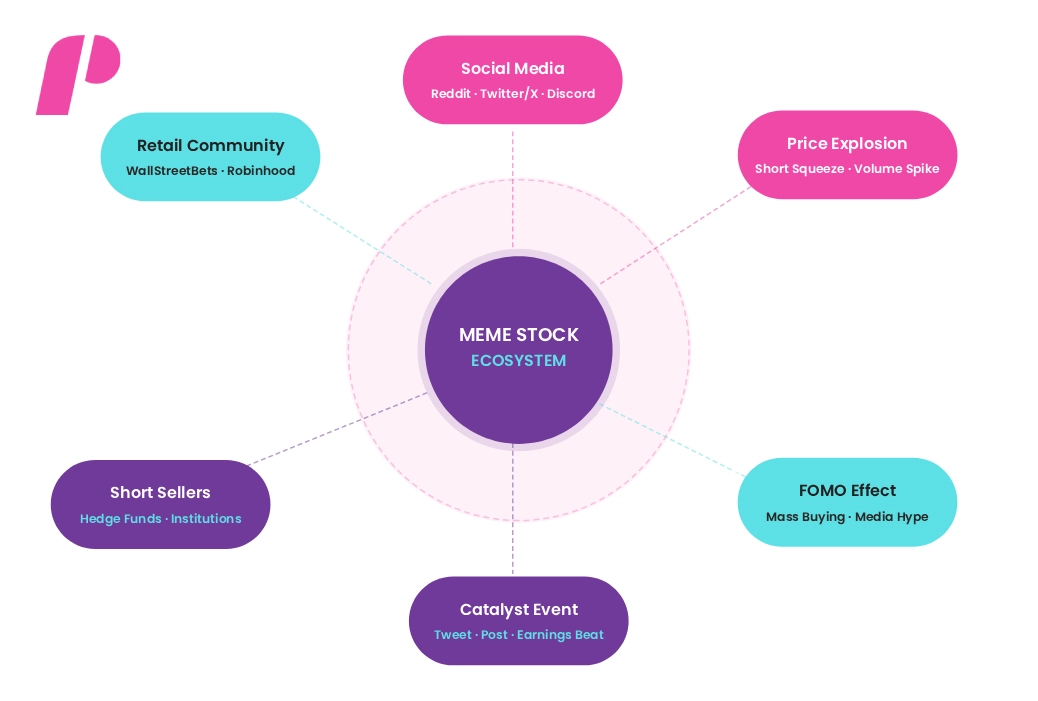
The meme stock definition clearly separates this asset class from traditional value or growth investing. Meme stocks attract buyers through narrative and momentum, not earnings, margins, or cash flow. However, this does not mean every meme stock lacks underlying business substance. Companies like Tesla and Palantir occupy a grey zone—strong communities amplify already volatile price action. Understanding the meme stock meaning helps traders identify entry and exit points far more effectively.
Why Do They Call Them Meme Stocks?
From Stonks to WallStreetBets: The Language of Retail Trading
The name comes directly from internet culture, where memes represent shareable ideas that spread rapidly across platforms. The viral “stonks” meme, an intentional misspelling of “stocks” originating in 2017, became the unofficial symbol of the WallStreetBets trading community. The meme features the character Meme Man standing confidently in front of a stock chart, used to mock overconfident financial decisions. When Elon Musk tweeted
“In January 2021, with a link to r/WallStreetBets, GameStop shares surged 157% in after-hours trading. That moment proved that internet slang and meme culture could directly move real market prices.
Meme stocks carry the same viral characteristic as stonks; they spread through social platforms before mainstream financial media ever reports them. The WallStreetBets community developed its own trading vocabulary: “to the moon” for rising prices, “diamond hands” for holding through volatility, and “paper hands” for portfolio losses. This cultural layer made trading feel participatory and community-driven for millions of new retail investors. Platforms like Robinhood eliminated commissions entirely, government stimulus checks provided fresh capital, and social media coordinated the action, together creating the conditions for the meme stock craze.
How Meme Stocks Start: The Anatomy of a Rally
Identifying the Next Meme Stock Before It Moves
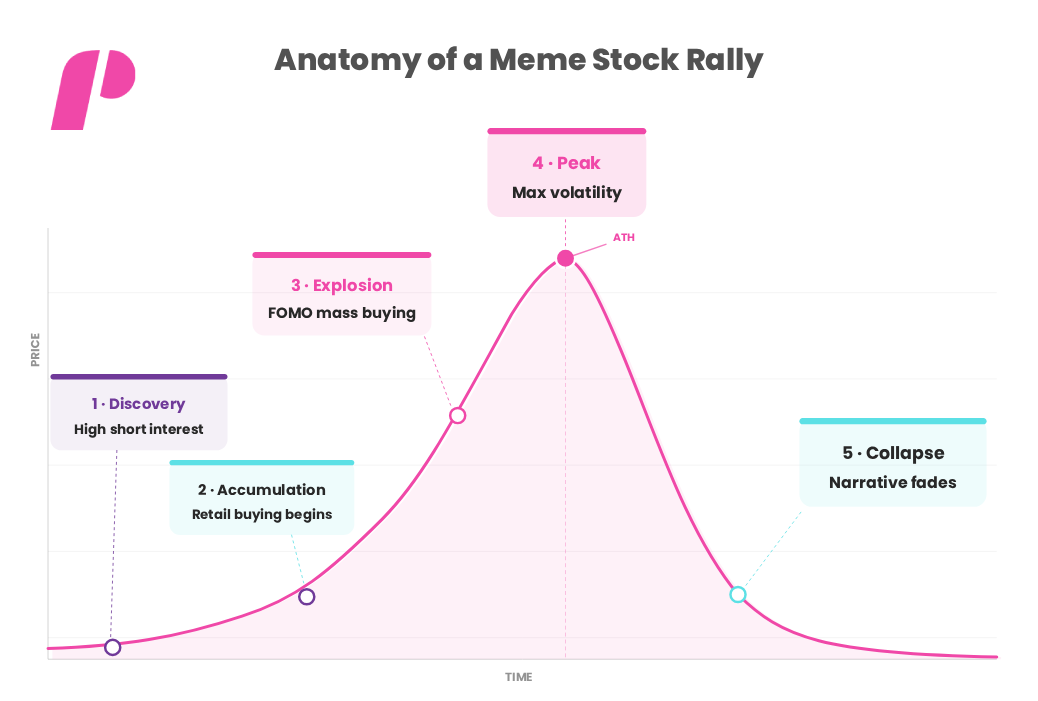
Identifying the next meme stock requires understanding precisely how these rallies begin. A meme stock rally typically starts when an online community identifies a heavily shorted company with weak institutional defense. The community then calls for coordinated buying, targeting the short squeeze mechanism. As prices rise, media coverage amplifies the narrative significantly. New retail buyers then enter on FOMO, accelerating momentum further.
The trigger events vary considerably; a viral Reddit post, a celebrity tweet, or an earnings surprise can all ignite a move. GameStop’s 2021 squeeze began when Reddit users noticed the stock’s short interest exceeded 140% of the free float. They recognized a structural opportunity to force short sellers to buy back shares at dramatically higher prices. This mechanism, the short squeeze, remains the most powerful engine behind meme stock explosions. Traders who recognize this setup early gain a substantial positional advantage over late entrants.
Anatomy of a Meme Stock Cycle: Social Dynamics and Market Evolution
| Stage | Trigger | Community Action | Market Impact |
|---|---|---|---|
| 1 – Discovery | High short interest identified | Reddit/Twitter posts circulate | Low price, minimal volume |
| 2 – Accumulation | Viral post gains traction | Retail buying begins quietly | Price climbs steadily |
| 3 – Explosion | Media coverage amplifies narrative | FOMO drives mass buying | Volume and price spike sharply |
| 4 – Peak | Institutional short sellers cover | Community holds; narrative at peak | Extreme volatility, wide spreads |
| 5 – Collapse | Narrative fades, no new buyers | Retail selling accelerates | Sharp, rapid price decline |
Who Started Meme Stocks? The Role of Keith Gill
Identifying who started meme stocks leads directly to one name: Keith Gill. Keith Gill—known as “DeepFuckingValue” on Reddit and “Roaring Kitty” on YouTube—began posting GameStop analysis in September 2019 with a $53,000 long position, arguing the stock was severely undervalued and over-shorted. By January 2021, his original stake had grown to nearly $48 million as the short squeeze accelerated after repeatedly adding to his position via shares and call options. Gill testified before the U.S. House Financial Services Committee in February 2021, stating simply: “I like the stock.” His story was later dramatized in the 2023 film “Dumb Money.”
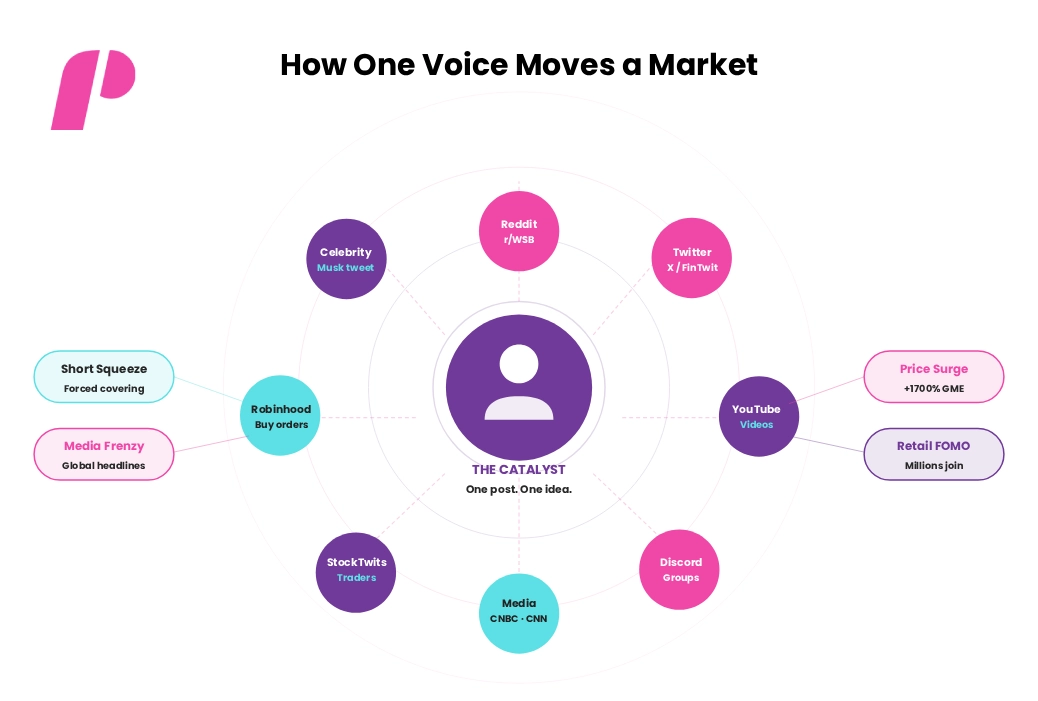
Roaring Kitty’s return to social media in May 2024—his first post in three years—immediately sent GameStop shares up 74% in a single session, halting trading eight times before noon. This confirmed a defining characteristic of meme stocks: a single influential voice can reignite an entire movement at any time. Furthermore, Elon Musk’s “Gamestonk!!” tweet demonstrated how celebrity amplification accelerates retail momentum beyond community-driven forces alone. Together, these events illustrate how meme stock rallies combine grassroots community action with high-profile external catalysts.
Top 10 Most Popular Meme Stocks of All Time
The Definitive Meme Stocks List: From GameStop to AI Names in 2026
Every trader needs a verified, comprehensive meme stocks list to distinguish genuine meme behavior from momentum investing. The following ten stocks represent the most widely recognized meme stocks across the original 2021 wave and the current 2026 cycle. Rankings reflect peak short squeeze intensity, Reddit mention volume, community size, and sustained cultural presence in trading forums. GameStop remains the undisputed king of meme stocks—its 2021 short squeeze redefined retail market power permanently.
The top 10 meme stocks list demonstrates that this phenomenon spans retail nostalgia brands, AI growth stories, and near-bankruptcy comebacks alike. Carvana surged approximately 1,600% in 2023 from near-bankruptcy levels, not stonks and short-squeeze dynamics. SoundHound AI attracts intense retail speculation around AI voice technology, reflecting how meme stock culture now overlaps with the AI investment narrative. Therefore, the meme stock market constantly evolves—new candidates emerge as communities identify heavily shorted stocks with strong narrative potential.
Top 10 Most Popular Meme Stocks of All Time (Verified)
| Rank | Stock | Ticker | Peak Event | Community Driver | Status 2026 |
|---|---|---|---|---|---|
| #1 | GameStop | GME | 1,700%+ Jan. 2021 | r/WallStreetBets / Roaring Kitty | Active — periodic revivals |
| #2 | AMC Entertainment | AMC | ~3,000% to Jun. 2021 | r/WallStreetBets | Active — diluted float |
| #3 | Bed Bath & Beyond | BBBY | ~120% Aug. 2022 | r/WallStreetBets / FinTwit | Bankrupt (2023) |
| #4 | BlackBerry | BB | ~280% Jan. 2021 | r/WallStreetBets | Low activity |
| #5 | Nokia | NOK | ~70% Jan. 2021 | r/WallStreetBets | Low activity |
| #6 | Palantir Technologies | PLTR | AI narrative 2023–26 | Reddit / FinTwit / X | Very Active |
| #7 | Tesla | TSLA | Ongoing since 2020 | Elon Musk / X / Reddit | Ongoing — borderline meme |
| #8 | Carvana | CVNA | ~1,600% in 2023 | Reddit / StockTwits | Active |
| #9 | SoundHound AI | SOUN | AI narrative 2024–26 | Reddit / StockTwits | Very Active |
| #10 | Rivian | RIVN | IPO surge Nov. 2021 | Reddit / EV community | Moderate activity |
Current Meme Stocks: What the Market Watches in 2026
Is PLTR a Meme Stock? Is Tesla a Meme Stock?
The meme stock landscape evolved significantly beyond the 2021 class. Current meme stocks now include technology and AI-adjacent names that attract both retail enthusiasm and speculative momentum in equal measure. Palantir Technologies (PLTR) frequently surfaces in debates about whether AI companies carry meme stock characteristics. Many traders argue that PLTR qualifies—its passionate community and valuation disconnects mirror classic meme stock behavior. However, Palantir also demonstrates genuine revenue growth, which partially separates it from pure meme plays.
Is Tesla a meme stock? This question divides traders sharply every quarter. Tesla occupies a unique market position—driven by Elon Musk’s social media influence and strong retail loyalty, the Tesla stock price frequently moves on narrative alone. However, Tesla’s fundamental scale and earnings power distinguish it clearly from companies like GameStop. Meanwhile, Roaring Kitty’s return in May 2024 confirmed that meme stock dynamics persist well beyond their original cycle. Traders who monitor Reddit and X activity consistently capture early signals on the best meme stocks to buy now.
Current Meme Stocks to Watch in 2026
| Stock | Ticker | Community Base | AI Exposure | Volatility Level |
|---|---|---|---|---|
| GameStop | GME | Reddit / WallStreetBets | Low | Extreme |
| Palantir Technologies | PLTR | Reddit / FinTwit | High | High |
| Tesla | TSLA | Twitter/X, Reddit | Medium | High |
| AMC Entertainment | AMC | Low | High | |
| SoundHound AI | SOUN | Reddit, StockTwits | Very High | Very High |
Who Buys Meme Stocks? The Retail Trader Profile
Why People Buy Meme Stocks Beyond Pure Profit Motives
Understanding who buys meme stocks clarifies why these movements sustain their momentum beyond the initial surge. Retail traders between the ages of 18 and 35 represent the core meme stock buyer demographic globally. Commission-free platforms like Robinhood and Webull dramatically lowered entry barriers for this group. Many buyers enter not for fundamental reasons but for community participation and asymmetric upside potential. Social belonging plays a surprisingly significant role in meme stock purchase decisions at the retail level.
Prop trading firms also monitor meme stocks actively, though their approach differs fundamentally from retail buyers. Prop traders focus on volatility extraction—they trade the momentum itself, not the underlying narrative. Furthermore, institutional desks have deployed real-time social sentiment tools to track Reddit post velocity and options flow simultaneously. Therefore, meme stocks now attract a layered buyer base: retail community members, momentum prop traders, and algorithmic systems. This multi-tier structure dramatically intensifies volatility at critical price levels.
Can You Make Money on Meme Stocks?
Profit Potential vs. Reality: What the Data Shows
Many retail investors ask whether meme stocks generate real, sustainable profits or merely redistribute capital. The answer depends entirely on timing, position sizing, and exit discipline—not luck alone. Keith Gill’s original $53,000 GME position grew to nearly $48 million by late January 2021—one of the most documented retail trading successes in modern history. However, late entrants who bought at peak prices lost 80–95% of their capital within weeks. The meme stock market consistently rewards early movers and ruthlessly punishes those who enter on FOMO.
Many new investors ask how much they need to invest in stocks to make $1,000 a month. Meme stocks do not generate consistent monthly income—they offer episodic, high-risk returns that require active daily management. Prop traders who trade meme stocks apply strict stop-loss rules and typically risk no more than 1–2% of capital per trade. Therefore, meme stock trading works best as a small speculative allocation within a diversified overall strategy. Treating it as a primary income source creates dangerous capital exposure over time.
Meme Stocks and Prop Trading: A Professional Perspective
How Trading Programs and Prop Desks Approach Meme Volatility
Proprietary trading firms approach meme stocks very differently from retail participants entering through community platforms. Prop traders use technical analysis, short interest data, and social sentiment tools to time entries and exits with precision. They rarely hold meme positions overnight during peak volatility phases due to gap risk. Instead, they scalp intraday momentum, profiting from retail-driven surges without directional overnight exposure. This approach requires a sophisticated trading program with real-time data feeds and automated risk management.
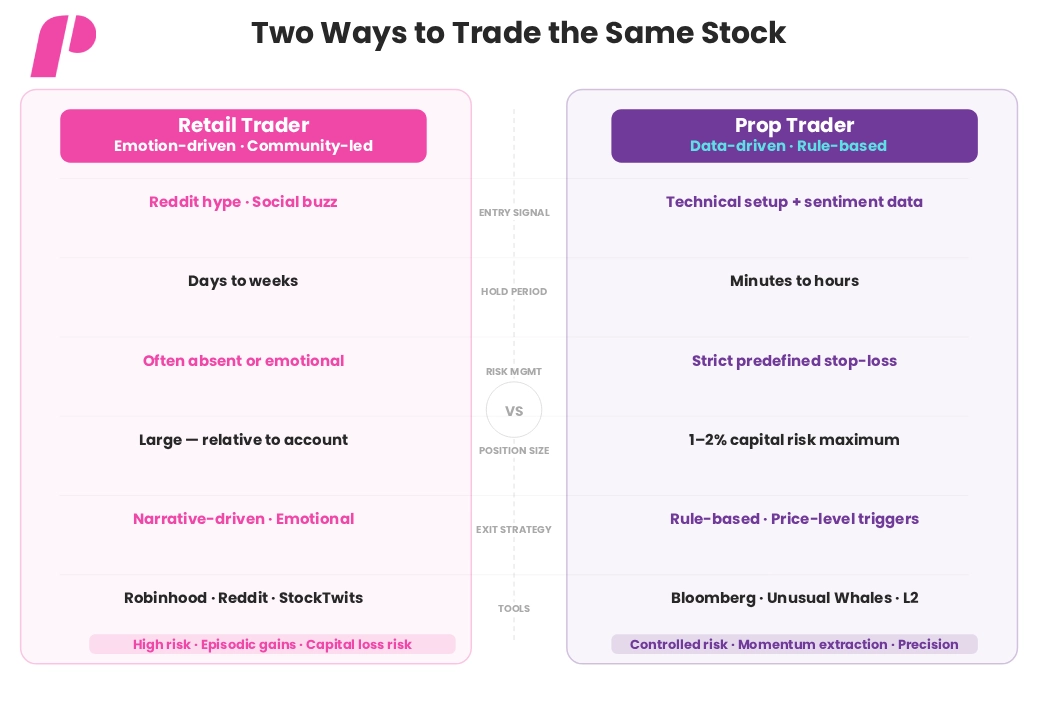 The meme stock market presents both significant opportunities and notable risks for prop trading desks simultaneously. Stock rotation patterns during meme events frequently pull capital away from cyclical stocks and established sector leaders. As retail money concentrates in high-momentum names, broader market correlations shift temporarily. Furthermore, geopolitical events—such as escalating Middle East tensions—amplify general market volatility significantly. Prop traders must actively account for macro risks when sizing positions in volatile meme stocks.
Execution Models: Behavioral Differences Between Retail and Proprietary Traders
| Factor | Retail Trader | Prop Trader |
|---|---|---|
| Entry Signal | Social media hype, Reddit posts | Technical setup + sentiment data |
| Hold Period | Days to weeks | Minutes to hours |
| Risk Management | Often absent or emotional | Strict, predefined stop-loss rules |
| Position Size | Large relative to the account | 1–2% capital risk maximum |
| Exit Strategy | Narrative-driven or emotional | Rule-based, price-level triggers |
| Tools Used | Robinhood, Reddit, StockTwits | Bloomberg, Unusual Whales, L2 data |
Geopolitical Volatility: The Middle East Effect
How Global Risk-Off Events Amplify Meme Stock Price Swings
The ongoing Middle East conflict influences global financial markets through several interconnected channels. Rising geopolitical tensions push institutional investors toward safe-haven assets like gold, US Treasuries, and the dollar. However, this risk-off shift creates meaningful secondary effects across retail-driven markets. When institutional players reduce broad equity exposure, overall market liquidity thins considerably. This thinning directly amplifies the volatility of high-momentum assets—including meme stocks—at critical price levels.
Energy price surges driven by Middle East instability directly affect cyclical stocks and reshape decisions about the best stocks for beginners with little money. Higher energy costs compress operating margins across consumer, industrial, and transportation sectors. Meanwhile, retail traders often rotate into speculative positions—idriven entirely by WallStreetBets momentum winds. Therefore, geopolitical pressure indirectly fuels meme stock activity by redirecting speculative capital toward narrative-driven names. Traders must monitor macroeconomic signals and social media simultaneously during geopolitical stress periods.
Is Meme Trading Legal? What Every Trader Must Understand
SEC Regulation, Market Rules, and Trader Protections
A common concern among new traders involves whether meme stock trading crosses legal boundaries into manipulation. Meme trading is entirely legal when participants buy and sell stocks through regulated, licensed brokers. The SEC investigated certain coordinated trading activity following 2021, but did not broadly criminalize social media-driven retail buying. However, spreading false information to manipulate stock prices—known as a pump-and-dump scheme—constitutes securities fraud. The regulatory boundary between community enthusiasm and illegal manipulation remains an active, evolving legal debate.
Regulatory bodies like the SEC continue monitoring social media trading communities closely, following the GameStop events. The SEC published a detailed 2021 staff report analyzing market structure implications of the craze. The report concluded that retail coordination did not violate existing securities laws in the majority of documented cases. Therefore, participating in these rallies through legitimate buying and selling remains a fully protected market activity. Traders should nonetheless consult a financial advisor before taking concentrated positions in highly volatile securities.
How to Identify a Meme Stock Before the Crowd Arrives
Five Signals Professional Traders Monitor Every Day
Identifying one early requires monitoring several converging, quantifiable signals simultaneously. The most reliable indicator is a rapid increase in Reddit mentions combined with elevated short interest data above 20% of the float. Free tools like Finviz, Market Chameleon, and Unusual Whales track social sentiment and short interest simultaneously. When a stock’s short interest exceeds 20%, and Reddit post volume spikes above 500 mentions per day, a potential setup may be forming. This combination precedes the majority of significant modern rallies.
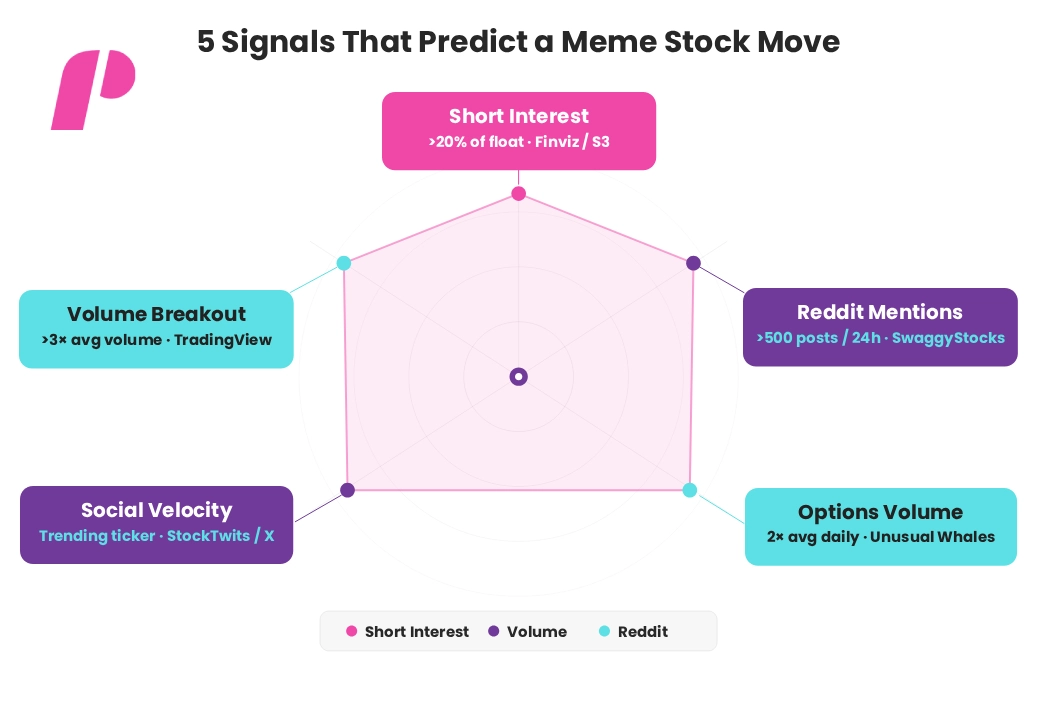
The next meme stock often emerges from sectors experiencing sharp narrative shifts, AI development, biotech breakthroughs, or short-squeezable retail names. Traders who follow WallStreetBets daily, monitor Unusual Whales for abnormal options flow, and track Google Trends for ticker search spikes gain early positional awareness. Furthermore, monitoring the Google stock price alongside broader tech-sector sentiment helps identify when institutional capital rotates into speculative AI names. Consistent application of these signals forms the foundation of a practical meme stock identification framework.
Trading Signals: Detection Tools, Thresholds, and Reliability
| Signal | Best Tool | Threshold | Reliability |
|---|---|---|---|
| Short Interest Level | Finviz / S3 Partners | >20% of float | High |
| Reddit Mention Spike | Swaggy Stocks / TrackTrends | >500 mentions / 24 hrs | High |
| Options Call Volume Surge | Unusual Whales | 2x average daily volume | Medium-High |
| Social Media Velocity | StockTwits / Twitter/X | Trending ticker, top posts | Medium |
| Price-Volume Breakout | TradingView | >3x average daily volume | High |
Should You Buy a Meme Stock? A Practical Framework
Are Meme Stocks Considered Gambling or Strategic Trading?
The decision to buy a meme stock requires honest self-assessment and clearly defined risk parameters in advance. Meme stocks are not suitable for passive, long-term investors who seek stable, predictable returns over time. They function best as a small speculative allocation—no more than 5–10% of a total portfolio. Furthermore, traders should only enter meme positions with capital they can afford to lose entirely. The asymmetric upside potential always accompanies equally asymmetric downside risk at every stage of the cycle.
Some economists argue that meme stocks closely resemble gambling due to behavioral similarities with casino activity. However, informed traders who apply technical analysis and strict risk management distinguish meme trading from pure chance-based gambling. The critical difference lies in systematic, rule-based decision-making versus impulsive emotional buying driven by FOMO. Traders who define entry levels, position sizes, and exit strategies before entering can extract real value from meme momentum. This disciplined approach clearly separates professional meme traders from retail participants acting purely on emotion.
Meme Stocks ETF: Diversifying Your Meme Exposure
The BUZZ ETF and Social Sentiment Diversification Tools
Traders who want exposure to meme stock volatility without single-stock concentration risk can explore ETF-based approaches. The BUZZ ETF (VanEck Social Sentiment ETF) tracks stocks with high positive social media sentiment across multiple platforms simultaneously. This product provides diversified exposure to current meme stocks and high-sentiment equity names in a single vehicle. However, BUZZ’s performance correlates closely with overall market conditions, limiting its effectiveness as a pure play on the phenomenon. It works better as a thematic satellite position than a core portfolio holding.
Broad technology ETFs also provide indirect exposure through significant holdings in names like Tesla and Palantir. Additionally, the best stocks for beginners with little money often include ETFs as a lower-risk method to participate in high-momentum thematic sectors. Stock rotation strategies that shift between cyclical stocks and high-growth technology names may benefit from ETF vehicles during volatile hype phases. Therefore, ETFs offer a well-structured alternative to direct trading for investors with lower risk tolerance or smaller capital bases.

Building Your Watchlist for 2026
How to Structure a Dynamic, Research-Driven Meme Watchlist
A structured meme stock watchlist combines ongoing sentiment screening, technical setup monitoring, and macro market awareness. Traders should maintain a focused list of 8–12 stocks with elevated short interest and active, vocal social media communities. Review this list weekly—removing names where momentum has faded and adding fresh emerging candidates actively. Align the watchlist with broader market conditions, as these assets typically outperform during low-volatility periods. Strong retail participation and ample market liquidity typically fuel the most explosive rallies.
The best meme stocks in 2026 will likely combine AI narrative exposure with traditional short-squeeze mechanics and community loyalty. Names like PLTR, SoundHound AI, and any newly shorted retail stock gaining Reddit traction represent strong watchlist candidates. Meanwhile, tracking macroeconomic signals—including energy price movements influenced by Middle East developments—helps traders anticipate risk-off periods. A dynamic, regularly updated watchlist remains the most practical and actionable tool for capturing these opportunities systematically.
Final Framework: From Scattered Questions to Structured Strategy
Meme stocks transformed from a curiosity into a legitimate and recurring market force that every active trader must understand. This article has moved from definition to identification, from historical examples to current 2026 candidates, and from retail behavior to professional prop trading strategy. The core frameworks—short interest screening, social sentiment monitoring, strict position sizing, and disciplined exits—give traders a structured edge. Geopolitical factors like Middle East tensions add macro volatility layers that affect these cycles, making macro awareness equally critical.
These setups do not reward passive observation—they reward preparation, speed, and discipline. Traders who combine social sentiment data with technical analysis and hard risk limits consistently outperform those who rely on narrative alone. As market conditions evolve through 2026 and beyond, revisit your watchlist, refine your identification criteria, and adjust your allocation accordingly. This highly speculative market continues to exist—and it will continue to reward those who approach it with both analytical rigor and tactical flexibility.
Disclaimer: This article is for informational/educational purposes only and is not financial advice or a guarantee of results. Trade The Pool uses simulated funds for evaluation; becoming a funded trader depends on performance and is not guaranteed. Trading involves risk of loss, and past performance does not indicate future results. Services may be restricted in certain jurisdictions. Always conduct independent research and consult a professional before trading.
If you liked this post make sure to share it!