
Shares outstanding are the silent input behind market capitalization and earnings per share, two figures traders watch daily. If a trader opens a stock quote page, however, the shares outstanding number usually does not indicate its source. A screener, for example, may still carry last quarter’s count and quietly ignore pending dilution.
🔗What Is Market Capitalization?
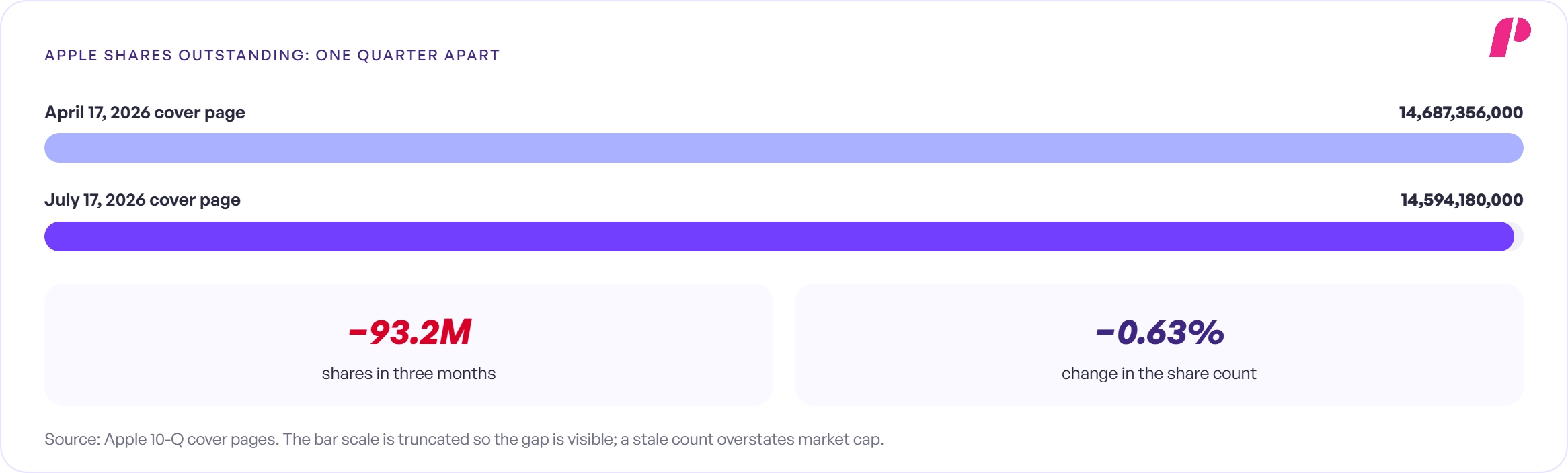
The lag costs more than it seems, because companies change their share counts every quarter. According to Apple’s 10-Q cover sheets, the count was 14,687,356,000 on April 17, 2026, and 14,594,180,000 by July 17. As a result, a trader using the April figure would overstate market cap and understate earnings per share.

The fix, however, needs no accounting degree, no expensive software, and no paid data subscription. It takes one short formula and the habit of opening a company’s latest quarterly filing. Done before each new position, that habit takes a few minutes and closes the blind spot.
For most beginners, meanwhile, the term first appears in a search bar, long before any SEC filing. Their first question is usually simple: what does shares outstanding mean next to a stock’s price? Shares outstanding means all issued shares held by shareholders today, excluding treasury shares the company holds.
🔗What Is a Stock? Definition, Types, and How Stocks Work for Traders
That’s the first thing this guide answers, before moving on to calculating and checking the number. Next, most readers want a company’s figure and ask, “Where can I find shares outstanding?” For example, the count is printed, dated, on the cover sheet of every 10-Q and 10-K on SEC EDGAR.
In contrast to most web pages, this guide considers the share count a trade variable. It covers basic and diluted counts, float, and what buybacks or splits do to the count. The last section gives funded stock traders a short share-structure checklist to run before each trade.
What Traders Will Learn
- What shares outstanding means, and why float and issued shares differ.
- A one-line formula for shares outstanding, tested on a made-up company.
- Why Apple and Nvidia’s 2026 filings list basic and diluted counts.
- The spot on a 10-Q cover page where the count and its date sit.
- What buybacks, offerings, and thin floats mean inside a funded stock account.
What Are Shares Outstanding?
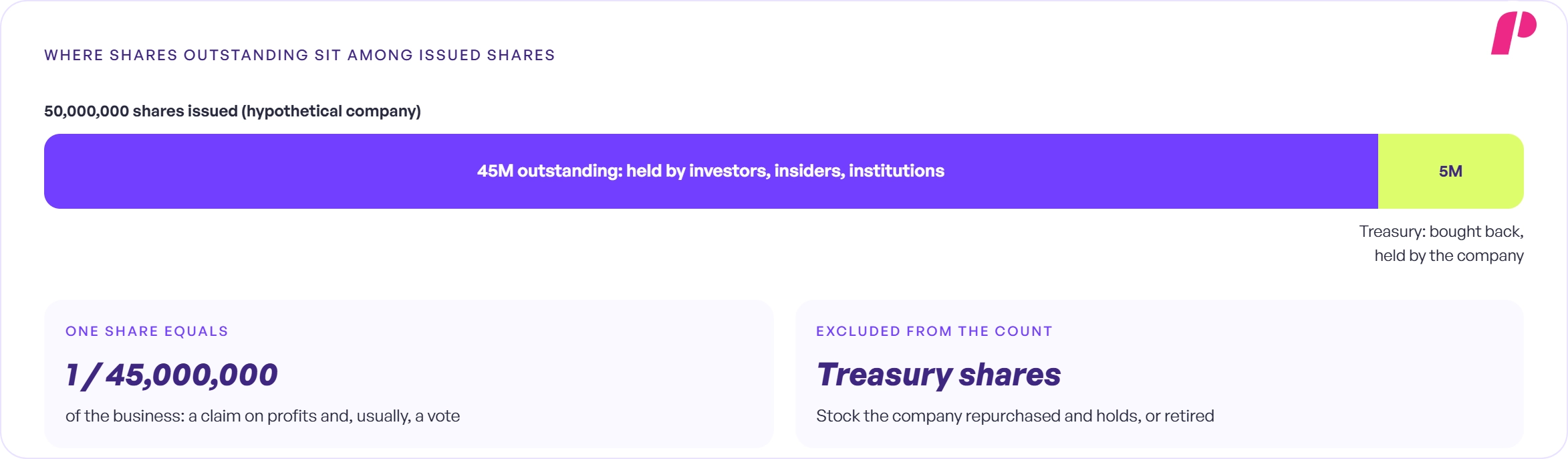
Shares outstanding are all the stock a company has issued that’s still sitting with investors, insiders, or institutions. The novice who reads this would ask, what are outstanding shares, and who holds them? Everyone but the company, however, since stock it buys back goes into treasury or gets retired.
Shares Outstanding Meaning In Plain Terms
Take a business which has 45,000,000 shares outstanding; consequently, each share represents a 45-millionth share of that business. So what is an outstanding share of stock to a trader who owns a few hundred? It is one unit of ownership, with a proportional claim on profits and, usually, a vote.
Common Shares Outstanding Vs. Preferred Shares
Pages that quote stocks almost always show common stock, as that is the kind most investors trade. In contrast, preferred stock is another type investors consider different, hence asking, what are common shares outstanding? Common shares outstanding leaves preferred stock out, and EPS divides profit, minus preferred dividends, by its weighted average.
🔗Earnings Per Share (EPS) Explained
How To Calculate Shares Outstanding
The Shares Outstanding Formula
The shares outstanding formula subtracts treasury shares, the stock a company bought back and holds, from issued shares. However, searching “how do you calculate outstanding shares” brings conflicting answers, some starting from authorized shares. That’s the incorrect starting point: 50 million shares issued minus 5 million shares in treasury equals 45 million shares outstanding.

The Math On One Company
Those 45 million shares feed straight into two numbers traders check: market value and earnings per share. For instance, at a price of $20 per share, the total market value of the company will be $900,000,000. In the same manner, $9,000,000 divided by 45,000,000 shares is $0.20 of EPS.
Weighted Average Shares Outstanding
Share counts move within a quarter too; as a result, companies report an average, not a snapshot. Many people type “how do you calculate weighted average shares outstanding” expecting a messy formula. There isn’t one: traders multiply each count by the fraction of the period it lasted and add them.
Hypothetical Example
| Step | Input | Calculation | Result |
| Shares issued | 50,000,000 | Start | 50,000,000 |
| Minus treasury shares | 5,000,000 | 50,000,000 – 5,000,000 | 45,000,000 shares outstanding |
| Market value at $20 | $20 price | 45,000,000 x $20 | $900,000,000 |
| EPS | $9,000,000 net income | $9,000,000 / 45,000,000 | $0.20 |
| After buying back 5,000,000 | 40,000,000 shares | $9,000,000 / 40,000,000 | $0.225 (up 12.5% on flat profit) |
| 90-day weighted average | 45,000,000 for 60 days; 51,000,000 for 30 days | (45,000,000 x 60 + 51,000,000 x 30) / 90 | 47,000,000 |
Basic Vs. Diluted Shares Outstanding
What Creates Dilution
Basic shares represent the current number of shares, while diluted shares also include the possibility of additional shares that can be issued in future periods. Earnings reports publish both kinds of numbers, and hence there is always curiosity from investors about the difference between basic and diluted shares outstanding. An illustration is that diluted includes all shares that options can issue.
🔗How to Read an Earnings Report
Basic Vs. Diluted Shares In Apple’s 2026 Filing
One of the most heavily traded stocks, even today in mid-2026, Apple had a dilution gap. For the period ending June 27, 2026, Apple reported 14,656,110,000 basic versus 14,714,676,000 diluted shares as its weighted average shares outstanding, resulting in a diluted EPS of $2.02, one cent less than the basic EPS of $2.03.
🔗Apple Earnings Reports Q2 FY2026
How To Find Diluted Shares Outstanding
Nvidia shows a similar gap: 24,190 million basic versus 24,285 million diluted shares, quarter ended July 26. However, finding diluted shares outstanding takes no spreadsheet for either company, just the right page. Both counts sit next to each other in the EPS note of the latest 10-Q filing.
🔗Nvidia Stock Analysis: Can NVDA Own AI, Robotics and Quantum?
Basic Vs. Diluted (Sometimes Called Fully Diluted), From SEC EDGAR 10-Qs:
| Company | Quarter Ended | Basic Weighted Average Shares | Diluted Weighted Average Shares | Gap | Gap % |
| Apple | June 27, 2026 | 14,656,110,000 | 14,714,676,000 | 58,566,000 | 0.40% |
| Nvidia | July 26, 2026 | 24,190,000,000 | 24,285,000,000 | 95,000,000 | 0.39% |
Shares Outstanding Vs. Float, Issued, And Authorized Shares
Authorized And Issued Shares
Four related counts describe a company’s stock, and each one answers a different question for traders. Beginners often ask, are authorized shares the same as outstanding shares, or just another name for them? No: authorized shares are only a legal ceiling; therefore, companies usually have far fewer shares outstanding.
Treasury Stock And Outstanding Shares
Meanwhile, buybacks create another difference, one which confuses many traders who analyze the balance sheet. Traders ask, do outstanding shares include treasury stock, and what is the difference between issued and outstanding shares? Outstanding shares never include it, while issued shares still count every repurchased share held in treasury.
Float Vs. Shares Outstanding
A big share count looks reassuring; however, insider and restricted shares rarely reach the open market. Day traders who watch float closely often ask, ” Are shares outstanding the same as float? Not quite, since float only counts freely tradable shares and usually comes in below the outstanding total.
🔗Stock Float Explained
The Four Share Counts, Largest To Smallest:
| Share Type | What It Means | Includes Treasury Shares? | Freely Tradable? | Where to Find It |
| Authorized | Charter maximum | N/A | No | Balance sheet, equity note |
| Issued | Shares sold or granted | Yes | Not all | Balance sheet equity |
| Outstanding | Issued minus treasury shares | No | Mostly | 10-Q cover page |
| Float | Outstanding minus insider and restricted shares | No | Yes | Data providers |
How To Find Shares Outstanding And What Changes The Count
Reading The 10-Q Cover Page
All American corporations filing with the SEC publish share counts on the cover pages of 10-Qs and 10-Ks. Beginners searching “how do you find the number of shares outstanding” often land on paid data sites. However, EDGAR is free: a trader searches the ticker and reads the latest cover page.
Apple And Nvidia Share Counts In 2026
Two 2026 filings show how precise, or rounded, and how dated cover page figures can be. How many outstanding shares does Apple have, and how many does Nvidia have? Well, Apple had 14,594,180,000 on its cover page as of July 17, 2026; Nvidia, on the other hand, said 24.1 billion on theirs as of August 21.
Buybacks, Offerings, And Splits
A stock buyback decreases the number, a stock issuance increases it, and a reverse stock split combines stocks. Repurchase headlines lead plenty of traders to ask, do stock buybacks increase the stock price? A buyback can lift EPS by shrinking the count; however, it can’t promise a higher share price.
🔗Stock Buybacks Explained
Cover Page Counts, SEC EDGAR 10-Qs:
| Company | Latest Cover Page Count | As-of Date | Previous Cover Page Count | Change | Main Driver |
| Apple | 14,594,180,000 | July 17, 2026 | 14,687,356,000 (April 17, 2026) | -93,176,000 (-0.63%) | Buybacks (215M shares, nine months to June 27) |
| Nvidia | About 24.1 billion | August 21, 2026 | About 24.2 billion (May 15, 2026) | About -0.1 billion (rounded) | Buybacks (94M shares, quarter to July 26) |
🔗Stock Splits and Reverse Splits Explained
Using Shares Outstanding In A Funded Stock Account
Market Cap And EPS Checks Before A Trade
Traders in a funded stock account use the share count to check valuation before they commit capital. A practical question follows: how do shares outstanding affect market cap when the price stays flat? Market cap equals price times shares outstanding; therefore, a falling count lowers market cap at a flat price.
Low Float Stocks And Volatility Risk
Float matters just as much in small caps, where restricted insider holdings can be large. Traders often wonder: does a low share count mean a stock will move faster than others? A low float can raise volatility; however, it never tells a trader which direction price will move.
🔗How to Trade Small Cap Stocks in 2026
A Four-Step Share Structure Checklist
Many funded traders skip share structure, yet one surprise offering can push the account toward its drawdown limit. Investor.gov, the SEC’s investor site, warns that investors may lose money from price swings after reverse stock splits. As a result, disciplined traders run the four short steps below before every new position.
🔗Risk Management in Stocks: A Complete Guide 2026
Share Structure Signals:
| Share Structure Signal | What It Means | Possible Trading Impact | Pre-Trade Action |
| Rising share count | Stock dilution | EPS may lag profit | Compare two cover pages |
| New offering (S-3 or 424B) | More shares may reach market | Price gap risk | Reduce position size |
| Reverse stock split announced | Fewer, pricier shares | Volatility afterward | Read the 8-K first |
| Float far below shares outstanding | Few shares trade freely | Sharper two-way moves | Size to loss limit |
| Wide basic-diluted gap | Large pending dilution | Pressure on diluted EPS | Use diluted EPS |
Confirm Program Rules On The Program Terms Page.
- Check the latest share count and its as-of date on the 10-Q cover page
- Set float beside shares outstanding to see how much of the stock trades
- Look at basic and diluted counts in the newest earnings report for dilution
- Skim recent 8-K, S-3, and 424B filings for any offering or reverse split
Shares Outstanding: The Short Version For Traders
Shares outstanding look like a constant value, but buybacks, grants, and offerings make the count vary quarterly. Certain investors still ask: is it better for a firm to have more or fewer shares outstanding? However, neither wins on its own: a smaller count doesn’t make a stock cheaper when total value holds.
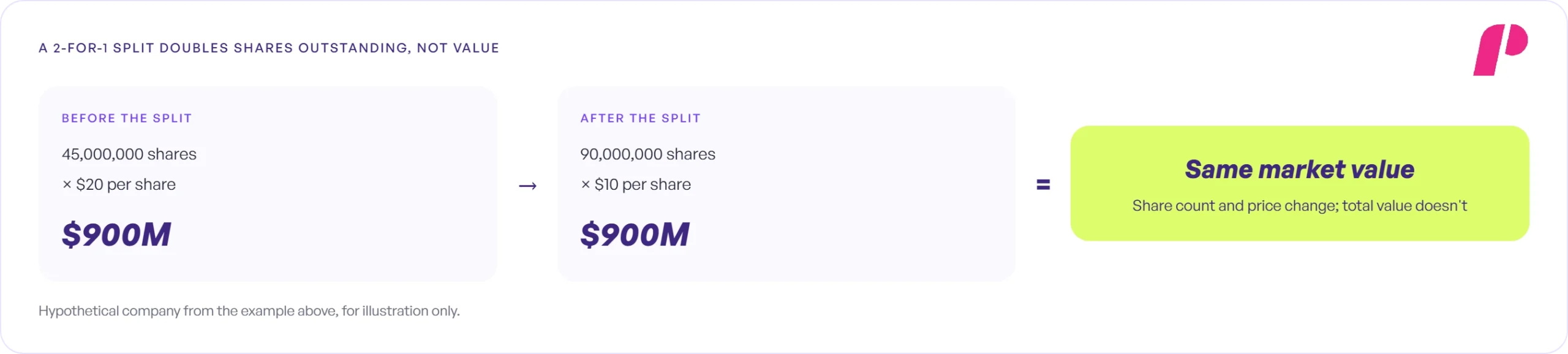
Meanwhile, traders keep the method simple, subtracting treasury shares from issued shares and then checking EDGAR. Every big split brings back the question of whether a stock split changes a company’s value. It doesn’t, since a split changes the share count and price per share, not total market value.
🔗Swing Trading Risk Management
Furthermore, quarterly lineups of basic, diluted, and float numbers provide traders with a more accurate picture of valuation. The practice goes alongside charting, previewing of earnings, and position sizing within a regular trading strategy. It will also give traders an anchor point when sitting down to evaluate each trade.
Traders ready to run this checklist with real buying power can look at the Trade The Pool funded stock program. Reading the program rules first makes sense, and then this check can become part of every pre-trade routine.
If you liked this post make sure to share it!