Prop trading can be found in two completely different areas: jobs at trading firms and advertisements for funding on the internet. Beginners who see both ask the same question: what is prop trading, and who supplies the money? In both cases, a trader buys and sells with a firm’s capital under the firm’s rules.
At an institutional firm, the trader usually risks no personal money. However, a retail trader pays an evaluation fee before placing a single trade. Therefore, the payout rules matter more than the account size shown in an ad.
Can Traders Prop Trade Stocks?
Many stock traders assume retail funding programs exist only for forex and futures accounts. That assumption leads to a common search: can traders prop trade stocks under a funded program? Yes; stock prop firms such as Trade The Pool fund traders in US stocks and ETFs.
The program, revised on April 26, 2026, provides for paying traders 70% of their eligible profits from FLEX and MAX. In case a trader receives $300, he will be entitled to $210 after two weeks.
Stock prop trading also carries an earnings rule, because results released after hours can gap a stock sharply. As a result, Trade The Pool bars overnight positions in reporting companies during earnings season.
What This Guide Covers:
- Why prop trading means one thing at a bank and another in a retail program.
- The four steps from evaluation fee to first payout at Trade The Pool.
- Where prop firms earn their revenue, and how far regulation reaches.
- What a 70/30 split pays in dollars, and how many traders reach a payout.
- How FINRA’s 2026 margin rule changes the case for stock prop trading.
What Is Prop Trading?
Prop trading means trading with a firm’s own capital, and the firm keeps or shares the resulting profit. Beginners then ask what a prop firm is, since most already trade through a broker. The difference is that the prop firm trades using its own money, while the broker earns its commission from trading.
🔗 Stock Prop Firms: Evaluation, Funding, Profit, and Payout Rules Explained
Institutional Vs Retail Prop Trading
Thus, for the trader to raise financing, he must first determine what trading model suits his career path. This decision is based on one question: what is the difference between institutional and retail prop trading? Institutional firms usually hire traders as salaried staff, while retail programs charge an evaluation fee and split profits.
🔗 Types of Prop Firms Explained
Proprietary Trading Comparison
| Proprietary Trading Feature | Institutional Prop Trading | Retail Prop Trading |
|---|---|---|
| Trader Classification & Personnel | Employed firm professionals and quantitative traders | Independent retail traders |
| Trading Capital Source | Firm’s dedicated live capital | Typically simulated or virtual funded capital |
| Upfront Cost to Trader | Usually none (employer-provided) | Required evaluation or challenge fee |
| Compensation & Revenue Share | Base salary plus performance-based bonus | Performance-based profit split payout |
| Key Operational & Regulatory Limits | Strict regulatory restrictions (e.g., Volcker Rule for commercial banks) | Specific proprietary program rules and drawdown parameters |
General comparison; terms vary by firm.
The Volcker Rule And Bank Prop Trading
As a result of the 2008 crisis, the Dodd-Frank Act of 2010 restricted bank proprietary trading. What is the Volcker Rule, and why does it matter for bank prop trading? The Federal Reserve says it generally prohibits banking entities from proprietary trading, with compliance required by July 21, 2015.
How Prop Trading Works For Stock Traders
From Evaluation To Funded Account
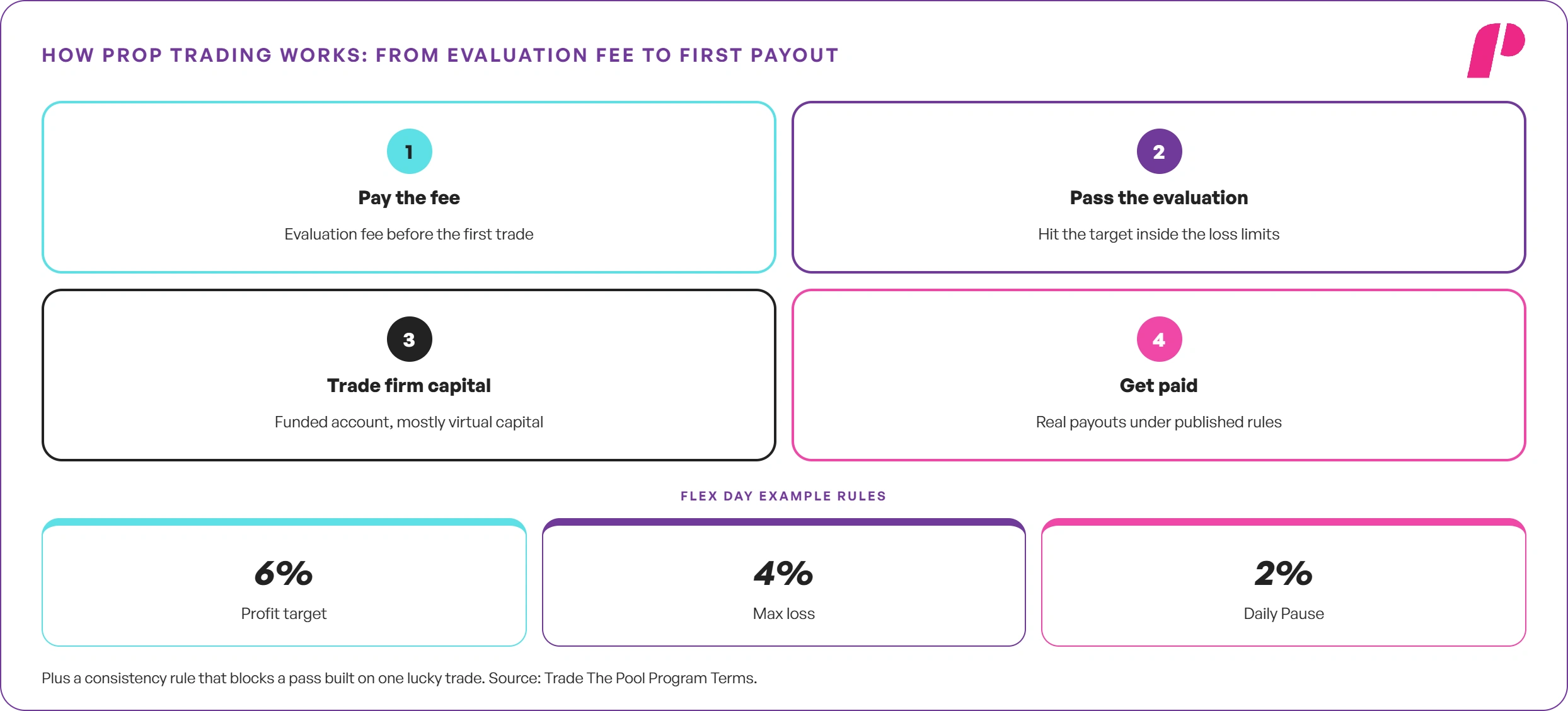
Retail prop trading works like a qualifying round, because the firm reviews a trader’s results before releasing capital. Newcomers therefore want two answers: how does prop trading work, and do prop traders use their own money? No; a trader pays an evaluation fee, passes the test, and only then trades the firm’s capital.
🔗 Funded Trading Evaluation Process
Retail Proprietary Trading Program Workflow
| Program Step | Process & Operational Stage | Trade The Pool Specific Example |
|---|---|---|
| Step 1: Program Selection | Select appropriate trading style and funded account size | FLEX or MAX programs; day trading or swing trading styles |
| Step 2: Evaluation Challenge | Achieve profit targets while respecting maximum drawdown limits | FLEX Day Program: 6% profit target with a 4% max loss limit |
| Step 3: Funded Account Activation | Live funded account provision following performance review | 70/30 profit split payout structure |
| Step 4: Profit Payout Requests | Comply with withdrawal conditions and eligibility rules | 14-day request cycle with a $300 minimum profit threshold |
Prop Trading Rules
A firm caps its losses before sharing profits, and its consistency rule blocks a pass built on one lucky trade. Traders preparing for an evaluation usually ask what rules prop traders follow before and after funding. On FLEX Day, for example, the target is 6%, the max loss is 4%, and the Daily Pause is 2%.
Virtual Capital And Real Payouts
Many beginners assume a funded balance sits in a real brokerage account under their own name. Is a funded account real money, or does the firm use simulated capital for retail traders? Most retail funded accounts use virtual capital; however, the firm pays real payouts under its published rules.
🔗 What Is a Funded Stock Account?
How Prop Firms Make Money
Profit Share And Evaluation Fees
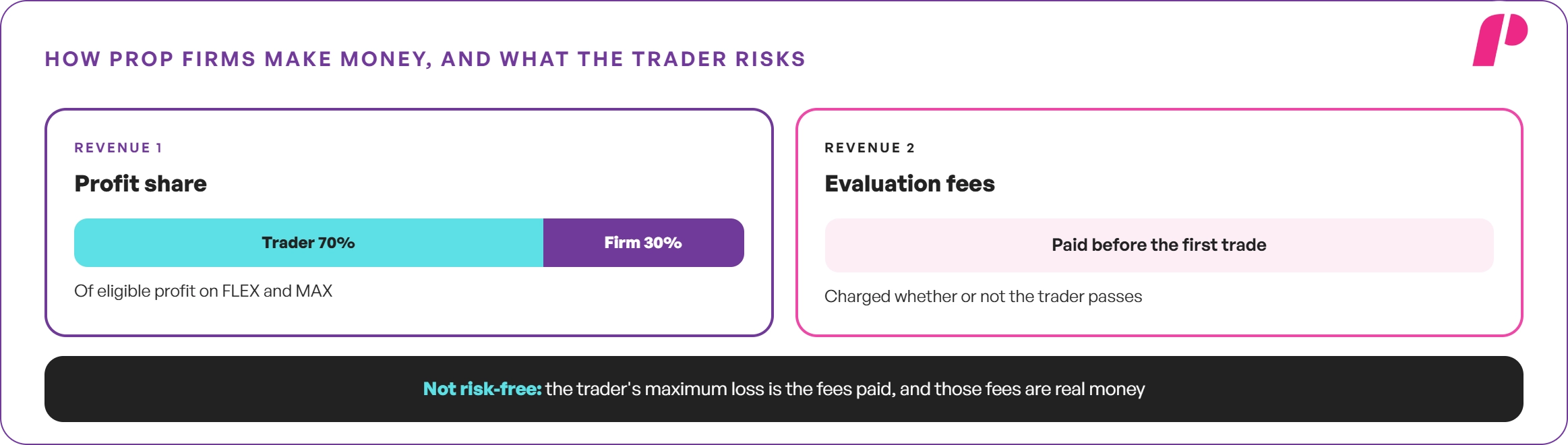
Retail prop firms earn money in two main ways, and both appear in their published terms. How do prop firms make money from traders who join their stock programs? They keep part of eligible profit, for example, 30% on Trade The Pool’s FLEX and MAX, and charge evaluation fees.
Proprietary Trading Revenue Models
| Revenue Source & Stream | Operational Mechanism & Description | Trade The Pool Specific Example |
|---|---|---|
| Trader Profit Share & Splits | Firm retains a percentage share of all eligible trading profits | 30% firm retention on both FLEX and MAX funded programs |
| Evaluation & Challenge Fees | Upfront fees paid by traders to attempt funded account evaluations | $47.00 to $1,475.00 for standard day-trading evaluations |
Is Prop Trading Risk-Free?
Because the firm supplies the capital, many advertisements present prop trading as trading without personal risk. Is prop trading risk-free for a trader who pays a fee to start an evaluation? No; it caps personal losses at the fees paid; however, those fees are real money that traders can lose.
🔗 Is It Risk-Free to Trade With a Prop Firm?
What Prop Trading Is Not
Prop trading is always presented together with day trading and hedge funds, thus confusing three distinct concepts. Traders wonder whether prop trading can be called the same thing as day trading, and what about hedge funds? No; a day trader can trade personal or firm capital, while a hedge fund invests money from outside clients.
🔗 Prop Trading vs Other Finance Jobs
Is Prop Trading Legit And Regulated?
Registration Is Not Regulation
Many traders, however, assume a prop firm faces broker-style oversight, because both businesses handle trading accounts. Is prop trading regulated in the United States the same way as a stock broker? No; DailyForex notes that US prop firms are registered companies but not regulated, since evaluations run on demo accounts.
🔗 What Are the Risks of Trading With a Prop Firm?
Is Prop Trading A Scam?
In May 2025, a judge dismissed a CFTC fraud case against a forex prop firm over agency misconduct. That outcome settled nothing for traders who still wonder whether prop trading is legit or a scam. Because the judge never ruled on the business model, the answer therefore depends on each firm’s rules and payout record.
How To Check A Prop Trading Firm
A short checklist turns that principle into action, and traders can complete it before paying any fee. Each trader should compare published rules, payout terms, fees, and account type across several firms. Firms that publish dated terms, as Trade The Pool does, therefore make that comparison faster to verify.
- The firm publishes its full rules with a “last updated” date.
- The firm states the payout split, cycle, and minimum in numbers.
- The firm lists every fee clearly before checkout.
- The firm states whether accounts use virtual capital.
- The firm publishes typical payout processing times.
🔗 How to Check a Prop Firm Before Buying
How Much Prop Traders Make And How Many Succeed
The Profit Split Math
Earnings in retail prop trading depend on two numbers: the eligible profit and the published profit split. How much do prop traders make when they trade a funded stock account? At a 70/30 split, for example, $3,000 of eligible profit pays the trader $2,100 and the firm $900.
Proprietary Trading Profit Split Distribution
| Eligible Trading Profit Tier | Trader Share Payout (70%) | Firm Retention Share (30%) |
|---|---|---|
| $1,000.00 Eligible Profit | $700.00 trader payout | $300.00 firm share |
| $3,000.00 Eligible Profit | $2,100.00 trader payout | $900.00 firm share |
| $5,000.00 Eligible Profit | $3,500.00 trader payout | $1,500.00 firm share |
Illustration only, before fees and taxes.
What The Success Data Shows
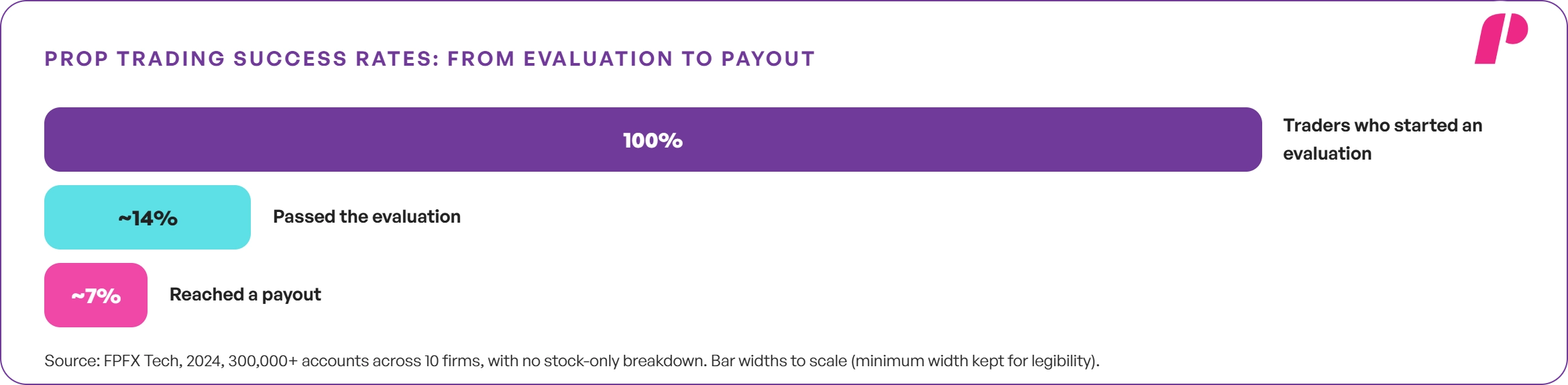
However, a single example says little about the odds, since most traders stop before the payout stage. What percentage of prop traders succeed after paying for an evaluation and starting the process? FPFX Tech data from 2024, covering 300,000+ accounts, showed about 14% of traders passed and 7% reached a payout.
🔗 Trading Challenge: Pass Rates and Rules
Can Beginners Make A Living From Prop Trading?
The FPFX Tech data covered 10 firms without a stock-only breakdown, so stock results may differ. However, the main question for beginners stays the same: can a beginner make a living from prop trading? Few traders earn a living from prop trading, because most never pass and payouts require consistent, rule-based results.
Prop Trading In 2026: The Pdt Change And How To Start
The End Of The $25,000 Rule
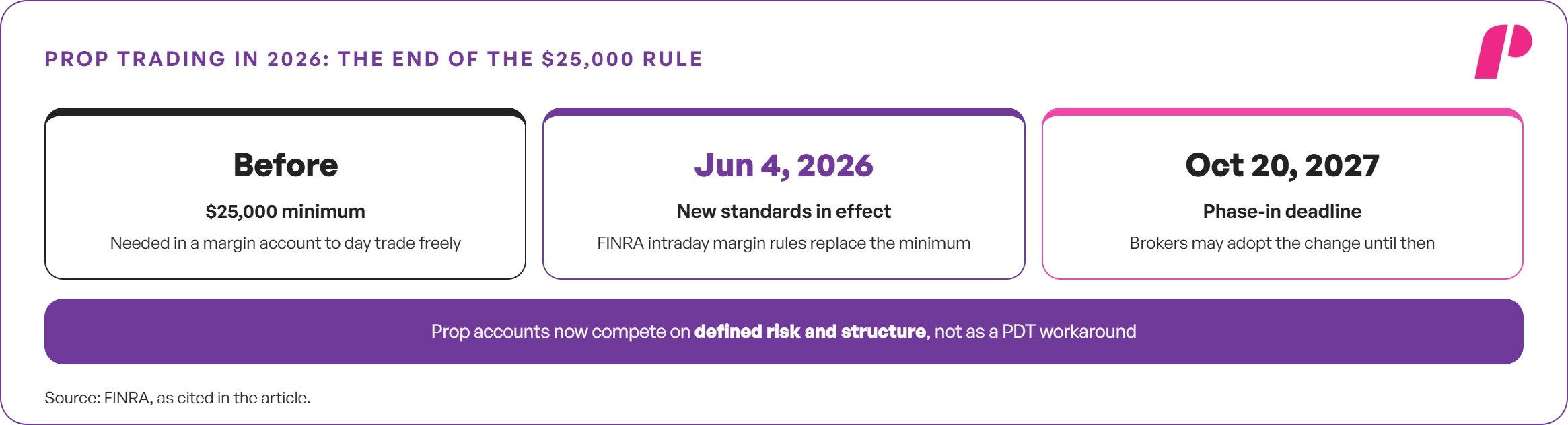
For years, small stock traders needed $25,000 in a margin account to day trade freely. Do day traders still need $25,000 to trade stocks actively in the United States? Not under FINRA’s intraday margin standards, effective June 4, 2026; however, brokers may phase them in until October 20, 2027.
🔗 What Is the Pattern Day Trader Rule?
What Prop Trading Still Offers Stock Traders
Older guides sold prop trading as the main route around that rule, so the pitch now needs updating. Do prop firms still help stock traders avoid the PDT rule after FINRA’s 2026 change? FINRA’s rule drops the $25,000 minimum; therefore, prop accounts now offer defined risk and structure, not a workaround.
How To Become A Prop Trader
The path into prop trading depends on a trader’s goals and the type of firm. Many readers ask how to become a prop trader without a finance degree or bank job. Institutional firms hire through interviews, and retail programs, for example, Trade The Pool, fund traders who pass an evaluation.
Trade The Pool Program Terminology & Published Rules
| Trade The Pool Term & Metric | Published Value & Parameter | Source Documentation Reference |
|---|---|---|
| Trader Payout Split | 70% trader / 30% firm split on FLEX and MAX programs | Program Terms (April 26, 2026) |
| Payout Request Cycle | Every 14 days | Program Terms documentation |
| Minimum Profit Threshold | $300.00 standard ($150.00 on $5,000 accounts) | Program Terms & official program page |
| FLEX Day Program Rules | 6% profit target, 4% max loss limit, 2% Daily Pause | Official program page |
| Earnings Season Restrictions | Strictly no overnight holds on reporting companies | Program Terms documentation |
Prop Trading: Key Takeaways For Stock Traders
Prop trading gives a stock trader access to a firm’s capital in exchange for following the firm’s rules. In retail programs, the trader pays an evaluation fee, and payouts start only after funding.
Nonetheless, according to the 2024 FPFX Tech numbers, just 7% of traders were able to hit a payout. A trader needs to consider rules, commission, and payouts before he pays for a service since changing brokers comes at zero cost.
In addition, a stock trader will not benefit much from having a big account if his program does not include his stocks. A firm that dates its terms and states its split in numbers makes that review simpler.
Meanwhile, FINRA’s new margin standards let accounts under $25,000 day trade at brokers that have adopted them. Day trading access no longer requires a prop firm, so prop trading now competes on its rules and payout terms.
Each evaluation also tests whether a trading plan holds up under fixed daily and total loss limits. Traders interested in stock prop trading can compare FLEX and MAX evaluations on the Trade The Pool programs page. Reading the Program Terms in full before purchase shows every rule and payout requirement in one place.
If you liked this post make sure to share it!