
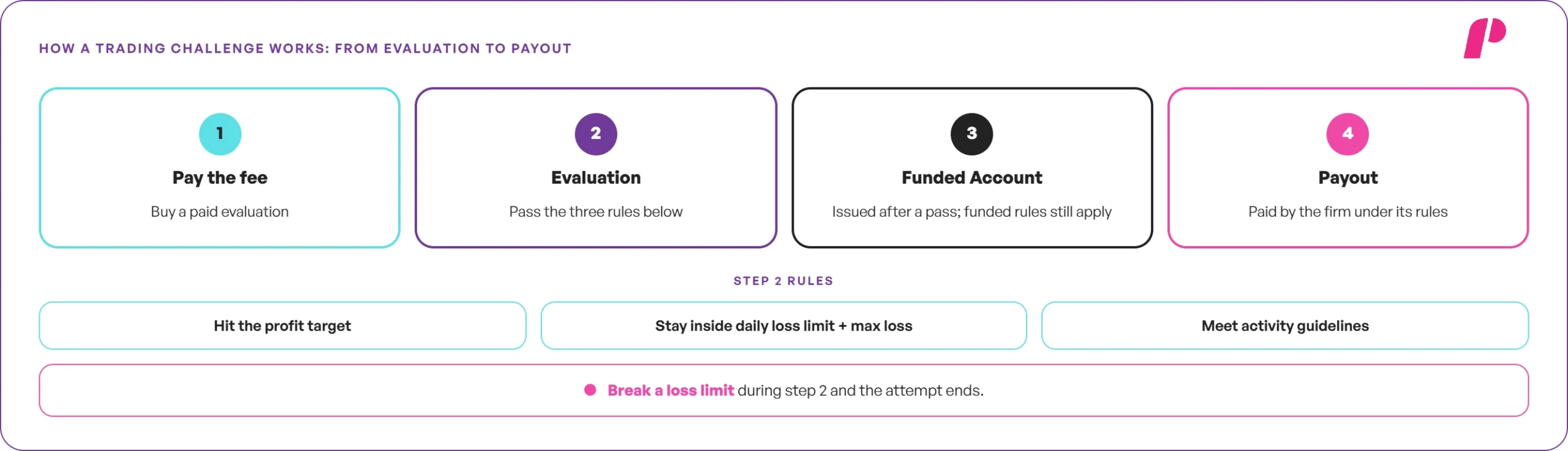
A trading challenge looks simple on paper: hit a profit target, respect the rules, get funded. So what is a trading challenge, and why do so many stock traders buy one? It is a paid evaluation in which a trader hits a target and, meanwhile, never breaks a loss limit.
Many traders fail once and buy another attempt right away, usually with the same habits. The sizing mistakes come along too, and every new fee makes the lesson more expensive.
As a result, a trader can spend hundreds of dollars before learning which rule ended each attempt. This guide considers the issue as a test of risk management rather than one of market predictions.
It provides an explanation of the rules, expenses, success rate, and strategy based on loss limitation. It also covers what follows a pass, because passing is only the middle of the journey.

Understanding Pass Rates And The Real Cost Of Challenges
Furthermore, most beginners ask one practical question before paying for a first stock trading challenge. So what percentage of traders pass a prop firm challenge on a typical attempt? An FPFX Tech study of more than 300,000 accounts found that about 14% of traders passed.
The sample included about 100,000 participants from 10 companies, but only 7% of them managed to earn a reward. In that particular study, every participant spent about $800 on an average of three challenges.
The above numbers do not devalue challenges; however, they show why planning is necessary before taking action. Most of the best-selling books on the subject are meant for forex and futures traders and not stock traders.
In contrast, this one is built for stock traders and leans on Trade The Pool’s published rules. It closes with what a funded account involves, including FINRA’s 2026 change to the $25,000 rule.
What This Guide Covers:
- How a trading challenge works, in plain terms.
- The rules that decide whether an attempt passes or fails.
- What a stock trading challenge costs and how long it takes.
- Why most traders fail, with real pass-rate data.
- What happens after a pass, from payouts to the 2026 PDT change.
What Is A Trading Challenge?
A trading challenge works like an audition, because the firm wants proof of risk control before funding anyone. How can this prop firm challenge be addressed for a trader seeking capital? It is important to note that a trader has to achieve a certain level of profit without exceeding the daily loss limit, maximum loss, and activity guidelines.
🔗 Stock Prop Firms: Evaluation, Funding, Profit, and Payout Rules Explained
Is The Money In A Trading Challenge Real?
New arrivals see a dashboard that is funded and presume that there is a real brokerage account. So is the money in a trading challenge real, or does the account run on simulated capital? Most funded accounts trade virtual capital; as a result, payouts come from the firm under its rules.
🔗 What Is a Funded Stock Account?
Trading Challenge Vs Student Stock Market Challenge
The same name also appears in schools, where students compete with virtual portfolios for rankings and prizes. Readers often ask, What is a stock market challenge for students, and how does it differ? For example, Junior Achievement ran a free team simulation with no funded account or payout split.
Trading Challenge Rules: Targets, Loss Limits, And Consistency
The Profit Target
Every trading challenge starts with one number: the profit a trader must reach before the evaluation ends. So what is a profit target in a trading challenge at a stock prop firm? Trade The Pool’s program page lists 6% for day programs; in contrast, swing programs require 15%.
Daily Loss Limit Vs Max Loss
Loss rules matter more than the target, because breaking one ends the attempt. Traders often ask, what is a daily loss limit, and how does it differ from max loss? The daily limit, the Daily Pause at Trade The Pool, caps one day; meanwhile, max loss sets the total floor.
Consistency Rules And Minimum Positions
However, some traders hope one large winner on a volatile day will carry them past the target. So what is a consistency rule, and can a trader pass with one big trade? Most programs block that shortcut, because consistency ru-les cap how much one trade can count toward the target.
🔗 Prop Firm Consistency Rules Explained
Trade The Pool Program Parameters
| Evaluation Program | Profit Target | Max Loss Limit | Daily Pause Threshold | Minimum Positions | Time Limit |
|---|---|---|---|---|---|
| FLEX Day Program | 6% | 4% | 2% | 10 positions | Unlimited |
| MAX Day Program | 6% | 3% | 1% | 20 positions | 60 days |
| FLEX Swing Program | 15% | 7% | 3% | 5 positions | Unlimited |
| MAX Swing Program | 15% | 7% | 3% | 5 positions | 100 days |
Trading Challenge Types, Time Limits, And Costs
One-Step Vs Two-Step Challenges
Challenges also differ in structure, since some firms use one evaluation phase and others use two. A two-step challenge adds a second target, so the trader must repeat the result before funding. In contrast, Trade The Pool uses one evaluation stage, then issues a new funded account.
🔗 Types of Prop Firms Explained
What A Stock Trading Challenge Costs
Different programs have different costs and restrictions in terms of time, so both should be considered when choosing a size. Usually, the questions asked by readers include: What is the cost of participating in a stock trading competition? How much time does it take? FLEX Day runs $47 to $1,475; for example, MAX Day allows 60 days, while FLEX sets no limit.
FLEX Day prices are as listed on October 4, 2026. The page shows two prices per size, so check it before buying.
Trade The Pool FLEX Day Account Pricing
| FLEX Day Account Size & Capitalization | Listed Evaluation Prices (Standard / Discounted Tiers) |
|---|---|
| $5,000 Capitalization Tier | $59 / $47 |
| $25,000 Capitalization Tier | $120 / $97 |
| $50,000 Capitalization Tier | $285 / $230 |
| $100,000 Capitalization Tier | $545 / $435 |
| $200,000 Capitalization Tier | $1,475 / $1,100 |
Is There an Easy Trading Challenge?
However, marketing tends to promise an easy route, while each program trades one rule against another. So what is the easiest prop firm challenge to pass for a small-account stock trader? No challenge is easy for every trader, because a looser rule in one place usually means a tighter rule elsewhere.
Trading Challenge Pass Rates and Why Traders Fail
What the Pass-Rate Data Shows
The FPFX Tech study tracked more than 300,000 accounts, which makes it a broad multi-firm sample. Furthermore, about 45% of funded traders reached a payout, equal to about 7% of everyone. The average payout equaled roughly 4% of plan size, a modest figure next to typical targets.
FPFX Tech multi-firm study, more than 300,000 accounts.
Proprietary Trading Funnel Conversion Metrics
| Evaluation Stage & Performance Milestone | Trader Conversion Share & Average Yield |
|---|---|
| Challenge Completion Stage | About 14% of participating traders successfully pass the evaluation challenge |
| Funded Payout Milestone | About 7% of traders reach an actual funded profit payout |
| Average Payout Yield | About 4% of total funded account plan size per successful distribution |
Why Most Trading Challenge Attempts Fail
Failed attempts often end at a loss limit, not the deadline, because oversized trades drain the buffer. For example, on MAX Day the max loss is 3%, exactly half of the 6% profit target. As a result, two or three oversized losses can end an attempt well before the target.
Are Trading Challenges Worth It?
Meanwhile, critics call challenges a fee business, while supporters see a route to buying power. Nonetheless, are these difficulties associated with trading a form of deception, or do they actually provide good value to the trader who is willing to follow the discipline? A trading challenge is a business deal that has certain rules that determine its value.
🔗 Is It Risk-Free to Trade With a Prop Firm?
How To Pass A Trading Challenge
Size Every Position Against The Max Loss
Passing starts with position size, because the max loss sets the real budget for every trade. For example, on a $50,000 FLEX Day account, the 4% max loss equals a buffer of $2,000. Risking $250 per trade allows eight full losses, while risking $500 allows only four full losses.
🔗 Position Sizing in Forex & Stocks
Hypothetical example; assumes each loss hits the full stop.
Position Sizing & Risk of Ruin Modeling
| Risk Per Trade Allocation & Percentage | Consecutive Full Losses Before Reaching $2,000 Max Drawdown Limit |
|---|---|
| $125.00 per trade (0.25% of account base) | 16 consecutive full losses |
| $250.00 per trade (0.50% of account base) | 8 consecutive full losses |
| $500.00 per trade (1.00% of account base) | 4 consecutive full losses |
Set A Personal Daily Stop
The Daily Pause adds a second budget, closing every open position once the daily limit is reached. Therefore, a trader can set a personal daily stop below the Daily Pause and end the session early. On that account, the 2% Daily Pause is $1,000, so a $500 stop sits well inside it.
Plan For Many Qualifying Positions
Activity rules also shape the plan, since FLEX Day needs at least 10 positions and MAX Day needs 20. Meanwhile, the consistency rule caps one position at 30% of profit, or 50% on FLEX. A written plan for size, daily stop, and trade count turns a trading challenge into a routine.
- Before: read every rule and write a risk plan for the whole attempt.
- Before: set risk per trade as a small fraction of the max loss.
- During: stop for the day well before the Daily Pause.
- During: keep winners similar in size to respect the consistency rule.
- After: review every position, then plan for funded-stage payout rules.
🔗 Funded Trading Evaluation Process
After The Trading Challenge: Funded Accounts, Payouts, And The 2026 Pdt Change
What Happens After Passing
Passing a challenge changes the account, but it does not end the rules for each trade. Newer traders often ask what happens after passing a trading challenge at a stock prop firm. Trade The Pool issues a new funded account with a 70/30 split; however, funded rules still apply.
🔗 Capelo Got $50K Funded in His First Attempt
Passing Is Not a Payout
However, many traders treat the pass as the finish line, yet in one study, only about 7% reached a payout. Does passing a trading challenge guarantee payouts for a trader who hits the target? Passing opens a funded account, but payouts still depend on the rules and later performance.
Do Day Traders Still Need $25,000?
Meanwhile, older guides sold challenges as the only way around the $25,000 pattern day trader rule. So do day traders still need $25,000 in 2026 to trade US stocks actively at a broker? Not under FINRA’s rule, effective June 4, 2026, although brokers may phase it in until October 20, 2027.
🔗 What Is the Pattern Day Trader Rule?
Trade The Pool after-pass terms, checked October 4, 2026.
Trade The Pool After-Pass Terms & Payout Framework
| After-Pass Term & Parameter | Published Value & Program Details | Documentation Source & Date |
|---|---|---|
| Payout Profit Split | 70/30 (Trader / TTP allocation) | Program Terms (Apr 26, 2026) |
| Payout Withdrawal Cycle | 14 days elapsed since last payout | Program Terms |
| Minimum Profit Threshold | $300 minimum profit ($150 on $5,000 accounts) | Program Terms & Program Page |
| Payout Processing Time | Usually 3 to 5 business days | Program Page |
Trading Challenge: Key Takeaways For Stock Traders
A trading challenge rewards traders who protect the loss limits first and chase the target second. However, some readers still ask: Is a trading challenge a fast way to make money? A trading challenge is a test of risk control, not a fast income plan, and most participants never pass.
The plan fits in one sentence: read the rules, size against the max loss, and quit early on bad days. Rules, costs, and time limits differ by program, though, so trading style should drive the choice.
Additionally, an appropriate program for the trading strategy is an equitable means of testing trading skills. At the same time, each failed or successful attempt produces evidence regarding which rule was closest to finishing the trade.

That record helps traders adjust size, daily stops, and trade count before paying for another attempt. Over time, the review process matters more than any single result on one evaluation account.
Traders who want to test a written plan on a stock trading challenge can review the Trade The Pool programs. Each trader should therefore read the Program Terms in full and choose the program that fits a personal style.
If you liked this post make sure to share it!