Profit split numbers get top billing on almost every prop firm homepage. A profit split is simply how a funded trader and the firm divide trading profit. It sounds like the whole story. However, it covers only the first line of what a trader actually collects.
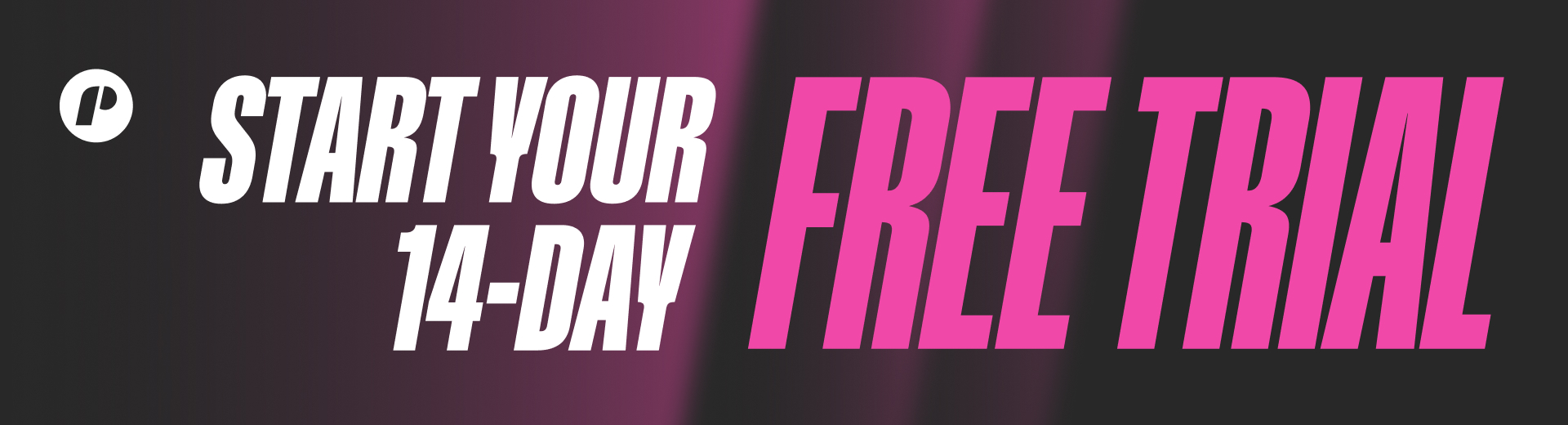
Picture two offers side by side, one at 90% and the other at 70%. The choice looks obvious. For example, the 90% firm might pay monthly while the 70% firm pays every two weeks. As a result, the smaller number can put money in a trader’s account sooner.
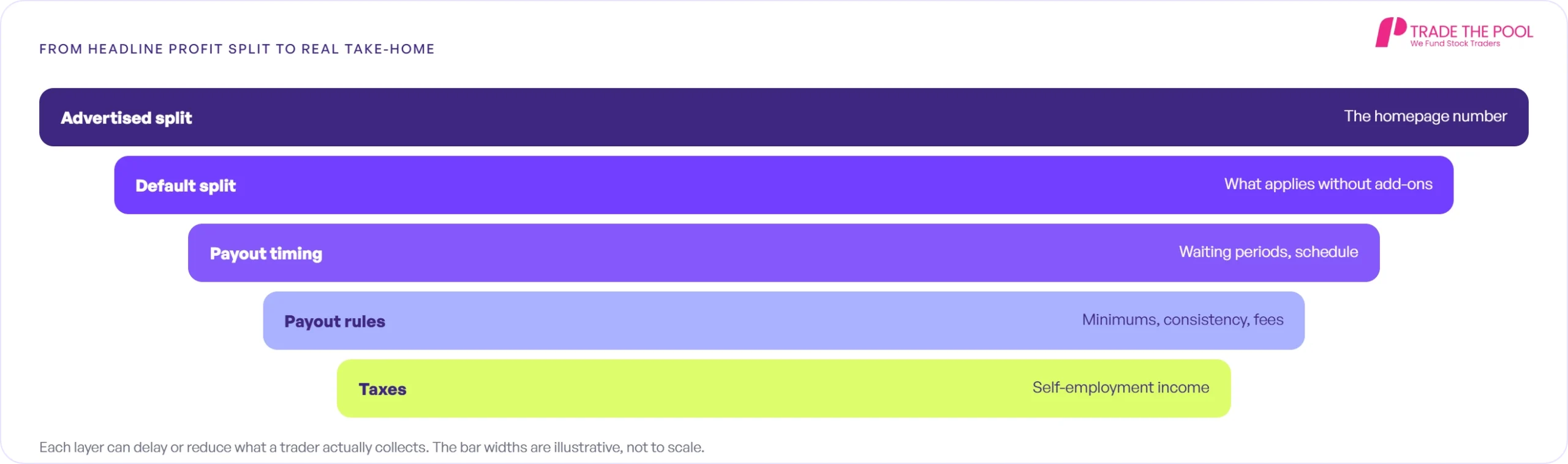
Thus, the comparison should be done by considering what is below the advertisement, rather than what is above it. This guide walks through the math, the common split levels, and the payout rules that change the result.
It then looks at Trade The Pool’s published terms and the basic US tax picture for funded traders.
What Does A Profit Split Actually Mean?
Furthermore, most readers land here after typing one blunt question into a search bar. What does profit split mean? For a funded stock trader, it means keeping an agreed percentage of eligible profit. The firm keeps the rest.
That part takes no finance degree, only a little arithmetic. This 70/30 ratio would send $70 from each $100 in eligible profits to the trader. The evaluation fee, on the other hand, is not part of any of these calculations.
It has been paid by traders at the beginning and does not affect the split. The beginner trader would treat these three factors as a single number. Contrary to many guides available online, this guide considers the split as just another item on the long list.
Other important factors such as payout schedule, minimum amounts, consistency, scaling, and taxation all have their own sections and dated sources. A closing checklist lets traders test any funded stock account evaluation before paying for it.
What This Guide Covers:
- What a profit split is and why prop firms use one.
- How to calculate a trader’s share with a worked example.
- How 70/30, 80/20, and 90/10 splits compare in practice.
- Which payout rules change real take-home pay.
- How Trade The Pool’s split, payouts, and US taxes work.
What Is A Profit Split?
A profit split is the share of trading profit a funded trader keeps, while the firm keeps the rest. Beginners ask what a profit split in prop trading is, and why a firm would share at all. As a result, both sides want the same thing. The firm collects its share only when traders earn.
🔗 Stock Prop Firms: Evaluation, Funding, Profit, and Payout Rules Explained
Reasons Behind Profit Sharing In Prop Trading Companies
This profit-sharing concept is possible due to the fact that the company provides the buying power, and the trader makes the decisions. So what happens after the trader passes the test? For example, the firm tracks eligible profit across a payout period. Then it pays the agreed percentage.

Virtual Capital And Real Payouts
Many beginners picture a funded stock account as real money sitting at a broker in their name. Is a funded account payout the same as real market profit? Not quite. Funded accounts use virtual capital; therefore, a payout works as a performance reward, not a market gain.
🔗 What Is a Funded Stock Account?
How A Profit Split Works: Calculation And Examples
The Profit Split Formula
The arithmetic is almost embarrassingly simple. Any trader can check a payout with a pocket calculator. No spreadsheet required. So what does a 70/30 profit split mean on payout day? The trader keeps 70% of eligible profit; in contrast, the firm keeps the remaining 30%.

Calculating A Trader’s Share
Take Trade The Pool’s published 70/30 profit split and run one payout through it. How does a trader calculate a share of profits? Multiply. For example, $3,000 of eligible profit times 70% gives the trader $2,100 and leaves the firm $900. Simple, but worth seeing once. The table below shows each step.
Profit Split Calculation: $3,000 Payout Example
| Profit Split Calculation Steps & Parameters | Value & Financial Breakdown |
|---|---|
| Step 1: Eligible Profit Generation | $3,000.00 total net profit |
| Step 2: Trader Payout Allocation ($3,000 $\times$ 70%) | $2,100.00 distributed to trader |
| Step 3: Prop Firm Share Allocation ($3,000 $\times$ 30%) | $900.00 retained by firm |
| Evaluation Fee Treatment | Paid upfront, excluded from profit split calculations |
Hypothetical example based on Trade The Pool’s published 70/30 split.
Evaluation Fees Sit Outside The Split
The evaluation fee trips up many beginners because traders pay it long before any profit exists. Trade The Pool’s program page listed $230 to $285 for a $50,000 evaluation on October 7, 2026. However, that is a separate upfront cost. The 70/30 split applies only to eligible profit. Keep the two apart.
🔗 Funded Trading Evaluation Process
70/30 vs 80/20 vs 90/10: Typical Profit Splits
Common Prop Firm Profit Split Levels
Prop firms write a split as two numbers, and the first normally belongs to the trader. So what is a typical prop firm profit split, and how do 70/30, 80/20, and 90/10 differ? Myfxbook lists all three as common. For example, $3,000 of profit pays $2,100, $2,400, or $2,700.
Profit Split Comparison
| Profit Split Tier | Trader Keeps (%) | Firm Keeps (%) | Trader Payout on $3,000 Net Profit |
|---|---|---|---|
| Standard Split (70/30) | 70% | 30% | $2,100.00 |
| Enhanced Split (80/20) | 80% | 20% | $2,400.00 |
| Scaling / Advanced Split (90/10) | 90% | 10% | $2,700.00 |
Hypothetical example, before fees and taxes. Source: Myfxbook, checked Oct 4, 2026.
Why a Higher Split Is Not Always Better
Here the headline starts to wobble. A September 2026 PropFirmMap study found 26 of 169 firms advertising 90% or more charged extra for it. In 16 of those 26, the default sat at 80%. Is a 90% profit split always better than 70%? However, no, because timing, minimums, and rules decide what arrives.
🔗 Types of Prop Firms Explained
The Truth About 100% Profit Splits
Then comes the 100% profit split, the most misread number in the category. Are 100% profit splits real? Most are, but limited. Some examples include insurance that covers only the first payment, limited to an amount or an additional cost. Therefore, the premiums will be reduced after the first drawdown.
Payout Rules That Change Real Take-Home
Payout Frequency and Waiting Periods
A profitable balance on screen is not spendable cash. Readers wonder how often prop firms pay out, and whether traders can withdraw at any time. Myfxbook describes fixed schedules, often every 14 or 30 days; therefore, traders cannot withdraw whenever they wish. Some firms also require a set number of trading days first.
🔗 What Are the Risks of Trading With a Prop Firm?
Minimum Payout Amounts
Then comes the floor. Many firms set a minimum payout, so a small gain may have to wait. Is there a minimum payout amount at prop firms, and how high is it? For example, Trade The Pool’s Program Terms of April 26, 2026 require $300 in profit.
Consistency Rules and Big Winning Days
Furthermore, some firms check how evenly profit arrives before approving a payout. What is a consistency rule in prop trading? It caps how much of total profit any single day can supply. Even when you have an account that is profitable, myfxbook notes that having a skewed performance may limit your ability to withdraw funds.
🔗 Prop Firm Consistency Rules Explained
Common Prop Firm Payout Rules and Their Effect on Take-Home
| Payout Rule & Policy Parameter | Definition & Operational Meaning | Effect on Trader Cash Flow & Take-Home |
|---|---|---|
| Payout Frequency Cycle | Fixed withdrawal timeline, frequently every 14 or 30 days | Delays access to earned trading capital and cash flow |
| Minimum Payout Threshold | Mandatory profit floor required per withdrawal request | Smaller trading gains must wait until threshold is reached |
| Minimum Trading Days Requirement | Preset number of active trading sessions required | Delays eligibility for the initial account payout |
| Consistency Rule | Caps the maximum percentage allowed from a single day’s profit | Can completely block or delay a withdrawal request |
| Processing Friction & Fees | Potential transfer fees and standard bank wire processing time | Reduces net cash received or delays final settlement |
Common industry rule types; terms differ by firm.
Profit Split at Trade The Pool
The 70/30 Profit Split on FLEX and MAX
Trade The Pool puts its split in writing; as a result, a trader can check it before paying anything. What is Trade The Pool’s profit split on FLEX and MAX? The Program Terms, updated April 26, 2026, state that the payout split is 70/30 across the board.
First Payout, Minimums, and Processing Time
Timing is just as important as percentage. When can the Trade The Pool member make a payout claim, and how long will it take to receive one? A request needs to be made 14 days after funded trading began. On the other hand, the process will take 3 to 5 days, and a fee will be charged.
How Scaling Affects the Profit Split
Growth adds one more layer, because successful accounts can move up to a larger tier. What happens to the profit split when a funded account scales up? The firm splits eligible profit at that point; therefore, it never splits previously split profit again. The trader’s share carries into the next account as credits.
🔗 Prop Firm Scaling Plans Explained
Trade The Pool Profit Split and Payout Terms
| Trade The Pool Terms & Parameters | Published Value & Program Details | Documentation Source & Date |
|---|---|---|
| Profit Split (FLEX, MAX Accounts) | 70/30 (Trader / TTP allocation) | Program Terms (Apr 26, 2026) |
| Payout Waiting Period | 14 days since last payout or initial funding | Program Terms |
| Minimum Payout Threshold | $300 profit (net of starting virtual capital); $150 on $5K accounts | Terms & Program Page |
| FLEX Account First Payout Criteria | 3 profitable days of 0.5% or more within the 14-day cycle | Program Page (Oct 7, 2026) |
| Payout Processing Time | Usually 3 to 5 business days; possible transfer fee | Program Page & Terms |
| Scaling Plan Mechanics | Split profit is not split again upon account scaling | Program Terms |
Source: Sources for Trade the Pool program agreement (April 26, 2026), program web page (October 7, 2026).
Profit Split Payouts and US Taxes
How US Prop Firm Payouts Are Usually Taxed
This part only gives general education; it does not constitute personal tax advice. All assertions made here have dates and sources attached to them. Is the income from prop firms taxable in the United States? Yes. Kathy Lien’s January 2026 Investing.com analysis describes payouts as business income, not capital gains.

Payouts Versus Capital Gains
Many stock traders already know capital gains from selling shares in a brokerage account. Prop firm payouts follow different rules. Are they taxed like stock market gains? In the US, payouts usually count as self-employment income; therefore, a 15.3% self-employment tax can apply too. That difference surprises many new funded traders.
🔗 Prop Firm Taxes for US Traders
Form 1099-NEC and the $2,000 Threshold
Reporting rules have been revised, but most of the old manuals continue to use the old rule that payments above $600 must be reported. Moreover, the new tax form instruction manual for the IRS states that the Form 1099-NEC threshold should be $2,000 for the tax years starting after 2025.
How Prop Firm Payouts Are Taxed in the US
| Tax Item & Compliance Parameter | General U.S. Treatment & Documentation Source |
|---|---|
| Payout Income Classification | Business income (taxed as self-employment income, not capital gains) — Investing.com (Jan 6, 2026) |
| Self-Employment Tax Rate | 15.3% statutory rate (with one-half deductible for income tax calculations) — Investing.com (Jan 6, 2026) |
| Form 1099-NEC Reporting Threshold | $2,000 reporting threshold (effective for tax years after 2025) — IRS (Oct 7, 2026) |
General education only, not tax advice.
Take-Home Checklist Before Buying an Evaluation
Traders can run this five-step take-home checklist before buying any evaluation from any prop firm.
- Confirm the default split, not only the advertised maximum.
- Note the waiting period and the first payout conditions.
- Check the minimum payout amount and any processing fee.
- Read the consistency and scaling rules in full.
- Record every payout date and amount for tax purposes.
🔗 Is It Risk-Free to Trade With a Prop Firm?
Profit Split: Key Takeaways for Funded Traders
Profit split is a method for distributing the profit from trades between a funded trader and the organization that opens the trading account. Does profit split provide steady income? No.
A profit split applies only to profits earned within the rules; therefore, it never guarantees any income. Losing periods produce no payout at all.
The main formula to calculate the money involved is: Eligible profit times trader’s percentage = Gross payout. Nonetheless, the factors that will determine the amount to be received and the payout timing include minimums, consistency rules, scaling, and taxes.
Traders who read every rule before buying an evaluation can compare offers on take-home, not advertising. In addition, the trader who keeps track of the profits that he or she gets from every trade gains an accurate picture of how much his or her trading activity is making.
It also keeps attention on steady, rule-based trading instead of one big payout day. Traders who want a clearly published 70/30 split can review the Trade The Pool funded stock program. Each trader should therefore read the Program Terms in full before buying, then apply this checklist to every payout.
If you liked this post make sure to share it!