The U.S. equity trading landscape is shifting under traders’ feet, with the long-standing Pattern Day Trader (PDT) rule officially on its way out. For two decades, the case for stock prop firms leaned heavily on dodging this exact constraint. In light of this shift, what is a prop firm, and how does a prop firm work? It works by providing capital scale, bounded personal risk, and a mechanism for turning a working strategy into real income without funding the account out of personal savings.
With day-trading counting disappearing, the real value of a funded structure comes into sharper focus. That’s what this guide is about: using Trade The Pool’s program as the working example.
The Basics: How Does A Prop Firm Work With Funding?
If you are asking, “How does a prop firm work?”, the simplest answer is that a stock prop firm (short for proprietary trading firm) funds the trade with its own capital. The trader operates that capital under a defined set of rules and earns a share of the profits. At Trade The Pool, that share is 70/30: seventy percent of every dollar of validated profit goes to the trader, and thirty percent stays with the firm. The split is flat across all account sizes, from the $5,000 Day Trading account to the $200,000 program. There is no tiered structure, no graduated bonus, no marketing copy promising up to ninety percent. The number is what it is, applied uniformly.
Execution Power: Prop Trading at TTP vs. Personal Capital
| Feature | Stock Prop Trading at TTP | Personal Capital Trading |
|---|---|---|
| Capital at risk | Evaluation fee only | Full account balance |
| Capital deployed | Up to $200K (Day) / $40K (Swing) | Limited by personal savings |
| Profit split | 70/30 — flat across all sizes | 100% to the trader |
| Scaling mechanism | +Buying power & +Pause every 10% milestone | Self-funded only |
| Platform & data | Trader Evolution + real-time data included | Pay broker, pay for data |
| Trade Flexibility | Earnings & Weekend holds allowed | Subject to broker margin policy |
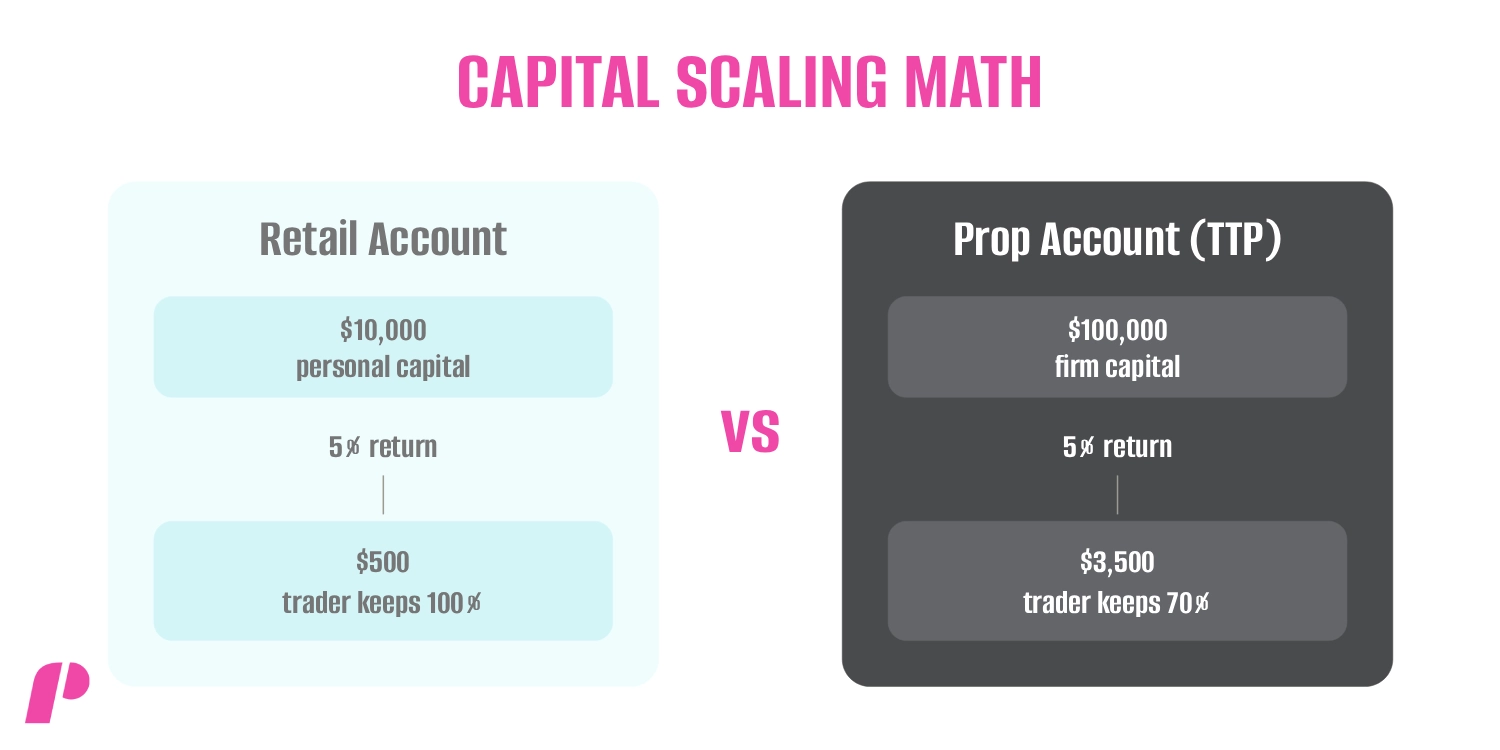
The structural value isn’t really about the percentage; it’s about the denominator. A 5% return on a $10,000 personal account is $500. The same 5% on a TTP-funded $100,000 account is $5,000, and the trader keeps $3,500 of it. The mathematics of scaling has far less to do with edge and far more to do with capital access. Most traders who plateau in retail accounts don’t have a strategy problem; they have a balance-sheet problem. Prop firms exist to remove the balance-sheet constraint.
After The Pdt Rule: What Actually Changed, And What Didn’t
The Pattern Day Trader designation, the $25,000 minimum, the day-trade counting, the 90-day account freezes — all of it is on the way out. FINRA published Regulatory Notice 26-10 confirming a June 4, 2026, effective date, with brokers permitted to phase in implementation over the following 18 months. What replaces PDT is a risk-based intraday margin framework, in which buying power is calculated dynamically based on the actual risk of open positions rather than on an arbitrary capital floor.
This is genuinely good news for retail traders. A determined trader with $5,000 in their personal account will, under the new framework, eventually be able to take more than three day trades a week through a regular brokerage. That’s a meaningful improvement, and Trade The Pool’s editorial position is straightforward: any regulation that lowers the barrier for serious traders to participate in markets is a net positive.
The Capital Reality: Why Prop Trading Still Matters
But eliminating PDT does not eliminate the case for prop trading. It clarifies it. The PDT rule was always a side effect of a deeper constraint — that retail traders need to put up their own capital to access meaningful position sizes. That constraint hasn’t moved. A trader with $5,000 in a personal account, post-PDT, can now day-trade more freely, but a 5% gain still pays $250. The same trader passing a TTP evaluation gains access to up to $200,000 of buying power, where 5% on a funded account pays vastly more, and the trader’s downside through the evaluation phase is limited to a single fee.
In other words, post-PDT, the question shifts from “how do I get around an outdated regulation?” to “how do I get access to capital I haven’t saved myself?” Understanding how does a prop firm work answers the second question. The first one is finally answering itself.
How Does A Prop Firm Work: How A Trade The Pool Evaluation Actually Works
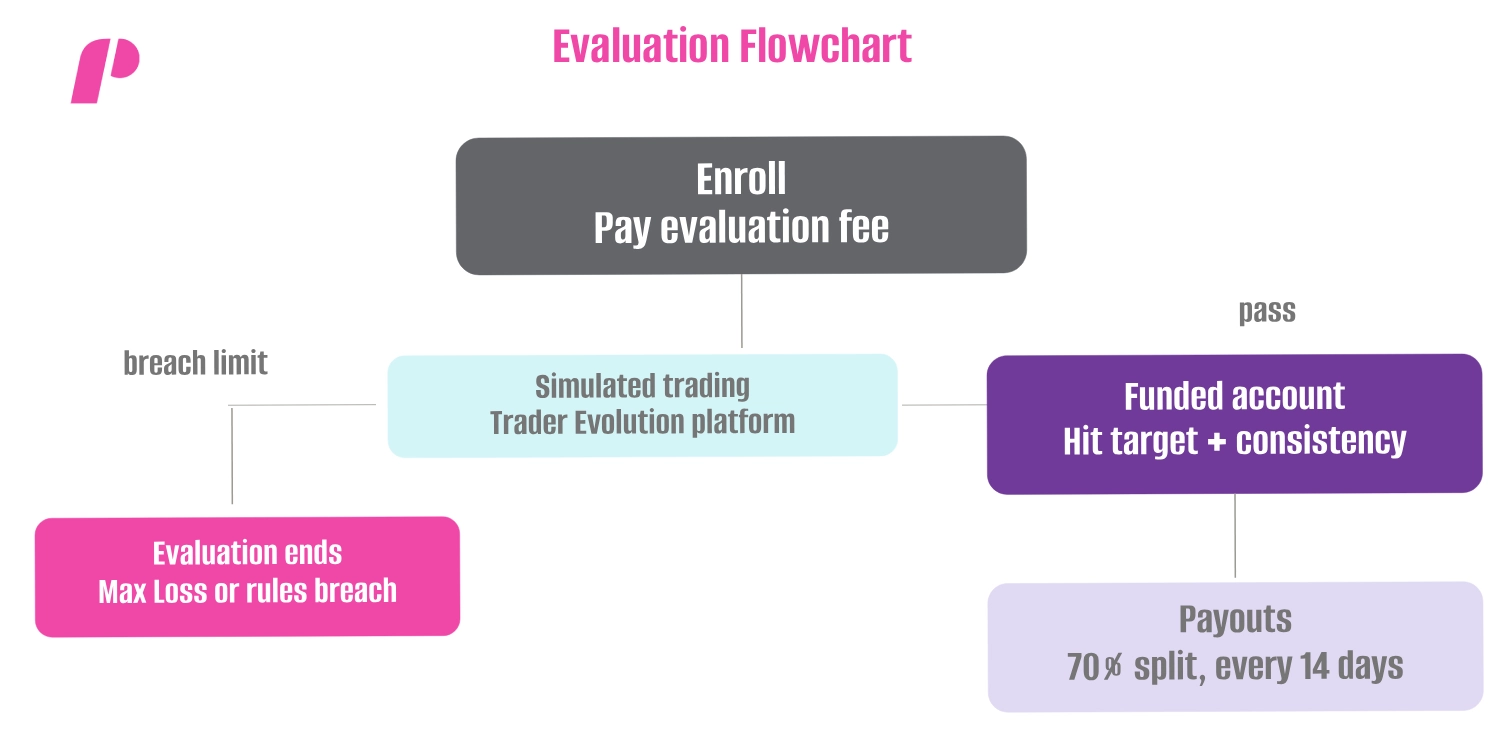
To see how does a prop firm work in practice, look at how Trade The Pool runs a single-phase evaluation, or a one-step model. The trader who hits the profit target while staying within all risk and consistency rules moves directly to a funded account. This matters because much of the prop trading commentary online assumes a two-phase model that originated in forex prop trading. TTP is a stock-trading firm, and the structure is different by design.
Evaluation Framework: Day Trading Parameters (FLEX vs. MAX)
| Day Trading Parameter | FLEX (Standard Risk) | MAX (High Velocity) |
|---|---|---|
| Profit Target | 6% | 6% |
| Daily Pause | 2% | 1% (Tight Control) |
| Max Loss | 4% | 3% |
| Consistency Rule | 50% | 30% (Evaluation Only) |
| Min Trade Duration | 30 seconds | 30 seconds |
| Min Trade Range | 10 cents | 10 cents |
Choice 1: Program Type and Account Size
Before starting, the trader makes two choices. The first is the program type — Day Trading or Swing Trading. Day Trading accounts come in five sizes: $5K, $25K, $50K, $100K, and $200K. Swing Trading accounts come in four: $2K, $10K, $20K, and $40K. The choice of size determines the evaluation fee and the buying power that follows in the funded account.
Choice 2: Flex vs. Max Evaluation Styles
The second choice is the evaluation style: Flex or Max. Flex evaluations have no time limit for trades to hit the profit target, as long as the daily pause and max loss limits aren’t breached. Max evaluations, on the other hand, have a set timeline to pass—sixty days for Day Trading and one hundred days for Swing. While Max features tighter risk parameters during the evaluation phase, it offers looser consistency rules once funded, making the path to payout more streamlined. Neither option is objectively better. The right choice depends entirely on how the trader paces their work and what matters to them most: passing the challenge or achieving a payout.
Evaluation Framework: Swing Trading Parameters (FLEX vs. MAX)
| Swing Trading Parameter | FLEX Swing (Unlimited Time) | MAX Swing (100-Day Limit) |
|---|---|---|
| Profit Target | 15% | 15% |
| Daily Pause | 3% | 3% |
| Max Loss | 7% | 7% |
| Trading Period | Unlimited | 100 Days |
| Consistency Rule | 50% | 30% |
| Overnight/Weekend | Allowed | Allowed |
The Next Steps: Simulation, Funding, and Payouts
After enrollment, the trader receives a simulated trading environment that mirrors live U.S. equity markets in real time on the Trader Evolution platform. The evaluation begins immediately. Hit the profit target, respect the rules, and the account is reviewed and converted to a funded account. From there, the same rules apply, but profits become withdrawable at TTP, after fourteen days from inception or the previous payout, with a $300 minimum profit ($150 for $5K accounts).
What The Evaluation Is Really Testing
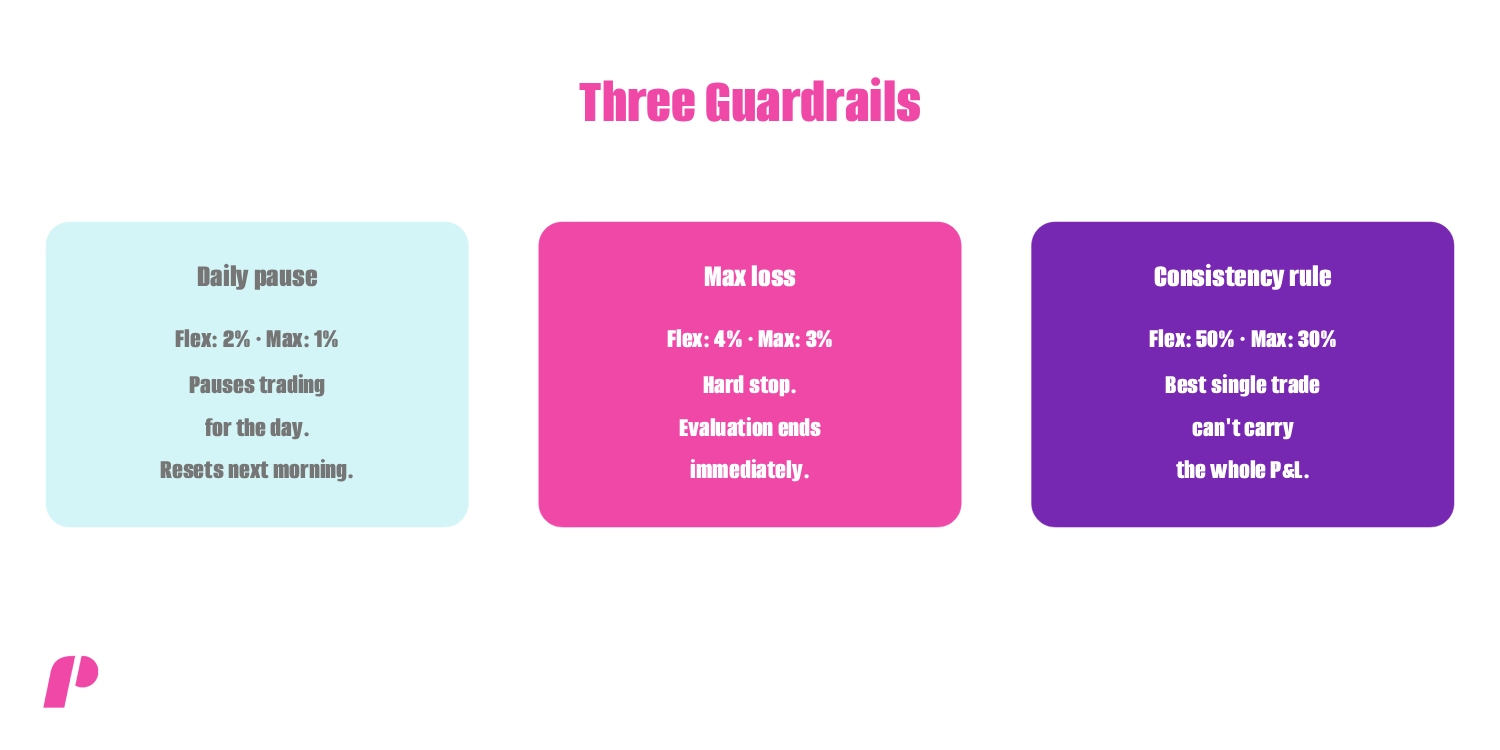
On paper, the evaluation looks like a profit test: hit 6% on Day Trading or 15% on Swing, and you’re funded. In practice, the profit target is the easy part for any trader with a real edge. What the evaluation actually measures is whether the trader can produce that profit without breaching three guardrails — the Daily Pause, the Max Loss, and the consistency rule.
Guardrail 1: The Daily Pause
The Daily Pause is a built-in risk management tool. On a Day Trading Flex account, it sits at 2% of the account balance; on a Max account, 1%. Hit it, and the account is paused for the rest of the trading day. The next morning, you start fresh. The Daily Pause is calculated at the open and stays fixed for that day, even if mid-session profits push your equity higher.
Guardrail 2: The Max Loss
The Max Loss is the hard line. Day Flex: 4%. Day Max: 3%. Swing: 7%. Touch it, and the evaluation ends. There is no reset on the same account. This is the number that separates funded traders from the rest, and the one that takes most failed evaluations down, almost always because of position sizing and not following their strategy.
Guardrail 3: The Consistency Rule
The consistency rule stops a single hero trade from carrying the entire P&L. On a Flex evaluation, your single best trade can’t account for more than 50% of the total profit target. On Max, it’s 30%. The rule doesn’t punish big winners — it just requires that they sit alongside other winners that prove the result is repeatable.
Technical Rules: Execution Minimums
Two more rules are easy to violate accidentally. Every trade has to last at least 30 seconds and move at least 10 cents. The system measures both down to the millisecond and to the fraction of a cent on weighted average prices, so a trade that looks like 30 seconds on the dashboard can still be invalidated if the precise math comes in at 29.7. These rules exist to prevent scalping the simulated environment, and they apply identically to the funded account.
Risk Management: Common Mistakes That End Evaluations
| Common Mistake | Why It Ends the Evaluation | How to Avoid It |
|---|---|---|
| Oversizing Positions | Hits Max Loss in one trade. | Size at 1%–2% of the account. |
| Revenge Trading | Breaks the consistency rule. | Stick to the pre-defined plan. |
| Holding Through Earnings | Auto-liquidated at 3:50 PM ET. | Exit before earnings; check the calendar. |
| Ignoring Daily Pause | Account paused for the day. | Set a hard mental stop pre-market. |
| One Trade Carrying P&L | Violates 30%/50% consistency rule. | Spread profits across many trades. |
| Trading Illiquid Names | Slippage breaks the risk math. | Stick to high-volume names. |
How Traders Actually Pass: Discipline Beats Edge
Spend any time in trading communities, and a pattern shows up over and over. Traders who fail the evaluation rarely fail because their strategy doesn’t work. They fail because they sized one trade too aggressively, refused to walk away after a losing morning, or held and added to a losing position for too long. The skills that pass an evaluation are the same skills that build a real career: position sizing, walk-away discipline, and trading psychology. Realizing this is key to understanding how does a prop firm works.
Mastering Position Sizing
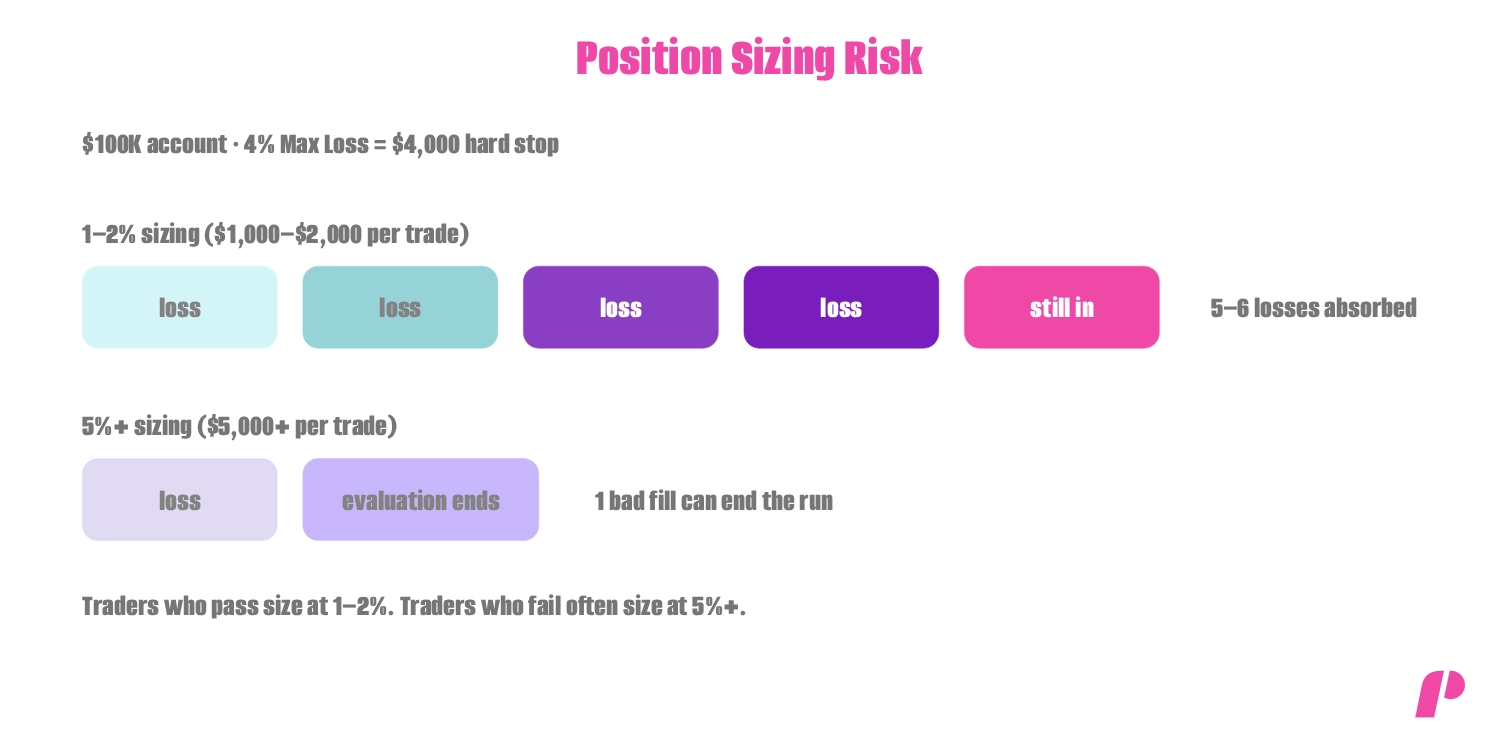
Position sizing is where most evaluations end in a single trade. TTP’s buying power is significant — and the temptation to use all of it is real. The traders who pass tend to size individual positions at one to two percent of account balance, which technically leaves enough headroom to take five or six losses in a row without triggering the Max Loss. The traders who fail tend to size at five percent or more, which means a single bad fill ends the run.
Avoiding The Psychology Trap: Holding Losers
The other quiet killer is deeply rooted in trading psychology: the toxic habit of holding, and even worse, adding to a losing position for too long. When a trade goes sideways, it is easy to let ego take over. Instead of cutting losses, traders will often average down, draining their mental capital and hoping for a sudden reversal to bail them out. Often, they will stubbornly hold these underwater positions into massive volatility events, praying for a miracle. Take earnings, for example.
A trader might refuse to close a loser, hoping an after-hours earnings beat will save the trade. TTP actually protects you from this specific psychological trap; the system automatically liquidates open positions ten minutes before the close at 3:50 PM ET on any day a held ticker has earnings scheduled after hours. While this stops a trader from getting blown up by a 20% post-earnings gap, relying on an automated system to force you out of a bad trade is a dangerous habit. The true fix is internal: accept the loss early, never average down on a loser, and check the calendar every morning so you are flat by 3:45 PM ET on your own terms.
What To Trade During The Evaluation
Trade The Pool gives access to more than 12,000 stocks and ETFs across U.S. markets, including penny stocks and IPOs. During the overnight session, the ticker pool narrows to roughly 3,500 highly liquid tickers via Blue Ocean’s data feed. The breadth is generous — but during an evaluation, breadth can be a trap. Traders who pass aren’t the ones who scan the widest watchlist; they’re the ones who trade the narrowest list with the most repetition.
Execution Guide: Top High-Liquidity Symbols for Newly Funded Traders
| Symbol | Why It Suits Newly Funded Traders |
|---|---|
| SPY (S&P 500 ETF) | Institutional liquidity, minimal gap risk, and clean technical setups. Ideal for testing execution speed. |
| QQQ / TQQQ | NASDAQ 100 exposure. Fast, responsive to macro trends and tech sector earnings. |
| TSLA | Exceptional liquidity and wide daily ranges. Provides momentum setups, but requires strict risk sizing. |
| NVDA | Strong, persistent momentum with very clear technical levels. Volatile—must size accordingly. |
| AAPL | Highest daily volume and tightest spreads. Respected technical structure for precise entries. |
| AMZN | Large-cap stability with frequent range-bound and breakout setups. |
The Gold Standard: ETFs and Large Caps
For most newly funded traders, the right move is to start with the largest, most liquid names available. SPY and QQQ — the S&P 500 and NASDAQ 100 ETFs — are the gold standard. Their order books are deep enough that slippage is rarely a concern, their charts respect technical structure cleanly, and their reactions to macro data are predictable enough to plan around. Adding two or three large-cap individual names — AAPL, MSFT, NVDA, AMZN — gives the trader enough variety without expanding into the noise of small-caps and penny stocks during the evaluation.
Penny Stocks and Small-Caps: Proceed With Caution
Penny stocks and small-caps are embraced at TTP. Short-selling penny stocks is allowed, and there is no extra locate fee — but slippage on illiquid names can break the math of a tight stop. During the evaluation, the goal is predictability. Once funded and scaled, the trader can expand the watchlist with full knowledge of how their strategy handles less liquid names.
One restriction worth flagging: TTP does not offer index futures (NQ, ES) or options. Everything is spot trading on real stocks and ETFs. Traders coming from a futures background sometimes assume they can trade NQ at TTP — they can’t, but they can trade QQQ, which is highly correlated and behaves similarly on most setups.
How Does A Prop Firm Work When It Comes To Payouts?
Another common question is, how does a prop firm work once you are profitable? Once funded, the trader continues operating under the same rules as the evaluation — the Daily Pause, the Max Loss, the consistency rule, the 30-second and 10-cent minimums. Nothing relaxes. What changes is that profits are now real and withdrawable at the 70/30 split.
The Payout Cycle: Withdrawals and Minimums
Withdrawals at Trade The Pool follow a clear cycle: fourteen days from the account’s inception, or fourteen days from the previous payout, whichever is more recent. The trader needs at least $300 in profit on standard accounts ($150 on $5K accounts) before a withdrawal can be requested. Payouts are processed via wire transfer, cryptocurrency, Hub credits, or credit card, and typically clear in three to five business days. For Flex accounts, there is one additional gate: at least three days within any fourteen-day period must show a profit of 0.5% or more of buying power. This rule rewards consistency over a single explosive day.
Scaling Up: Turning A Funded Account Into A Career
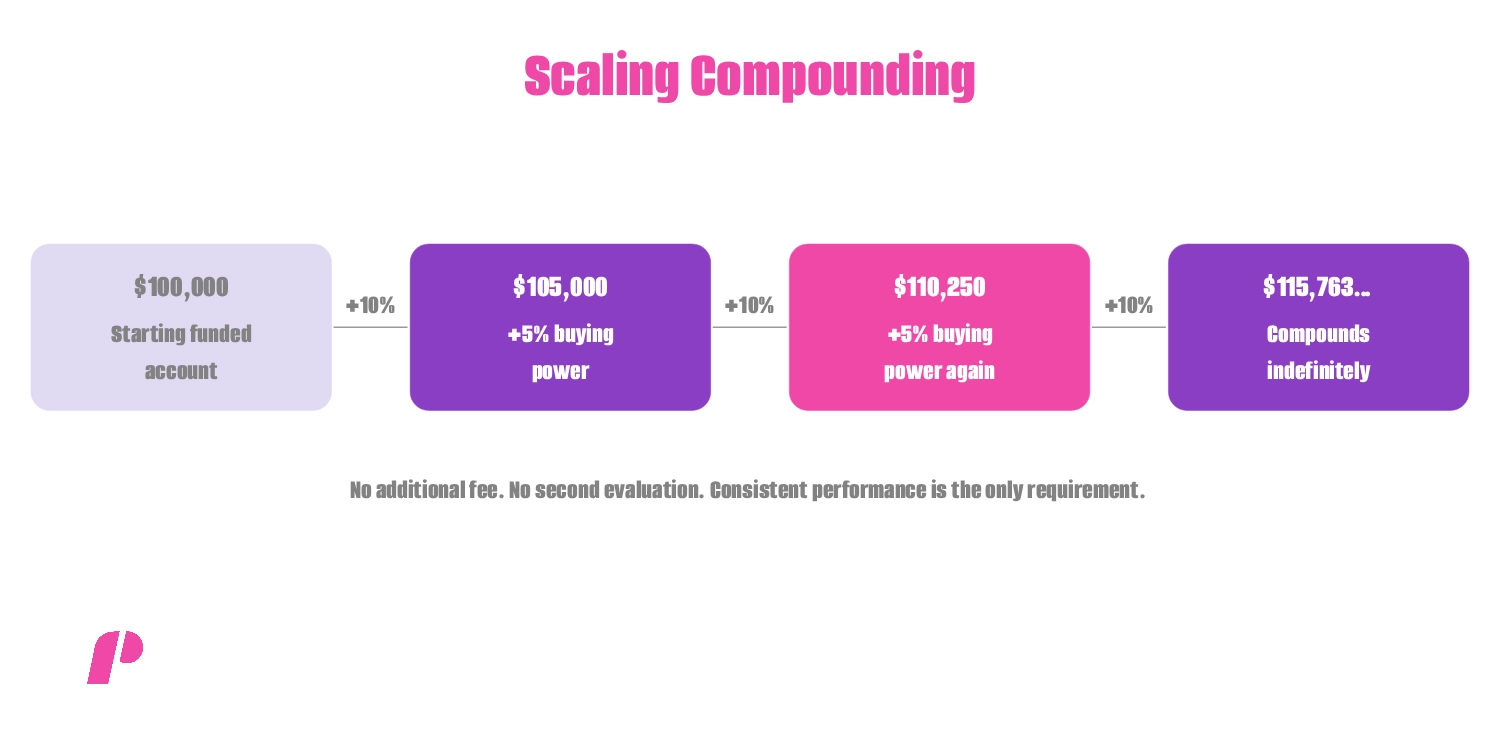
Scaling is what turns a funded account into a career path. At TTP, every time the trader generates 10% of validated profit on the buying power of the current account, the account scales to the next tier. Buying power increases by 5%, and the Daily Pause increases by 10% — a structural reward for consistency. For Flex accounts, scaling additionally requires those three profitable days at 0.5% or higher within a fourteen-day window. Each new tier compounds: a $100,000 account that hits 10% becomes a $105,000 account, then $110,250, and so on. There is no additional fee for scaling, and no second evaluation. Consistent performance is the only requirement.
So, is Stock Prop Trading The Right Path For You?
The honest answer is that prop trading is not a shortcut. The evaluation is rigorous, and most traders who attempt it on the first try will not pass on the first try. This isn’t unique to TTP — it’s a structural feature of how prop firms identify the traders worth funding. The question isn’t whether the evaluation is hard, but whether the structure is more favorable than the alternative.
The Reality: Retail vs. Prop Trading
Post-PDT, that comparison gets clearer. Retail brokerages will offer more flexibility to small accounts than they did under the old rule. But they will not offer $200,000 of buying power to a trader with $97 in their pocket. They will not bind personal financial exposure to a one-time fee. They will not provide structured scaling that compounds without additional capital deployment. Those are prop firm features, and they remain prop firm features regardless of what FINRA does to retail margin rules.
Three Traits of a Funded Trader
The traders who succeed at Trade The Pool tend to share three traits. They have a defined strategy they’ve already tested on a personal account or in a demo. They’ve internalized that risk management — not market reads — is what funds them. And they treat the evaluation as a personal project. If those three things describe you, the structure is built for the way you already trade.
Still Building Your Edge? Try The Demo
If you’re earlier in the journey — still building a strategy, still figuring out how you handle a losing morning — the right move is the free 14-day trial. The demo environment uses the same platform, the same data, and the same dashboard as a paid evaluation. You can prove to yourself whether the rules fit your style before any money changes hands.
Start Trading Stocks: How Does A Prop Firm Work For You?
Understanding how does a prop firm work is the first step. Trading the program is the second. Trade The Pool’s structure was built specifically for U.S. equity traders — a single-phase evaluation, transparent 70/30 profit split, scaling at every 10% milestone, and access to over 12,000 stocks and ETFs across regular and 24/5 sessions. The capital is real, the rules are public, and the path from evaluation to funded to scaled is documented step by step on the program page.
Explore the Day Trading and Swing Trading programs — Flex and Max — at tradethepool.com, or start with the free 14-day trial to test the platform before committing to an evaluation fee.
Disclaimer: This article is for informational/educational purposes only and is not financial advice or a guarantee of results. Trade The Pool uses a simulated environment with fictitious funds for evaluation; becoming a funded trader depends on performance and is not guaranteed. Trading involves risk of loss, and past performance does not indicate future results. Services may be restricted in certain jurisdictions. Always conduct independent research and consult a professional before trading.
If you liked this post make sure to share it!