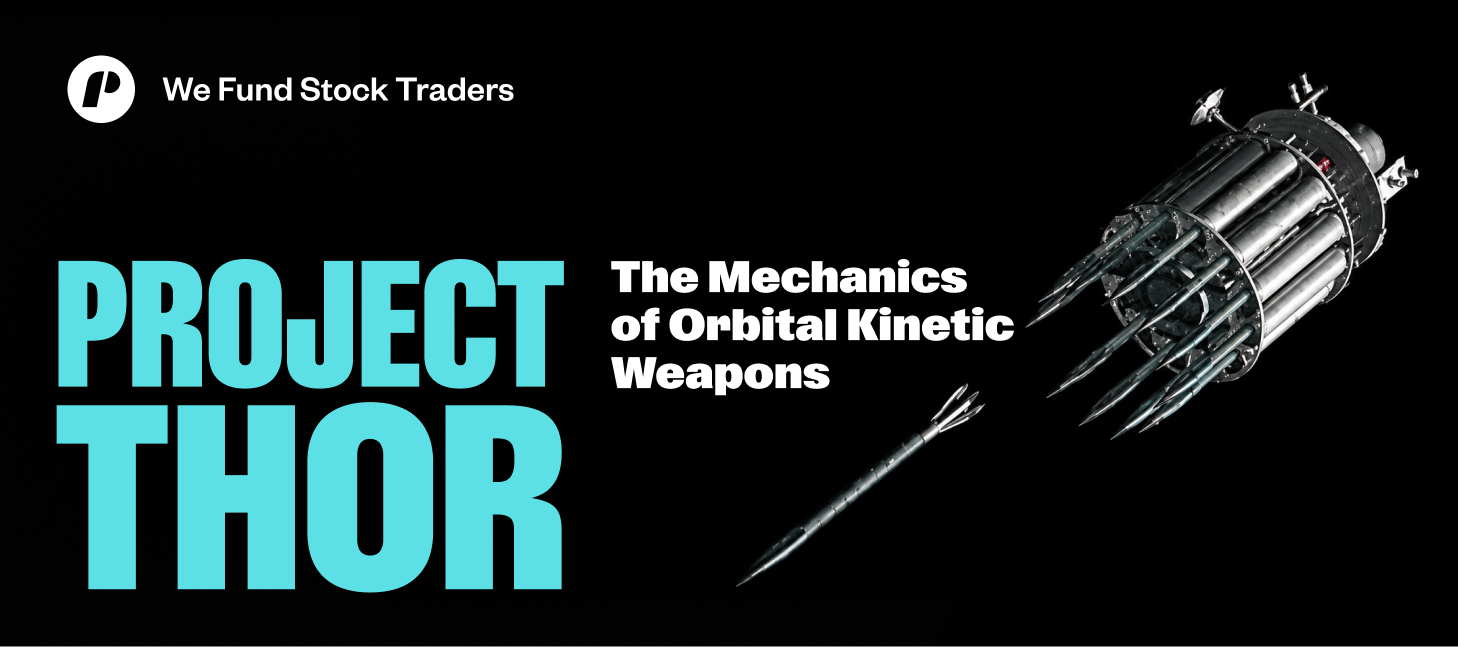
The concept of Project Thor has moved from military theory into active research. Defense experts commonly refer to this system as Rods from God. Specifically, this system involves placing tungsten rods in low Earth orbit and releasing them over a target. Consequently, gravity and velocity combine to deliver energy comparable to a tactical strike, without a single gram of explosive material.
Furthermore, the principle is straightforward. A dense metal rod, roughly the size and weight of a telephone pole, drops from orbit. According to the 2003 US Air Force feasibility study, the standard configuration for Project Thor is a tungsten cylinder measuring 6.1 meters in length and 0.3 meters in diameter, weighing approximately 9 metric tons. As it reenters the atmosphere, the rod decelerates from orbital speed and strikes at a hypersonic terminal velocity estimated between 3 and 6 km/s — still sufficient to deliver energy equivalent to approximately 11.5 tons of TNT. However, the difference from a nuclear weapon is the complete absence of radiation. Therefore, the strike produces no fallout, creates no contaminated zone, and leaves no atmospheric contamination.
For decades, this concept remained impractical because lifting heavy payloads into orbit cost a prohibitive amount of money. Although that economic barrier has not yet disappeared, it has narrowed significantly with the rise of partially reusable launch vehicles. Meanwhile, aerospace companies continue to develop fully reusable systems. Ultimately, the trajectory of cost reduction has brought kinetic orbital weapons, like Project Thor, from theoretical impossibility into serious defense research.
The Physics Behind the Project Thor Strike
Project Thor relies entirely on kinetic energy. Indeed, there are no explosives, no chemical propellants, and no nuclear material. The weapon is simply a piece of metal moving very fast.
Physicists calculate kinetic energy using a precise physical law. The formula is:
Kinetic Energy: Ek = 1/2 x m x v2
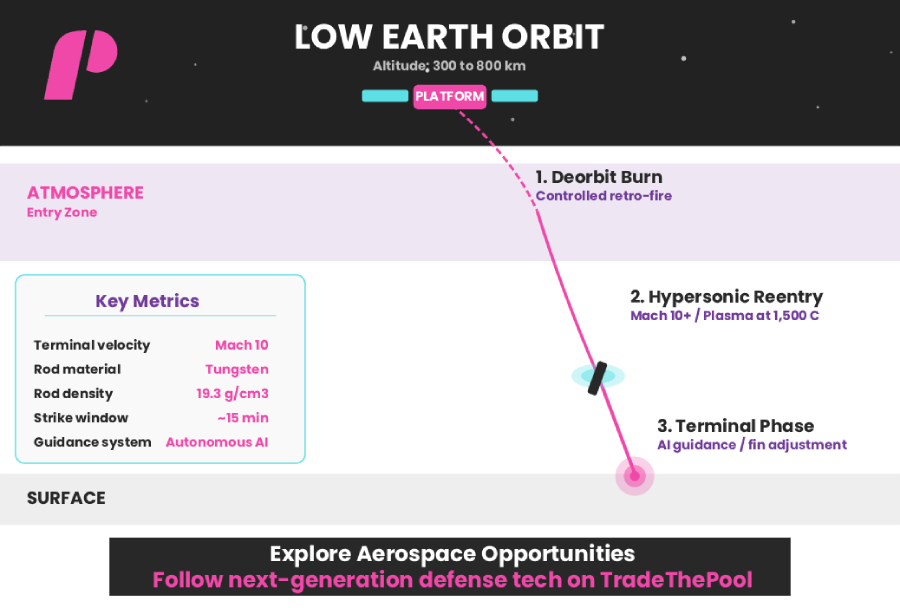
In this equation, mass (m) contributes to the total energy, but velocity (v) is the dominant variable because it is squared. Therefore, doubling the rod’s speed does not merely double the energy delivered on impact. Instead, it quadruples it. This is exactly why engineers choose tungsten as the material of choice for Project Thor. Its density of 19.3 grams per cubic centimeter means a relatively compact rod carries an enormous amount of mass.
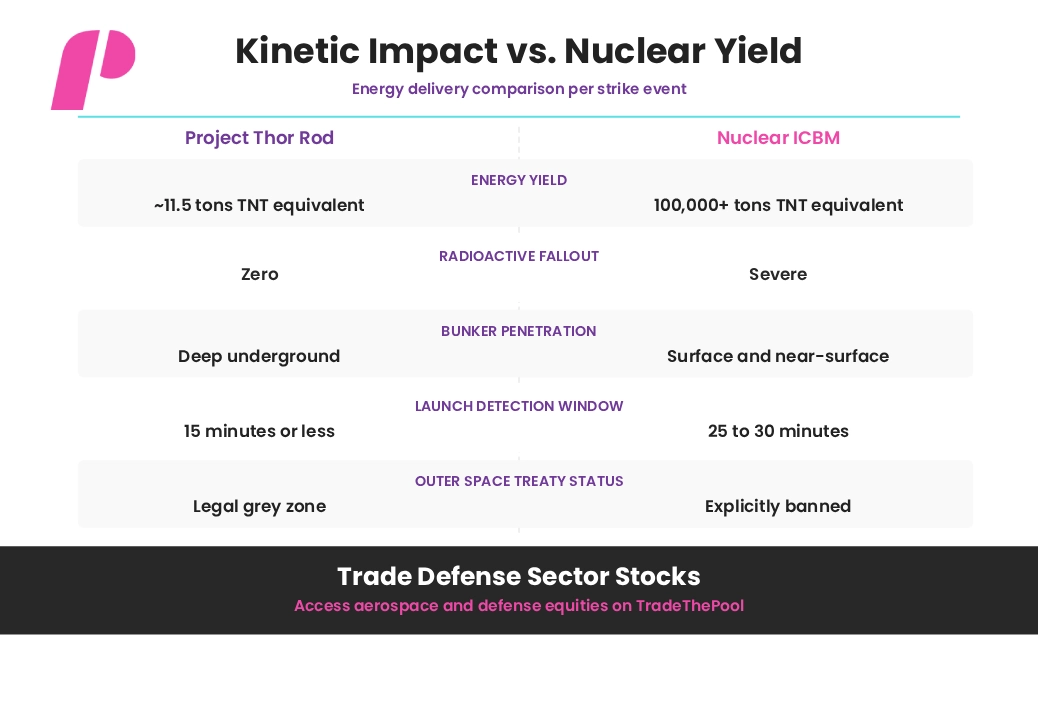
At terminal velocity, the rod impacts at speeds exceeding Mach 10. Consequently, the energy released upon impact with the ground equals approximately 11.5 tons of TNT equivalent per rod, according to the 2003 Air Force report. That figure falls far below that of a nuclear weapon in terms of raw yield, yet the delivery mechanism is fundamentally different. Specifically, the Project Thor kinetic strike is precise and penetrating, leaving no contamination behind.
The rod does not explode on impact. Rather, it penetrates. The enormous density and velocity carry it deep underground before the ground fully dissipates the energy. As a result, this makes Project Thor particularly relevant for hardened underground targets, deep bunkers, and reinforced command structures that conventional munitions cannot reach.
Doubling the velocity of a tungsten rod quadruples its impact energy. At Mach 10, a single rod delivers approximately 11.5 tons of TNT equivalent force to hardened underground targets with zero radioactive contamination.
Project Thor Weapon System Comparison
The table below places Project Thor in context against conventional and nuclear strike options.
Strategic Yield Models: Energy Sources, Destructive Yields, and Structural Penetration
| System | Energy Source | Primary Effect | Penetration Depth | Residual Impact |
|---|---|---|---|---|
| Conventional TNT | Chemical | Blast wave | Surface only | Debris and smoke |
| Nuclear ICBM | Atomic fission | Thermal and radiation | Surface and shallow | Severe radioactive fallout |
| Project Thor | Kinetic velocity | Deep penetration | Underground bunkers | None |
The Economic Shift That Made Project Thor Possible
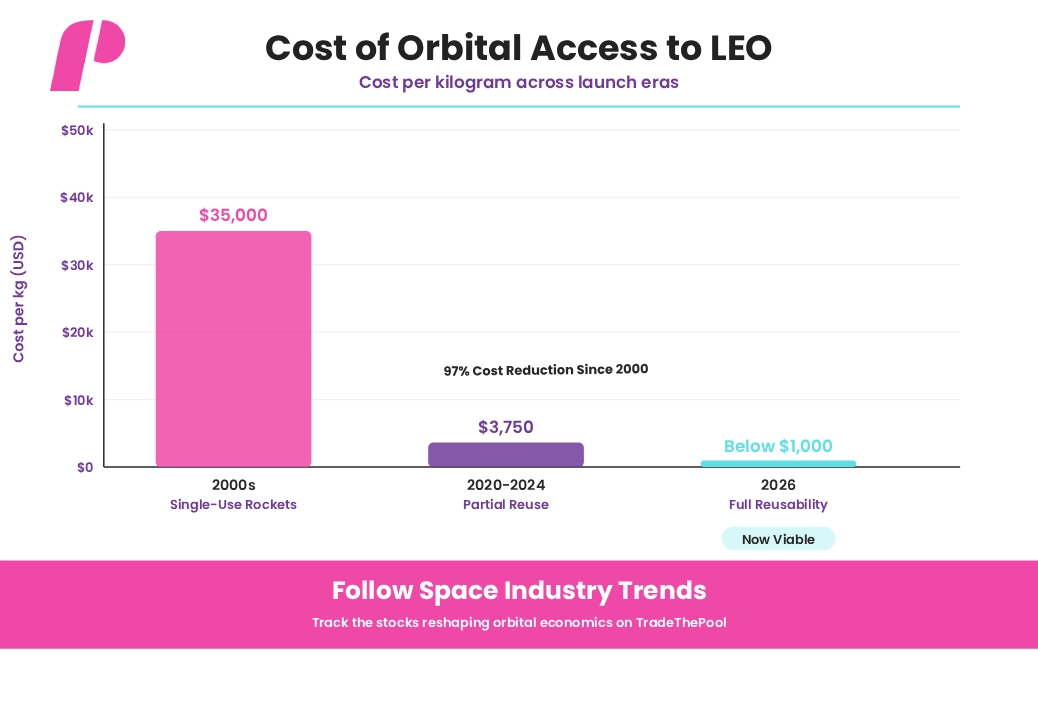
Throughout the twentieth century and early 2000s, deploying heavy payloads to space cost a prohibitive amount of money. For example, transporting a single kilogram of cargo to low Earth orbit (LEO) via expendable rockets costs between $10,000 and $20,000. For kinetic bombardment concepts like Project Thor—which rely on massive orbital platforms housing dense tungsten rods—these financial barriers placed deployment well beyond any realistic defense budget.
The Impact of Commercialization on Project Thor
However, that economic calculation has fundamentally shifted. The commercialization of spaceflight, pioneered by partially reusable systems like the SpaceX Falcon 9, has driven LEO launch costs down to approximately $2,500–$3,000 per kilogram as of 2026. Consequently, this marks a roughly 85% reduction compared to the single-use vehicles of previous decades, making Project Thor more feasible.
The Promise of Full Reusability
Furthermore, fully reusable heavy-lift vehicles, such as the SpaceX Starship, target launch costs below $500 per kilogram. While Starship remains in its development and certification phase and the FAA has not yet commercially certified it for payloads, its maturation will drastically strengthen the economic viability of heavy orbital platforms. Until then, launch expenses remain a significant, though steadily declining, constraint for Project Thor.
A New Operational Model for Project Thor
This paradigm shift extends beyond cheaper hardware; specifically, reusability has overhauled the entire operational model. Aerospace companies can now refurbish and relaunch rockets that they once discarded after a single flight within days. As a result, this accelerates launch frequencies, continuously amortizes per-flight costs, and transforms orbital logistics from a purely academic theory into a practical reality for defense planners evaluating Project Thor.
Orbit as an Operational Zone
Consequently, orbit is evolving from an exclusive domain for scientific probes and satellites into a functional operational zone. Indeed, in-space manufacturing, fuel depots, and orbital platform research are now active components of commercial and military strategy. Ultimately, whether launch economics cross the threshold required for practical Project Thor kinetic-weapon deployment hinges entirely on next-generation launch systems achieving their ambitious reuse targets.
Launch Cost Progression by Era
The table below reflects verified cost data and distinguishes between current operational costs and projected targets.
Launch Economics: Vehicle Reusability Trends, LEO Cost Models, and Project Feasibility
| Era | Vehicle Type | Cost per kg to LEO | Feasibility | Program Stage |
|---|---|---|---|---|
| Early 2000s | Single-use expendable | $10,000 to $20,000 | Impossible | Concept only |
| 2020 to 2024 | Partial reusability (Falcon 9) | $2,500 to $3,000 | Prohibitive | Research stage |
| 2026 (current) | Partial reuse, Starship in dev. | $2,500 to $3,000+ | High cost | Active research |
| Starship (projected) | Full reusability (target) | Below $500 | Viable if achieved | Target state |
The Engineering Gauntlet: Reentry Challenges
Although the economy is improving, the engineering remains genuinely difficult. Releasing a tungsten rod from orbit sounds simple. However, ensuring it hits a precise target at hypersonic speed, while surviving extreme temperatures and maintaining guidance through a plasma cloud, represents one of the most demanding engineering problems in modern defense research regarding Project Thor.
Plasma Blackout
When the Project Thor rod enters the atmosphere at Mach 10, friction with air molecules generates temperatures high enough to ionize the surrounding gas. Consequently, this creates a plasma sheath around the rod. At these temperatures, approaching 1,500 degrees Celsius, two problems emerge simultaneously.
First, the extreme heat threatens the rod’s structural integrity. Standard metals deform and ablate at these temperatures. Therefore, engineers are developing Ultra-High-Temperature Ceramics, or UHTCs, as protective coatings. These materials retain their properties above 2,000 degrees Celsius and can withstand reentry conditions without compromising the rod’s mass or trajectory.
Second, the plasma blocks radio frequency signals. Ground-based operators cannot communicate with the rod during the most critical phase of its descent. As a result, operators cannot transmit any steering correction, abort command, or target update through the plasma layer.
Autonomous AI Guidance for Project Thor
To address this, the solution to the plasma blackout problem removes the human operator entirely from the loop during reentry. Specifically, modern research programs are developing onboard autonomous guidance systems that allow the rod to navigate itself during descent. Onboard sensors track the trajectory, atmospheric conditions, and estimated impact point in real time. Furthermore, small aerodynamic fins make micro-corrections without requiring any external signal.
This approach carries a significant operational advantage. An enemy cannot jam the guidance system via radio-frequency countermeasures during the plasma blackout phase, as the system operates without external signal dependency. Additionally, it requires no satellite link. It operates entirely on internal data.
Meanwhile, laser communication systems offer a parallel research track for Project Thor. Laser wavelengths can theoretically penetrate plasma, unlike radio waves. If researchers mature this technology, it would restore a real-time link between ground operators and the rod during reentry. Indeed, scientists actively research both approaches in 2026.
Technical Barriers and Current Solutions
The table below summarises the primary engineering challenges and the solutions engineers are developing to address them.
Hypersonic Engineering Challenges: Technical Root Causes, Tactical Risks, and Current Solutions
| Challenge | Root Cause | Risk | 2026 Solution |
|---|---|---|---|
| Plasma blackout | Ionized air blocks radio signals at Mach 10+ | Loss of guidance and control | Autonomous AI onboard navigation |
| Extreme heat | Reentry temperatures reach 1,500°C | Structural destruction of the rod | Ultra-High-Temperature Ceramics (UHTCs) |
| Target accuracy | Hypersonic speeds reduce adjustment time | Miss distance increases significantly | Real-time fin adjustment algorithms |
| Signal intercept | Enemy jamming or hacking of guidance systems | Weapon redirection or neutralization | Quantum Key Distribution (QKD) |
The Legal Grey Zone and Geopolitical Risk of Project Thor
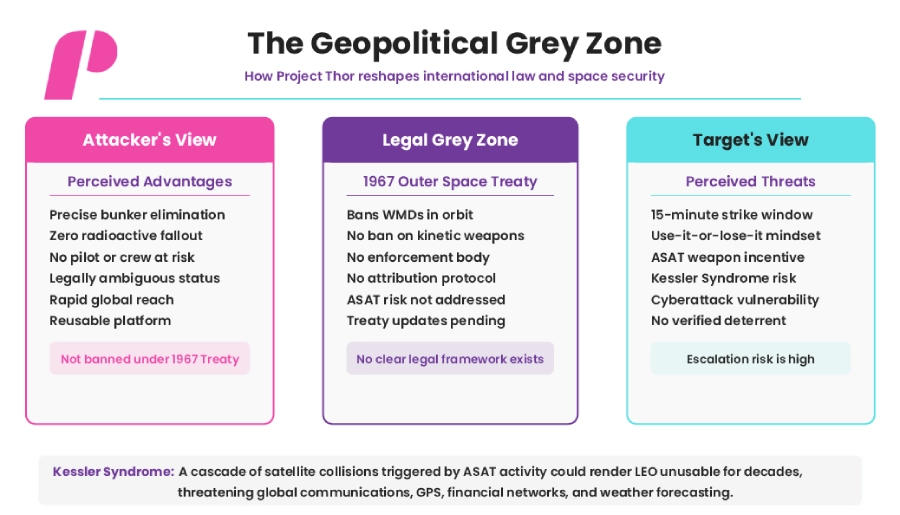
The 1967 Outer Space Treaty remains the foundational document of international space law. It explicitly prohibits the placement of weapons of mass destruction in orbit. Specifically, the treaty bans nuclear warheads, biological agents, and chemical weapons from space. However, Project Thor falls into none of those categories. A tungsten rod legally functions as just a piece of metal.
Consequently, this gap in international law creates one of the most serious strategic dilemmas in modern defense planning. Nations developing kinetic orbital platforms face no formal legal restriction. Conversely, nations that these platforms might target have no treaty mechanism through which they can challenge their existence.
The Attacker and Target Calculation
From the perspective of a nation operating a Project Thor platform, the system offers a combination of attributes that no current weapons system provides. Military commanders can direct precise strikes at targets that remain otherwise unreachable. Furthermore, commanders put no crew at risk. The weapon leaves no radioactive signature. And lastly, the operation technically complies with existing space law.
From the perspective of a potential target, the situation is destabilizing in a specific and dangerous way. A 15-minute warning window between detection of a rod release and impact is dramatically shorter than the 25 to 30 minutes that a standard ICBM trajectory provides. As a result, this brevity creates a use-it-or-lose-it mentality among targeted nations. Enemy command might interpret any perceived threat of a Project Thor strike as a trigger to launch retaliatory weapons before confirmation is possible.
Orbital Debris and Project Thor
Moreover, a secondary but potentially catastrophic risk is the incentivization of Anti-Satellite (ASAT) weapons. If nations believe that Project Thor orbital kinetic platforms pose a first-strike threat, the logical counter-strategy is to destroy them before the enemy can use them. Therefore, an increase in ASAT activity raises the risk of triggering a Kessler Syndrome event.
Kessler Syndrome describes a chain reaction of satellite collisions in which debris from one destroyed satellite strikes other satellites, creating more debris that strikes further satellites in a cascading sequence. At a sufficient debris density, low Earth orbit becomes functionally unusable for generations. Consequently, the consequences would extend far beyond military systems. GPS navigation, global financial transaction networks, weather forecasting infrastructure, and international communications all depend entirely on orbital satellites.
Cybersecurity of Orbital Kinetic Platforms
An orbital weapon platform is, at its core, a networked computing system. It receives instructions, processes sensor data, updates targeting calculations, and communicates with ground control. Every one of those functions represents an attack surface for adversaries.
The cybersecurity implications of a hackable kinetic weapon in orbit are serious. An adversary who gains control of the platform controls a global strike capability without needing to develop their own system. The software becomes the most critical component, and protecting it requires defense-grade security at every layer of the communication and computation stack.
The leading approach in 2026 research is Quantum Key Distribution, or QKD. This method uses the principles of quantum mechanics to encrypt communications. Any interception of a QKD-secured signal disturbs the quantum state of the transmitted photons in a way that is physically detectable. An intercept attempt does not go unnoticed. It generates an immediate alert, providing a fundamentally different security model from conventional encryption, which can, in theory, be broken given sufficient computational resources.
QKD is not yet deployed at scale, but multiple national defense research programs have announced active QKD satellite testbeds. The technology is maturing alongside the kinetic weapon concept itself.
Monitoring the Indicators That Matter
Project Thor is not a market product. It is a research concept at varying stages of technical maturity across several national programs. The 2003 US Air Force report established the foundational physics and proposed initial deployment timelines that have yet to materialize. In 2026, the engineering challenges in reentry guidance and materials remain the primary barriers, and the economic case rests on launch cost reductions that have been partially achieved but are not yet at the level required for practical heavy orbital deployment.
Strategic Milestones for Project Thor
For analysts tracking the defense sector, three observable milestones indicate the pace of development and the proximity of operational capability.
- Launch cadence and cost: Sustained sub-1,000 US dollar per kilogram pricing to LEO, achieved through verified full reusability, would confirm that orbital logistics can support heavy kinetic platform deployment at scale.
- Material science milestones: Successful high-temperature testing of UHTC coatings under simulated reentry conditions would confirm that the structural heat problem is solved.
- Treaty developments: Any formal update to the 1967 Outer Space Treaty, or the introduction of a new framework specifically addressing kinetic weapons, would signal that the geopolitical community considers operational deployment to be imminent.
The Evolution of Low Earth Orbit
The strategic high ground of low Earth orbit is changing in character. For most of the space age, it operated as a domain of satellites, scientific instruments, and commercial communications infrastructure. However, the declining cost of launch access, the maturation of autonomous guidance technology, and the legal ambiguity created by a 58-year-old treaty are converging to bring kinetic orbital weapons like Project Thor from theory toward feasibility.
Future Outlook and Analyst Takeaways
Ultimately, whether international law contains this shift or accelerates toward active deployment will depend on the pace of technological development, the willingness of major powers to negotiate constraints, and the strategic calculations of nations that feel either threatened or advantaged by the new capability.
In conclusion, for defense sector investors and market analysts, Project Thor represents a lens through which they can view a broader transformation of the commercial space industry, aerospace materials science, and the geopolitics of orbit.
If you liked this post make sure to share it!