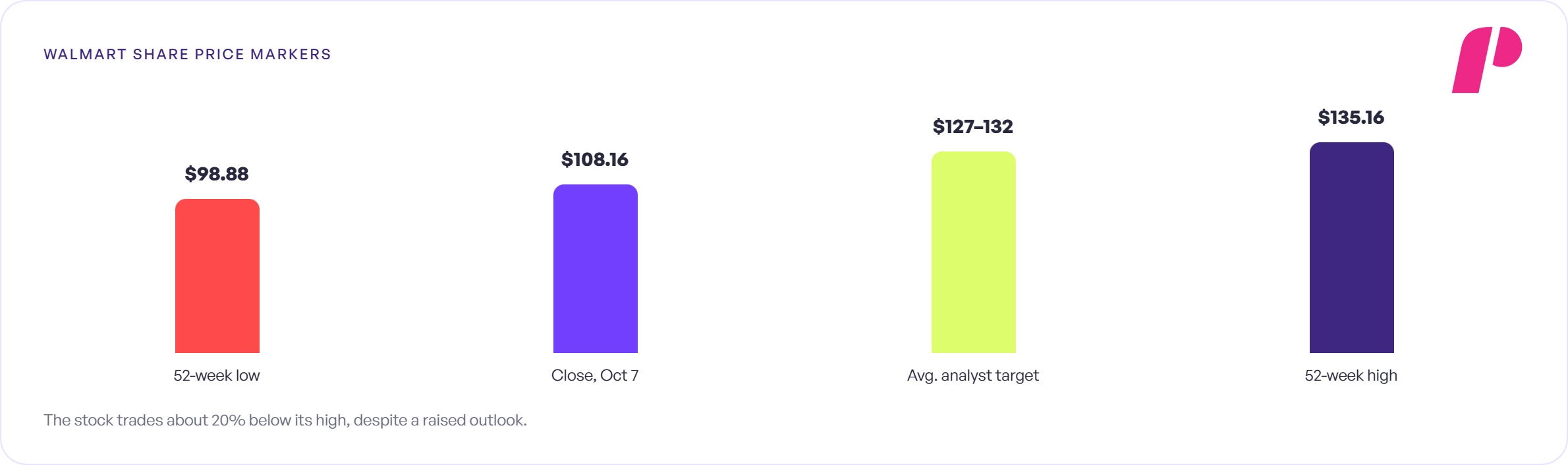
On October 7, Walmart stock closed at $108.16, which is about 20% below its 52-week high of $135.16.
That’s despite the fact that the company just raised its full-year outlook and saw advertising revenue grow by 38%. Investors still price it like the world’s largest store.
🔗Cyclical Stocks in 2026: The Complete Prop Trader’s Guide
In our view, that view misses what Walmart has become. The fact is that it now works more like a technology conglomerate.
It runs a retail media network that earns from the data of about 270 million weekly customers, and its supply chain is driven by AI.
Furthermore, its pharmacy network is moving into weight-loss drugs, while its digital payments business in India keeps growing.
In this article, we will look at what the numbers support and where the vision is still ahead of reality.
The Numbers Behind Walmart Stock
Start with scale, because nothing else in retail comes close.
Looking at fiscal 2026 (the year that closed on January 31), Walmart’s total revenue came to $713.2 billion. Out of this amount, $706.4 billion was net sales.
The biggest part came from Walmart U.S., which brought in $483.0 billion compared with $462.4 billion one year before. That is close to 68% of all net sales.
Walmart Fiscal 2026 Financial Results: Total Revenue, Segment Net Sales, Trailing Metrics & Net Income (2026 Reference)
| Walmart Fiscal 2026 Financial Metric | Figure & Performance Data |
|---|---|
| Total Revenue | $713.2 billion |
| Net Sales | $706.4 billion |
| Walmart U.S. Net Sales | $483.0 billion (up from $462.4 billion) |
| Share of Net Sales from Walmart U.S. | About 68% |
| Trailing Revenue (as of October 2026) | About $736 billion |
| Trailing Net Income | About $22.1 billion |
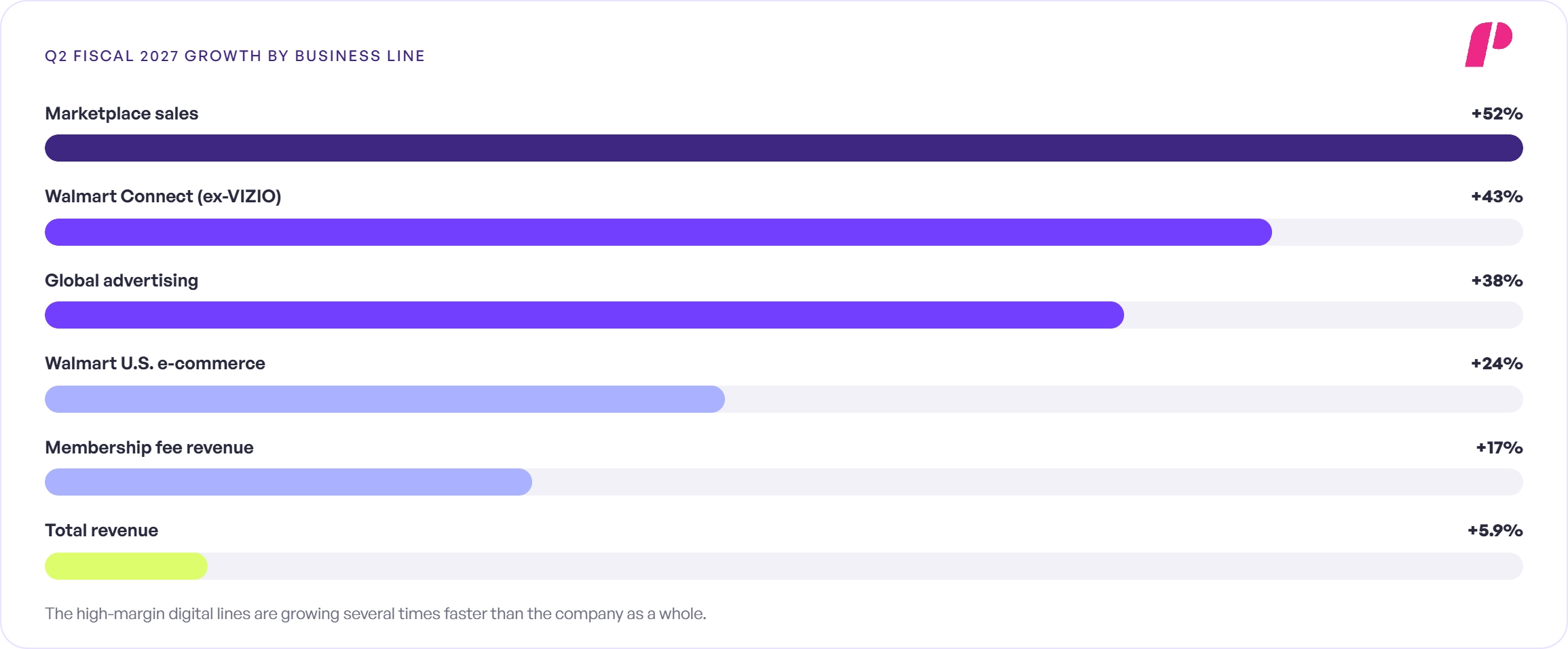
The strong momentum continued through the second quarter of fiscal 2027, which ended on July 31. Revenues increased by 5.9% to reach $187.9 billion.
On the other hand, global e-commerce increased by 23%, while Walmart U.S. e-commerce increased by 24%, marking its tenth consecutive quarter of over 20%.
🔗Amazon Stock Price: Growth Strategies for Investors
On top of that, membership fee revenue went up 17%, and marketplace sales jumped 52%.
Investment Takeaway: Every year, Walmart’s revenue grows by tens of billions of dollars, and there isn’t a rival that works on this kind of scale.
🔗Target Stock Price: Private Labels’ Impact Explained
More and more of this growth comes from the digital side of the business, not from opening new stores.
The Q2 Paradox: Growth and a 9% Drop
The market’s reaction to that quarter tells the real story.
Walmart stock fell 9% on August 20, results day, despite the beat and a raised outlook. U.S. comparable sales grew 2.6%, short of the 3.5% analysts expected.
🔗How to Read an Earnings Report
Health and wellness subtracted 0.8 percentage points as price caps on certain drugs took effect.
Q2 Fiscal 2027 Financial Results: Revenue, Comparable Sales, Operating Income & Guidance (2026 Reference)
| Q2 Fiscal 2027 Financial Metric | Result & Performance Data |
|---|---|
| Q2 Revenue | $187.9 billion (up 5.9% Year-over-Year) |
| U.S. Comparable Sales | Up 2.6% (versus 3.5% consensus expected) |
| Health and Wellness Drag | 0.8 percentage point negative impact |
| Operating Income | Up 28.8% (boosted by tariff refunds) |
| Additional Fuel Costs | More than $2.0 billion projected for the year |
| Full-Year Net Sales Guidance | Raised to 4% to 5% growth range |
Tariff refunds also flattered profits. Chief financial officer John David Rainey said they added a net benefit of about 750 basis points to operating income growth.
Without them, growth landed at the top of the 7% to 10% guidance range. Walmart, on the other hand, anticipates having to incur more than $2 billion in additional fuel expenses this year.
🔗Lululemon Q2 2026 Earnings Preview: Guidance Risk Meets a Leadership Reset
Investment Takeaway: The headline growth numbers look impressive, but then again, one-off gains and drug pricing caps distort them. Walmart stock needs clean, organic margin expansion to recover.
Advertising: The Engine Behind Walmart Stock
Here the conglomerate thesis behind Walmart stock becomes concrete.
In the second quarter, Walmart’s global advertising business grew 38%. Walmart Connect, which is its U.S. retail media network, grew 43% when VIZIO is excluded.
According to Rainey on the call with analysts, the pace of advertising growth is roughly 40%, which leaves e-commerce well behind.
Consequently, advertising together with membership pushed the incremental margins of Walmart U.S. e-commerce into double digits during the first half.
Walmart keeps widening its ad reach. It acquired TV maker VIZIO in December 2024 and closed its acquisition of Vibe, a self-serve connected TV advertising platform, on August 4, 2026.
Management expects Vibe integration costs to trim about 20 basis points from operating income growth this year.
AI now shapes the shopping funnel too. Chief executive John Furner said customer use of Sparky,
Walmart’s AI shopping assistant, rose 70% from last year, and Sparky users spend 40% more per order.
🔗AI Stocks in 2026: How to Evaluate, Choose, and Trade
Investment Takeaway: Advertising turns customer traffic into high-margin profit. In our view, it is the single most important driver of Walmart’s long-term valuation.
Corporate Structure and Global Bets
Walmart separates its operating businesses from its technology and intellectual property.
Much of the company’s patent portfolio sits with Walmart Apollo, LLC, separately from the store network.
On a global level, the company controls a majority share in the biggest Indian online marketplace, Flipkart, and also the largest Indian digital payments company, PhonePe.
🔗Fintech Stocks: What They Are and How Traders Approach Them in 2026

Walmart de México anchors its Latin American business and its near-shoring supply chain.
The company has also pulled back where it saw elevated risk. An illustration is JD.com. In August 2024, Walmart exited the Chinese e-commerce company completely by selling its whole stake.
Investment Takeaway: India is Walmart’s largest international growth bet. PhonePe gives it exposure to digital payments in the world’s most populous country, far beyond retail.
The Leadership Reshuffle
Walmart rebuilt its top team over the past year, a shift that matters for anyone holding Walmart stock through a period of heavy regulatory attention.
Corporate Leadership & Governance: Executive Roles, Board Composition & Appointment Timelines (2026 Reference)
| Executive Leader | Corporate Role & Appointment Details |
|---|---|
| John Furner | President and Chief Executive Officer (serving since February 1, 2026) |
| John David Rainey | Chief Financial Officer |
| Erin Nealy Cox | Chief Legal Officer (appointed April 13, 2026) |
| Dan Bryant | Executive Vice President, Global Public Policy |
| Gregory B. Penner | Chairman of the Board of Directors |
| Randall Stephenson | Lead Independent Director |
John Furner succeeded Doug McMillon, who retired on January 31. Erin Nealy Cox joined from Kirkland & Ellis. During the years 2017 to 2021, she served as the U.S.
Attorney for the Northern District of Texas. During this time, she was also serving as the chairperson of the Attorney General’s Advisory Committee.
Additionally, the outcome of the Boeing 737 MAX matter that her office managed was a deferred prosecution agreement worth more than $2.5 billion.
Concerning Rainey, he was a former CFO of PayPal and United Airlines and had been a member of the Nasdaq Board. OpenAI chief financial officer Sarah Friar serves on Walmart’s board.
In our view, the reason behind these legal and policy hires is fairly clear. Walmart expects heavy regulatory and antitrust scrutiny, and therefore it is putting a strong defense in place ahead of time.
🔗How Antitrust Cases Move Stocks
Investment Takeaway: On one side of the leadership team, there are retail operators, while on the other side there are people with deep legal, policy, and technology backgrounds.
This mix makes sense for a company whose biggest risks are now coming from regulators.
Labor Market Power
Walmart’s scale reaches into local economies.
Given that Walmart is the biggest private employer in the US, it can influence wage rates in the locality.
The truth is that the Washington Center for Equitable Growth released a working paper about this matter.
It found that Walmart Supercenter openings act like a monopsony, meaning a market with one dominant buyer of labor, and local retail wages go lower.
🔗Walmart Stock Price Reactions to Wage Increases
Consequently, the same power over labor also helps Walmart keep its costs down.
Investment Takeaway: Labor-market power supports Walmart’s low-cost model. Nevertheless, it also draws political and regulatory pressure over wages and working conditions.
AI and the Supply Chain
Artificial intelligence is part of almost every step at Walmart, from the moment demand is forecast until the order is delivered.
The demand-forecasting models do not look at only one date in the future. They look at various aspects simultaneously, taking into consideration past trends, planned events, as well as the weather conditions of the area.
After the customer places his order, it is then taken care of by the multi-agent system. As a result, the customer does not get a fixed delivery promise but an arrival window that can move.

Within the fulfillment centers, the groceries are picked and sorted using the Alphabot system and subsequently handed to human packers.
Sustainability is yet another application of artificial intelligence. In this case, AI optimizes the delivery route while computer vision gauges the size of each order to make packaging fit. In this way, less cardboard goes to waste.
Investment Takeaway: The cost of every order goes down with automation. When it comes to margins over the long term, this improvement carries more weight than opening any single new store.
Patents: What Walmart Actually Owns
A widely shared analysis described US Patent 10,719,805, covering mobile secure lockers in autonomous delivery vehicles, as the crown jewel of Walmart’s portfolio.
Patent records show it belongs to Nuro, the autonomous delivery company, whose co-founders appear among the inventors.
Walmart has worked with Nuro on autonomous delivery pilots, which may explain the confusion.
Walmart Apollo holds its own patents across supply chain, logistics and retail technology. In our view, however, its real edge doesn’t come from any single patent. It comes from the data and operating scale that competitors find very hard to copy.
🔗Patent Portfolios and IP Moats
Investment Takeaway: Investors shouldn’t give Walmart credit for autonomous-delivery patents that belong to another company. Its moat is built on scale and data rather than on robotics IP.
Cybersecurity at Scale
When a company holds data on about 270 million weekly customers, security has to be rigorous.
Walmart’s security is based on a Zero Trust framework. Under this approach, no user or device is trusted until it has been verified.
In addition, the network is micro-segmented, so an attacker who gets into one system cannot easily move to the next one.

Meanwhile, Jerry Geisler, the Chief Information Security Officer, has pushed for protection that customers barely notice when they shop.
According to Walmart, 1.4 million associates completed cybersecurity and data-handling training in fiscal 2026.
Investment Takeaway: A major data breach would hurt customer trust, and it would also hurt the advertising business, since that business depends on first-party data. Therefore, security is part of the core business.
Pharmacy and the Weight-Loss Market
Health care is another area where Walmart keeps going deeper.
In May 2025, it opened its largest automated central-fill pharmacy in Frederick, Maryland. Robotics at the facility count, label, and sort prescriptions, and as a result, pharmacists have more time for patient care.
Since November 2025, Walmart pharmacies have offered pickup for Eli Lilly’s Zepbound through LillyDirect, the first retail partner for that program.
🔗Magnificent 7 Stocks: Where Investors Are Finding Growth in 2026
Zepbound Vial Pricing: Self-Pay Monthly Rates, Dosage Tiers & Refill Windows (2026 Reference)
| Zepbound Vial Dosage Tier (Self-Pay) | Monthly Price & Refill Conditions |
|---|---|
| 2.5 mg Starter Dose | $299.00 per month |
| 5 mg Maintenance Dose | $399.00 per month |
| 7.5 mg to 15 mg Doses | $449.00 per month (requires refills within 45 days) |
Lilly cut those prices on December 1, 2025, and pickup costs the same as home delivery. Government drug price caps, however, work in both directions. They widen access, but they also trimmed Walmart’s second-quarter comparable sales.
Investment Takeaway: Pharmacy brings customers in often and keeps them loyal. On the other hand, lower drug prices make the market bigger but squeeze the revenue Walmart books on each prescription.
The Physical-Digital Disconnect
Here the vision meets the store floor.
In our view, Walmart builds advanced digital capabilities on top of a vast physical footprint that struggles to keep pace. Retail theft is one problem.
Local zoning limits on autonomous delivery are another, and the large number of aging stores slows the transformation down further. In simpler terms, the software can move fast, while the buildings can’t.
Investment Takeaway: The gap between Walmart’s digital ambitions and its physical network is the central execution risk. Closing it is what would justify a technology-style valuation.
Valuing Walmart Stock: Closing Price, 52-Week Range, P/E Multiples & Analyst Targets (2026 Reference)
| Valuation Marker & Financial Parameter | Figure & Market Data |
|---|---|
| Closing Price (as of October 7) | $108.16 per share |
| 52-Week Trading Range | $98.88 to $135.16 per share |
| Market Capitalization | About $860 billion |
| Trailing Price-to-Earnings (P/E) Ratio | About 39x earnings |
| Average Analyst Price Target | About $127.00 to $132.00 |
| Analyst Consensus Rating | Buy |
Analysts remain positive but more cautious. Mizuho cut its target to $125 and Telsey to $130 after the second quarter.
🔗What Is Market Capitalization?
The bull case is relentless scale, 38% advertising growth, accelerating e-commerce, and expanding health care.
🔗Analyst Price Targets Explained
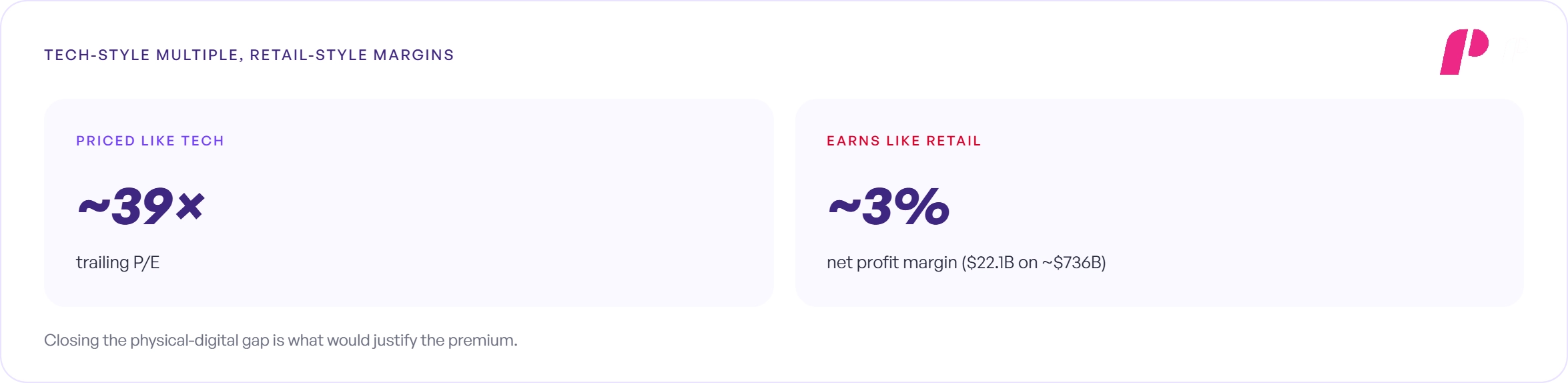
The bear case is a premium valuation of about 39 times earnings for a retailer with roughly 3% profit margins, slower third-quarter guidance, and the distortion from one-time tariff refunds.
Investment Takeaway: Walmart stock trades at a technology-style multiple on retail-style margins. Advertising growth must keep accelerating to defend that premium.
The Risks That Matter for Walmart Stock
- Valuation. A trailing P/E near 39 leaves little room for disappointment.
- Earnings quality. Tariff refunds inflated second-quarter operating income growth.
- Drug price caps. Government pricing reduced health and wellness sales.
- Fuel costs. More than $2 billion of extra fuel expense weighs on the year.
- Regulation. Scale invites antitrust and labor scrutiny.
- International risk. India’s regulatory environment shapes Flipkart and PhonePe.
- Execution. The physical network must keep pace with digital ambitions.
🔗Swing Trading Risk Management
Closing Thoughts
Few companies can match the assets Walmart has put together. Its retail media network is growing near 40% a year, and its supply chain runs on AI.
Furthermore, it owns a payments platform in India, and its pharmacy network is moving into GLP-1 drugs. Last year it generated $713.2 billion of revenue, yet it still grows faster online than most of its rivals.
So the verdict comes down to one question: “Can advertising and digital profits grow fast enough to justify a technology multiple on a retail balance sheet?” Investors who want to follow this can watch four markers.
These are third-quarter advertising growth, organic operating margins without the tariff refunds, Walmart+ membership, and the progress on store automation.
In our view, the core operational moat remains virtually unassailable, and if Walmart bridges the physical-digital gap, it could achieve unmatched global supply-chain dominance.
NFA. DYOR. This analysis is for informational purposes only and is not investment advice. Sources include Walmart SEC filings, including its fiscal 2026 Form 10-K and second quarter fiscal 2027 earnings release, Walmart and Business Wire announcements, Eli Lilly pricing disclosures, Google Patents, the Washington Center for Equitable Growth, and CNBC, MarketBeat, and StockAnalysis data as cited.
If you liked this post make sure to share it!