The Netflix stock price ended the day at $67.06 after closing on October 2, which is approximately 46% lower than its highest price over the last year at $124.86. Normally, a drop of this size follows weak results.
In this case, however, the business kept growing throughout the decline, as second-quarter revenue rose 13% to $12.56 billion and the operating margin reached 33.4%.
The gap between the business and the share price is the story. Netflix won streaming, then lost Warner Bros. to Paramount, and growth is slowing. Then, on October 14, it cut about 1,000 jobs.
In our view, Netflix now faces the problems of a mature global utility, not a challenger.
🔗Cyclical Stocks in 2026: The Complete Prop Trader’s Guide
Therefore, this analysis examines whether its engine can carry the NFLX stock price through that shift. Results arrive on October 20.

The Numbers Behind the Netflix Stock Price
Start with the record, because it remains strong. For example, in 2025, sales amounted to $45.2 billion, indicating 16% growth compared Netflix now faces the problems of a mature global utility, not a challengerto the previous year, and the operating margin increased by three points to 29.5%.
Moreover, paid memberships reached 325 million at the end of the fourth quarter. Similarly, the first part of 2026 followed the same trend, reporting close to $25 billion in revenue, a growth of 15% in one year. Back in 2025, the advertising income also increased by more than 2.5 times, to over $1.5 billion.
Netflix Financial Performance & Operating Margin Trends
| Financial Period & Results | Total Revenue & Growth Rate | Operating Margin Percentage |
|---|---|---|
| Full Year 2025 Actuals | $45.2 billion (up 16% year-over-year) | 29.5% |
| Q1 2026 Financial Results | $12.25 billion (up 16% year-over-year) | 32.3% |
| Q2 2026 Financial Results | $12.56 billion (up 13% year-over-year) | 33.4% |
| Q3 2026 Guidance | $12.86 billion (~12% growth) | 33.2% |
| Full-Year 2026 Guidance | $51.0 billion to $51.4 billion | 31.5% |
The trend line is the problem. Nevertheless, the growth in sales for the company has continued to decline for four straight quarters, and the growth is currently at 11% for the second quarter on a constant-currency basis.
🔗How to Read an Earnings Report
On the other hand, the hours people spent watching increased by just 2% to 97 billion for the first half of the year. The net income for the second quarter reached $3.4 billion, representing a 9% increase.
However, the guidance for the third quarter fell short of Wall Street expectations, and content spending is expected to increase by about 10% in 2026.
Investment Takeaway: On the profit front, Netflix is scaling up. But slowing growth now drives the Netflix stock price more than margin expansion.
The Warner Bros. Deal That Got Away
The year’s defining event happened in February. Netflix entered into an agreement on December 5, 2025, to purchase the Warner Bros. studio and HBO Max properties for about $82.7 billion, inclusive of debts.
Shortly afterward, Paramount Skydance answered with a higher rival bid. On February 26, 2026, Warner Bros. Discovery declared Paramount’s offer superior. Netflix declined to raise its price within an hour.
Warner Bros. Discovery Acquisition Timeline
| Transaction Date & Timeline | Corporate Event & Merger Milestone Description |
|---|---|
| December 5, 2025 | Netflix signs definitive agreement to acquire Warner Bros. assets for approximately $82.7 billion |
| February 26, 2026 | WBD determines Paramount’s competing bid is superior, prompting Netflix to step away |
| February 27, 2026 | Merger agreement with Netflix terminated; Paramount pays $2.8 billion termination fee |
| October 2026 | Paramount officially completes its corporate takeover and integration of WBD |
The $2.8 billion termination fee lifted first-quarter earnings to $1.23 per share, against a $0.76 forecast. Chief financial officer Spence Neumann said the decision came down to price.
The competitive cost is lasting. Moreover, Paramount intends to combine HBO Max and Paramount+ into one global service. As a result, Netflix finds itself facing a competitor that is stronger than ever before.
Investment Takeaway: Netflix received a $2.8 billion termination fee for ending the deal while keeping its books clean. It also lost a premium library to a strengthened competitor, and that is a cost the Netflix stock price still carries.
Layoffs and the Growth Reset
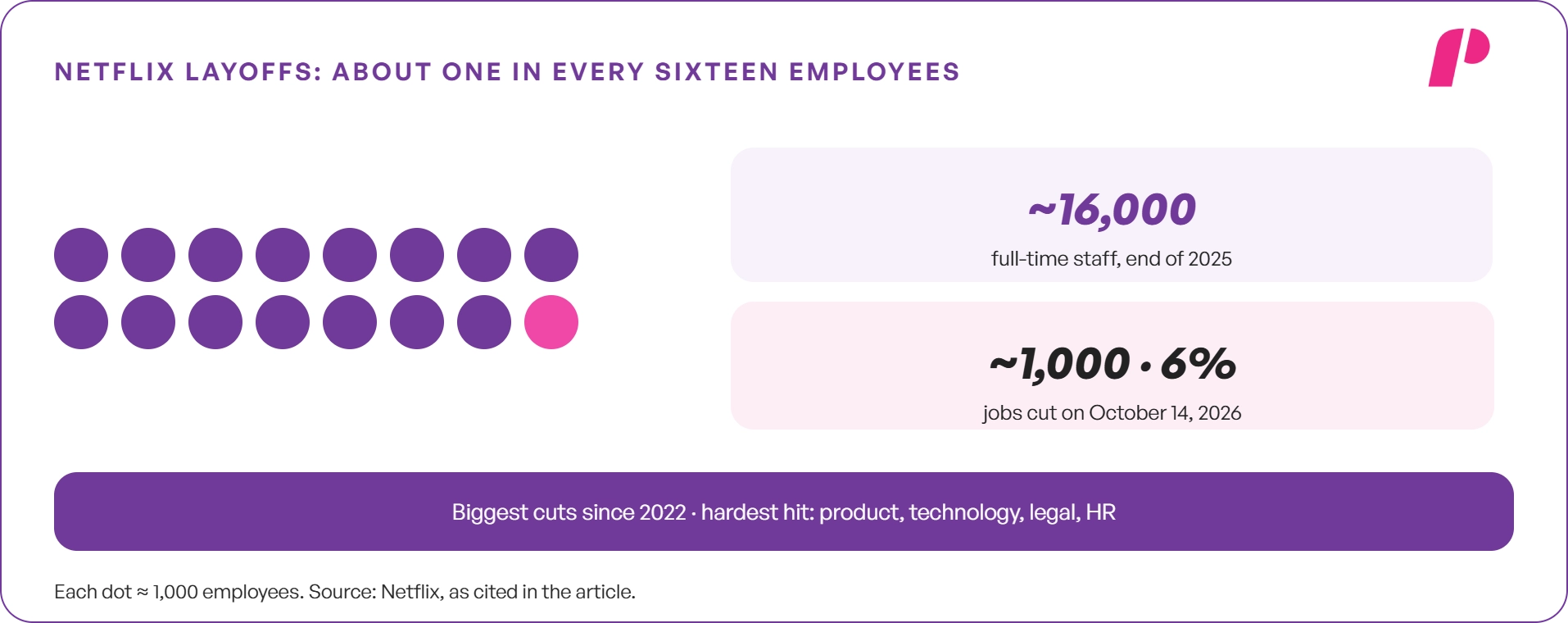
The October cuts confirm the shift in priorities. On October 14, Netflix said it would cut about 6% of staff, close to 1,000 people. The cuts hit product, technology, legal, and human resources most.
In fact, it was Netflix’s biggest layoffs since 2022, when it had seen a decline in its subscription base for the first time after ten years.
As of the end of 2025, the total number of full-time staff at Netflix was about 16,000, so the cuts affect approximately one in every sixteen employees.
Even before the layoffs, co-chief executive Ted Sarandos had acknowledged that growth is slower than he would like. In a memo, he and co-CEO Greg Peters put the emphasis on discipline.
The company, they wrote, must be “disciplined about where we prioritize our people and resources.” At the same time, Netflix said it remains on track for its full-year forecast.
For these reasons, the job cuts can be seen as margin protection, not distress. In other words, Netflix is now run with profit as the priority, since its growth phase is winding down.
Investment Takeaway: Cost control is key to profitability, and therefore to the Netflix stock price. The question for traders is whether management will also present a credible growth plan alongside it.
The Advertising Bet
Netflix once rejected advertising. However, slowing growth in mature markets reversed that stance. As a result, the ad tier now drives much of the growth story.
The company had 190 million monthly active ad viewers by November 2025, while according to trade reports for its May 2026 upfront, the number is close to 250 million.
Consequently, management projects that ad revenues will increase roughly twofold in 2026, from more than $1.5 billion in 2025. In our view, advertising brings back the cable bundle that Netflix once disrupted.
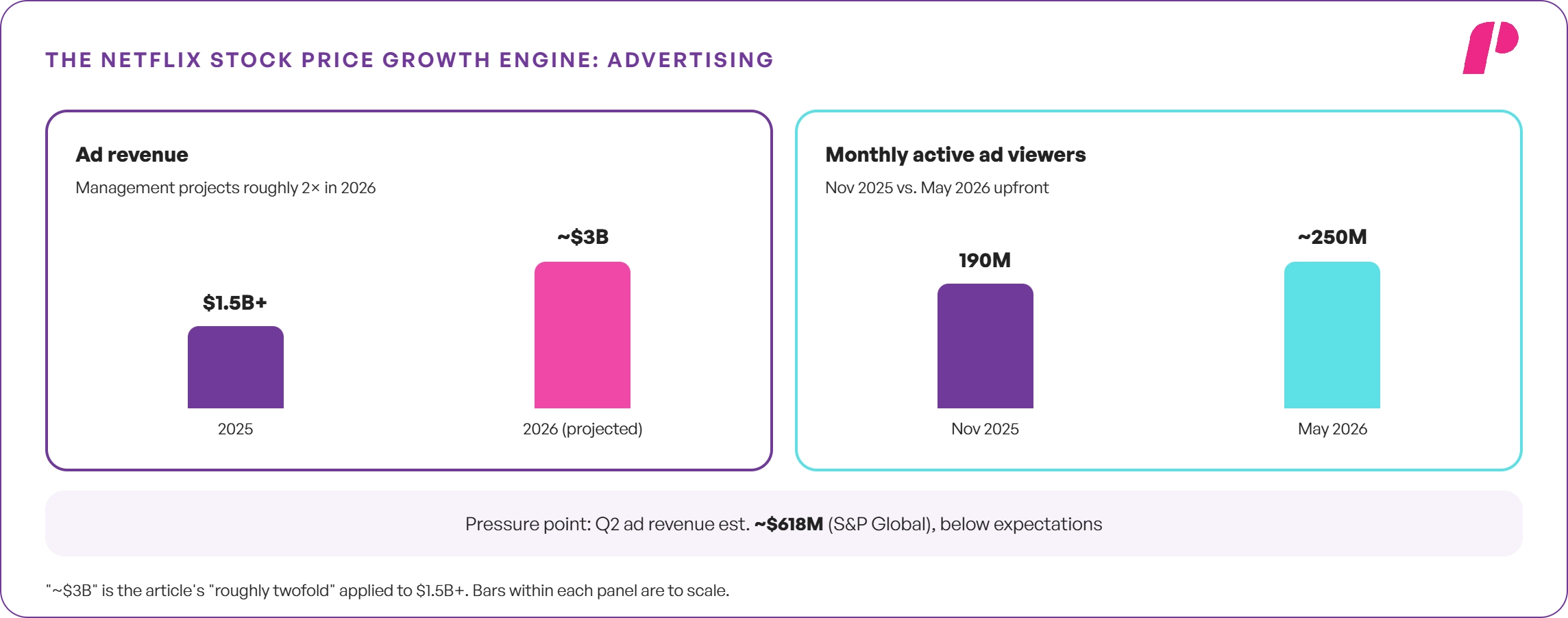
The fact is that ads, tiers and live events all follow the model of linear television, and as a result they also carry its economics. That said, the pressure points are real. S&P Global estimated second-quarter ad revenue at about $618 million, which came in below expectations.
Furthermore, Amazon and Disney keep adding ad inventory, and this weighs on connected-TV pricing. In addition, live sporting events have fixed costs too. An example would be the $5 billion, 10-year WWE Raw contract and the NFL holiday games.
🔗Amazon Stock Price: Growth Strategies for Investors
Investment Takeaway: Advertising may help increase revenue per subscriber and, as a result, support the Netflix stock price. But that would be dependent on Netflix’s pricing power amid heavy competition.
Margins: The Fourth-Quarter Math
At this point, traders can check the guidance on their own. Netflix guided its 2026 operating margin to 31.5%, while the first three quarters sit close to 33%.
If all this is true, then Q4 is going to be softer than the rest of the year. Put simply, the Q4 margin is what remains of the operating income for the whole year once the first three quarters are taken out, divided by Q4 revenue.
For example, by considering the mid-point of the revenue guidance, which is $51.2 billion, and using a margin of 31.5%, we get operating income for the year at approximately $16.1 billion.
If we deduct what Netflix earned in the first two quarters and what it expects to earn in the third, the amount remaining for the fourth quarter will be approximately $3.7 billion.
The reason for this gap is, most likely, that the fourth quarter carries the heaviest content and live sports bills of the year. That implies Q4 revenue near $13.5 billion and a margin near 27.4%. This is our calculation from published guidance, not a company figure.
Operating Margin & Implied Q4 Financial Breakdown
| Margin Component & Financial Metric | Figure & Projected Operating Performance |
|---|---|
| Full-Year 2026 Revenue Guidance Midpoint | $51.2 billion |
| Full-Year Operating Income (at 31.5% margin) | About $16.1 billion |
| Cumulative Q1 to Q3 Operating Income | About $12.4 billion |
| Implied Q4 Operating Income | About $3.7 billion |
| Implied Q4 Operating Margin Percentage | About 27.4% |
Investment Takeaway: Content and live sports costs weigh on the fourth quarter. Therefore, a Q4 guide above this implied level would surprise positively and could lift the Netflix stock price.
Geopolitics and Content Quotas
Working in over 190 countries, it’s hard for Netflix to stay away from regulatory challenges. Take the EU as an example, where at least 30% of a streaming library has to be European productions.
Similarly, France levies streaming revenue to fund local film. Likewise, Canada’s Online Streaming Act forces contributions to domestic content.
In South Korea, broadband provider SK Broadband fought Netflix for years over network usage fees before settling.
For this reason, Netflix answers with local production. It runs major production hubs in Spain and the United Kingdom, and studios across Latin America.
In our view, quotas raise regional costs but also feed the local content that wins global audiences.
Investment Takeaway: Sovereign rules add steady overhead. They rarely threaten the core model, but they cap margin expansion abroad.
Technology and Patent Defense
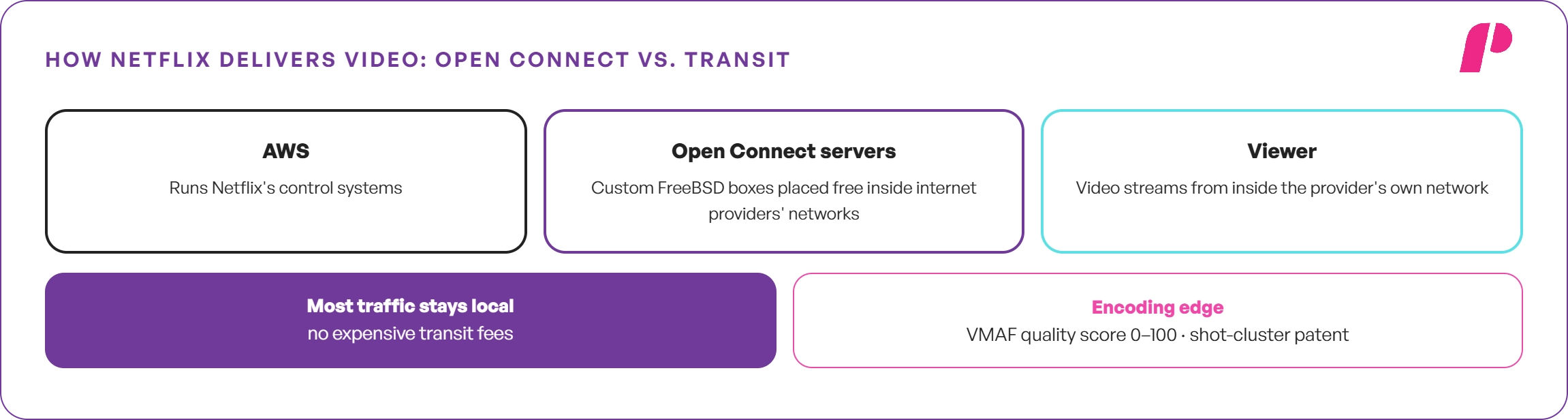
Netflix runs its control systems on Amazon Web Services. In addition, it delivers video through Open Connect, its own content delivery network. Netflix places custom servers running FreeBSD inside internet providers’ networks at no charge.
Because of this setup, most of the traffic never leaves the provider’s network, and Netflix doesn’t have to pay expensive transit fees. Its encoding science gives Netflix a further advantage. VMAF, for instance, was developed by Netflix together with university researchers.
Basically, it gives a video a score from 0 to 100, depending on how good it looks to the person watching it. Netflix also got US Patent 11,818,375 back in September 2023, and this one is about putting similar shots together into groups, or clusters.
Each cluster is then encoded at an optimized setting, so computing costs fall while the quality remains high. When it comes to protecting this IP, Netflix has been aggressive.
In February 2026, the Federal Circuit reversed the patent board in Netflix’s favor against DivX. Later, on September 21, the board invalidated DivX patent 10,225,588 as obvious.
In February, Netflix also won against GoTV Streaming, as the court ruled its claims ineligible.
🔗How Patent Litigation Affects Tech Stocks
Investment Takeaway: The infrastructure and encoding IP help lower delivery costs at scale. Furthermore, the litigation wins reduce the legal overhang on the Netflix stock price.
Leadership and Governance
The leadership structure within Netflix features co-CEOs, Ted Sarandos in charge of the creative segment and Greg Peters in charge of technology. Meanwhile, the company’s co-founder Reed Hastings is chairman.
Corporate Governance & Board of Directors
| Board Member Name | Professional Background & Executive Experience |
|---|---|
| Reed Hastings | Co-founder and Chairman of the Board |
| Susan Rice | Former U.S. National Security Advisor and former U.N. Ambassador |
| Brad Smith | Vice Chair and President, Microsoft Corporation |
| Mathias Döpfner | Chief Executive Officer, Axel Springer SE |
| Strive Masiyiwa | Founder and Executive Chairman, Econet Group |
| Ann Mather | Former Chief Financial Officer, Pixar Animation Studios |
In our view, the board blends diplomacy, technology and international media experience. Consequently, that mix suits a company navigating quotas, data rules and global regulators.
Investment Takeaway: Governance depth supports global expansion. It cannot by itself restart faster growth.
The Risks That Matter for the Netflix Stock Price
- Slowing Growth. Revenue growth has decelerated for four straight quarters.
- Engagement. Viewing hours rose just 2% in the first half of 2026.
- Competition. Paramount’s combined HBO Max and Paramount+ service, plus YouTube, pressures attention.
- Ad Pricing. More streaming ad inventory may weigh on rates.
- Sports Costs. Live rights add large fixed commitments.
- Margins. Guidance implies a softer fourth quarter.
- Regulation. Content quotas and levies raise costs abroad.
🔗Risk Management in Stocks: A Complete Guide 2026
Trading the Netflix Stock Price Around October 20
Netflix will publish its Q3 results after the market closes on October 20. Its own guidance calls for revenue of about $12.86 billion and an operating margin of 33.2%. Analysts, on their side, are looking for earnings of around $0.82 per share.
To estimate the size of the reaction, traders can use a simple formula:

🔗Options Expected Move Explained
Let’s say, for example, that options imply a 7% move. At $67.06, that works out to roughly $4.69 either way, which gives a range of about $62.37 to $71.75. Finally, replace that assumption with the live options figure before the report.
🔗Fair Value Gap Trading: Here’s What You Need to Know
Netflix Equity Catalyst & Monitoring Framework: Key Signals, Data Sources & Likely Stock Impact (2026 Reference)
| Catalyst Signal & Metric | Where to Find / Data Source | Likely Effect on NFLX Stock Valuation |
|---|---|---|
| Revenue vs. $12.86 Billion Guidance | Official shareholder letter | Directly tests the corporate revenue slowdown narrative |
| Q4 Margin Guidance vs. Implied ~27% | Quarterly shareholder letter disclosures | Serves as the primary valuation swing factor for profitability |
| Advertising Revenue Trajectory | Earnings video interview commentary | Tests the momentum of the nascent ad-tier growth engine |
| Platform Engagement Trends | Shareholder letter metrics & analyst notes | Addresses core institutional concerns (such as HSBC’s view on engagement) |
| Share Buyback Execution Pace | Quarterly cash flow statement | Signals management confidence and commitment to capital returns |
Valuation Markers & Analyst Price Targets
| Valuation Marker & Financial Metric | Figure & Benchmark Comparison |
|---|---|
| Share Price Close (October 2, 2026) | $67.06 per share (split-adjusted) |
| 52-Week Trading Range | $65.08 to $124.86 |
| Forward Price-to-Earnings (P/E) Ratio | About 20.0x |
| Wall Street Consensus Price Target | About $92.00 to $93.00 per share |
| HSBC Analyst Target (Downgraded to Hold) | $76.00 per share |
| Citi and Bernstein Analyst Targets | $100.00 per share |
| Remaining Buyback Authorization (Post-Q2) | About $27 billion remaining |
Keep in mind that Netflix split its stock 10-for-1 in November 2025, so every figure here is split-adjusted.
🔗Stock Splits and Reverse Splits Explained
Over the past twelve months, the Netflix stock price has dropped by more than 40%.
On September 22, HSBC reduced its rating on Netflix to Hold due to low engagement and YouTube competition. Before that, Citi analyst Jason Bazinet had listed four pressures on the shares.
These were tepid viewership, a deal overhang, few catalysts, and investor enthusiasm for chip stocks. He still rates Netflix a Buy, however, and both Citi and Bernstein keep a target of about $100.
🔗Analyst Price Targets Explained
At roughly 20 times forward earnings, the stock trades far below the premium it held historically. We still consider Netflix an exceptional engine.
Nevertheless, to preserve its valuation, the company now has to defend its technology, control its sports commitments, and manage sovereign politics.
Investment Takeaway: Slower growth is already reflected in the NFLX stock price. Therefore, a credible acceleration in ads or engagement would challenge the bearish consensus.
Closing Thoughts
Netflix has built a global platform that funds itself, with 325 million paid memberships, 33% operating margins, and a powerful delivery network. When it walked away from Warner Bros., it also left with $2.8 billion and a clean balance sheet.
On the other hand, growth is slowing, engagement is flat, and a stronger rival is forming.
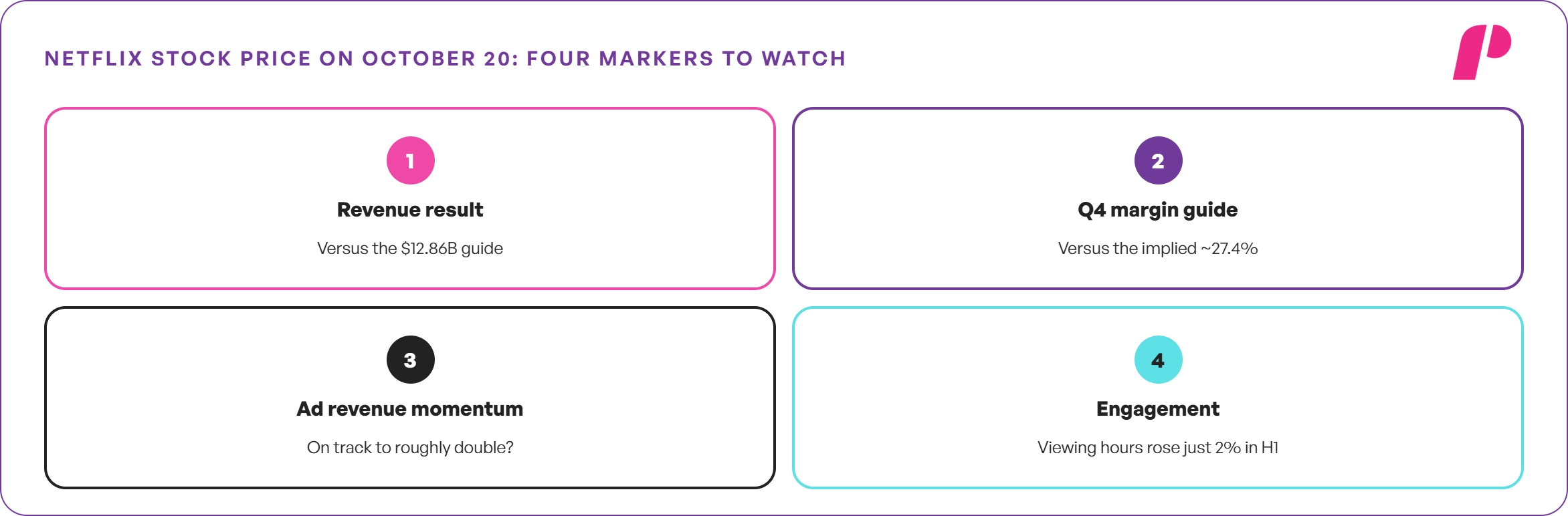
In the end, the verdict on the Netflix stock price depends on one question: can Netflix turn its global scale into renewed growth, rather than become a slow-moving utility? On October 20, traders should watch four markers: the revenue result, the fourth-quarter margin guide, ad revenue momentum, and engagement.
In our view, Netflix has the operating engine to survive its own triumph, although the market will first demand proof of growth.
NFA. DYOR. This analysis is for informational purposes only and is not investment advice. Calculations are hypothetical illustrations or derived from company guidance.
If you liked this post make sure to share it!