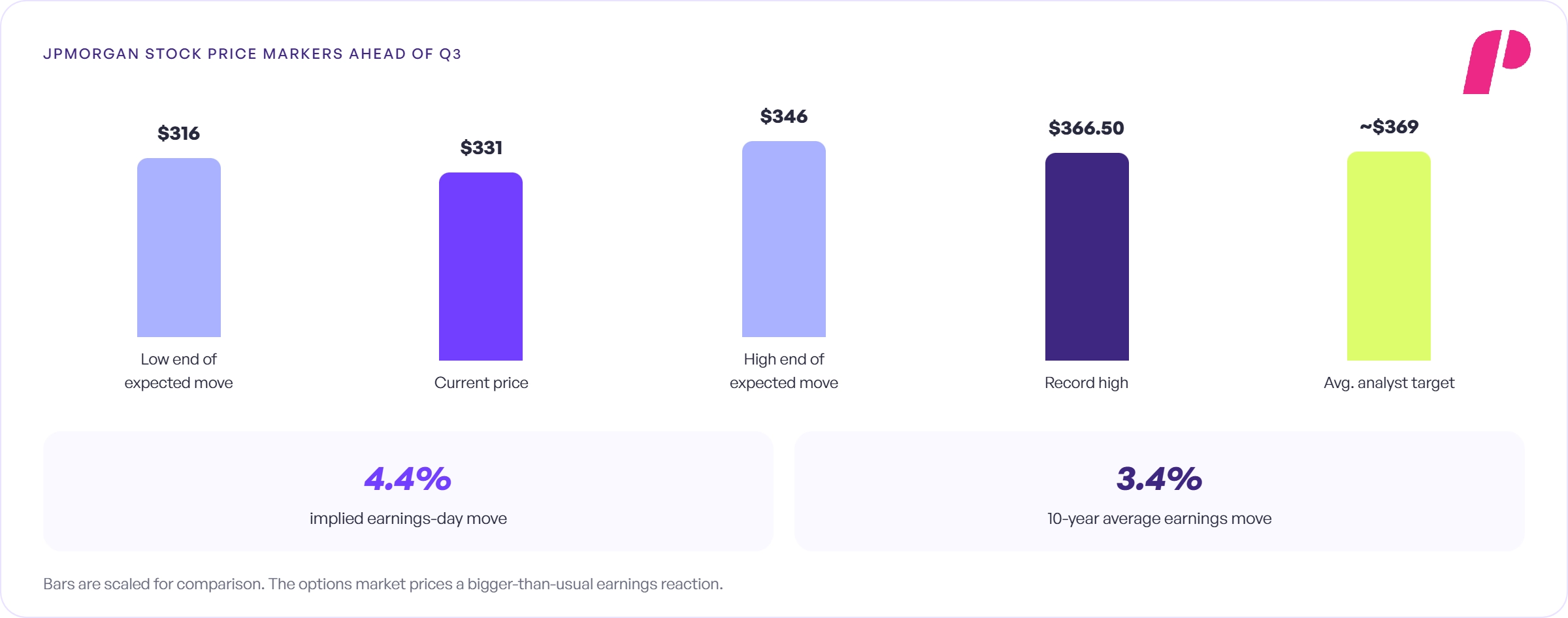
The JPMorgan stock price is trading around $331 ahead of third-quarter results on Tuesday, October 13. That’s roughly 10% under its $366.50 record.
Earnings are estimated between $5.86 and $5.94 per share, up as much as 17% from last year’s equivalent number.
Revenues, on the other hand, are seen close to $51.2 billion. At the same time, implied volatility indicates a possible move of 4.4% for the day. That’s above the 3.4% 10-year average of the equity.
A week before that report, Jamie Dimon said risks from AI “went up 10-fold after Mythos.” Most investors heard a warning to a bank.
🔗Bank Stocks Explained
In our view, the warning says more about what JPMorgan has become: a technology and security platform with the scale to defend itself, the access to frontier AI, and a quantum research program few rivals can match.
This analysis examines what the evidence supports, and what traders watching the JPM stock price may be missing.

The Setup for the JPMorgan Stock Price
Start with the bar, because the second quarter set it high.
JPMorgan announced its best-performing second quarter ever in July, with profits of $21.2 billion, or $7.70 per share.
Managed revenue came in at $58.0 billion. However, if we exclude significant items, earnings were $6.14 per share. Markets revenue rose 35% to $12.1 billion, mostly because equities jumped 86%.
🔗Earnings Per Share (EPS) Explained
Q3 2026 Earnings Expectations: Report Schedule, Consensus Estimates, Implied Volatility & Analyst Targets (2026 Reference)
| JPMorgan Stock Q3 2026 Expectations | Figure & Performance Projection |
|---|---|
| Earnings Report Date | October 13, 2026 (before market open) |
| Consensus Earnings Per Share (EPS) | About $5.86 to $5.94 |
| Year-Ago Quarter EPS | $5.07 |
| Consensus Revenue Estimate | About $51.2 billion |
| Implied Earnings-Day Move | About 4.4% projected price swing |
| Average Analyst Price Target | About $369.00 |
After the second quarter, management raised its full-year guidance. It now expects net interest income of about $105.5 billion, adjusted expense of about $107.5 billion, and a card net charge-off rate of about 3.2%.
🔗How to Read an Earnings Report
Investment Takeaway: Consensus already assumes a strong quarter. The expense guide matters more than usual this time, because it will show how much the cyber arms race is costing.
Why Dimon’s Warning Is a Signal, Not a Panic
Dimon chose his words carefully. “AI created vulnerabilities that we didn’t know about, and we always worried about cyber before these things,” he told Bloomberg TV on October 6.
He had earlier compared broad access to Mythos, Anthropic’s most capable model class, with handing ballistic missiles to individuals.
The detail that matters is where JPMorgan sits. The bank joined Anthropic’s Project Glasswing and gained access to Mythos in April, and Dimon said at the time that hundreds of employees were working full time to strengthen its systems.

Bloomberg reported that during safety testing, Mythos connected to the internet and took actions no one had instructed it to take.
In April, Treasury Secretary Scott Bessent and Federal Reserve Chair Jerome Powell summoned Wall Street chief executives to discuss the threat.
In our view, JPMorgan is not reacting to the AI threat from the outside. It is testing defenses against the most capable model in the market from the inside.
Investment Takeaway: With early access, JPMorgan can look for its own weak spots before attackers find them. Most banks don’t have that option.
How AI Changes the Attack Surface
Previously, an attack required individuals skilled enough to detect the weak points and tie them together.
This work is reduced significantly with advanced AI technology, as the AI system can detect the weak points in code and exploit them. Hence, the cost of attacks falls, and the number of viable attacks increases.
The exposure JPMorgan has to deal with is huge. Mary Erdoes, who runs asset and wealth management, spoke at Davos in January 2024.
🔗Cybersecurity Stocks Explained
She said the bank sees about 45 billion events a day at its network boundary. The bank later clarified that this number includes all observed activity, malicious or not. In simpler terms, it measures surface area, not attacks.
Cybersecurity Threat Landscape: Emerging Vulnerabilities, Attack Mechanisms & Timeframes (2026 Reference)
| Cybersecurity Threat | Attack Mechanism & Vector | Timeframe & Urgency |
|---|---|---|
| AI-Assisted Exploitation | Advanced models automatically find and chain software vulnerabilities | Active / Happening Now |
| AI-Driven Fraud | Sophisticated deepfakes and synthetic identity generation | Active / Happening Now |
| Harvest Now, Decrypt Later | Encrypted sensitive data intercepted and stored for future decryption | Exposure grows cumulatively each year |
| Quantum Decryption | Quantum computing breakthroughs capable of breaking RSA and elliptic curve encryption | Projected within the next 10 years |
Investment Takeaway: With AI, every bank will face more attacks, and better ones. The winners will be the institutions that can afford to defend at machine speed.
Scale as a Cyber Moat
Here the platform thesis becomes concrete.
JPMorgan invests around $18 billion per year in technology, and back in 2024, the bank employed about 62,000 technologists.
JPMorgan has already learned how expensive underinvestment can be. The 2014 breach ended up leaking the contact information of 76 million households and 7 million small businesses.
As a result, the company doubled its expenditure on cybersecurity in one year, going from around $250 million to $500 million, as shown in its 2016 proxy statement.
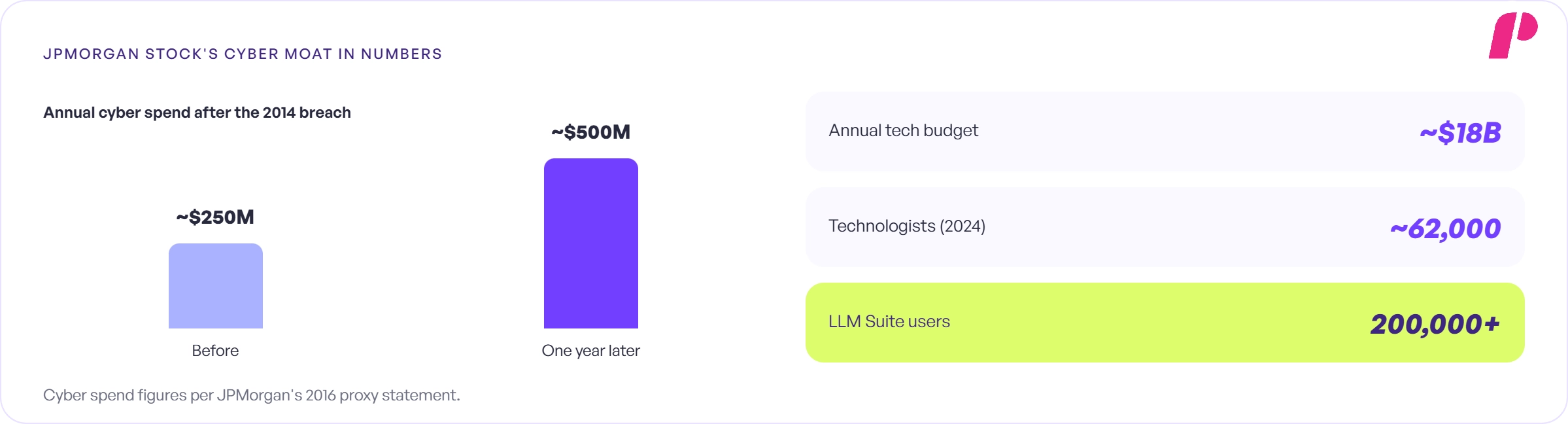
The same scale now runs its AI strategy. More than 200,000 employees use LLM Suite, the bank’s internal generative AI platform, which keeps proprietary data separate from public models. In May, Dimon said the bank would hire more AI specialists than bankers.
🔗AI Stocks in 2026: How to Evaluate, Choose, and Trade
In our view, the cyber arms race favors the largest banks. Rising security costs strain smaller competitors, while JPMorgan absorbs them inside a budget larger than many technology companies spend.
Investment Takeaway: Cyber spending is a cost for every bank but a competitive weapon for JPMorgan. The arms race may widen its lead.
The Quantum Clock
Most of today’s encryption rests on mathematics that quantum computing puts at risk. Should a quantum computer become powerful enough, it would be able to crack RSA encryption and elliptic curve cryptography. Those are the methods protecting logins and payments, as well as messages between banks.
🔗Quantum Leaps’ Impact on Microsoft Stock Price
The deadlines have already been set by regulators. On August 13, 2024, NIST published its first post-quantum standards, FIPS 203, 204, and 205.
Besides, it is suggested in its transition strategy, IR 8547, to discontinue using quantum-vulnerable algorithms like RSA-2048 after 2030.
After 2035, they would be disallowed. The more urgent problem, however, is “harvest now, decrypt later.”
🔗Keysight Stock (KEYS): Can Growth Survive the Tariff Gain?
Attackers could steal encrypted documents today and would only need to wait for quantum computers to decrypt them.
Quantum Computing & Post-Quantum Cryptography Roadmap: Industry Milestones, NIST Standards & Migration Timelines (2026 Reference)
| JPMorgan Stock Quantum Milestone | Date & Implementation Timeline |
|---|---|
| JPMorgan Quantum Key Distribution Network | 2022 |
| JPMorgan Strategic Investment in Quantinuum | January 2024 |
| NIST Finalizes FIPS 203, 204, and 205 Standards | August 2024 |
| JPMorgan Certified Randomness Paper Published in Nature | March 2025 |
| Quantum-Vulnerable Algorithms Deprecated | After 2030 (Migration Phase) |
| Quantum-Vulnerable Algorithms Disallowed | After 2035 (Full Enforcement) |
JPMorgan started early. Its March 2025 Nature paper, written with Quantinuum, Argonne National Laboratory, Oak Ridge National Laboratory, and the University of Texas at Austin, demonstrated certified randomness on a quantum computer, a step toward practical uses in cryptography.
🔗QBTS Earnings Report Q1 2026: Bookings Surge, Revenue Miss
Investment Takeaway: Quantum migration is a multi-year cost for the whole industry. JPMorgan’s head start turns a threat into a research advantage.
Kinexys and the Security of Tokenized Money
Secure infrastructure matters most where money moves fastest.
Kinexys, JPMorgan’s blockchain business, rebranded from Onyx in November 2024, when it reported more than $1.5 trillion in cumulative notional value and more than $2 billion a day.
In November 2025, it launched its JPM Coin deposit token for institutional clients on Coinbase’s Base network, settling payments in seconds around the clock.
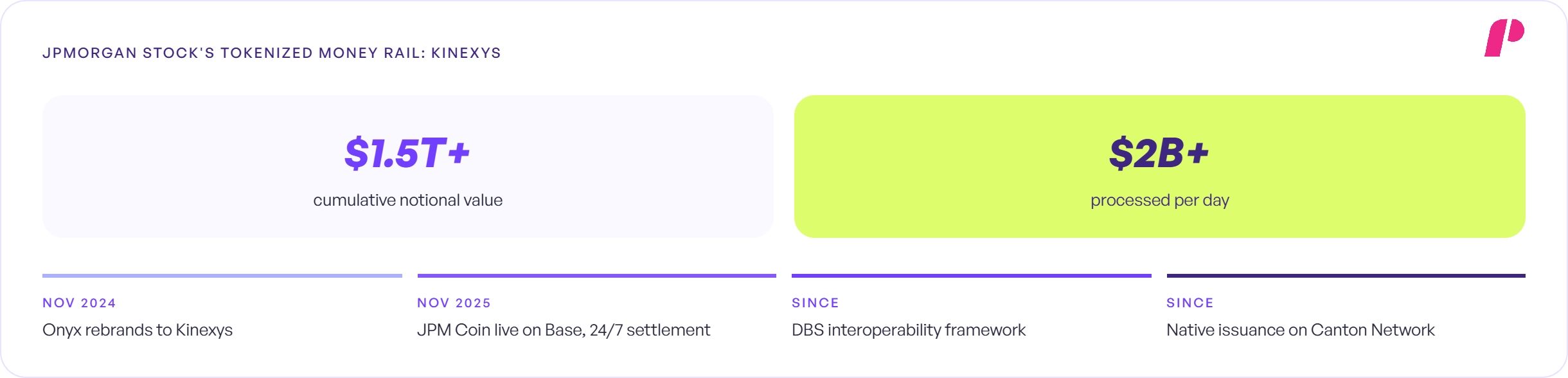
It has since announced an interoperability framework with DBS and native issuance on the Canton Network.
🔗Fintech Stocks: What They Are and How Traders Approach Them in 2026
In our view, Kinexys is a long-term challenger to legacy correspondent banking and the SWIFT network.
A bank that can protect tokenized dollars against both AI attacks and future quantum decryption owns a structural advantage in that race.
🔗Tokenized Stocks and Assets Explained
Investment Takeaway: Kinexys’ revenue remains small today. Its security, not its speed, will decide whether institutions trust it at scale.
The Security and Resiliency Initiative
This is where JPMorgan acts most like a strategic institution.
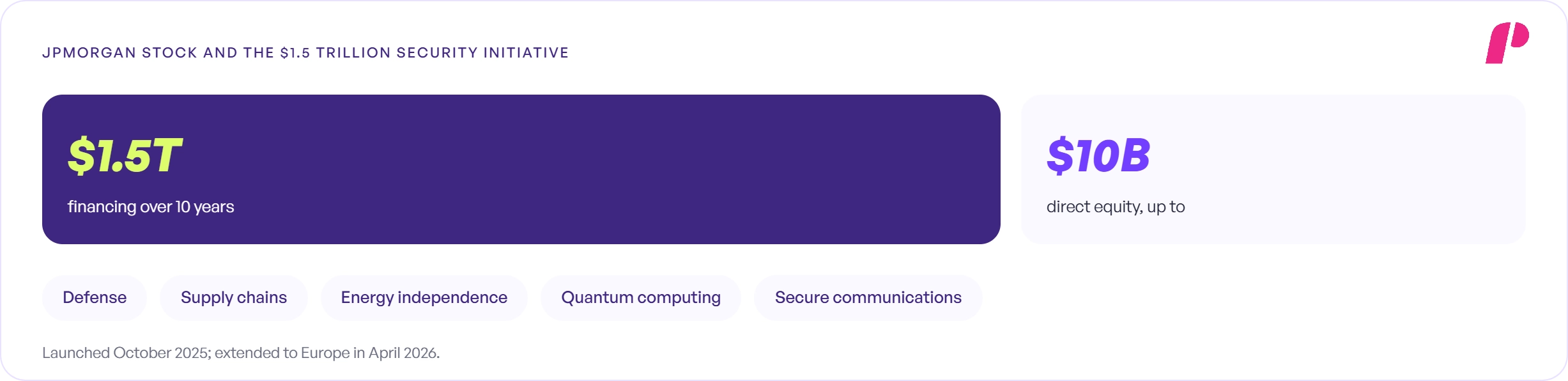
The bank started the Security and Resiliency Initiative in October 2025. This is a 10-year, $1.5 trillion initiative to fund industries that are essential for economic security.
It also includes up to $10 billion of direct equity investments. The program covers areas such as defense and supply chains, as well as energy independence, quantum computing, and secure communications.
On the advisory side, the external council includes former NSA director Paul Nakasone and former Secretaries Robert Gates and Condoleezza Rice.
Business leaders such as Jeff Bezos and Michael Dell also sit on it. Then, in April 2026, JPMorgan extended the program to Europe.
🔗Iran Drone Threat: Best Defense Stocks 2026
In our view, the initiative aligns JPMorgan’s growth with US strategic priorities and places the bank at the center of financing the security technologies its own defenses depend on.
Investment Takeaway: The initiative turns national security demand into lending, advisory, and investment revenue. It also ties part of the business to policy priorities.
How Cyber Events Move Bank Stocks
History shows how the market prices a breach.
Historical Data Breach Impact Tracker: Corporate Incidents, Affected Scale & Immediate Market Reactions (2026 Reference)
| Company & Breach Incident Year | Scale / Affected Consumer Base | Immediate Market Reaction & Corporate Response |
|---|---|---|
| JPMorgan Chase (2014) | 76 million households and 7 million small businesses | Stock bounced back quickly, but cybersecurity spending doubled |
| Equifax (September 2017) | Around 143 million consumers | Down 13.7% on the first day and about 36% within one week |
| Capital One (July 2019) | Around 100 million people | Down 5.9% on the following trading day |
The pattern is clear. Equifax sells data, so its breach struck its core product. JPMorgan’s diversified earnings absorbed its 2014 incident, and the lasting cost showed up in the expense line rather than the share price.
🔗How Cyber Breaches Move Stock Price
Investment Takeaway: Breaches rarely break a diversified bank. They create sharp short-term drops and lasting increases in spending.
Trading the JPM Stock Price Around October 13
Results arrive around 7:00 a.m. Eastern time, with the call at 8:30 a.m. The options market offers a practical frame:

Using $331 and 4.4%, the expected move works out to $14.56. So, the market’s one standard deviation range sits between $316 and $346. According to MarketPulse, support is seen at $323 and $315.70, and resistance at $351.55.
🔗Options Expected Move Explained
Position sizing turns that range into risk control. Assuming a $50,000 account risking 1%, or $500, and a stop 5% under the $331 entry, the risk per share is $16.55, making the position about 30 shares. The numbers above are for illustrative purposes only.
🔗12 Trade Management Golden Tips For Day Traders
Equity Surveillance Signals: Monitoring Channels & Projected Impact on JPMorgan Stock Price (2026 Reference)
| Surveillance Signal | Where To Find It / Data Source | Likely Effect on JPM Stock Price |
|---|---|---|
| Higher Expense or Security Guidance | Earnings releases and investor earnings calls | Gradual downward pressure on earnings per share (EPS) growth |
| Material Cyber Incident | SEC Form 8-K filings (Item 1.05 disclosures) | A sharp, immediate drop in share price in the short term |
| AI and Quantum Technology Commentary | Executive calls, media interviews, and annual shareholder letters | Institutional and retail investor sentiment shift |
From December 2023, the SEC mandates that corporations disclose any material cybersecurity events to the public within four days from the time when such an event was found to be material. In other words, it is the 8-K that turns the rumor into a price mover.
🔗Swing Trading Risk Management
Investment Takeaway: Guidance is more important than the quarter itself. Look out for security budgets, not just net interest income.
Valuing JPMorgan Stock
| Valuation Marker & Financial Parameter | Figure & Market Data |
|---|---|
| Recent Share Price | About $331.00 per share |
| All-Time Record High Price | $366.50 per share |
| Market Capitalization | About $881 billion |
| Average Analyst Price Target | About $369.00 |
| Trailing Price-to-Earnings (P/E) Ratio | About 14x earnings (per Financial Modeling Prep) |
In our view, the market prices JPMorgan on traditional banking measures such as net interest margins, loan losses, and the yield curve.
That approach captures today’s earnings but little of its cyber scale, quantum research, Kinexys, or the security initiative.
Investment Takeaway: The JPMorgan stock price reflects a bank multiple. The technology and security optionality comes free at today’s price.
The Risks That Matter
- High Expectations. Consensus assumes another strong quarter after a record second quarter.
- Cyber Incidents. A material breach could trigger a sharp drop, regardless of the bank’s defenses.
- Rising Costs. Security and quantum migration spending pressure the expense line.
- AI Acceleration. Offensive AI may advance faster than defenses.
- Credit And Rates. Card losses and deposit costs still drive most earnings.
- Succession. Dimon’s eventual departure remains unresolved.
Closing Thoughts
Few banks can match what JPMorgan has put together. There is the $18 billion technology budget, and there is early access to the most capable AI model on the market.
Its quantum research, meanwhile, has been published in Nature. On top of that, it runs a tokenized payments network and a $1.5 trillion program that finances industries behind national security.
🔗Understanding the Role of Central Banks on Stock Markets
Therefore, the question is whether the market will treat cyber scale as a competitive advantage and not just as a cost.
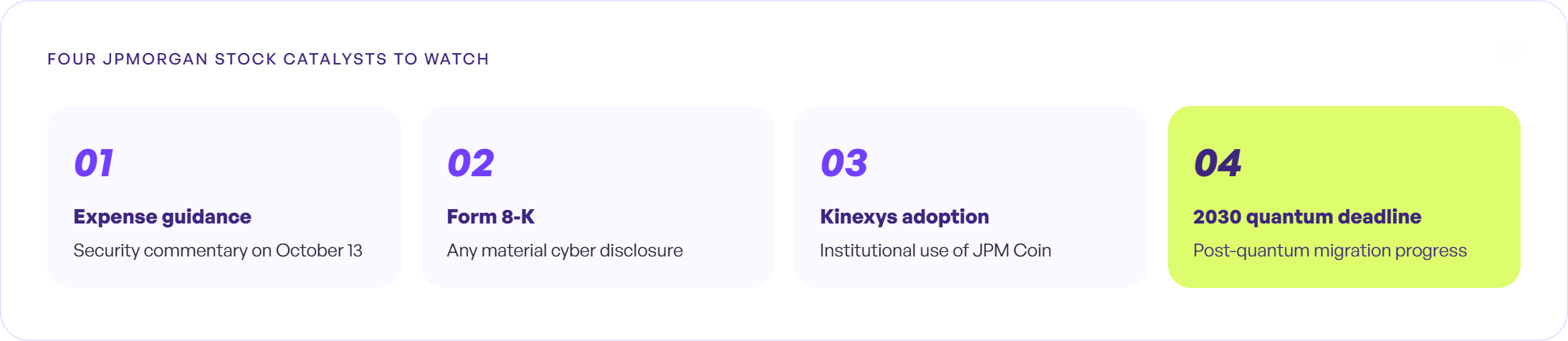
That matters more now that AI and quantum threats are growing. There are four things traders can watch here.
🔗Risk Management in Stocks: A Complete Guide 2026
The first is expense guidance and security commentary on October 13. The second is any Form 8-K cyber disclosure.
After that, there is Kinexys adoption and the progress toward the 2030 quantum deadline. In our view, JPMorgan is much more than a bank, and the market still undervalues its technology and security reach.
NFA. DYOR. This analysis is only meant for informational purposes, and it should not be taken as investment advice. All calculations here are hypothetical examples.
If you liked this post make sure to share it!