You may already know what a gold stock is and how miners and streamers differ. The Gold Stocks vs ETFs question is the practical one that comes next. How do they stack up against physical bullion, and what can go wrong? And how does a trader size one on a funded account? New to the sector for the first time? Start with What Are Gold Stocks?
Mining, Streaming, and Why They Move More Than Gold. This piece compares all three ways to get gold exposure side by side, then walks through the risks and the sizing discipline an active trader needs once gold gets volatile.
This Piece Will Walk You Through:
- How gold stocks compare to gold ETFs and physical gold, side by side
- How to buy gold stocks and how they are taxed
- The real risks of holding gold stocks
- How a trader approaches gold stocks on a funded stock account

Gold Stocks vs ETFs vs Physical Gold
Gold Stocks vs Gold ETFs
Risking gold via one miner exposes every ounce of risk associated with the company to just one name, and therein lies the appeal of a gold miner ETF.
The VanEck Gold Miners ETF (GDX) or the iShares MSCI Global Gold Miners ETF (RING) is a portfolio of miners and streamers that diversifies the risk of one company having a bad quarter.
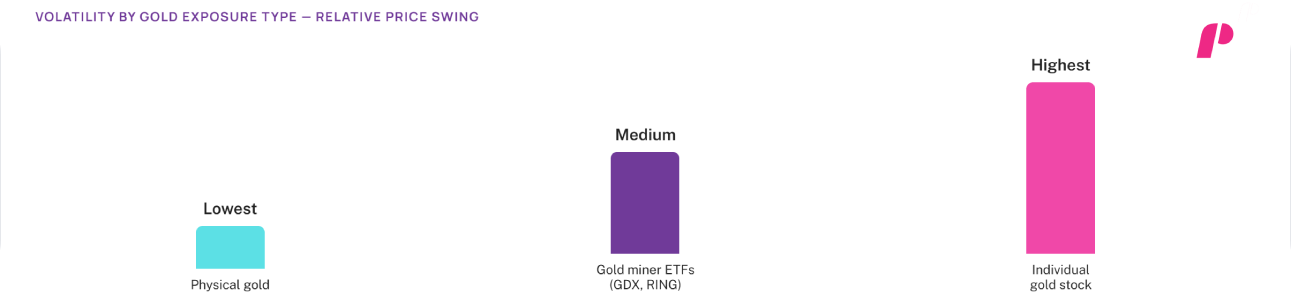
A single miner still offers more raw movement for someone trading short-term swings, since one name can outrun or undershoot the sector average by a wide margin. An ETF smooths that out through diversification, trading some upside for a steadier ride.
Neither choice is wrong. It comes down to whether you want concentrated exposure to one company’s story or a broader read on the sector.
🔗Gold ETFs
Gold Stocks vs Physical Gold
Gold stocks are not a safe haven the way physical gold is, because they trade like equities and can fall right alongside the broader stock market, even when gold itself holds firm.
That gap shows up hardest during a sharp downturn, exactly when investors want gold’s protection the most. Gold stocks also make a weaker inflation hedge than bullion, since operational costs and market swings can pull a miner’s share price away from gold’s protective role entirely.
None of that makes gold stocks a poor choice. It just means physical gold and gold stocks serve different jobs in a portfolio, and mixing them up can leave you exposed when you least expect it.
🔗Safe-Haven Assets
How to Buy and How They Are Taxed
Gold stock purchases are made the same way as any other stock purchases, by opening a normal stock trading account, searching for the stock ticker, and placing your trade. This approach applies to individual mining companies, streaming firms, or ETFs within the gold industry in general.
When it comes to taxes, gold stocks are treated like normal stocks and not as collectibles, which means that if you keep them for more than one year, all profits will be taxed according to the long-term capital gains tax rate. This tax factor already makes gold stocks and ETFs more convenient than buying gold physically.
Asset Class Comparison: Physical Gold vs. Mining Equities vs. Gold ETFs (2026 Reference)
| Comparison Feature | Physical Gold | Gold Mining Stocks | Gold ETFs |
|---|---|---|---|
| What You Hold | The actual precious metal | Corporate equity shares | A fund basket or metal proxy |
| Volatility Profile | Lowest price volatility | Highest equity volatility | Medium market volatility |
| Income Generation | None (no yield) | Possible corporate dividends | Varies by fund structure |
| Safe-Haven Status | Strongest systemic safe haven | Weak (behaves like equities) | Moderate liquidity hedge |
| Storage & Custody | You manage physical storage | None required (brokerage account) | None required (brokerage account) |
| Optimal Investor Fit | Capital preservation & insurance | Tactical trading & capital growth | Liquid, diversified market exposure |
How To Choose Your Gold Exposure:
- Want steadiness and crash protection? Lean toward physical gold or a gold ETF.
- Want leverage and possible dividends? Consider individual gold stocks.
- Want sector exposure without picking one name? Use a miner ETF like GDX.
- Want to trade short-term moves? A single high-beta miner offers more range.
- Trading on a funded account? Size smaller to account for the bigger swings.
- Remember that gold stocks are not a safe haven, since they trade like stocks.
🔗Capital Gains Tax
The Risks of Gold Stocks
Volatility and Operational Risk
Gold stocks carry risks that physical gold simply does not have to deal with. A labor strike, a cost blowout, or a permitting dispute can sink a miner’s share price even while gold itself keeps climbing, since company problems can override the metal’s move entirely.
Beyond that, gold stocks fall alongside the broader market during a genuine equity selloff, something physical gold rarely does to the same degree. Are gold stocks a good investment, then? They can offer strong upside in a genuine gold bull run, but they are not a guaranteed win, since results depend on company execution as much as on gold itself.
That combination makes the sector a growth and trading play rather than a defensive holding.
🔗Risk Management
How Much Gold Exposure Is Sensible
There is no single right answer for how much of a portfolio should sit in gold exposure, and this is not personal financial advice. Many sources frame gold, in any form, as a smaller diversifying slice rather than a core holding, given how sharply the sector can swing.
Gold stocks can absolutely deliver strong upside in a genuine gold bull run, but that upside is never guaranteed. Their fortunes depend on company execution as much as on where gold trades, so treating them as a sure thing ignores half of what actually drives the stock.
🔗Diversification

Trading Gold Stocks in a Funded Account
Miners as a High-Beta Vehicle
For an active trader, a gold miner functions as a high-beta tool rather than a slow-moving blue chip, and that beta demands real respect. A single name can swing far more than the broader market inside one session, especially around a gold move, an earnings print, or unexpected production news.
A position sized the way you would size a stable utility stock can produce a far bigger swing than intended once gold gets volatile.
That gap between expectation and reality is exactly what caught out traders during 2025’s run, when gold miner ETFs roughly tripled the metal’s own gain. Treating that leverage as free money misses the point. It works exactly as hard on the way down.
Sizing Gold Stocks on a Trade The Pool Account
On a funded stock account, that outsized swing becomes a sizing problem more than an opportunity. Trade The Pool gives traders access to thousands of U.S.-listed stocks and ETFs, including the gold-sector names covered here, through a single-phase evaluation model.
Because gold miners can post daily moves well beyond the broader market’s, a normal-looking position size can eat into a drawdown limit faster than expected.
Traders who work with gold stocks on a funded account tend to size smaller than they would on a steadier name, and separate a move driven by gold itself from one driven purely by company news.
Confirm the current drawdown rules and available symbols directly on Trade The Pool’s evaluation page before sizing any gold-stock trade.
Proprietary Trading Framework: Key Evaluation Factors & Risk Parameters for Funded Accounts (2026 Reference)
| Evaluation Factor | What to Confirm | Why It Matters & Strategic Implication |
|---|---|---|
| Product Availability | Confirm that specific gold-sector equities and ETFs are tradable | The execution strategy must match the real, available broker product lineup |
| Asset Beta | Recognize that gold miners swing wider than broader markets | Position sizing must account for amplified price ranges to prevent premature stop-outs |
| Drawdown Rules | Review current daily and maximum allowable loss limits | High equity beta can breach strict prop firm drawdown limits faster than anticipated |
| Evaluation Model | Analyze single-phase structures and profit-split terms | Directly shapes how aggressively or conservatively you should trade the setup |
🔗Drawdown Rules
Trade Gold Stocks for What They Are, Not What You Assume
Gold stocks remain one of the more misunderstood corners of the market, but the picture gets simple once you separate the pieces. They track gold loosely while carrying a full set of company-specific risks on top.
That combination lets them outrun the metal in a rally, and it lets them fall harder than gold when sentiment turns. Each has its distinct purpose, and none of them acts as an automatic hedge.
What is important is to find the correct instrument for the intended purpose rather than being preoccupied with which of them has been the most successful in generating headlines during the last quarter.
On a funded account, that clarity becomes an edge instead of a warning label, since the same high beta that makes gold stocks compelling to trade also means position size deserves real care.
Ready to trade gold-sector stocks on a funded account? Explore Trade The Pool’s evaluation options and bring a plan to the position size before you do.
If you liked this post make sure to share it!