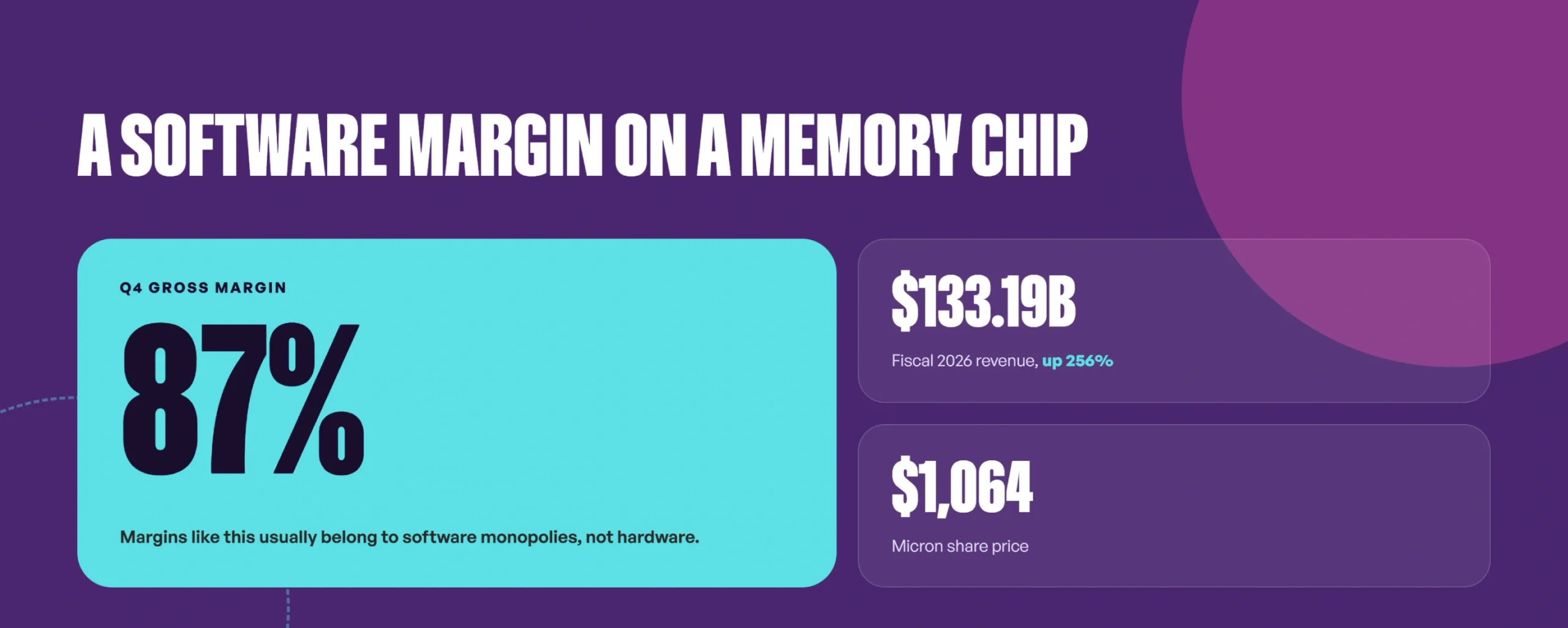
The Micron stock is currently trading at $1,064 following the announcement by the company of its fiscal 2026 revenue of $133.19 billion, representing an increase of 256% with a fourth-quarter gross profit margin of 87%. This is the margin for a monopoly in software, not hardware.
🔗Micron Earnings: Can HBM4 Outrun the Netlist Patent Fight?
The numbers themselves are not in dispute. The real question is duration: how long can a cyclical business sustain margins this extreme? In this article, we will weigh the evidence on both sides.

The Numbers Behind Micron Stock
Results come first because there is no precedent for them.
According to Micron Technology’s press release dated September 30, Q4 revenues amounted to $54.23 billion, up 379% compared to last year and significantly exceeding expectations of about $51.07 billion.
🔗How to Read an Earnings Report
The GAAP net income in fiscal 2021 was $84.97 billion, or $74.33 per diluted share. DRAM revenues exceeded $100 billion.
🔗Earnings Per Share (EPS) Explained
Micron Technology Fiscal 2026 Financial Results: Full-Year Performance, Cash Flows & Balance Sheet Highlights (2026 Reference)
| Micron Fiscal 2026 Metric | Reported Results & Performance Data |
|---|---|
| Full-Year Revenue | $133.19 billion (up 256% Year-over-Year) |
| Fourth Quarter (Q4) Revenue | $54.23 billion (up 379% YoY) |
| Q4 Gross Margin (Non-GAAP) | 87.0% |
| Full-Year Gross Margin | 81.1% (expanded substantially from 41.1% prior year) |
| Operating Cash Flow | $89.68 billion |
| Capital Expenditure (Net) | $27.37 billion |
| Adjusted Free Cash Flow | $62.31 billion |
| Cash, Marketable’)?.concat(‘ Investments & Equivalents | $73.48 billion total liquidity position |
The outlook, however, was even stronger. Management guided fiscal first-quarter 2027 revenue to about $61.5 billion and non-GAAP earnings of $38.15 per share, with gross margin near 86.25%. Chief executive Sanjay Mehrotra said he expects an even stronger fiscal 2027.
Investment Takeaway: Micron isn’t forecasting a peak. It is guiding to another record quarter; therefore, any margin-compression thesis has to explain why management is wrong.
The Case for Duration
Three pieces of evidence suggest these margins could last longer than past cycles.
First, the contract structure has changed. Micron now has 26 signed Strategic Customer Agreements covering more than 35% of revenue through 2030, backed by roughly $32 billion of customer financial commitments. Memory used to be sold largely at spot prices. In contrast, a growing share is now contracted years ahead.
Second, supply cannot respond quickly. Citi noted after the report that the principal industry constraint is cleanroom space, and that most of Micron’s fiscal 2027 construction spending is for cleanrooms coming online in late 2028 and beyond. As a result, new memory capacity takes years to build, not quarters.
Third, management has described the fiscal first-quarter margin guide of about 86.25% as a floor for fiscal 2027, not a ceiling.
Strategic Customer Agreements & Revenue Visibility: Long-Term Commitments, Cleanroom Capacity & Margin Guidance (2026 Reference)
| Strategic Metric Category | Duration Evidence & Strategic Detail |
|---|---|
| Strategic Customer Agreements | 26 signed agreements secured |
| Revenue Covered | More than 35% of projected revenue secured through 2030 |
| Customer Financial Commitments | About $32 billion in total commitments |
| New Cleanroom Capacity | Scheduled for late 2028 and beyond |
| Fiscal 2027 Margin Floor (Guided) | About 86.25% guided margin floor |
Investment Takeaway: Contracted volume and multi-year capacity lead times are the strongest arguments that this cycle ends more slowly than the last ones.
The Case for Mean Reversion
The other side of the argument comes from history.
Memory has always been cyclical. High prices pull in capacity from Samsung, SK Hynix and Chinese producers, and margins fall when that capacity arrives.
Acer chief executive Jason Chen has even questioned whether a true shortage exists, arguing that Chinese makers are ramping output while suppliers protect margins.
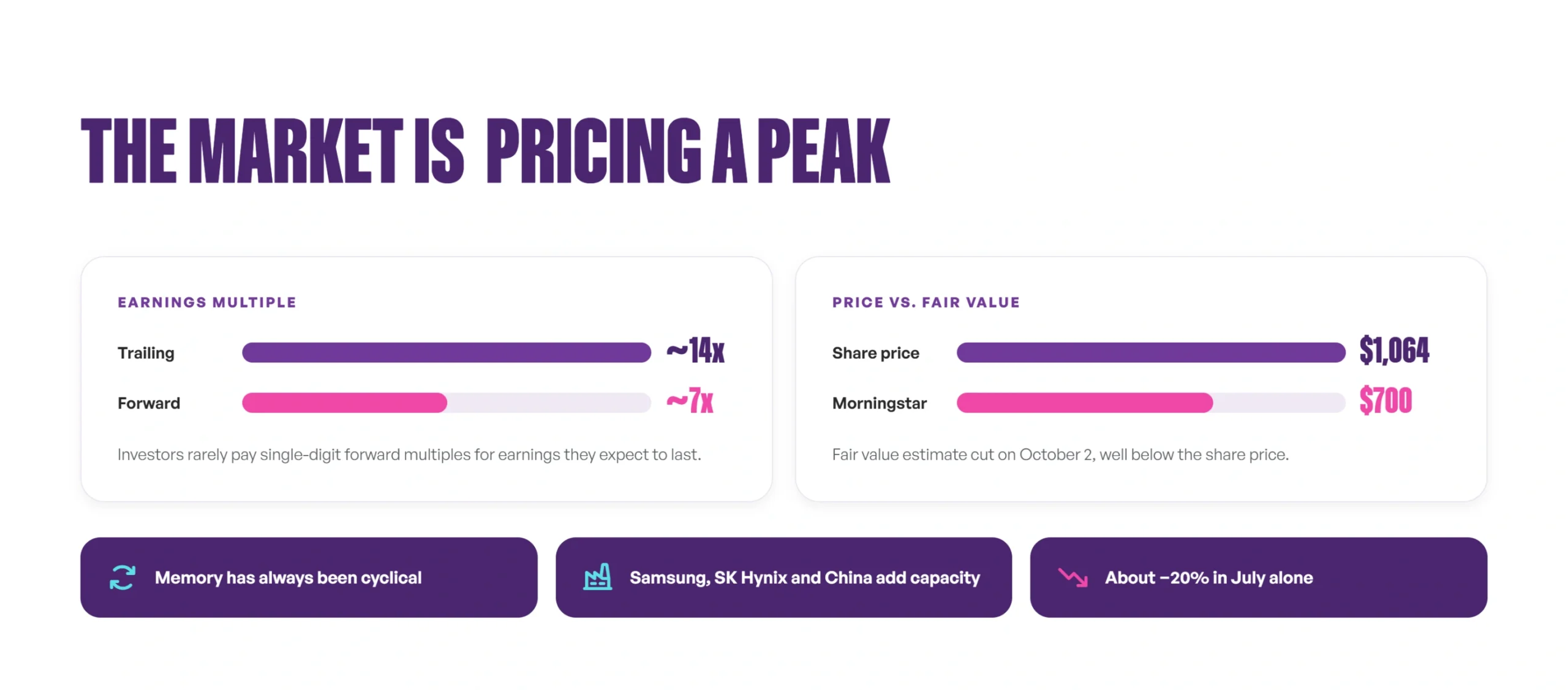
Morningstar cut its fair value estimate to $700 on October 2, well below the share price. The stock has also been very volatile this year, falling about 20% in July alone before recovering.
The market itself appears to be pricing a cyclical peak. At roughly $1,064, Micron stock trades near 14 times fiscal 2026 earnings and about seven times forward estimates.
🔗Swing Trading Risk Management
The fact is, investors rarely pay single-digit forward multiples for earnings they believe will last.
Investment Takeaway: A low multiple on record earnings is the market’s way of saying it expects those earnings to fall. The debate, therefore, is about when those earnings fall, not whether they do.
Insider Selling, Read Correctly
Insider sales are often cited as a peak signal, so the details matter.
Mehrotra was selling his shares around $1,128 to $1,168 between June 26, when prices were near their high level of late June, and selling 40,000 shares on July 24 for about $37.3 million in a series of trades that occurred under his Rule 10b5-1 trading plan that he instituted on January 30, 2026, months ahead of the June price highs. However, he still had some 337,000 shares of his own firm.
CFO Mark Murphy also established his 10b5-1 trading strategy in 2025 to sell 162,000 shares by April 2026.
Investment Takeaway: Pre-scheduled plans adopted months in advance are weak evidence of timing. Heavy executive selling is worth noting, but it doesn’t prove management expects a downturn.
Sovereign Manufacturing and the Board
Micron is the sole DRAM producer with its headquarters in the United States, and this makes Micron vital to the strategic interests of the US government.
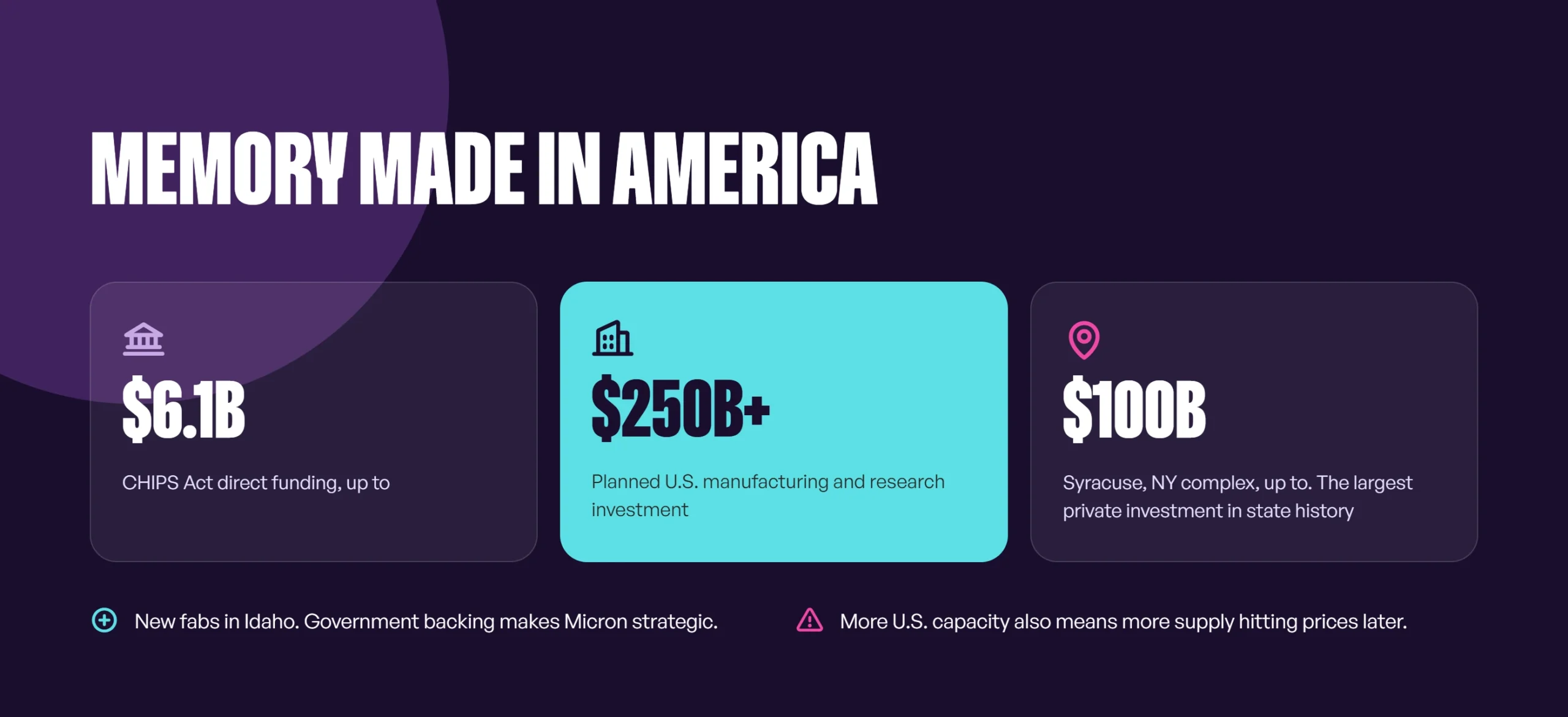
Micron has been allocated up to $6.1 billion worth of direct funding from the CHIPS Act and intends to invest more than $250 billion worth of money into the US manufacturing and research.
That includes a complex near Syracuse, New York, of up to $100 billion, the largest private investment in the state’s history, alongside new fabs in Idaho.
The New York project faces local pushback, including legal challenges over its environmental review.
The board, meanwhile, brings experience from both defense and the foundry business. Lynn Dugle, Lead Independent Director from January 2025, was CEO of Engility and headed the intelligence and information business of Raytheon.
Mark Liu, the executive chairman of TSMC from 2018 to 2024, joined in March 2025, a move analysts at TrendForce interpreted as indicating closer cooperation on custom HBM logic dies.
Investment Takeaway: While government backing and local production make Micron safe, the US production expansion means extra supply that will eventually affect prices.
The EUV Lithography Race
Advanced DRAM depends on some of the most complex machines ever built.
The first Micron DRAM generation that uses Extreme Ultraviolet lithography from ASML is the 1-gamma DRAM node.
The EUV systems use laser beams to hit liquid tin droplets to produce plasma that emits light at a 13.5 nm wavelength. Since all materials absorb light at this wavelength, light travels through a vacuum and is reflected by molybdenum-silicon multilayer mirrors.
Lithography Generation Benchmarks: Numerical Aperture Specifications & Approximate Tool Costs (2026 Reference)
| Lithography Generation | Numerical Aperture (NA) | Approximate Tool Cost |
|---|---|---|
| Deep Ultraviolet (DUV) | Not applicable (Refractive optics) | Under $100 million |
| Standard Extreme Ultraviolet (EUV) | 0.33 NA | Around $200 million |
| High-NA Extreme Ultraviolet (High-NA EUV) | 0.55 NA | Around $380 million |
The industry roadmaps indicate that High-NA EUV will be used in future DRAM nodes. It will have a larger 0.55 aperture and hence print smaller features; however, the power of the source needed to operate it is even higher, at about 500 watts.
The accumulation of tin particles on the collector mirror reduces its performance, and hence its replacement is necessary periodically.
Investment Implication: The increased capital outlays with each lithography node will ensure that incumbents like Micron will be protected from new entrants.
HBM4 and the Physics of Packaging
HBM is the primary area for AI requirements, but it is also where the engineering challenge lies.
JEDEC HBM4 interface will double bandwidth up to 2,048 bits per stack. The speed at 11 gigabits per second per pin means a total theoretical throughput of about 2.8 TBps per stack.
In order to develop customized HBM4E solutions, Micron is going to team up with TSMC to develop the logic base die using foundry node technology.
But packaging continues to be an issue. The industry had hoped to see the copper-to-copper hybrid bonding technology take over from the microbumps made of solder in the case of taller HBM stacks, but issues of particle contamination and yield problems have delayed that development. In the case of HBM4, TSMC and other companies continue to use microbumps.
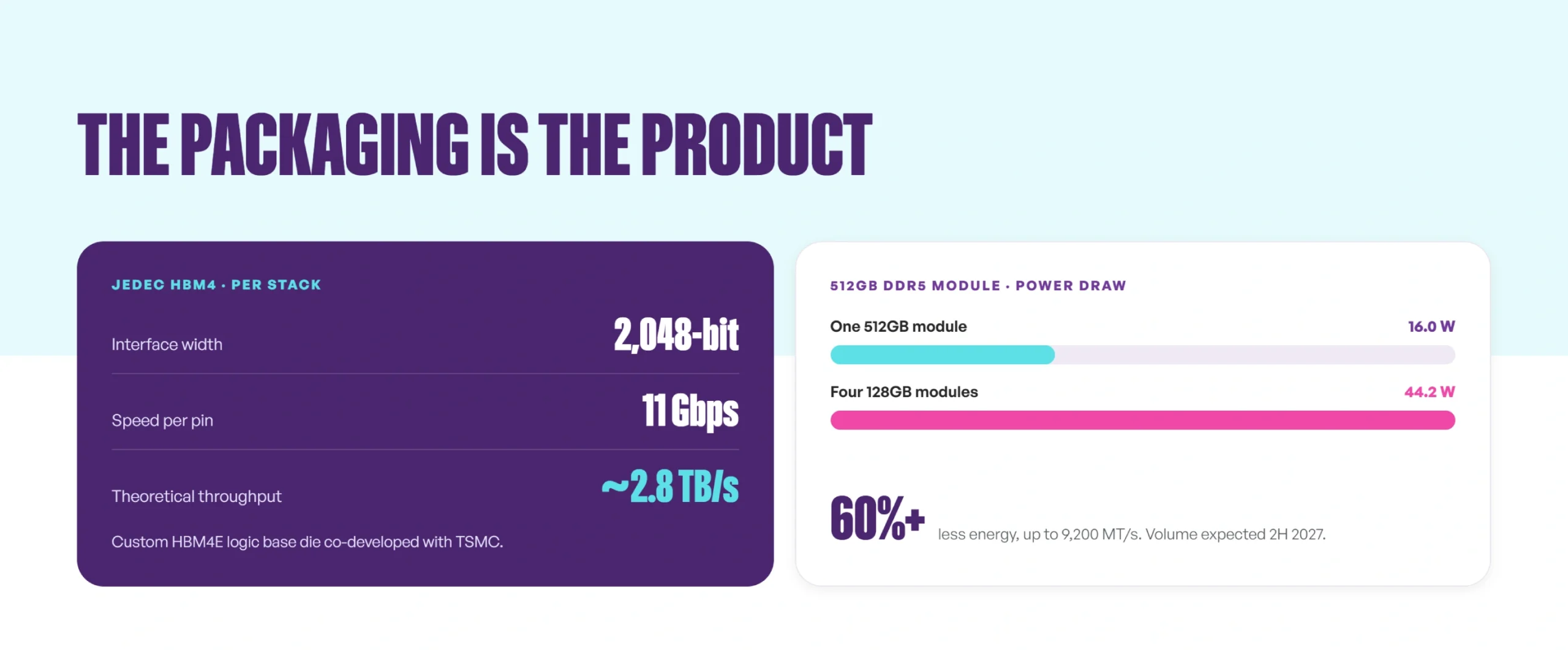
In the same manner, packaging gains are now reaching standard servers. On September 15, Micron showed the world’s first 512GB DDR5 module, achieved using stacks of DRAM dies with through-silicon vias.
The module operates at speeds up to 9,200 MT/s and consumes more than 60 percent less energy than four 128GB modules: 16.0 versus 44.2 watts. AMD and Intel are validating it, with volume production expected in the second half of 2027. Micron’s SOCAMM2 modules bring low-power LPDDR5X into servers in a detachable, horizontal format.
🔗Dell Technologies Earnings Report: AI Server Backlog Fuels a Record Beat
Investment Takeaway: HBM leadership depends as much on packaging yields and foundry partners as on memory cells. The TSMC base-die relationship adds capability, but it also adds a dependency.
Litigation and the Consumer Exit
Two strategic pressures cut against the bull case.
Netlist won a $445 million patent verdict against Micron in 2024. In August, it filed an International Trade Commission complaint over DDR5 server modules, which the ITC has opened an investigation into.
On September 29, it filed a second complaint targeting Micron’s HBM3E, HBM4 and HBM4E products and seeking to block imports of Google, Nvidia and Broadcom systems that use them.
🔗Nvidia Stock Analysis: Can NVDA Own AI, Robotics and Quantum?
No import ban has been ordered, and the Federal Circuit recently upheld decisions invalidating five Netlist patents Micron had challenged. YMTC separately won German injunctions, now under appeal.
Semiconductor Legal & Patent Litigation Tracker: Verdicts, ITC Investigations, Federal Circuit Rulings & International Injunctions (2026 Reference)
| Legal Matter & Proceeding | Status & Case Summary |
|---|---|
| Netlist Jury Verdict (2024) | $445 million judgment rendered against Micron |
| ITC Complaint (August 2026) | DDR5 server modules targeted; formal investigation opened |
| ITC Complaint (September 29) | HBM3E, HBM4, and HBM4E components covered in newly filed complaint |
| Federal Circuit Appeal | Upheld invalidation of five Netlist patents (Micron legal win) |
| YMTC Litigation in Germany | Injunctions issued on two utility models, currently under appeal |
Micron also exited its Crucial consumer business, announced in December 2025, to focus capacity on data center and AI products. In our view, that leaves the consumer volume market to Chinese producers such as CXMT and YMTC, giving them revenue to fund their own advance.
Investment Takeaway: No ruling has yet disrupted supply, but ITC cases move quickly. An exclusion order covering HBM would be the clearest single risk to near-term revenue.
Research, Talent and DARPA JUMP 2.0
Micron is also investing in the research that determines the next cycle’s winners.
Micron Research Labs, announced in August and headquartered in Boise, is backed by a planned $10 billion over the next decade.
🔗Analyst Price Targets Explained
On September 15, Micron named Deirdre Hanford, who spent 37 years at Synopsys, as its president.
The university pipeline runs through DARPA. DARPA had received support from industry for its joint university microelectronics program through sponsors such as Micron, along with Intel, IBM, Samsung, TSMC, Raytheon, Northrop Grumman, and Lockheed Martin.
One of its centers, CRISP, was set up specifically to topple the “memory wall.” Its replacement, JUMP 2.0, which is spearheaded by the Semiconductor Research Corporation and DARPA, currently supports seven centers in 50 universities, such as PRISM for intelligent storage and memory, and SUPREME for energy-efficient materials.
Lesson For Investors: Research over long time periods and the university pipeline have more influence at the bottom of the cycle because they determine the leader of the next upcycle.
Valuing Micron Stock on Duration
Wall Street remains firmly bullish on Micron stock. The median target for the 49 analysts is around $1,522, with the lowest price target at $361 and the highest at $2,200. The target of Morgan Stanley is $1,200, KeyBanc $1,750, and Melius Research $2,200.
Valuation Metrics & Equity Benchmarks: Share Price, P/E Multiples, Analyst Targets & Earnings Calendar (2026 Reference)
| Valuation Marker & Financial Parameter | Figure & Market Data |
|---|---|
| Share Price (as of October 5) | ~$1,064 per share |
| Trailing P/E Ratio (Fiscal 2026) | ~14x earnings |
| Average Analyst Price Target | ~$1,522 |
| Analyst Target Range | $361 to $2,200 |
| Morningstar Fair Value Estimate | $700 |
| Next Earnings Announcement | Expected around December 23 |
Bull Thesis:
Record revenues, growth that is steered to fiscal 2027, shrinking revenue base until 2030, $73.48 billion in cash, and constrained capacity through 2028.
🔗Money Management in Stock Trading
Bear Thesis:
Classic memory cycle, rampant insider selling, two active ITC lawsuits, consumer market lost to Chinese competitors, and a market multiple that is already skeptical
Investor Takeaways: In other words, Micron shares are undervalued if these margins hold up for another two years, and overvalued if margins fall within one year. The key lies in the capacity schedule, not demand.
The Risks That Matter
- Margin Reversion. An 87% gross margin is far above memory’s history, and competitors are adding capacity.
- Litigation. Netlist’s ITC complaints seek import bans on Micron server memory and HBM.
- Customer Concentration. AI hyperscalers drive most of the demand, so any pause in their spending would hit hard.
- Volatility. The stock fell about 20% in July alone, and swings of that size remain likely.
- Execution. HBM4 packaging yields and the TSMC base-die partnership must deliver on schedule.
- China. Exiting consumer memory gives CXMT and YMTC scale to fund their own technology.
- Capital Intensity. EUV, High-NA, and new US fabs require very heavy spending that will continue through the cycle.

Closing Thoughts
Micron has produced the most profitable year in the history of the memory industry. The revenues more than trebled, gross profit margin is at 87%, and there is a $73.48 billion cash reserve, with management looking for yet another quarter record and 26 agreements from long-term customers which will secure part of the future business.
🔗AI Stocks in 2026: How to Evaluate, Choose, and Trade
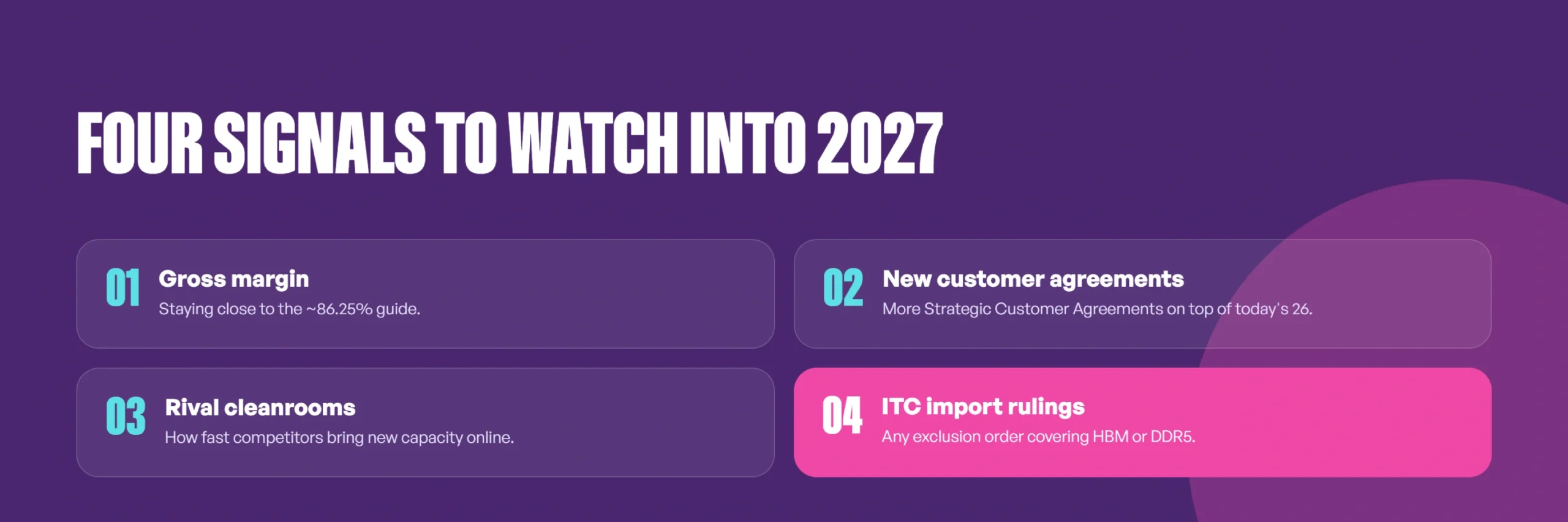
It all boils down to one thing – for how long would such margins be sustainable until new capacities arrive? Monitor these four factors leading to 2027: gross margin staying close to the 86.25% guidance, number of additional Strategic Customer Agreements signed by Micron, rate of clean room capacity addition by competitors, and ITC’s actions towards banning imports.
The supercycle is real. However, its length is what decides the trade.
NFA. DYOR. This analysis is for informational purposes only and is not investment advice. Sources include Micron SEC filings, including its fiscal fourth-quarter 2026 earnings release and Form 4 filings, Micron and GlobeNewswire announcements, CNBC, Reuters, TrendForce, Semiconductor Engineering, and analyst research as reported.
If you liked this post make sure to share it!