Gold hit a record above $5,600 an ounce in January 2026, and traders rushed toward gold stocks expecting the same steady climb. Many got something else entirely. One miner rallied hard while a peer barely budged, even though both dug up the same metal.
That gap is the first lesson anyone needs before touching this sector: a gold stock is not gold. It is a company whose fortunes track the metal loosely, then adds a full layer of its own risk on top.
So what are gold stocks, and how do they actually behave once you own them? This guide breaks that down in plain terms, starting with the definition and the split between mining and streaming companies.
From there, it covers why miners swing harder than gold itself and who the major names and dividend payers actually are. By the end, you will know exactly what you are holding and what drives it.
This Piece Will Walk You Through:
- What gold stocks are and how they differ from owning gold outright
- The difference between mining, streaming, and royalty companies
- Why do gold stocks swing more than the metal itself
- Who the major producers and streamers are, and which ones pay dividends

What Are Gold Stocks?
Gold Stocks Are Companies, Not Metal
Gold stock means an ownership unit issued by a publicly traded company involved in gold mining, processing, finance, or streaming, and not the ownership of the precious metal.
This difference is significant because when the price of gold goes up and the cost of mining remains constant, the margins of a company mining gold increase, and consequently, the value of its stock.
None of that goes away just because gold is having a good year. So buying a gold stock means buying a business with gold exposure baked in, not a locker of bullion.
Some investors expect the two to move in lockstep. They rarely do, and the gap is where both the opportunity and the risk live.
Why Gold Stocks Are Hot In 2026
Gold’s path in 2026 has been anything but a straight line, and that has kept gold stocks in the headlines all year. The metal marked its record just above $5,600 during the last week of January, but subsequently fell sharply throughout the spring season amid weakening demand from central banks and changing interest rate outlooks from the Fed, registering the worst quarterly performance in almost a decade.
🔗Gold Price
Gold was quoted back towards the $4,300-$4,400 area by mid-August, up more than 30% on the year. Central banks continued their purchases despite the volatility, with China continuing to boost gold reserves for the 21st consecutive month. That said, gold stocks are still not the same as owning gold outright, since a mining company carries its own costs and execution risk on top of whatever gold does next.
Gold Stocks At A Glance
Asset Class Characteristics: Gold Stocks vs. Direct Metal Exposure (2026 Reference)
| Comparative Feature | Gold Mining Stocks / Equities | Direct Physical Gold |
|---|---|---|
| Underlying Ownership Structure | Equities and corporate shares in a mining business | Physical bullion, coins, or allocated metal storage |
| Market Exposure Profile | Indirect exposure tied to gold-linked operating revenue | Direct spot price correlation and physical tracking |
| Volatility & Risk Profile | Significantly higher volatility than physical gold | Moderate volatility aligned directly with commodity spot movements |
| Income Generation | Some profitable mining firms pay regular dividends | Zero yield (generates no cash flow or dividends) |
| Safe-Haven Status | Not a true safe haven; trades like an equity | Classic macroeconomic safe-haven asset |
Mining, Streaming, and the Gold-Price Link
Miners Vs Streamers And Royalty Companies
Stocks of the gold industry can be distinguished into two entirely different business models. The miners mine gold; thus, they bear all the costs associated with operating the mine – wages, fuel, equipment, even a strike here and there.
Streaming and royalty companies take a different path. They finance a miner’s project upfront in exchange for gold at a low, fixed price down the road, so they collect the upside without operating a single pit or shaft.
This structure will yield more stable margins due to the fact that the streamers do not have to worry about any operational difficulties faced by a running mine.
The miners that play a role on the producer side are Newmont, Barrick, and Agnico Eagle, while the streamers are Franco-Nevada and Wheaton Precious Metals.
Do Gold Stocks Track The Gold Price?
Gold stocks do not shadow gold’s daily price tick for tick, but their revenue is genuinely correlated with it over time. That gap shows up constantly.
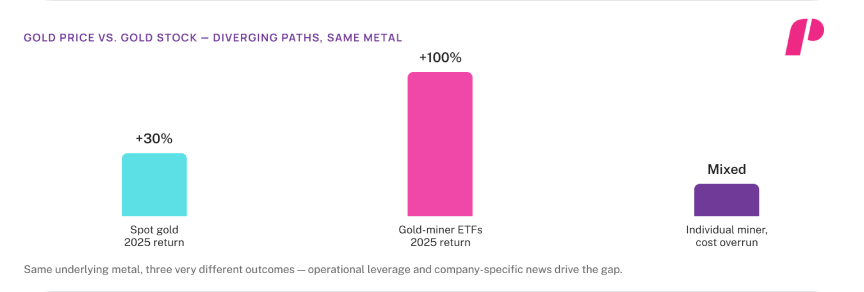
A miner can lag a strong gold session if the broader stock market sells off, or it can fall even as gold holds steady if a mine reports a cost overrun.
Gold stocks will not always rise just because gold does. Company-specific news, from a permitting delay to a bad quarter, can override a rising gold price entirely.
🔗Streaming & Royalty
That is the piece a lot of newcomers miss, and it is exactly why treating a miner as a simple gold proxy can backfire.
Mining Vs Streaming/Royalty
Precious Metals Equities: Mining Operators vs. Streaming & Royalty Business Models (2026 Reference)
| Business Type / Entity | Revenue Generation Mechanism | Structural Trade-Off & Risk Profile |
|---|---|---|
| Traditional Mining Operators | Extracts raw ore and sells physical gold on global spot markets | Full operational, labor, and geological risk with high operating leverage |
| Streaming & Royalty Firms | Finances miners upfront in exchange for future metal at low fixed prices | Minimal operational risk, insulation from inflation, and steadier margins |
| Major Mining Examples | Newmont (NEM), Barrick Mining (GOLD), Agnico Eagle (AEM) | Large-scale, geographically diversified producers |
| Major Streaming Examples | Franco-Nevada (FNV), Wheaton Precious Metals (WPM) | High-margin, cash-flow-driven royalty portfolio model |
Why Gold Stocks Move More Than Gold
Operational Leverage Explained
The reason gold stocks swing harder than gold comes down to operational leverage, and it cuts in both directions.
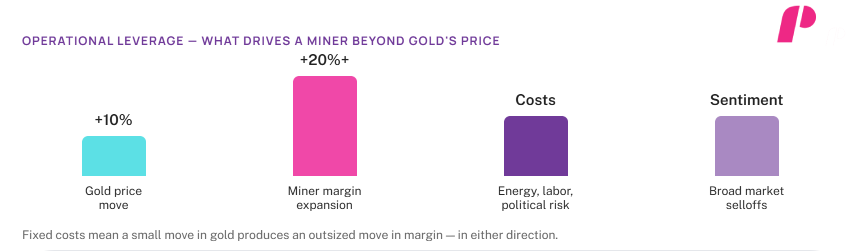
With a 10% increase in gold prices, the profit margins of miners could soar by more than 20% as their cost structures do not fluctuate greatly while their incomes increase as a result of rising gold prices.
This appeared magical during most of 2025 as the gains of gold mining ETFs amounted to about 100% while those of spot gold were at 30%. A miner fighting runaway diesel costs or a labor dispute can still post a loss while gold climbs around it.
That same leverage boosting a miner’s upside in a rally also deepens its losses when gold or the broader market turns lower, so it is not a shortcut to easy riches.
What Else Moves A Gold Stock
Gold is only one input into what a mining stock does on any given day. Production costs, energy prices, and labor disputes all move the needle directly, since they hit the bottom line regardless of where gold trades. Political risk matters too.
A mine sitting in an unstable jurisdiction carries a real discount compared to one in Nevada or Ontario. Debt levels and overall stock-market sentiment add another layer, since gold stocks are still equities and can get pulled down in a broad selloff.
Understanding these extra drivers is what separates a trader who reads a miner correctly from one who assumes gold is the only variable in play.
🔗Operational Leverage
The Major Names and Dividends
Majors, Juniors, And Streamers
Only a few names tend to pop up whenever there is a discussion regarding gold stocks, and these should be mentioned here for the sake of example and not as a recommendation.
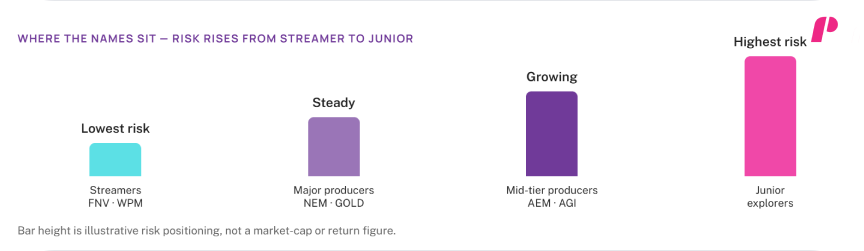
Some of the biggest gold mining firms include Newmont (NEM), Barrick (GOLD), and Agnico Eagle (AEM). These companies operate in diverse multi-mine operations within safe jurisdictions. The junior gold miners and explorers represent the other end of the spectrum.
Being that these companies have nothing in terms of production yet, their share prices depend on the outcome of their drilling programs and fundraising, making them much riskier than a seasoned major.
None of this is a buy list. It is simply the map of who operates where in the sector and why the risk profile shifts so much across it.
Do Gold Stocks Pay Dividends?
However, some gold stocks actually offer dividends, but the rate varies considerably and is not always assured. The dividend yield for Newmont has remained around 1% up until the middle of 2026, while the yield on Barrick is in roughly the same single-digit category.
Some others have actually offered higher rates, including several medium-cap miners that have advertised higher dividend yields than the industry average in 2026.
A higher dividend is not automatically the better pick, either, because gold-stock dividends get cut when gold falls or costs spike, unlike a bond coupon. Physical gold, by contrast, pays nothing at all, so any yield from a miner is a genuine trade-off against that added company risk.
Major Vs Junior Vs Streamer
Precious Metals Sector: Mining Equity Categories, Risk Profiles & Key Examples (2026 Reference)
| Mining Equity Category | Operational Profile & Risk Structure | Representative Industry Examples |
|---|---|---|
| Major Producer | Large-scale, producing operations delivering steadier cash flow and liquidity | Newmont (NEM), Barrick Mining (GOLD) |
| Mid-Tier / Growth Producer | Active producers focused on expanding output and asset growth | Agnico Eagle (AEM), Alamos Gold (AGI) |
| Junior Explorer | Pre-production, drilling-driven companies carrying high speculative risk | Smaller early-stage exploration firms |
| Streamer / Royalty Company | Finances miners in exchange for future metal streams with high operating margins | Franco-Nevada (FNV), Wheaton Precious Metals (WPM) |
Named companies are examples for illustration only, not recommendations.
What This Means for How You Get Gold Exposure
At this point, you know what a gold stock actually is, why mining and streaming companies behave differently, and why the whole sector swings harder than gold itself.
The next question is how gold stocks actually compare against gold ETFs and physical bullion side by side, what the real risks look like, and how a trader sizes a position once gold gets volatile.
That comparison, plus how it plays out on a funded stock account, is covered in the companion guide: Gold Stocks vs ETFs vs Physical Gold: Risks and How Traders Approach Them.
🔗Gold ETFs
If you liked this post make sure to share it!