In August 2025, Washington paid $20.47 per share for nearly 10% of Intel. Fourteen months later, the Intel stock price traded near $93 on Monday, October 19.
🔗Intel’s Sovereign Chipmaker Pivot: SHIELD, Tan and Trump
As a result, taxpayers now sit on a paper gain of roughly $31 billion, by our calculation. The market now prices Intel as America’s strategic chipmaker, yet its foundry still loses about $2 billion a quarter.
On Monday, the picture improved a little, since JPMorgan analyst Harlan Sur moved the stock from Underweight to Neutral. The shares reacted with a gain of about 4%.
The bank kept its $85 price target, however, below Friday’s $89.85 close. In simpler terms, analysts now credit the turnaround, but many of them still question the valuation.
🔗Analyst Price Targets Explained
The next real test for the company is its third-quarter report, which the market expects on Thursday, October 29.
From $20 to $141 and Back to $93: How the Intel Stock Price Got Here
It is hard to find another large-cap stock that has made a move of this size so quickly. The rally began with a sovereign backstop and accelerated on reports that Apple would use Intel’s factories. It peaked in June and has since given back more than a third.
Corporate Valuation & Price Milestone History
| Corporate Milestone & Event Description | Date / Timeline | Share Price / Valuation Benchmark |
|---|---|---|
| US Government 9.9% Equity Stake Purchase | August 2025 | $20.47 per share |
| All-Time Record Closing High | June 22, 2026 | $140.94 per share |
| $20 Billion Secondary Stock Offering Priced | August 11, 2026 | $95.00 per share |
| September Post-Offering High Close | September 24, 2026 | $127.39 per share |
| Prior Friday Market Closing Price | October 16, 2026 | $89.85 per share |
| Valuation Following JPMorgan Equity Upgrade | October 19, 2026 | About $93.00 per share |
Why Has Intel Lost a Third of Its Value Since June?
Several forces have driven the pullback since then. Chip stocks sold off on October 8 after reports questioned OpenAI’s revenue. On October 3, Elon Musk confirmed early talks with TSMC about Terafab.
Intel had joined that chip project in April. Rates did not help either. The wholesale price index exceeded expectations, while the 10-year Treasury yield held at 5.1%. Under that pressure, the tech sector closed its weakest week since June.
🔗Understanding the Role of Central Banks on Stock Markets
The fact is that the selloff reflects valuation and rates more than any break in Intel’s operating story.
What it Means for Traders: Investors who bought in August paid $95 a share, which is above today’s price. Many of them may sell into a rally toward that level, so $95 can act as a ceiling.
🔗12 Trade Management Golden Tips For Day Traders
Intel’s Turnaround: Do the Numbers Back the Hype?
Q2 2026: Intel’s Fastest Growth Since 2011
The second quarter is where the bulls found their best argument. Sales came to $16.1 billion, up 25% from a year before. CEO Lip-Bu Tan called it Intel’s best growth in more than 15 years.
It is worth noting that revenue from the Data Center and AI division increased by 59% to $6.3B. The margins also experienced a rise, as the non-GAAP gross margin was 41.8% compared to 29.7% last year.
🔗How to Read an Earnings Report
Where did that growth come from? JPMorgan’s answer is agentic AI. These types of workloads rely heavily on the CPU, and the bank further added that leading-edge silicon chips are in short supply.
In other words, the AI agent performs a number of functions sequentially, and it is managed mainly by a general-purpose CPU. The AI boom, once a story about GPUs alone, now lifts demand for Intel’s server CPUs too.
That does not mean the competitive pressure has eased. AMD is still nibbling away at the Intel server market share, and the big cloud companies are making their own Arm processors.
🔗AMD Stock Before Q2 Earnings: Is It the True King of the AI Era?
Quarterly Financial Performance & Segment Results
| Financial Metric & Segment Description | Q2 2026 Results | Q2 2025 Comparison |
|---|---|---|
| Total Quarterly Revenue | $16.1 billion | $12.9 billion |
| Data Center and AI Revenue | $6.3 billion | Not disclosed (up 59% YoY) |
| Non-GAAP Gross Margin | 41.8% | 29.7% |
| Non-GAAP Earnings per Share (EPS) | +$0.42 per share | $(0.10) per share |
| GAAP Earnings per Share (EPS) | $(2.16) per share | $(0.67) per share |
| Intel Foundry Operating Loss | $(2.1) billion loss | Not disclosed in comparable format |
Why a Strong Quarter Still Showed a $2.16 Loss Per Share
Why is GAAP EPS so far below the adjusted figure? Intel booked a $12.5 billion mark-to-market loss on escrowed shares tied to its Secure Enclave defense agreement.
Those shares await release to the Commerce Department as Intel performs under that contract. Well, there is an odd side effect here: each time the Intel stock price rises, the accounting loss grows larger.
Since Intel leaves this item out of its non-GAAP numbers, most traders look at those adjusted figures instead.
🔗Earnings Per Share (EPS) Explained
From an $18.8 Billion Loss to Almost Break-Even
The annual figures tell a similar story. Intel’s net loss in 2024 was $18.8 billion; in 2025, it came to only $267 million. The foundry is moving the same way, although slowly, since its operating loss went from $13.3 billion to $10.3 billion.
Full-Year Financial Performance ($ Billions)
| Full-Year Financial Metric ($ Billions) | FY2024 Results | FY2025 Results |
|---|---|---|
| Total Annual Revenue | $53.1 billion | $52.9 billion |
| GAAP Net Loss Attributable to Intel | $(18.8) billion loss | $(0.3) billion loss |
| Intel Foundry Operating Loss | $(13.3) billion loss | $(10.3) billion loss |
| Gross Capital Spending (CapEx) | $25.1 billion | $17.7 billion |
| Adjusted Free Cash Flow (FCF) | $(2.2) billion deficit | $(1.6) billion deficit |
What it Means for Traders: The product side of Intel is profitable again. Whether the foundry can do the same is still the open question for the stock.
Washington Owns 10% of Intel: Who Really Benefits?
Intel’s strategic role explains much of its premium. TSMC builds the large majority of the world’s most advanced chips in Taiwan. Intel describes itself as the only US company that both develops and manufactures leading-edge logic at home. As a result, it has received unusual support from Washington.
🔗AI Infrastructure and Semiconductor Stocks in 2026
How the Government Paid for Its Intel Stake
Under the August 2025 agreement, Washington received 433.3 million shares in exchange for $8.9 billion. Where did the money come from? Entirely from funds already promised to Intel: $5.7 billion in unpaid CHIPS Act grants and $3.2 billion from Secure Enclave.
The stake is passive, with no board seat. The government also holds a five-year warrant for another 5% at $20. It can exercise that warrant only if Intel’s ownership of its foundry falls below 51%.
The Warrant Clause That Limits Intel’s Options
That warrant matters more than it seems, since it effectively discourages Intel from selling control of its foundry. As a result, Intel loses one obvious path to unlocking value. At about $93, the stake is worth roughly $40 billion, by our calculation.
Sovereign Support & Federal Financing Structure
| Sovereign Support Dimension | Detailed Terms & Program Breakdown |
|---|---|
| US Government Direct Equity Stake | 433.3 million shares at $20.47 per share ($8.89 billion total valuation) |
| Federal Funding & Grant Sources | $5.7 billion in CHIPS Act direct grants plus $3.2 billion Secure Enclave funding |
| Warrant Coverage Provisions | Additional 5% warrant coverage at a $20 strike if foundry ownership falls below 51% |
| Corporate Governance & Control | Strictly passive equity stake with no voting board representation |
| SHIELD Defense IDIQ Contract | Official awardee designation secured in January 2026 for defense electronics |
Is the $151 Billion SHIELD Contract Really Revenue?
The SHIELD contract, however, is easy to misread. The Missile Defense Agency vehicle carries a $151 billion ceiling. The agency shares it across a large pool of awardees. A ceiling is not revenue. Intel earns money only when it wins individual task orders.
🔗Intel Earning Reports: The Intel SHIELD Contract Explained
Implications for traders: Government support reduces the risk of insolvency. But it doesn’t guarantee any profits for the stockholders, and the warrant limits some strategic options.
Apple, Musk and Fortinet: Which Intel Foundry Deals Are Real?
Intel Foundry needs outside customers to fill its expensive fabs. So far, filings confirm only one outside foundry customer, and the rest are still open questions.
Foundry Customer Prospects & Strategic Partnerships
| Foundry Customer / Prospect | Partnership Status & Timeline | What Is Confirmed & Technical Scope |
|---|---|---|
| Fortinet Semiconductor | Announced July 21, 2026 | Production commitment for SP6 security processor utilizing the Intel 4 manufacturing node |
| Apple Inc. | Preliminary reports (per WSJ and public executive statements) | Speculative partnership; neither corporate entity has officially confirmed terms or production scope |
| Terafab (Tesla & SpaceX Consortium) | Intel joined the ecosystem in April 2026 | Musk referenced Intel 14A process interest, though parallel discussions with TSMC remain underway |
| United States Government | Ongoing operational phase | Active Secure Enclave program integration for specialized national security and defense microelectronics |
Fortinet Signed, Apple Still Unconfirmed
Fortinet is, for now, the only confirmed data point. It became the first named outside customer for Intel 4, three years after that node entered production.
Apple carries far more weight but remains unconfirmed. The Wall Street Journal reported a preliminary deal in May. President Trump announced it on June 18, yet neither company has disclosed volumes or terms.
🔗Apple Earnings Report Q2 FY2026
Why Musk’s TSMC Talks Hit Intel Shares
Terafab, on the other hand, shows the risk of trading on headlines. Musk said in April that Tesla would use Intel’s 14A process. On October 3, he described TSMC talks as “just discussions, but something may come of it.” Intel shares fell about 4% on that report. Tan told Bloomberg that Intel will stay involved.
In our view, the market prices Apple and Terafab as near certainties, while the filings still show only Fortinet.
What it Means for Traders: A named, high-volume foundry customer on October 29 would likely be a strong positive. Without such a name, the premium in the stock becomes harder to defend.
Can Intel’s Chip Technology Close the Gap With TSMC?
Intel’s Early Bet on High-NA EUV
Intel’s process roadmap now centers on 18A and its enhanced version, 18A-P. Intel says 18A-P entered risk production on schedule in the second quarter.
Xeon 6+ became its first server chip on 18A. Intel also began high-volume manufacturing of some Core Ultra Series 3 processors with ASML’s High-NA EUV tools.
Adopting High-NA early is a deliberate bet, since Intel absorbs tool and tuning costs before TSMC does. If yields mature quickly, Intel gains an advantage for 14A. Industry reports place 14A mass production around 2028 to 2029.
🔗ASML Stock Price: Innovating the Future of Tech
Packaging: Intel’s Faster Route to Foundry Revenue
Packaging, in contrast, offers a more immediate edge. The EMIB technology from Intel places a silicon bridge within the substrate of the package.
The US patent number 10,163,798, awarded in December 2018, describes one form of this architecture. TSMC’s rival CoWoS approach places chips on a full silicon interposer, which costs more as packages grow.
🔗Patent Portfolios and IP Moats
Packaging may become Intel’s fastest route to foundry revenue, because AI chip designers face shortages of advanced packaging capacity.

What it Means for Traders: Packaging revenue and customer comments are worth following closely. They may confirm the foundry’s progress before 14A does.
A $14.2 Billion Buyback and a $20 Billion Raise: Where Intel’s Balance Sheet Stands
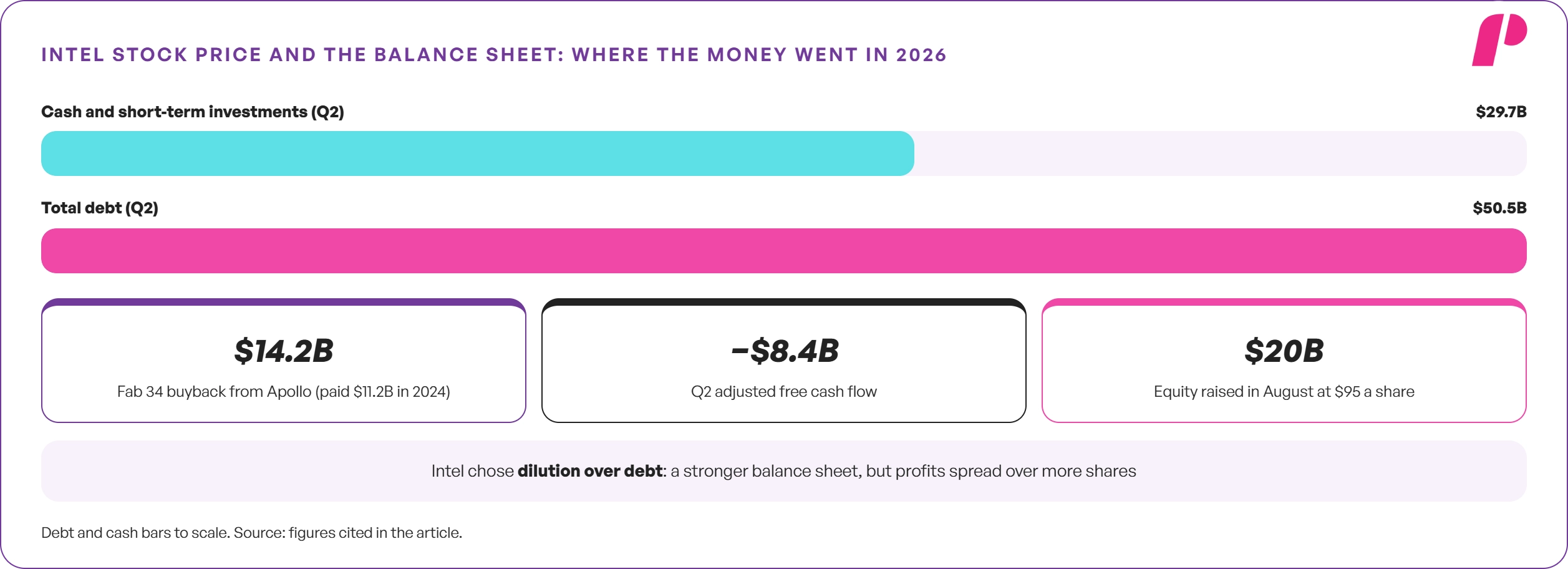
Intel spent 2026 reshaping its capital structure. In April, it agreed to buy back Apollo’s 49% stake in its Ireland Fab 34 venture for $14.2 billion.
Since Apollo paid $11.2 billion for that stake in 2024, its gain on the exit was roughly $3 billion. On the funding side, Intel used existing cash together with a $6.5 billion term loan.
The repurchase has impacted the results of the second quarter, where adjusted free cash flow fell to minus $8.4 billion. Cash and short-term investments for this period stood at $29.7 billion against debt totaling $50.5 billion.
The company came back into the equity market in August, having raised $20 billion worth of stock at $95 per share. Tan bought 105,263 shares at that same $95 price, worth about $10 million.
Intel chose dilution over debt to fund its buildout. The balance sheet benefits from this choice, although future profits now spread across a larger share count.
🔗Secondary Offerings and Stock Dilution Explained
What it Means for Traders: The new shares are already part of the share count. The next test is whether Intel can keep funding its capital spending without another equity raise.
Is the Intel Stock Price Too Expensive at 63 Times Earnings?
What Intel’s Valuation Multiples Say
Why do many analysts stay on the sidelines? Valuation is the main reason. On a sales basis, GuruFocus puts the stock at about 7.7 times, while the historical median is around 3.0 times. On earnings, the picture is no better: the next-twelve-month P/E was close to 63 in early October.
Valuation Markers & Financial Multiples
| Valuation Marker & Financial Metric | Figure & Multiplier Benchmark |
|---|---|
| Market Capitalization (at ~$93 share price) | About $475 billion |
| Price-to-Sales (P/S) Ratio | About 7.7x (historical sector median ~3.0x) |
| Forward P/E Ratio (Next Twelve Months) | About 63.0x |
| 2026 Consensus EPS (FactSet, August Estimate) | $1.49 per share |
| 2027 Consensus EPS (FactSet, August Estimate) | $2.04 per share |
| JPMorgan Analyst Price Target | $85.00 per share |
Those multiples assume earnings keep compounding quickly. At 2027 consensus, the shares trade near 46 times earnings, by our calculation. Investors are paying for a foundry turnaround that has not yet reached the income statement.
How Rising Estimates Could Make Intel Look Cheaper
The bull case, nevertheless, rests on consensus that keeps rising. FactSet’s 2026 estimate jumped 38% in the month after the July report. If upgrades continue at that pace, the multiple compresses quickly without any fall in the Intel stock price.
🔗Factor Rotation Explained: Value vs Growth Stocks
What it Means for Traders: For now, the direction of earnings estimates matters more than the current multiple. Further upward revisions after October 29 could support the shares.
How to Prepare for Intel Earnings on October 29
What Intel Promised for Q3 and What Analysts Expect
Regarding Q3 estimates, management expects the company’s revenue to range from $15.8 billion to $16.8 billion. The other estimate includes the fact that a 42% non-GAAP gross margin is expected, with $0.38 non-GAAP EPS at the midpoint level. Meanwhile, the street estimates have suggested revenues of $16.5 billion.
How Far Could Intel Stock Move After Earnings?
One practical way to prepare for the report is to estimate the expected move from options pricing.

🔗Options Expected Move Explained
The example below assumes a hypothetical implied move of 8%. Traders should replace it with live options data before the report.
$93.27 × 0.08 ≈ $7.46, which means the interval is approximately $85.81 to $100.73.
Earnings Scenario Analysis & Price Action Framework
| Market Scenario | Fundamental Catalyst & Trigger | Anticipated Price Reaction & Technical Result |
|---|---|---|
| Bull Scenario | Quarterly revenue exceeding $16.8 billion alongside a newly announced, named tier-1 foundry customer | Upside breakout above the current consolidation trading range |
| Base Scenario | Financial results landing in-line with prior guidance and no major external foundry customer announcements | Neutral sideways movement contained within the established range |
| Bear Scenario | Operating margin misses, higher-than-anticipated capital expenditures, and ongoing CPU market share losses | Downside breakdown below the established technical support range |
Position size should follow risk. A $100,000 account risking 1% has a $1,000 budget. With a stop one expected move away, size equals $1,000 ÷ $7.46, or about 134 shares. The numbers here serve as an example, not as a recommendation.
🔗Position Sizing in Forex & Stocks
What it Means for Traders: Intel’s share price has often moved sharply after earnings. Position size should reflect the move the options market prices, rather than the outcome a trader expects.
7 Risks That Could Pull the INTC Stock Price Lower
- Valuation. A forward P/E above 60 leaves little room for disappointment in the INTC stock price.
- Customer Concentration. Apple remains unconfirmed, and TSMC may join Terafab.
- Foundry Losses. Intel Foundry lost $2.1 billion in the second quarter.
- Dilution. The August offering added about 210 million shares.
- Market Share. One sell-side estimate projects Intel’s CPU share falling to 68.1% in the third quarter.
- Operations. A blast at Intel’s Kiryat Gat site in Israel on October 14 killed two workers. Intel has not disclosed any production impact.
- Rates. With the 10-year yield still around 5.1%, stocks that trade on high multiples remain under pressure.
🔗Risk Management in Stocks: A Complete Guide 2026
Bottom Line: What October 29 Will Tell Us About Intel
Intel has completed the first half of its turnaround. The product business grows again, margins have recovered, and Washington has removed the existential risk.
The second half, however, is harder. Intel must convert its fabs into a commercial foundry that outside customers trust with volume.
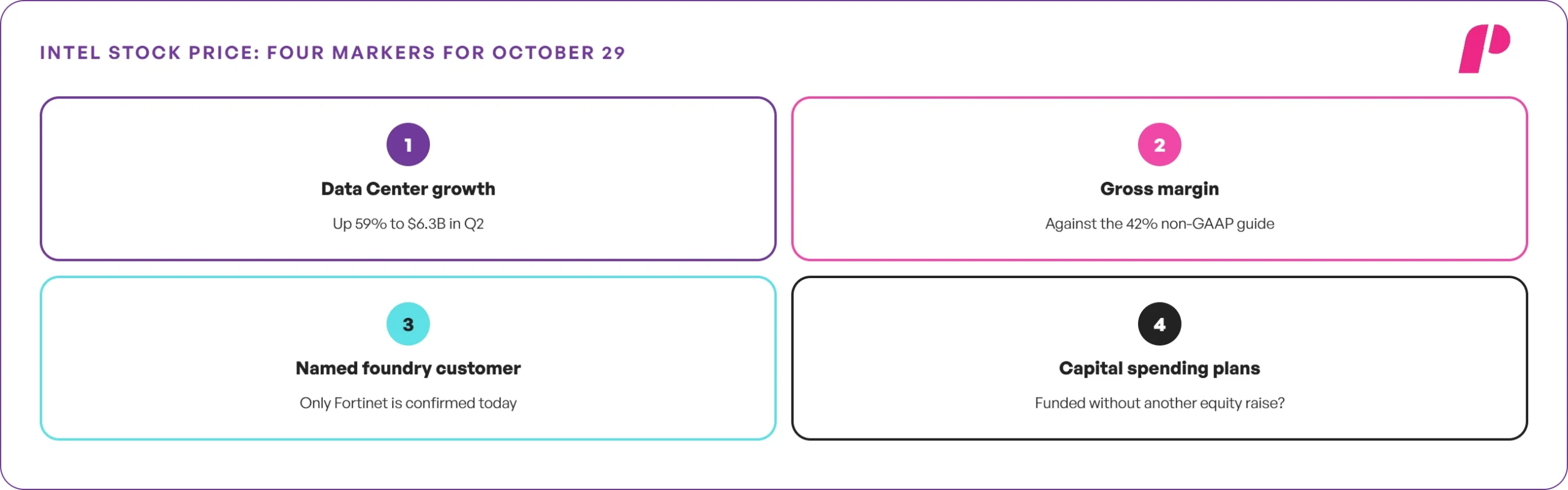
The October 29 report will show whether that second half has started. Watch four markers. They are Data Center growth, gross margin against the 42% guide, any named foundry customer, and capital spending plans.
In our view, Intel has earned its sovereign status. The INTC stock price, however, already discounts commercial success the foundry has yet to prove.
Event-driven setups such as an Intel earnings report are where a clear risk plan matters most. Traders who want to apply that discipline to US stocks and ETFs can explore Trade The Pool’s funded programs.
This analysis is for informational purposes only and is not investment advice.
If you liked this post make sure to share it!