The backlogs of orders in Boeing stand at $715 billion, and this is the highest in the history of the company. Nevertheless, the share price of Boeing ended at $191.42 on Monday, October 19. The price stands 25% below the 52-week high of $254.35.
The market is not doubting demand for Boeing’s jets. What it doubts is Boeing’s ability to certify, build, and deliver them on time.
The next week brings both tests at once. Reuters reported that the FAA may give the 737 MAX 10 its certification as early as this week. Boeing’s third-quarter results are then due on Tuesday, October 27.
Between those two events sits a company with a new fighter contract and a stronger balance sheet. Its factory, however, still has to prove it can run at higher rates.
Why the Boeing Stock Price Lags Its Order Book
The paradox starts with timing. Orders arrive years before cash, and Boeing collects most of an airplane’s price at delivery. As a result, the size of the backlog says very little about Boeing’s cash flow in the near term. What actually decides when the backlog becomes money is the pace of deliveries and the certification process.
Equity Valuation & Price Performance Benchmarks
| Valuation & Price Performance Metric | Figure / Financial Value |
|---|---|
| Closing Share Price (October 19, 2026) | $191.42 per share |
| 52-Week High Benchmark | $254.35 per share |
| Year-to-Date Change (Through September 30, 2026) | About -14.0% decline |
| Single-Day Price Drop (September 28, 2026) | -6.9% single-session decline |
| Consensus Analyst Price Target (27 Analysts, Barchart) | About $272.00 per share |
| Forward P/E Ratio (Late September 2026 Estimate) | About 50.0x |
The September 28 drop shows how sensitive the shares still are. So, why did Boeing stock fall that day? A software issue: the FAA said it would delay MAX 10 certification after Boeing disclosed the problem.
The flaw could stop pilots from using automated flight guidance during a go-around. FAA Administrator Bryan Bedford said the agency would wait “until we’re satisfied that we don’t have an issue here.” On October 2, however, the FAA concluded the glitch posed no safety concern.
In other words, Boeing’s valuation now hinges on regulators’ calendars as much as on its own factories.
Investment takeaway: Analysts see about 40% upside to their average target. Nevertheless, the gap will not close until certification and delivery risk fade.
🔗Analyst Price Targets Explained
The MAX 10: One Certificate, 1,500 Orders
The MAX 10 matters far more than a typical variant. According to Reuters, airlines have ordered nearly 1,500 of them, about 30% of Boeing’s 737 backlog.
United, Alaska, Ryanair, Delta and American are all waiting for the jet. Meanwhile, Boeing has already built a handful of MAX 10s that sit undelivered.
The FAA’s Type Certification Board completed a key safety review on Friday, October 16. That review is the final step before the agency makes its decision.
Earlier this year, Boeing completed certification flight testing for both the MAX 7 and MAX 10. Even so, Boeing still expects first MAX 10 deliveries in 2027.

Certification also carries a strategic benefit. The MAX 10 is Boeing’s answer to the Airbus A321neo, the best-selling large single-aisle jet. Without it, Boeing cannot fully compete in the most profitable corner of the narrow-body market.
Investment takeaway: FAA approval would remove a headline risk, not add near-term revenue. Deliveries, and the cash that comes with them, start in 2027.
The 777-9: The Wide-Body Clock
The MAX 10 is not Boeing’s only pending certificate. This year, the 777-9 received FAA approval to begin certification flight testing. It’s the largest twin-engine jet in development.
As for the first delivery, Boeing is still aiming for 2027, which is years later than what was originally planned.
These delays have a cost that shows up directly in Boeing’s results. In 2025, Boeing booked $5.3 billion of reach-forward losses on its 777X and 767 programs. The year before, this figure was $4.1 billion.
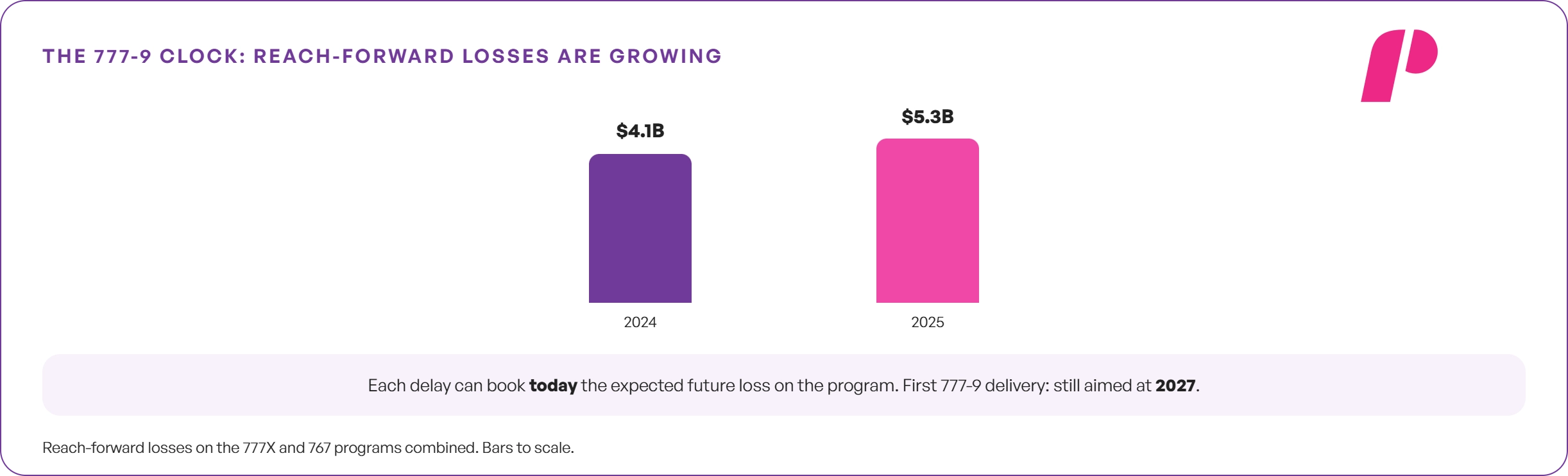
What is a reach-forward loss? It’s an accounting charge that books the expected future loss on a program today. Consequently, each new 777-9 delay can add another charge. The program remains the largest swing factor in Boeing’s reported earnings.
🔗How to Read an Earnings Report
Launch customers such as Emirates and Lufthansa have waited years for the jet. For Boeing, every quarter of delay keeps their delivery payments in the future rather than on the cash flow statement.
Investment takeaway: Any new 777X charge on October 27 would signal further slippage. On the other hand, a clean quarter on that program would ease a key overhang on the BA stock price.
Production Tempo: Turning Rate Into Cash
The second test takes place on the factory floor in Renton. Earlier this year, the FAA cleared Boeing to raise 737 output from 42 to 47 jets a month. Boeing began that transition in the second quarter. Then, in July, it activated low-rate production on a new 737 North Line.
Commercial Aircraft Delivery Metrics
| Aircraft Program / Model | Q2 2026 Deliveries | Q3 2026 Deliveries | 2026 Year-to-Date Total |
|---|---|---|---|
| Boeing 737 Program | 129 units | 124 units | 367 units |
| Boeing 787 Dreamliner | 25 units | 22 units | 62 units |
| Boeing 777 Program | 7 units | 5 units | 20 units |
| Boeing 767 Program | 10 units | 10 units | 26 units |
| Total Commercial Deliveries | 171 units | 161 units | 475 units |
In the third quarter, deliveries went down to 161 jets, compared with 171 in the second quarter. Out of these, 124 were 737s, which is an average of roughly 41 jets per month. This means the delivery pace is still below the build rate of 47 jets a month.
Does that mean the ramp is failing? Not necessarily: deliveries can lag production during a ramp, as new jets move through test and handover.
CEO Kelly Ortberg has tied the 2026 cash target to this ramp. Boeing aims for $1 billion to $3 billion of free cash flow this year. Ortberg links that outcome to steadier production and to clearing inventory of unfinished aircraft.
Every jet that leaves the factory finished, rather than reworked later, shortens the path from backlog to cash.
Investment takeaway: Watch the $1 billion to $3 billion free cash flow target on October 27. A cut would likely weigh on the BA stock price more than an earnings miss.
The Defense Pivot: F/A-XX and PAC-3
Defense provided the quarter’s biggest headlines. The segment grew revenue 13% in the second quarter, yet it still posted a small operating loss.
On September 29, the Pentagon selected Boeing to build the Navy’s sixth-generation F/A-XX carrier fighter. The full-scale development contract is worth more than $20 billion. Furthermore, Boeing already holds the Air Force’s sixth-generation F-47 award from 2025.
🔗Iran Drone Threat: Best Defense Stocks 2026
A week later, Lockheed Martin awarded Boeing a contract worth about $14.7 billion. Under it, Boeing will triple production of seekers for PAC-3 MSE interceptors at its Huntsville, Alabama site. The award ties to a seven-year framework with the Pentagon.
🔗RTX 2026: The $300 Billion Titan of Aerospace and Defense
Major Defense Contracts & Aerospace Awards
| Defense Program / Award | Award Date | Contract Value / Scope | Key Technical & Contractual Detail |
|---|---|---|---|
| F/A-XX Carrier Fighter Program | September 29, 2026 | $20 Billion+ (Development Phase) | Specific contract structure and vehicle classifications remain classified/undisclosed |
| PAC-3 MSE Missile Seekers | October 5, 2026 | About $14.7 Billion | Undefinitized contract action designed to triple current manufacturing output |
| F-47 Air Dominance Fighter | 2025 | Not Disclosed (Classified) | Next-generation United States Air Force sixth-generation tactical fighter program |
🔗Kratos Defense Stock: The 2026 Architect of Autonomous Warfare
These wins, however, come with a lesson from Boeing’s own history. Fixed-price development contracts, signed under earlier management, produced repeated losses.
For example, Boeing booked $280 million of VC-25B losses in the second quarter alone. KC-46 tanker charges added about $600 million in the fourth quarter of 2025.
So, how should investors value these awards? It depends on the contract terms, and Boeing has not disclosed them yet. A cost-plus development deal shares risk with the government. In contrast, a fixed-price deal could repeat the KC-46 pattern.
Investment takeaway: F/A-XX secures Boeing’s fighter franchise for decades. Its profit value, however, depends on contract terms Boeing has not yet disclosed.
Inside the Numbers: Recovery Without Profits Yet
Boeing’s financial record shows real improvement from a very low base. Revenue rose to $89.5 billion in 2025, and deliveries climbed to 600 jets.
Net income also turned positive at $2.2 billion. However, a $9.6 billion gain on the sale of Boeing’s digital aviation business drove that profit.
Full-Year Financial Performance & Operational Key Metrics
| Financial & Operational Metric | FY2024 Results | FY2025 Results |
|---|---|---|
| Total Annual Revenue | $66.5 Billion | $89.5 Billion |
| Net Earnings (Loss) Attributable to Shareholders | $(11.8) Billion (Net Loss) | $2.2 Billion (Net Profit) |
| Core Earnings Per Share (Core EPS) | $(20.38) per share | $1.19 per share |
| Free Cash Flow Generation | $(14.3) Billion Burn | $(1.9) Billion Burn |
| Total Commercial Aircraft Deliveries | 348 units | 600 units |
🔗Earnings Per Share (EPS) Explained
The second quarter confirmed both sides of the story. Revenue for the quarter increased by 8% to $24.6 billion, and free cash flow came in positive at $631 million. On the other hand, core EPS was still a loss of $0.76, below what analysts had estimated.
Q2 2026 Segment Financial Performance
| Business Segment | Q2 2026 Revenue | Q2 2026 Operating Margin |
|---|---|---|
| Commercial Airplanes Segment | $11.8 Billion | (2.7)% Operating Loss Margin |
| Defense, Space & Security Segment | $7.5 Billion | (0.2)% Operating Loss Margin |
| Global Services Segment | $5.3 Billion | 18.1% Operating Profit Margin |
Global Services carries the company. Its 18.1% margin funds losses elsewhere, while Commercial Airplanes still loses money on each dollar of revenue.
For this reason, Boeing’s recovery depends on the Commercial Airplanes unit getting to break-even. More growth in services will not be enough on its own.
Investment Takeaway: For traders following the turnaround, the margin of Commercial Airplanes is probably the most useful number to watch. Narrowing losses there would matter more than headline revenue growth.
A Repaired Balance Sheet
Compared with a year earlier, Boeing started 2026 with a lot more financial flexibility. The 2024 equity raise and the digital aviation sale rebuilt its liquidity.
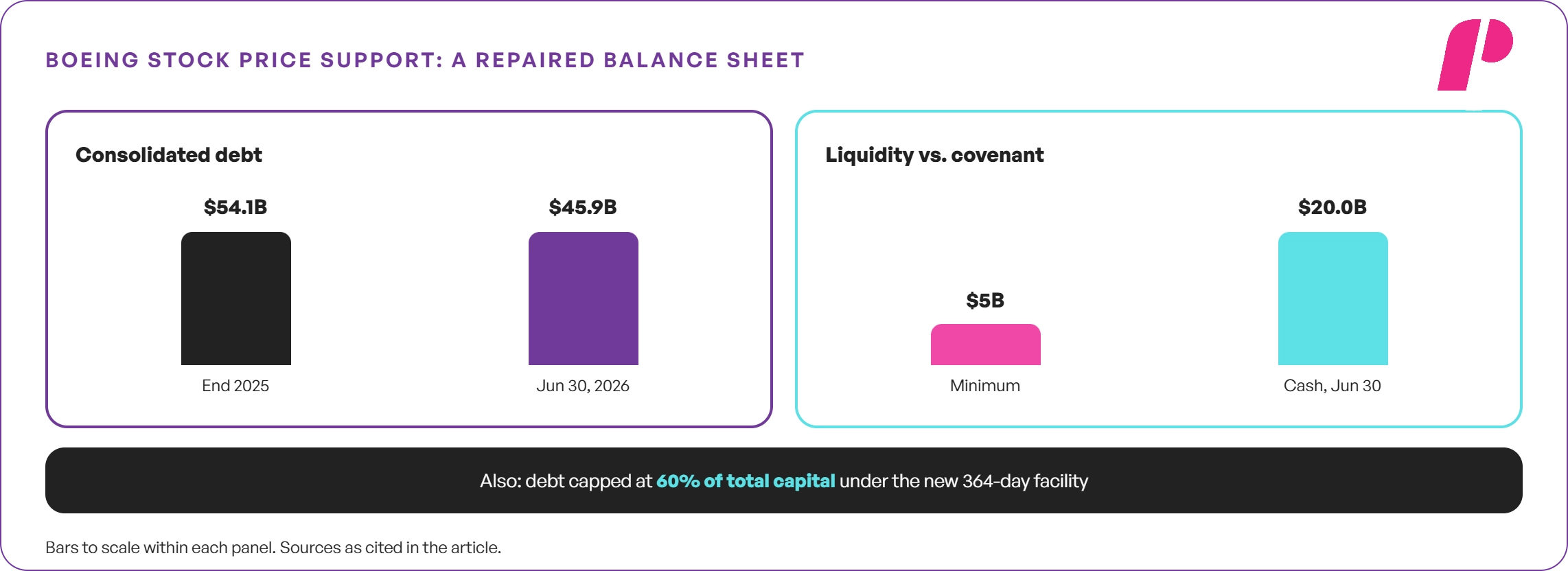
Boeing’s consolidated debt went down to $45.9 billion as of June 30, from $54.1 billion at the end of 2025. As of the same date, Boeing held $20.0 billion in cash and marketable securities.
In August, Boeing renewed $10 billion of bank credit lines, with Citibank and JPMorgan as the lead banks. The agreements require at least $5 billion of liquidity.
Furthermore, under the new 364-day facility, Boeing’s consolidated debt cannot go above 60% of its total capital. In simpler terms, these covenants are there as a safety limit, and Boeing’s liquidity is well over the minimum required.
Boeing finalized its deal to buy Spirit AeroSystems in December 2025. The deal returned 737 fuselage production to Boeing’s direct control. In the long run, this change should improve quality. However, the integration costs are putting pressure on margins in the near term.
🔗How Mergers and Acquisitions Move Stocks
The fact is that the balance sheet is no longer a major risk for shareholders. As a result, attention shifts fully onto execution.
Investment takeaway: Liquidity risk has faded from the Boeing stock price. Over time, further debt reduction would support a higher multiple.
What Boeing Owns: Manufacturing Know-How
Boeing’s patents show where its engineering edge sits. An example of this is US Patent 8,714,226, granted in May 2014, which covers an automated fiber placement system. The system uses a layup mandrel designed to reduce vibration.
One of its claims describes a mandrel of at least 19 feet in diameter. That’s close to the size of a 787 fuselage barrel. The design lets Boeing build one-piece composite barrels rather than fastening separate panels together.
🔗Patent Portfolios and IP Moats
Boeing is also building a software layer on top of its installed fleet. On October 20, it launched Dataliner, an AI data platform built with Microsoft.
With this platform, airlines can share maintenance and operating data while still controlling their own records. As for Boeing, software that is connected to thousands of aircraft could help grow Global Services, its highest-margin business.
🔗AI Stocks in 2026: How to Evaluate, Choose, and Trade
Investment takeaway: Dataliner will not move near-term earnings. It does, however, strengthen the recurring services business that already funds Boeing’s recovery.
Trading the October 27 Report
Four lines will matter most in the release. Free cash flow is the first one to check. It shows whether Boeing is on track for its $1 billion to $3 billion target. Next comes the Commercial Airplanes margin, which indicates if higher production rates are improving profitability.
Defense charges come third, given the VC-25B and KC-46 history. Finally, management commentary on MAX 10 and 777-9 timing closes the list.
The market will likely read cash before earnings. Since Boeing is still reporting core losses, a smaller loss is less important than a believable plan for cash.
For this event, traders can use a basic formula to estimate the expected move:

🔗Options Expected Move Explained
The example below assumes a hypothetical implied move of 6%. Live options data should replace it before the report.

Earnings Scenario Planning & Price Action Triggers
| Market Scenario | Catalyst Trigger & Operational Event | Possible Price Reaction & Technical Result |
|---|---|---|
| Bullish Scenario | MAX 10 aircraft certification achieved; free cash flow targets maintained or raised | Upside breakout above current trading range |
| Base Case Scenario | Earnings results match expectations; full-year corporate guidance remains unchanged | Sideways consolidation within established range |
| Bearish Scenario | Unexpected financial charges, lowered cash targets, or slower 737 production ramp | Downside breakdown below support range |
Position size should follow risk. For instance, a $100,000 account risking 1% has a $1,000 budget. With a stop one expected move away, the size equals $1,000 ÷ $11.49, or about 87 shares. These figures are illustrative only.
🔗Position Sizing in Forex & Stocks
Investment takeaway: The 6.9% drop on September 28 shows that one regulatory headline can exceed a normal earnings move. Therefore, positions are best sized with that in mind.
🔗Swing Trading Risk Management
The Risks That Matter for the Boeing Stock Price
- Certification. Any new MAX 10 or 777-9 delay would push cash further out.
- Fixed-price exposure. Legacy defense programs keep producing charges.
- Commercial losses. Commercial Airplanes still posts negative margins.
- Production ramp. Deliveries trailed the 47-a-month build rate in the third quarter.
- Valuation. A forward P/E near 50 assumes a strong earnings recovery.
- Safety events. A single incident could trigger new FAA limits.
🔗Risk Management in Stocks: A Complete Guide 2026
Closing Thoughts
Boeing has repaired its balance sheet and secured its fighter franchise for decades. Its backlog has never been larger. The hardest part, however, remains. Boeing must certify the MAX 10 and the 777-9, then convert orders into cash at scale.
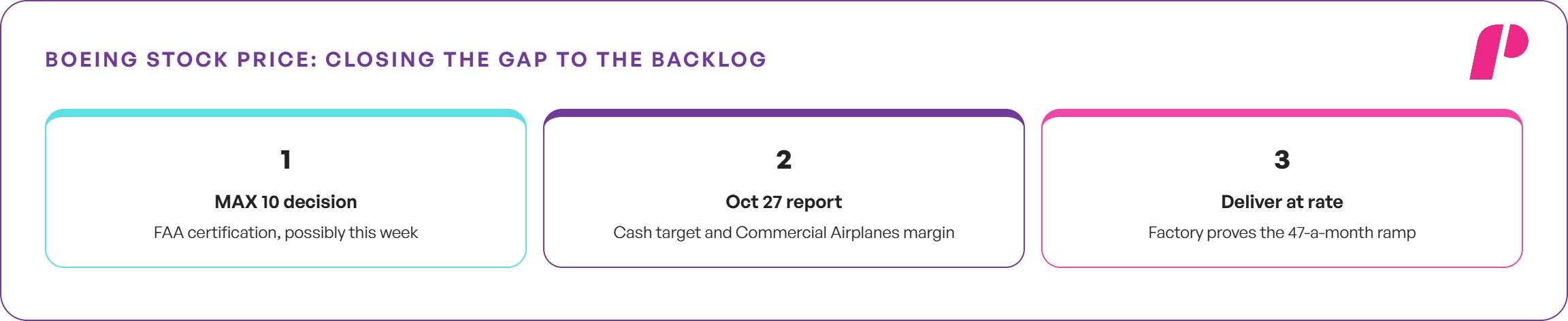
The coming week tests both halves of that task. The FAA’s MAX 10 decision comes first. Then, on October 27, the focus moves to the cash target and the Commercial Airplanes margin.
The BA stock price is likely to close the gap to its backlog only when certification risk fades. The factory must also prove it can deliver at rate.
Traders who follow event-driven setups in stocks like BA can apply that analysis through Trade The Pool. The prop firm offers funded accounts for US stocks and ETFs, under defined risk rules.
NFA. DYOR. This analysis is for informational purposes only and is not investment advice.
If you liked this post make sure to share it!