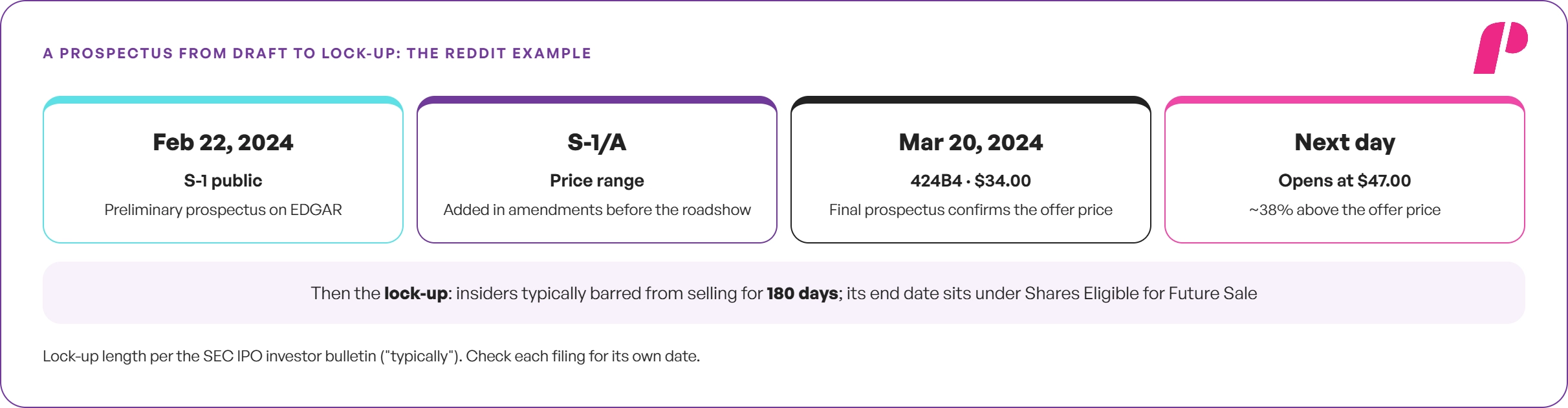
Reddit’s prospectus priced its shares at $34.00, and the stock opened at $47.00 the next day. Anyone who bought that first print paid roughly 38% above the offer price.
The company had listed its main risks across 56 pages, from user growth to dependence on advertising. None of it was hidden. The first public S-1 went up on EDGAR on February 22, almost a month before the debut.
In its IPO investor bulletin, the SEC says staff review does not guarantee complete or accurate disclosure. The checking falls to the reader, and the prospectus is where that checking starts.
Where the Risks Are Written Down
A broker app shows a ticker and a price, while the filing behind a new listing sits elsewhere. That gap is why new traders still search “What is a prospectus?” before their first IPO trade.
In essence, a prospectus is the document that should be given to investors by a firm when selling them new shares. It indicates how the firm generates revenues, what the audited figures are, possible risks, and terms of the transaction.
Readers who ask “What is another name for a prospectus?” will meet two common labels in IPO coverage. The formal answer is offering document, and the SEC calls the early draft a preliminary prospectus. News stories shorten that to red herring, a nickname that comes from the color of an old cover warning.
What This Guide Covers:
- SEC review compared with SEC approval
- Reddit’s $34.00 IPO prospectus as a worked example
- S-1, S-1/A and 424B4 forms on SEC EDGAR
- Lock-up agreements that typically last 180 days
- Daily loss limits in a funded stock account
What Is a Prospectus in the Stock Market?
In finance, a prospectus is the formal disclosure document behind any registered public offer of securities. Investors who ask “What is the purpose of a prospectus in the stock market?” get a one-word answer: disclosure.
🔗 IPO Explained: How Initial Public Offerings Work
What Is a Prospectus for Shares?
The investors of the fund also get a prospectus; however, the prospectus of the mutual fund concentrates mainly on objectives, fees, and performance. That tells a trader little about a new stock, which is why people search “What is a Prospectus for Shares?” This particular one deals with the issuing of stocks, be it the initial issue of stocks or an additional issue of stocks by the publicly held company.
Who Prepares a Prospectus and Who Reviews It?
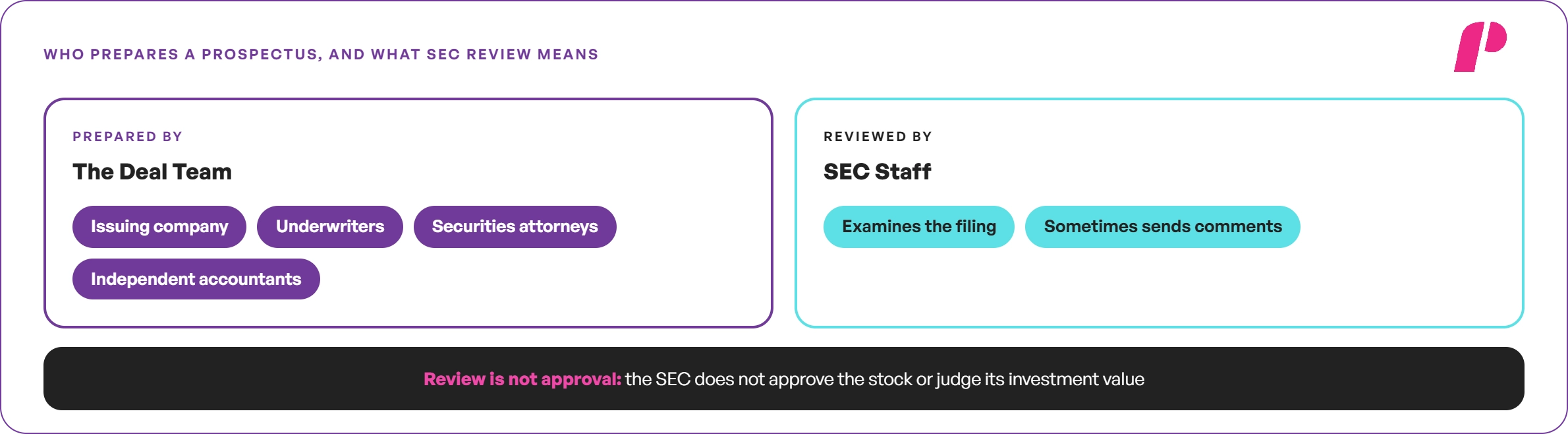
The SEC staff examines IPO applications and sometimes responds with its comments. They don’t approve the stock nor determine its investment value. That leaves beginners asking, “Who prepares a prospectus?” before they trust any figure inside it. It is the company that issues the stock, along with underwriters, securities attorneys, and independent accountants who certify the auditor’s opinion.
Types of Prospectus: Preliminary, Red Herring and Final
How Many Types of Prospectus Exist?
India’s Companies Act, 2013 recognizes four kinds: red herring, shelf, abridged, and deemed prospectuses. Those labels dominate answers to “What are the four types of prospectus?”, which confuses US readers. It depends on the country: in a US IPO, traders mainly meet two versions, the preliminary and the final prospectus.
The S-1 Registration Statement
The preliminary prospectus is the first public version, filed inside the S-1 registration statement. That settles “What does preliminary prospectus mean?” for most readers following IPO news. Then come the amendments. Each S-1/A amends the registration statement, while the price range is normally disclosed just prior to the roadshow.
What Is a Red Herring Prospectus?
However, broker notes and IPO coverage often give the draft a shorter nickname. Anyone searching “What is a red herring prospectus?” is looking at that same preliminary draft. The company files it before pricing, so it shows no final price and no final share count.
Where the Red Herring Name Comes From
Under Regulation S-K Item 501, the preliminary cover must warn that the information is incomplete and may change. Printers traditionally set that warning in red ink. As a result, the answer to “What is a red herring in investment?” has nothing to do with detective-story clues.
The Final Prospectus on Pricing Day
Pricing day changes the document. SEC Rule 424(b) gives the company until the second business day after pricing to file the final terms. That filing answers “What is a final prospectus?” The completed version, usually listed on EDGAR as a 424B4.
A Real Prospectus Example: Reddit’s 424B4. Regarding Reddit’s 424B4 which was issued on March 20, 2024, they have been able to confirm a price of $34.00 per share on 22,000,000 Class A shares. This has led to 6,723,473 of the selling stockholders
Set beside the S-1, it answers “What is the major difference between a red herring and a prospectus?” The answer is completeness, since both describe the same deal.
Preliminary Prospectus vs Final Prospectus
| Prospectus Version | SEC EDGAR Form Classification | Pricing Structure Disclosed | What a Trader / Analyst Learns |
|---|---|---|---|
| Preliminary Prospectus (Red Herring) | Form S-1, followed by amendments (S-1/A) | Indicative price range disclosed in later amendments | Core business model, operating risks, and early structural deal terms |
| Final Prospectus | Form 424B4 (occasionally 424B1 or 424B3) | Final confirmed public offering price | Definitive offering price, exact share count, and underwriting commitments |
What a Prospectus Tells You About a Company
Risk Factors and Use of Proceeds
Reddit’s Use of Proceeds section planned about $202 million for employee tax withholding. A trader asking “What would a prospectus tell you about a company?” rarely finds such details elsewhere. Around it sit the basics: what the company sells, who runs it, and how the audited numbers look.
Dilution and Capitalization
New IPO buyers usually pay far more per share than founders and early investors paid. However, many readers skip the Dilution table because it looks dense. According to the SEC’s IPO investor bulletin, the section shows a usually significant gap between IPO price and book value.
Key Sections at a Glance
Most US filings follow a similar order, so two companies are easy to compare side by side. That order also answers “What should be included in a prospectus?” for readers checking a filing for gaps. The list runs from the summary, risk factors, and use of proceeds through dilution, capitalization, management, and underwriting.
🔗 How to Read an Earnings Report
IPO Prospectus Due Diligence Framework
| Prospectus Section | What the Disclosure Shows | Core Trader / Analyst Question |
|---|---|---|
| Risk Factors | Comprehensive review of primary operational, legal, and market risks | What structural vulnerabilities could permanently damage the business? |
| Use of Proceeds | Planned allocation of newly raised capital (e.g., R&D, debt paydown, expansion) | Where exactly does the newly raised cash go to drive growth? |
| Dilution | Comparison of public IPO offering price versus net tangible book value per share | How much extra premium are public buyers paying over tangible book value? |
| Capitalization | Pro-forma breakdown of total debt and stockholders’ equity following the offering | How much long-term debt remains on the balance sheet post-IPO? |
| Shares Eligible for Future Sale | Insider lock-up expiration schedules and potential future equity supply | When do lock-up agreements expire and insiders become free to sell? |
How to Find a Prospectus on SEC EDGAR
Free Access Through EDGAR
Market data often sits behind a subscription, so beginners ask “Are SEC EDGAR filings public?” before they search. Yes: the SEC describes EDGAR as free public access to corporate filings, prospectuses included. Anyone asking “How to get a prospectus?” can also use the company’s investor relations page, which usually links to the filing.
How to Search the EDGAR Database
However, the search itself takes a few minutes. The answer to “How can I search the EDGAR database?” is a name or ticker in the sec.gov search bar. From there, the form-type filter does the sorting. S-1 means a draft; 424B4 means the deal is priced.
- Search the ticker, for example, RDDT, on SEC EDGAR
- Open the company’s full filing list
- Narrow the form type to S-1 or 424B4
- Print the filing to save a prospectus PDF
SEC EDGAR Primary Filing Schedule
| SEC Filing Form | What the Document Contains | When It Appears in Offering Lifecycle |
|---|---|---|
| Form S-1 | Initial registration statement containing the preliminary prospectus for domestic issuers | Filed prior to public offering pricing |
| Form S-1/A | Amended registration statement updating business metrics and offering ranges | Filed sequentially before pricing |
| Form F-1 | Registration statement tailored for foreign private issuers entering US markets | Filed prior to public offering pricing |
| Form 424B4 | Final prospectus containing the confirmed public offering price and share allocation | Within two business days following pricing |
Checking the Filing Date
Old copies raise a timing question. Under Securities Act Section 10(a)(3), a prospectus used over nine months after effectiveness needs information no older than sixteen months. That is the US answer to “How long is a prospectus good for?” The 12-month limit many sites repeat comes from EU rules.
How to Read a Prospectus Before Trading an IPO
A Practical Reading Order
Reddit’s filing reached its financial statements only after page 235. Reading that much before a listing opens is unrealistic, so “How to read an IPO prospectus?” comes down to order.
Therefore, the summary comes first, then risk factors, use of proceeds, dilution, and shares eligible for future sale.
The Lock-Up Date
According to the SEC’s IPO investor bulletin, lock-up agreements typically bar insiders from selling for 180 days.
When they expire, the bulletin warns, the price may fall sharply if many shares reach the market at once. The lock-up period end date sits under Shares Eligible for Future Sale, ready to mark early.
Red Flags Traders Should Not Ignore
The Missouri Securities Division lists four warning signs: insiders selling out, excessive pay, sweetheart deals and unexplained accounting changes.
It also calls an auditor’s going-concern doubt one of the most serious qualifications a filing can carry. However, none of these predicts the price. Each one marks where risk runs higher.
🔗 IPO Trading Strategies and Tips
IPO Prospectus Red Flags & Due Diligence Risk Framework
| Prospectus Red Flag | Where to Look in Filing | Why It Matters / Analytical Significance |
|---|---|---|
| Extensive Insider Share Selling | Principal and Selling Stockholders Section | Heavy insider dumping indicates management may possess negative private knowledge about near-term prospects |
| Excessive Executive Compensation | Executive Compensation Table | Disproportionate pay relative to performance suggests management and public shareholder priorities are misaligned |
| Related-Party Transactions | Certain Relationships and Related-Party Transactions | Reveals potential conflicts of interest where corporate assets or revenues may benefit insiders privately |
| Unexplained Accounting Policy Changes | Notes to Financial Statements | Changes in methodology can artificially inflate financial results to make operations look stronger than reality |
| Going-Concern Auditor Doubt | Auditor’s Report and Risk Factors Section | Signals severe liquidity distress, indicating the fundamental risk of corporate bankruptcy is elevated |
Prospectus Research in a Funded Stock Account
From Red Flags to Position Size
In a funded stock account, one oversized trade on a volatile new listing can breach a daily loss limit. Prospectus findings belong in the share count before the order goes in. For example, an auditor’s going-concern doubt is a reason to cut size and set the stop first.
🔗 Position Sizing in Forex & Stocks
Matching Risk to Daily Loss Rules
New listings can swing hard in early sessions, and volatility halts can freeze a position mid-move. Meanwhile, Trade The Pool’s program terms close every open position once daily losses pass the account’s limit. Dilution and the lock-up date are in the filing before day one, so there is no reason to size blind.
🔗 Prop Firm Risk Rules: How to Trade Without Breaching Them
Building a Pre-Trade Checklist
Nobody needs to memorize 200 pages. Five questions, asked the same way on every new listing, are enough to start. A checklist supports judgment.
However, it never replaces stop levels, position limits, or the account’s rules. Table 5 maps each finding to a risk question and an action.
Turning Findings Into Funded-Account Actions
| Prospectus Finding & Vulnerability | Core Risk Question for Trader | Required Funded-Account Action & Risk Protocol |
|---|---|---|
| Large Corporate Equity Dilution | Is the current market entry price artificially stretched relative to book value? | Reduce position sizing and establish strict stop-loss parameters prior to market execution |
| Insider Lock-Up Expiration During Holding | Will circulating share supply surge suddenly and crush near-term momentum? | Map out exact position exit and profit-taking targets well in advance of the expiration date |
| Auditor Going-Concern Warning | Can financial distress cause the stock to gap sharply down overnight? | Trade significantly smaller position lots to remain strictly within daily program loss limits |
Reading the Prospectus With Realistic Expectations
A prospectus describes a company in detail and never forecasts the share price. Traders who ask “What is the golden rule in a prospectus?” sometimes expect a hidden trading signal. The term is borrowed from company law, and it refers to informing the investors about everything without hiding anything material.
Is a Prospectus Required for an IPO?
The preliminary version sets the range, the 424B4 confirms the terms, and SEC EDGAR keeps both free. For anyone asking “Is a prospectus required for an IPO?”, the answer for a registered US offering is yes. Every cover also states that the SEC has not approved the securities or passed on the disclosure’s accuracy.
Building the Habit on Every Listing
Each new listing is another chance to run the same reading order and checklist. After a few filings, risk factors, dilution tables, and lock-up dates become familiar, and reviews get faster. However, faster reading never replaces position limits, stop levels, or the rules of a funded account.
Traders who want to apply this research with clear risk rules can explore Trade The Pool’s funded stock accounts.
If you liked this post make sure to share it!