Four times a year, the market gets loud. Thousands of US companies report within a few weeks, and quiet stocks can jump or collapse overnight on a single number. Earnings trading means positioning around those releases: setting up in the days before, or trading the reaction after. The date is known. The outcome isn’t. That’s why active traders come back every quarter.
Here’s the trap: plenty of traders still assume a beat means the stock rises the next morning; however, that belief rarely holds up. Most companies beat their estimates in a normal quarter, so a beat is hardly news.
🔗 Lululemon Q2 2026 Earnings Preview
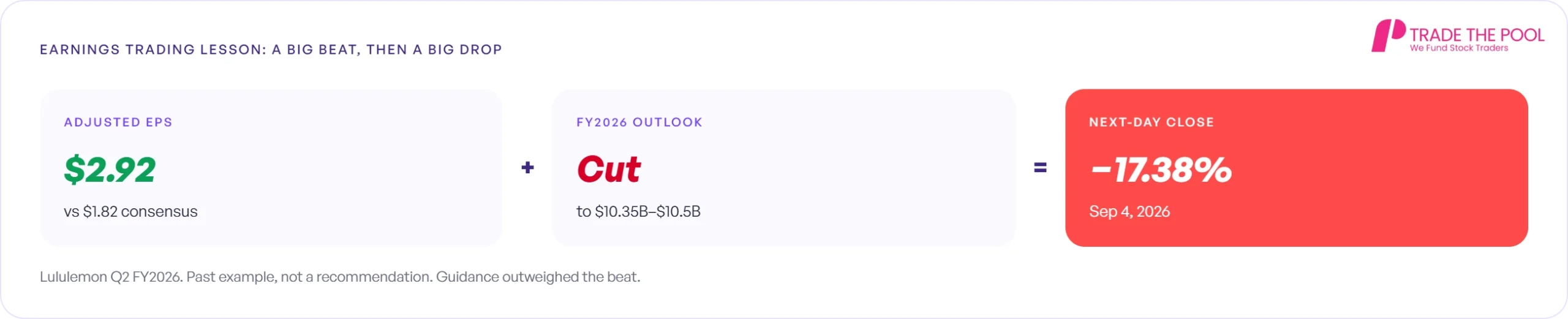
As a result, the reaction depends on guidance and on what the market expected. An illustration is Lululemon in September 2026, whose stock fell hard the day after a profit beat. The reason was a lower forecast for the rest of the year. Therefore, this guide treats the release as the riskiest moment and the reaction that follows as the opportunity.
Why Guidance And Market Expectations Drive Stock Reactions
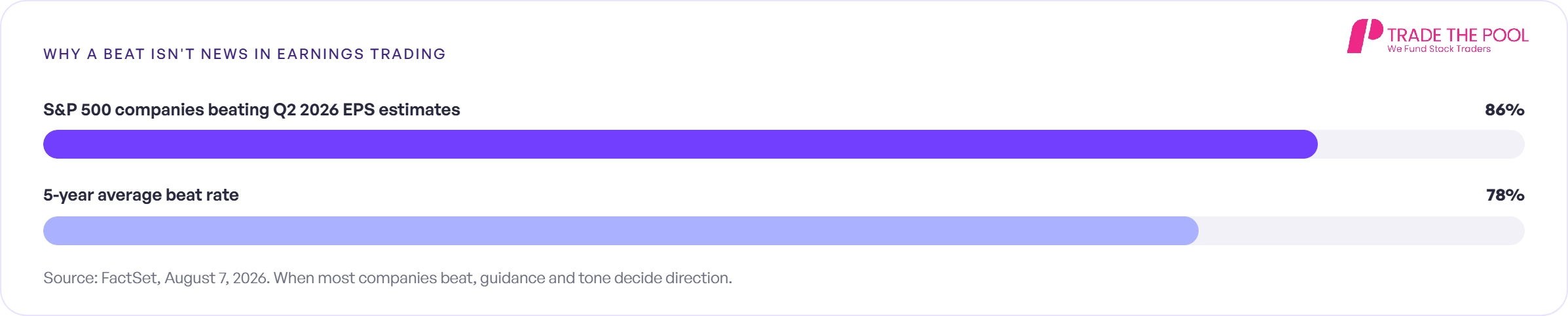
Furthermore, almost every beginner types the same question into Google before a first earnings trade: How do earnings affect stock prices once the results are out? Prices react to results compared with expectations, and to guidance, far more than to the raw numbers. According to FactSet’s August 7, 2026 update, 86% of S&P 500 companies beat their Q2 EPS estimates.
For comparison, the 5-year average is 78%, so a beat told traders very little on its own. Meanwhile, guidance and management’s tone on the call often decided which way the stock went. In contrast to most guides, this article approaches earnings trading as a routine in three time windows.
It covers the expected move, surprises, gaps, drift, and risk, each backed by dated sources and plain examples. Finally, it explains how Trade The Pool’s earnings-season rule shapes earnings trading in a funded stock account.
This Guide Covers:
- What earnings trading is and when companies report.
- How to read the expected move before a release.
- Reasons for stock decline despite favorable earnings report.
- How the process of gaps, fades, and drifts takes place post-release.
- How earnings trading works in a funded stock account.
What Is Earnings Trading?
Earnings trading focuses on a short window around one scheduled event: a company’s quarterly results release. Beginners often ask, “What is earnings season, and when does it start each quarter?” Nasdaq says it typically begins within two weeks after each quarter ends; for example, early October.
🔗 How to Read an Earnings Report
When Earnings Trading Happens: BMO and AMC
Release timing decides when the first price reaction can happen, so every earnings trading plan starts there. A related question is what time companies release earnings, and why that timing matters so much. Most report before market open (BMO) or after market close (AMC); therefore, the first reaction usually arrives as a gap.
BMO and AMC Release Examples
| Company & Reporting Period | Release Timestamp | Trading Session |
|---|---|---|
| JPMorgan Chase (Q3 2026) | Oct 13, 2026, about 7:00 a.m. ET | Before market open |
| Lululemon Athletica (Q2 FY2026) | Sep 3, 2026, after the close | After market close |
Finding Confirmed Earnings Dates
Trading earnings reports also means confirming the date first. With the wrong date, a position may stay open through the announcement. A common search is “where can I find an earnings calendar with confirmed dates?” The company’s investor relations page is the safest place; for example, JPMorganChase set its Q3 2026 results for October 13.
🔗 Earnings Season Calendar 2026
Earnings Trading Before The Release: Expected Move And Run-Up
The Three Windows Of Earnings Trading
Every earnings trade falls into one of three windows, and each window carries its own kind of risk. How do traders trade earnings in a structured way, rather than simply guessing the result? They split the event into before, at, and after the release; meanwhile, each window gets its own written plan.
Earnings Trading Strategy By Window
| Trading Window | Market Dynamics & Price Action | Trader Evaluation Checklist | Primary Risk Factor |
|---|---|---|---|
| Before the Release | Price run-up; options markets price in expected move | Check report date, time, consensus estimates, and implied move | Binary gap risk if position is held through announcement |
| At the Release | Financial results and forward guidance become public | Compare actual results vs. consensus and evaluate guidance tone | Sharp, volatile initial price reaction |
| After the Release | Opening gap holds or fades during the session | Monitor trading volume, price direction, and stop-loss placement | Trend reversal or fakeout price action |
The Expected Move Formula
For example, options prices give traders a rough estimate of the move the market expects. What is the expected move for earnings, and how is it calculated before the report? Add the nearest at-the-money call and put prices; CMEG notes this gives a roughly two-in-three range.
Expected Move ≈ At-the-Money Call Price + At-the-Money Put Price
🔗 What Is Implied Volatility?
Buying Before Or After Earnings
Meanwhile, the earnings run-up before a report pushes many traders to buy early and hold. That raises the question: “Is it better to buy a stock before or after earnings?” No timing works every quarter: buying before adds gap risk, while buying after means a higher entry. Fidelity calls market timing “exceedingly difficult”, so traders compare the expected move with their target first.
At The Release: Earnings Surprises And Guidance
Surprise Earnings And Whisper Numbers
After releasing the report, the traders will then compare the results against the estimates made by the analysts. What is the definition of an earnings surprise and whisper number? A surprise is actual EPS minus consensus EPS; in contrast, a whisper is an unofficial and often higher expectation.
Why Forward Guidance Moves Stocks
In many cases, forward guidance carries more weight than the quarter itself, since prices look ahead. Traders often search “what is forward guidance” and wonder why it moves stocks so strongly. It is management’s forecast; for example,Lululemon cut its fiscal 2026 revenue outlook to $10.35 to $10.5 billion.
🔗 What Is Forward Guidance?
Why Stocks Drop After Good Earnings
Lululemon’s adjusted EPS came in at $2.92, against a consensus of $1.82. Still, the stock closed 17.38% lower the next day. So why do stocks drop after good earnings, even after a beat this large? In simpler terms, a beat only counts against expectations; therefore, a weaker outlook can cancel it out.
Lululemon’s Q2 Report And Reaction (Past Example, Not A Recommendation)
| Financial Item & Metric | Figure & Performance Comparison | Documentation Source |
|---|---|---|
| Release Timing & Session | Sep 3, 2026 (after market close) | Lululemon Corporate Release |
| Adjusted EPS vs. Consensus | $2.92 vs. $1.82 expected (includes $0.86 tariff refunds) | Yahoo Finance & Lululemon |
| Revenue vs. Consensus | $2.40 billion vs. $2.46 billion expected | Yahoo Finance |
| FY2026 Revenue Outlook Revision | Lowered to $10.35B–$10.5B (from previous $11B–$11.15B) | Lululemon & Forbes |
| Share Price Close (Sep 4, 2026) | $100.61 per share (down 17.38% post-earnings) | The Motley Fool |
After The Release: Gaps, Fades, And Post-Earnings Drift
What Is An Earnings Gap?
The first reaction often appears as a gap, because the news arrives while the regular session is closed. What is an earnings gap, and why does it form right at the open? The open differs sharply from the prior close; for example, Lululemon reported after the September 3 close.
Gap-And-Go Versus The Fade
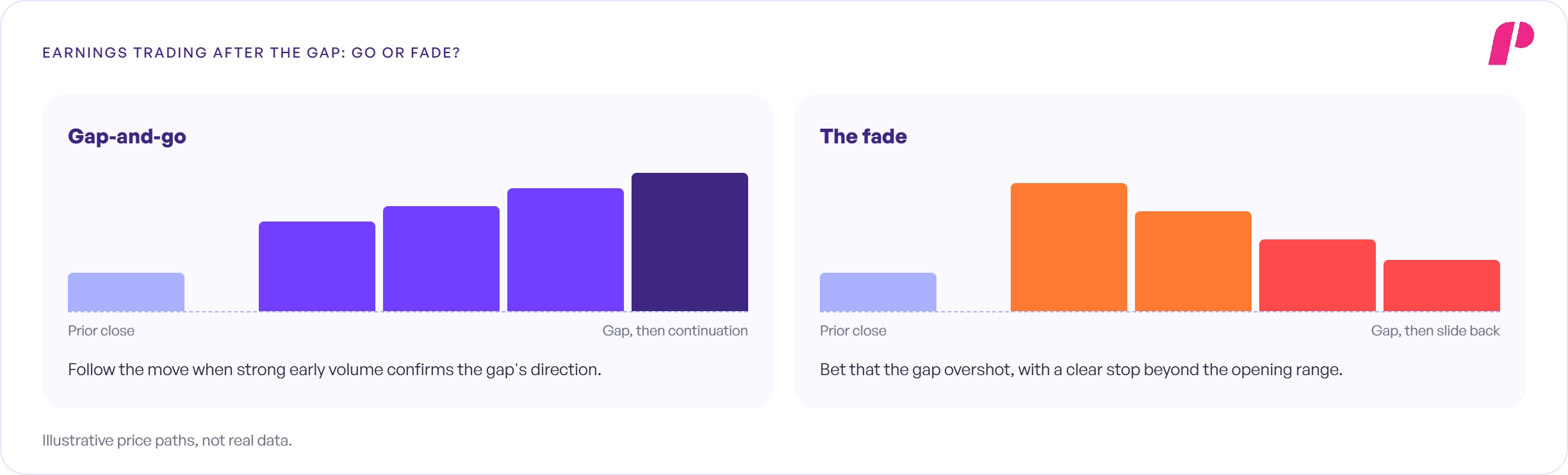
After the gap, traders watch whether price keeps the gap’s direction or slips back toward the prior close. A gap-and-go trade follows the move when strong early volume confirms it during the opening session. In contrast, a fade bets that the gap overshot, so it needs a clear stop beyond the opening range.
🔗 Large Cap, Gap & Go Strategy
Does Post-Earnings Drift Still Work?
Prices kept on moving in the aftermath of big earnings surprises according to Bernard and Thomas (1989). What is post-earnings announcement drift, and does it still work in large stocks today?
It is that tendency to keep moving in the surprise’s direction; however, it has largely faded in larger stocks. A January 2026 UCLA Anderson Review summary places drift mainly in microcaps, so price and volume must confirm it.
Earnings Trading Risks: Overnight Gaps, IV Crush, And Position Size
Holding Through Earnings
However, the biggest earnings risk sits outside regular hours, when a position stays open through the release. Should traders keep holding through earnings when a stop order is already in place? Not reliably: holding through a release exposes a position to an overnight gap that a stop can’t limit.
IV Crush And Options
Meanwhile, options look attractive before a release, yet their prices already include a large expected move. What is IV crush, and do options remove earnings risk for the option buyer? Not entirely: IV crush, the post-release drop in implied volatility, can shrink an option’s value even after a correct call.
Position Sizing For Earnings Trading
Size decides how much damage one surprise can cause, so earnings trading calls for smaller positions. How should position size change for an earnings trade compared with a normal setup? It should shrink, because a gap can push price past a stop; as a result, the loss grows beyond plan.
🔗 Position Sizing in Forex & Stocks
Earnings Risks and Practical Controls
| Trading Risk Factor | Market Impact & What Happens | Practical Risk Control & Mitigation Strategy |
|---|---|---|
| Overnight Price Gap Risk | Asset opens past stop-loss levels due to after-hours news | Be flat ahead of the release or size positions appropriately for potential gaps |
| Implied Volatility (IV) Crush | Options contracts rapidly lose extrinsic value post-announcement | Compare the options-implied expected move against your specific profit target |
| Oversized Position Exposure | Unexpected earnings surprise breaches daily drawdown limits | Trade significantly smaller position sizes than your standard setup |
Earnings Trading In A Funded Stock Account
Trade The Pool’s Earnings-Season Rule
Funded traders face one more layer of rules, and Trade The Pool states its earnings rule in writing. Can funded traders trade earnings at Trade The Pool, and what exactly does the rule say?
Yes, during the session; however, the Program Terms (April 26, 2026) add one firm limit. During the earnings season, the user “will not be allowed to hold an overnight position on a reporting company.”
🔗 What Are the Risks of Trading With a Prop Firm?
Day Accounts And The Daily Loss Limit
The rule also covers related instruments, for example, single-stock leveraged or inverse ETFs such as NVDL and TSLL. Meanwhile, day accounts liquidate all open orders and positions automatically, beginning 10 minutes before each session ends. If the Daily Loss exceeds the Daily Loss Limit, the Daily Pause closes all open positions and orders.
A Post-Release Earnings Trading Routine
These rules point funded traders toward one routine: trade the reaction, not the announcement itself. Therefore, a funded trader waits for the opening range, sizes smaller, sets a stop, and closes before the bell. That approach keeps earnings trading inside the rules, while still giving access to the season’s larger moves.
Trade The Pool Earnings-Related Rules
| Trade The Pool Rule & Parameters | Rule Definition & Operational Meaning | Documentation Source & Date |
|---|---|---|
| Earnings Season Restrictions | Strict prohibition on holding overnight positions in reporting companies | Program Terms (Apr 26, 2026) |
| Related Instrument Coverage | Rule extends to cover single-stock ETFs (such as NVDL) | Program Terms |
| Day Account Auto-Liquidation | Automatic position liquidation 10 minutes before market close | Program Terms |
| Daily Loss Limit Enforcement | Breaching the threshold immediately triggers the Daily Pause | Program Terms |
How To Trade An Earnings Report In Five Steps
- Confirm the report date and time on the company’s IR page.
- Note the consensus and the expected move before the release.
- Wait for the opening range, then judge volume and direction.
- Size smaller than usual and set the stop before entry.
- Close every earnings position before the session ends.
🔗 What Is a Funded Stock Account?
Earnings Trading: Key Takeaways For Funded Traders
Earnings trading rewards preparation more than prediction, because no trader knows the numbers before the release. Some readers still ask, “Is earnings trading profitable enough to justify the extra risk each quarter?” Earnings trading offers larger moves, yet larger moves cut both ways; therefore, no strategy guarantees a profitable quarter.
The core routine stays simple: check the date and expected move, judge the reaction, then manage the gap. However, guidance, whisper numbers, and IV crush can change the outcome even when headline numbers look strong.

A trader with a plan for each window is less likely to just guess at the open. Moreover, it will be helpful to maintain a brief track of every earnings response: what you were expecting and what happened.
After a few quarters, this track will clearly reveal which systems worked and which shortcomings became irrelevant. In the long run, it will make earnings season a systematic process instead of a quarterly gamble.
Traders who want to apply this routine with larger buying power can explore the Trade The Pool funded stock program. Before the next release, each trader should read the Program Terms, including the earnings-season rule.
If you liked this post make sure to share it!