Behind every stock issue, there is always an underwriter, and the bank is involved in the deal even before the stock hits the market. In the stock market, it is the investment banks that handle the pricing, buyer search, and the initial period of the stock.
However, most traders only meet these banks as famous names in IPO headlines and breaking news alerts. As a result, a big bank name on the cover often reads like a quality stamp for the stock.
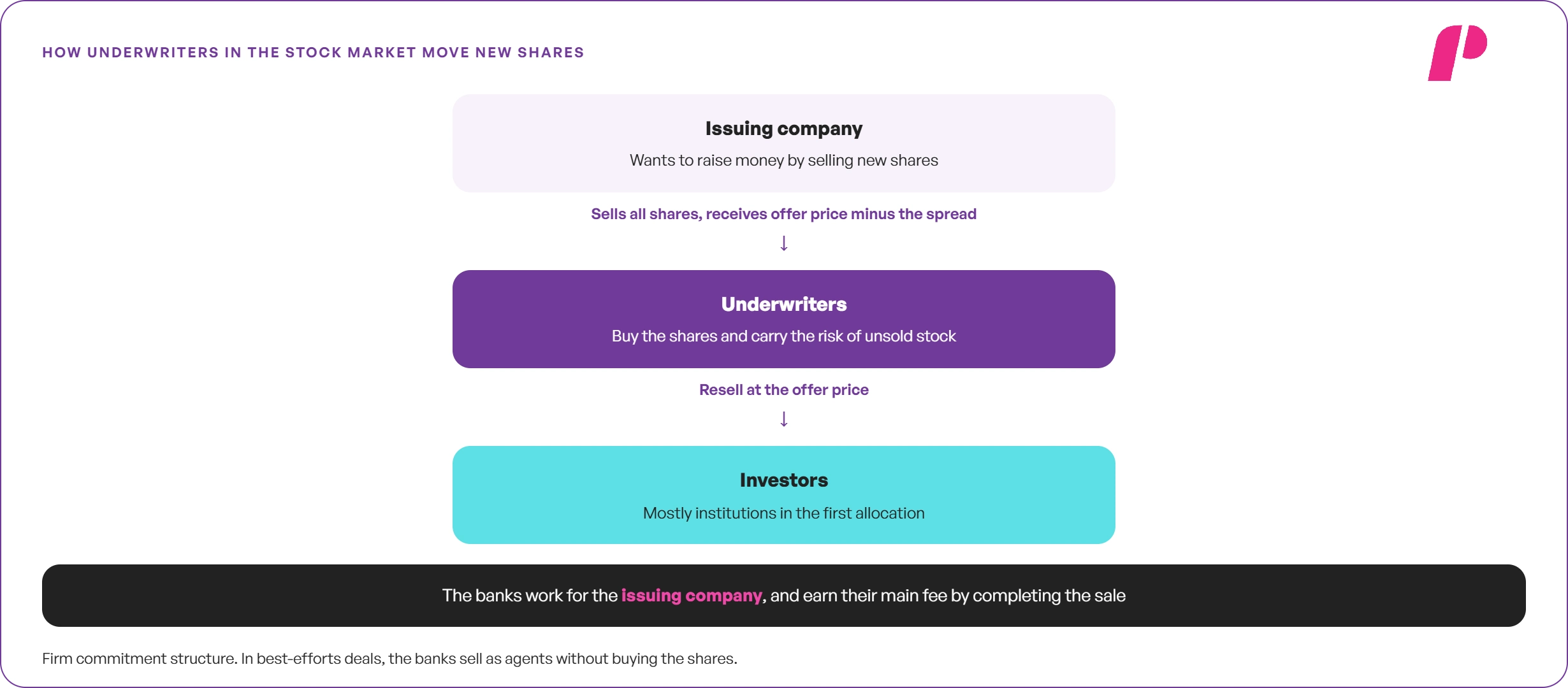
Meanwhile, the banks work for the issuing company, and they earn their main fee by completing the sale. Furthermore, Bloomberg’s October 6, 2026 ranking of top IPO underwriters showed Citi passing Goldman Sachs through September.
Rankings like this one measure deal volume, but they say nothing about how a specific new stock will trade. Therefore, a trader who understands what an underwriter actually does can read the deal instead of the headline.
What Do Underwriters Actually Do in the Stock Market?
However, someone encountering the term for the first time usually wants a plain explanation before anything else. Underwriters in the stock market are who? And does it have anything to do with anyone trying to trade the stock in the IPO? To put it simply, they are the banks that help issue stocks.
In a firm commitment deal, for instance, the banks buy the shares themselves and then sell them on to investors. People also search “What does underwriting an IPO mean?”, which is close to the same thing.
A bank takes on the job of managing and selling a company’s first share offering, and gets paid a fee.
What This Article Covers:
In this article, we will run through their roles, the main deal types, and the way they get paid. As a result, a trader can read the underwriters as a set of signals, not just a famous name.
- What underwriters in the stock market actually do
- How firm commitment, best efforts, and standby differ
- How the gross spread is calculated
- What greenshoes, stabilization, and quiet periods mean
- How these signals fit funded-account risk rules
What Is an Underwriter in the Stock Market?
An underwriter in the stock market is basically an investment bank that a company brings in to sell new shares. Anyone going through an IPO prospectus will probably wonder, “What is the purpose of an underwriter?” To raise money: for example, the bank prices, markets, and sells the shares while carrying some risk.
🔗 IPO Explained: How Initial Public Offerings Work
Why Are They Called Underwriters?
The word itself sounds a bit odd in finance, and its history actually has to do with sharing risk. Curious beginners usually ask, “Why are they called underwriters?” once they notice the term in insurance too. The name comes from Lloyd’s of London, where backers wrote their names under a voyage’s risk details.
Underwriter vs Broker
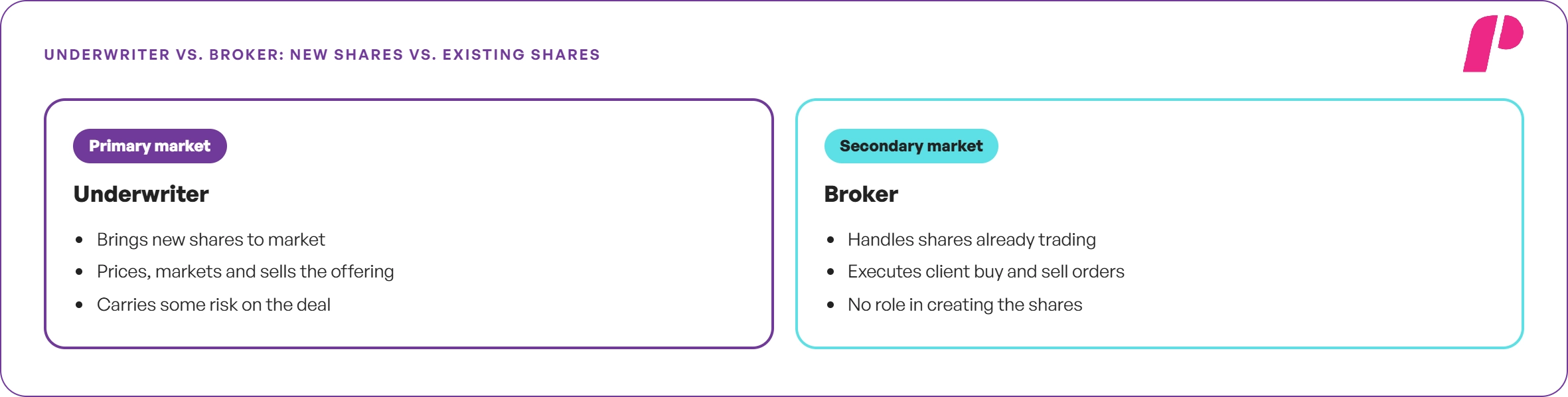
Furthermore, brokers and underwriters both sell shares to clients, so beginners mix the two jobs. This is why new traders often search “What’s the difference between a broker and an underwriter?” A broker deals in shares that are already trading, whereas the underwriter is the one bringing new shares in.
What Underwriters Do in an IPO
Responsibilities and Risks of an IPO Underwriter
From the moment a company decides to list until the first trade, most of the work sits with the underwriter. The answer to “What are the responsibilities of an underwriter?” is quite a long list. It includes due diligence, the registration statement, the roadshow, bookbuilding, pricing, allocation and, later, price support.
Of course, all of this comes with exposure, since the bank puts its own name on the offering documents. That leads to a sharper question: “What risk does an underwriter assume during an IPO?” When it buys the shares outright, it risks unsold shares, and Securities Act Section 11 makes it liable for misstatements.
Lead Underwriters and Bookrunners
Meanwhile, a large IPO rarely sits with one bank, so someone has to lead the deal. Anyone reading an IPO announcement soon wonders, “What are lead underwriters?” since several names appear together. These are the banks running the deal and the order book, and the rest of the underwriters follow their lead.
Bloomberg Law, for instance, listed Goldman Sachs and Morgan Stanley among the banks on the SpaceX IPO. Two titles usually appear next to those names, hence “What is the difference between a lead manager and a bookrunner?” The bookrunner keeps the order book, while lead manager is a broader title that the same banks often hold.
The Underwriting Syndicate
Furthermore, the lead banks invite other firms in, so the shares and the risk spread out. This is where people ask, “What is the difference between a syndicate and an underwriter?” Well, an underwriter is a single bank. The syndicate is the whole group, and it splits the shares, the risk, and the fees between its members.
How much risk the syndicate takes depends on the agreement it signs with the company. This brings up “What are the three main types of underwriting?”, a question found in many guides. It depends on the source: some guides list three types, while others also count all-or-none deals.
Underwriter Roles in an Underwriting Syndicate
| Syndicate Role & Banking Title | Primary Job Function & Operational Scope | Underwriting Fee Share & Compensation |
|---|---|---|
| Lead Underwriter (Bookrunner) | Runs the institutional order book, determines final pricing, and manages share allocations | Largest share of underwriting economics and fee pool |
| Co-Manager | Assists with institutional roadshows, marketing syndication, and share distribution | Moderate / smaller fee share relative to lead bookrunner |
| Syndicate Member | Sells allocated share blocks directly to its own retail and institutional clients | Smallest fee share allocation for secondary placement |
Types of Underwriting: Firm Commitment, Best Efforts and Standby
Firm Commitment Underwriting
Most large IPOs use the structure that shifts the most risk from the company to the banks. Therefore, anyone reading about IPO pricing should know the answer to “What is a firm commitment in underwriting?” Simply put, the underwriters buy all the shares and resell them, so unsold shares become their loss.
Best Efforts Underwriting
In contrast, smaller or riskier offerings sometimes use a structure in which the bank never buys anything. That is why small-cap IPO news triggers the search, “What is a best efforts underwriting?” The underwriters try to sell as many shares as possible, but the company keeps the demand risk.
Standby Underwriting
Meanwhile, a third structure appears mostly when a company offers new shares to its existing shareholders first. Here the question is, “What is the difference between stand-by underwriting and a firm commitment?” In a standby deal, the banks only buy whatever the shareholders did not take. With a firm commitment, they buy the whole offering.
IPO Underwriting Commitment Types
| Underwriting Mechanism Type | Who Buys Shares Upfront | Risk Allocation & Liability | Typical Offering Application |
|---|---|---|---|
| Firm Commitment | Underwriting syndicate purchases all shares upfront from the issuer | Underwriters bear full financial risk of unsold shares | Larger, well-capitalized initial public offerings (IPOs) |
| Best Efforts | No upfront share purchase by banks; agents act solely as distributors | Issuing company bears the complete risk of offering failure | Smaller, highly speculative, or early-stage capital offerings |
| Standby Commitment | Underwriters agree to buy any leftover shares not claimed by existing holders | Shared risk between the issuing company and the underwriting syndicate | Secondary rights offerings and preemptive stock issues |
How Underwriters Get Paid: The Gross Spread
What Is An Underwriting Spread?
Investors pay one price for each IPO share, yet the company never receives that full amount. Therefore, comparing the offer price with company proceeds leads to the question, “What are underwriting spreads?” That gap is the spread, and PwC puts it at 4% to 7% of gross IPO proceeds.
The 7% Rule in IPO Underwriting
However, Jay Ritter’s data through 2025 shows many moderate-size US IPOs paying exactly a 7% gross spread. Search that number, and “What is the 7% rule in stock?” mostly returns stop-loss trading advice. The phrase has two meanings, and the IPO meaning has nothing to do with a stop-loss rule.
How to Calculate the Underwriter Spread
For instance, an initial public offering of $20 with a spread of 7% would pay the underwriter $1.40 for each share issued. Readers who want to check their own deals ask, “How do you calculate the underwriter spread?” Subtract the $18.60 paid to the company from the $20 price, then divide the $1.40 gap by $20.
🔗 Stock IPOs and IPO Trading
- Find the offer price on the final prospectus cover
- Find the underwriting discount per share
- Divide the discount by the offer price
- Multiply the result by 100 for the percentage
How the Gross Spread Works on a $20 IPO
| Financial Item & Distribution Metric | Per Share Amount | Total on 10,000,000 Shares |
|---|---|---|
| Public Offer Price Paid by Investors | $20.00 per share | $200,000,000 gross proceeds |
| Underwriting Gross Spread (7.0% Fee) | $1.40 per share | $14,000,000 syndicate fee pool |
| Net Proceeds Delivered to the Company | $18.60 per share | $186,000,000 net capital raised |
Underwriters After The Listing: Greenshoe, Stabilization And Research
The Greenshoe Option
Through a greenshoe option, underwriters can sell up to 15% more shares than the base deal. For example, SpaceX granted a 15% greenshoe in June 2026, about 83.3 million shares at $135. Furthermore, Bloomberg Law reported that SpaceX paid its underwriters no fee on those extra shares.
🔗 Can SpaceX Justify a $1.8 Trillion IPO?
How an Underwriter Stabilizes the Price
After the debut, underwriters may also support the price, but SEC rules limit that support. Under Regulation M, Rule 104, a stabilizing bid cannot exceed the offering price, and the market receives prior notice. Therefore, a stock holding near its IPO price may reflect support that can stop at any time.
🔗 IPO Trading Strategies and Tips
The Research Quiet Period And Lock-Up
Meanwhile, the same banks usually publish research on the new stock, but FINRA makes them wait. Under FINRA Rule 2241, the research quiet period after an IPO lasts 10 days for all syndicate members. As a result, coverage can start soon after the debut, while the lock-up period ends much later.
Underwriter Tools After the Listing
| Support Tool / Mechanism | Governing Rule, Regulation, or Source | What Traders & Analysts Watch |
|---|---|---|
| Greenshoe Option (Over-Allotment) | Standard syndicate provision (typically 15% of base offering size) | Over-allotment share limits and exercise terms stated in the prospectus |
| Stabilizing Bid | SEC Regulation M, Rule 104 compliance framework | Support price thresholds (strictly prohibited from exceeding the public offer price) |
| Research Quiet Period | FINRA Rule 2241 underwriting restrictions | Timeline milestones (underwriting analyst coverage can initiate after 10 calendar days) |
| Insider Lock-Up Agreement | Contractual agreement between insiders and underwriters | Exact expiration dates and supply release schedules disclosed in the prospectus |
Reading Underwriter Signals In A Funded Stock Account
Underwriter Dates To Mark Before The Trade
A funded stock trading account will see a single trade too large in an unstable market break a loss guideline.In this case, it is therefore imperative to determine the offer price, greenshoe figure, and the date of research. For example, a price near the offer level may hold only while stabilizing bids are still in place.
🔗 Position Sizing in Forex & Stocks
Matching Deal Risk to Daily Loss Rules
New listings can move sharply early on, so limits must hold once that support disappears. Meanwhile, prop firm accounts set defined daily loss limits, and one impulsive IPO trade can breach them. As a result, sizing each IPO position to the account’s rules keeps one listing from deciding the outcome.
🔗 Prop Firm Risk Rules: How to Trade Without Breaching Them
Building an Underwriter Checklist
The existence of the short list enables the assessment of the same factors using the same methodology with regard to each new entry on the list. Yet, the short-list is merely a tool in decision-making, and priorities are determined via stop levels and position sizing. In the table below, every underwriter signal corresponds to a risk question and action item on a funded account.
Turning Underwriter Signals Into Funded-Account Actions
IPO Post-Pricing Signals & Funded-Account Execution Framework
| Post-Pricing Signal & Event | Core Risk Question for Trader | Required Funded-Account Action & Risk Protocol |
|---|---|---|
| Offer Price & Stabilization Level | Where is the official syndicate stabilization ceiling and support threshold? | Set stop-loss parameters with the offer price stabilization floor firmly in mind |
| Research Quiet Period Expiration | Can new analyst coverage and rating initiations spark a sharp price move? | Reduce position sizing and manage volatility carefully around the research start date |
| Insider Lock-Up Expiration Date | Will a sudden influx of unlocked insider supply overwhelm buying demand? | Plan position exits and profit-taking well in advance of the expiration date |
Underwriters With Realistic Expectations
Even after all this, some readers still link the word underwriter with insurance. They end up asking, “What is the difference between an underwriter and an insurer?” In the stock market, the underwriter is an investment bank, and it has nothing to do with insuring people.
The gross spread is what pays the banks for their work and for the risk they take on each listing. That naturally raises the question, “Do underwriters make money?” and the honest answer comes with a warning.
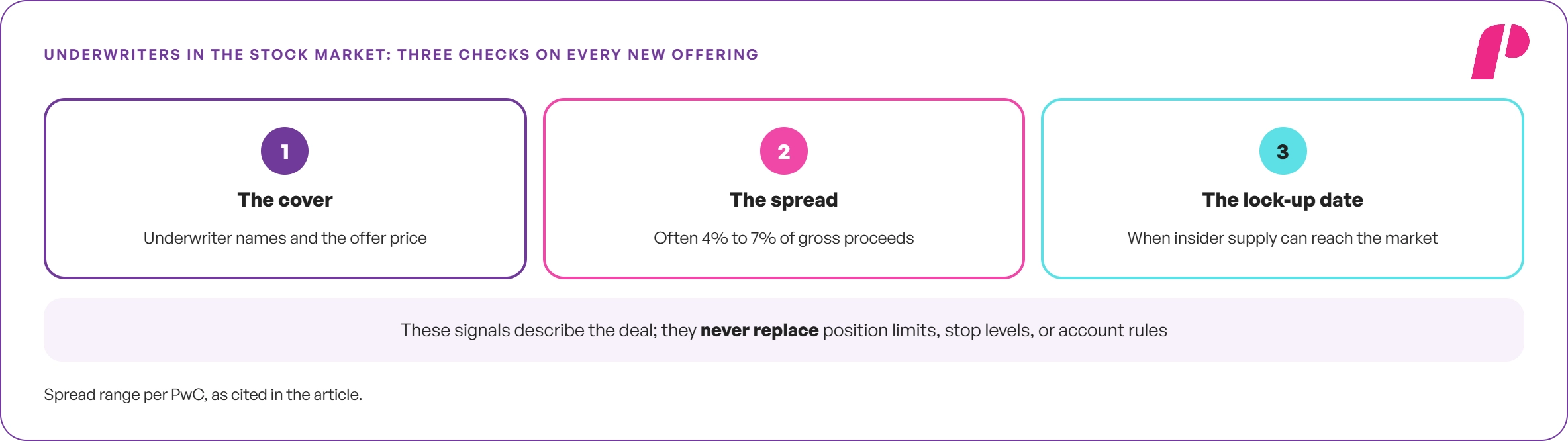
Yes, in most cases through the spread, although a firm commitment deal can also end in a loss for them. In each new offering, a trader will be able to return to the cover, the spread, and the lock-up date.
Doing this a number of times makes the process faster, and the reading of the next prospectus becomes lighter. However, these signals describe the deal, and they never replace position limits, stop levels, or account rules.
Traders who want to apply this research with clear risk rules can explore Trade The Pool’s funded stock accounts.
If you liked this post make sure to share it!