“Prop trading” once meant one thing. It meant a salaried seat at an institutional trading firm, won through recruiting and interviews. Over the past decade, a second meaning grew alongside it. That shift is why traders now weigh a prop firm challenge vs prop trading job before they commit any money.
Independent traders can now pay for an online evaluation and trade a firm’s capital from home. Both paths involve trading someone else’s money for a share of the profit. So the confusion between them makes sense.
So, how does a prop firm challenge compare to an institutional prop trading job? This guide breaks down how you join each path, how you get paid, and how a typical evaluation works.
It also looks at two examples, The5ers and Trade the Pool, to show how the retail model operates. For a deeper comparison with other finance careers, the companion guide covers investment banking, hedge funds, and bank trading.
🔗Trading Jobs

Prop Firm Challenge vs Prop Trading Job: How They Differ
It Is An Evaluation, Not A Hire
So where does a prop firm challenge vs prop trading job actually diverge? The split starts at the door. A prop firm challenge is not a salaried hire. It works through a paid evaluation instead. The trader pays a fee, meets a set of profit and risk targets, and then trades the firm’s capital for a share of the profit.
One path is a paid online test. The other is a salaried institutional seat. That structure changes the relationship in a few ways. An institutional prop trader gets recruited, trained, and paid a base salary. That pay holds regardless of a single day’s results.
A challenge trader earns only after passing the evaluation and producing a profit. There is no formal onboarding, no desk of colleagues, and no manager reviewing performance. The tradeoff is real. You get lower barriers to entry, but none of the stability of employment.
Whose Money, And How You Get Paid
The whose-money question still applies, with a different structure behind it. After passing, the trader trades the firm’s capital, not personal savings. Many programs run on simulated capital tracked against live market prices. Others route real capital through a trading partner.
Pay comes entirely from a profit split, commonly between 50 and 100 percent, depending on the program and tier. There is no deal bonus, no year-end review, and no fixed salary. That makes the route closer to running an independent business than holding a job.
How a Prop Firm Evaluation Actually Works
Profit Targets And Risk Rules
| Prop Firm Evaluation Rule | Operational Mechanics & Execution Parameters |
|---|---|
| Profit Target Objective | A modest percentage gain objective, varying by account size and challenge tier. |
| Maximum Daily Loss Limit | Strictly capped daily risk limit; a breach results in immediate account failure. |
| Maximum Overall Drawdown | Capped total drawdown limit; breaching instantly terminates the funded account. |
| Per-Trade Exposure Cap | Limits how much of the target or risk a single trade can supply. |
| Evaluation Testing Phases | One, two, or multiple testing stages required before reaching live funded status. |
| Account Reset Option | An optional paid reset fee enabling traders to retry after a failed attempt. |
Most programs follow a broadly similar structure, though exact numbers vary by firm and account size. A trader first pays a one-time fee to access an evaluation account. That account is usually smaller than the eventual trading account.
During the evaluation, the trader must hit a profit target while staying within strict risk limits. Common limits include a maximum daily loss and a maximum overall drawdown. Some firms use a single evaluation phase.
Others require two or more phases before granting access. These risk rules exist for a practical reason. The firm needs proof that a trader can profit without reckless risk.
A trader who breaks the daily loss limit or the maximum drawdown usually fails at once, regardless of overall profit. Firms also often cap how much of the target one trade can supply.
That rule stops a single lucky bet from carrying the whole evaluation. So passing shows consistency, not just raw skill. That mirrors what institutional firms look for in real hires.

Reaching The Trading Stage And Scaling Up
Once a trader clears the evaluation, the account moves to the live-capital stage. Some firms track simulated capital against a real market feed. Others route real capital through a partner broker.
From there, the trader keeps trading under the same or slightly adjusted risk rules. Profit pays out on a regular schedule, often every one to two weeks. Many programs also offer scaling.
Consistent profit over time raises the account size and, in some cases, the profit split. That structure rewards traders who sustain performance rather than post one strong month.
🔗Drawdown
Be realistic about the numbers. Entry fees for smaller evaluation accounts often run under $100. Larger accounts and instant-access programs can cost more.
Programs also usually charge a reset fee if a trader fails and wants to retry. None of this guarantees income. A trader still has to produce real, consistent profit to earn anything beyond the initial evaluation.
Where The5ers And Trade The Pool Fit
The choice between a prop firm challenge vs prop trading job gets clearer once you see how live programs run. The5ers and Trade the Pool show the retail side in practice.
Prop Firm Comparison: The5ers vs. Trade the Pool (2026 Reference)
| Comparison Dimension | The5ers (Multi-Asset Platform) | Trade the Pool (Equity-Focused Platform) |
|---|---|---|
| Tradable Markets & Instruments | Forex, indices, commodities, and multi-asset classes | US-listed equities, small-caps, and stock ETFs |
| Evaluation Model Structure | Multiple testing phases across tiered scaling programs | Streamlined single-phase evaluation model |
| Capital & Buying Power | Lower initial base scaling toward several million dollars | Starting from several thousand up to ~$200k, with equity scaling beyond |
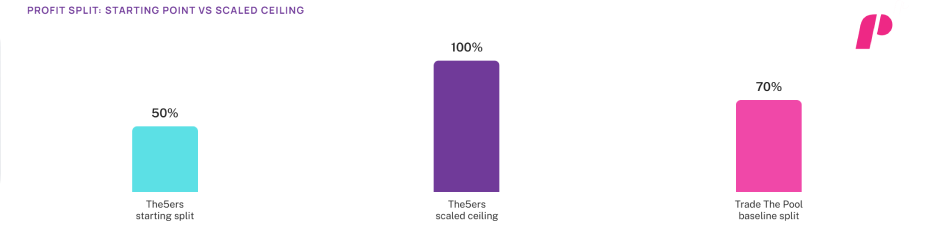
| Profit Split Tiers | Starts around 50%, scaling dynamically toward 100% | Competitive baseline split around 70% to the trader |
| Payout Schedule & Timing | Biweekly payouts once reaching the funded trading stage | Recurring payouts processed after an initial waiting period |
| Execution Access & Infrastructure | Simulated capital environment tracking live institutional prices | Direct access to thousands of stock instruments via partner broker |
The5ers: Multi-Asset Evaluation Programs
This route has grown into a real alternative for independent traders who want firm capital without a job search. The5ers, founded in 2016, offers evaluation programs across forex and other markets through a structured process. It runs several program tiers, including lower-cost entry options and faster-scaling paths.
Account sizes can start in the low thousands and scale toward several million dollars in buying power as a trader proves consistency. The5ers apply these accounts as simulated capital against live market prices. Strict risk rules also protect the firm’s capital.
It requires a stop-loss on every position and caps how much you can risk on a single trade. Profit splits vary by program and tier. They can start around half of the profits and scale toward 100 percent at higher levels.
Payouts run on a regular biweekly schedule once a trader reaches the trading stage. Program terms and regional eligibility change periodically. So confirm current rules on the official The5ers site before signing up.
Trade the Pool: Stock and ETF Evaluations
Trade the Pool, part of the same group, focuses on stock and ETF trading. It gives equity-focused traders a comparable evaluation path. Unlike many multi-asset firms that use two or three phases, Trade the Pool uses a single-phase model.
So a trader clears one set of targets before reaching the trading stage. Account buying power has ranged from a few thousand dollars up to around $200,000, with scaling beyond that for consistent performers.
Profit splits commonly sit around 70 percent. The firm gives access to thousands of U.S.-listed stocks and ETFs through a partner broker, plus extended trading hours.
Because Trade the Pool is equity-only, it suits a trader who thinks in individual stocks rather than currencies or commodities. Profit targets and drawdown limits differ by account type.
They generally require a modest percentage gain while staying within a capped daily loss and overall drawdown. Payouts run on a recurring schedule after an initial waiting period. As with The5ers, exact fees, targets, and splits change over time. Verify current terms before committing.
Prop Firm Challenge vs Prop Trading Job: Side by Side
Proprietary Trading Pathways: Institutional Seats vs. Retail-Funded Challenges & Trade-Offs (2026 Reference)
Proprietary Trading Pathways: Institutional Seats vs. Retail-Funded Challenges & Trade-Offs (2026 Reference)
| Comparison Feature | Institutional Trading Career | Retail Prop Firm Challenge Route |
|---|---|---|
| Entry & Onboarding | Rigorous campus recruiting and multi-stage hiring | Pay an evaluation fee and pass testing phases |
| Compensation Structure | Guaranteed base salary plus performance bonus | Performance profit split with zero base salary |
| Industry Examples | Jane Street, major institutional bank trading desks | The5ers, Trade the Pool |
| Optimal Target Audience | Career quants and traders seeking a long-term seat | Independent remote traders leveraging firm capital |
Prop Firm Challenge: Comprehensive Pros and Cons Breakdown
| Advantages & Benefits (What You Gain) | Limitations & Risks (What You Do Not Get) |
|---|---|
| Access to significant buying power far beyond personal account limits | No guaranteed base salary, health benefits, or formal job security |
| Financial downside strictly capped to the initial challenge evaluation fee | Absence of institutional research support structures and desk mentorship |
| Strict risk discipline enforced automatically by daily loss and drawdown limits | No guaranteed monthly income or stable cash flow reliability |
| Significantly lower barrier to entry compared to competitive institutional seats | Strict drawdown and consistency rules that many traders find restrictive |
What It Gets You
A prop firm challenge gives an independent trader access to far more capital than a personal brokerage account allows. It does this without risking personal savings beyond the modest evaluation fee.
That limits the trader’s financial downside. The structure also builds discipline. Strict daily loss and drawdown rules force careful risk management, or the trader fails. For a trader with a working strategy but little capital, that combination can be valuable.
What It Doesn’t
However, the route does not provide a salary, benefits, job security, or an institutional support structure. It also does not guarantee income, since profit comes only from consistent performance under a firm’s rules.
Some traders find those rules restrictive, especially around position sizing, holding periods, and per-trade profit caps. Those who have thought about taking this route should consider it an opportunity rather than a job.
Who a Prop Firm Challenge Suits Best
An independent trader with a working strategy but limited capital is the clearest fit. The route offers far more buying power than a personal account, without risking savings beyond the entry fee.
Yet it demands the same discipline an institutional trader needs. That means strict risk limits, consistency, and the ability to survive a losing stretch without breaking the rules.
A trader still building a strategy, or uneasy with real losses, may do better practicing on a smaller personal account first. Be clear about what the route is not. It is not a job offer, and it does not hand you guaranteed income. Nor does it replace the recruiting process behind an institutional seat.
Anyone weighing a prop firm challenge vs prop trading job side by side should treat them as different products. One is an employer-employee relationship built on salary and training. The other is a paid evaluation that unlocks access to trading capital, nothing more.
Prop Firm Challenge vs Prop Trading Job: The Verdict
A prop firm challenge and a prop trading job both put someone else’s capital behind your trading. However, their similarity ends there, when you think about their day-to-day aspects.
One is actually hiring and training you, paying you money, and giving you a career in the process. The other charges an evaluation fee, skips the salary, and pays through a profit split once you qualify.
You have a decision to make depending on where you are right now on your career path and what you are looking for. Then the institutional route in the companion guide is the better start.
Do you already trade with discipline and simply want more capital than your account allows? Then a prop firm evaluation like The5ers or Trade the Pool is worth exploring. Whatever you choose, remember that neither will earn you money guaranteed, and both take a lot of dedication.
If you liked this post make sure to share it!