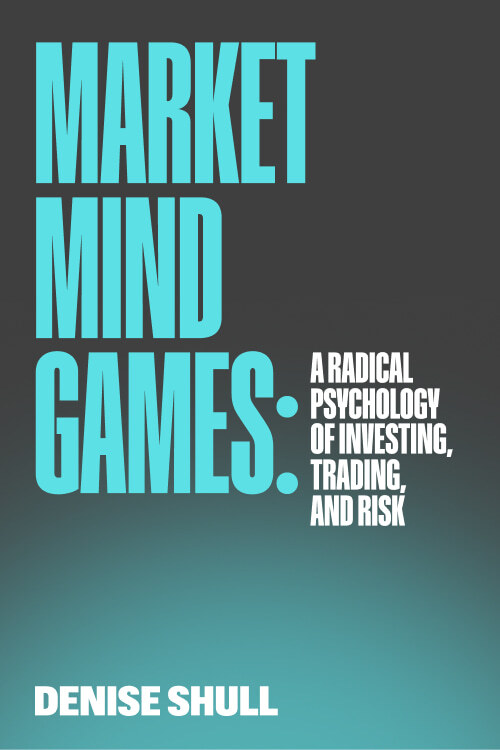
Making decisions that can swing millions isn’t just about reading charts—it’s about understanding yourself. In Market Mind Games, Denise Shull takes the conversation far beyond numbers, leading us into the quieter, often overlooked terrain where emotion quietly shapes perception and influences every choice. With the perspective of someone who has lived both the intensity of Wall Street and the precision of neuropsychology, she reframes feelings not as distractions to be suppressed, but as vital instruments for clarity.
Through layered storytelling and thoughtful analysis, Shull reveals a paradox at the core of decision-making: we’ve been taught to strip emotion from our process, yet it’s emotion that carries the most valuable information. Moving between the pulse of the trading floor and the stillness of self-reflection, she builds a case for redefining how we understand risk, uncertainty, and our own reactions.
This isn’t a how-to guide—it’s an invitation to look inward, where the sharpest edge in the markets may be found.
Chapter 1 – From Wall Street to the Ivory Tower and Back
Imagine trading not as a profession, but as an intricate game of chess—every move, a decision that reflects perception more than probability. Denise Shull introduces us to Michael, a character whose journey mirrors her thesis: emotions are not hindrances, but essential data. Michael transitions from a Wall Street prop trader to a PhD student delving into decision theory, only to be drawn back to trading.
Through this narrative, she illustrates the conflict between academic rationalism and the visceral experience of markets. The chapter sets the tone: beneath market charts lie human stories, where decisions are shaped by unconscious emotional contexts, not just quantitative logic. As Michael meets Renee, a cognitive scientist, we witness the merging of two worlds—trading and neuroscience—foreshadowing the book’s core argument: understanding risk begins with understanding perception.
Chapter 2 – Numbers Look You in the Eye and Lie
Numbers can be seductive, comforting in their precision—but according to Denise Shull, they’re also dangerously misleading. This chapter dismantles the illusion of objectivity in statistical analysis. Through examples of market crashes and traders’ failures, she emphasizes that probability models often ignore the most volatile factor: human perception.
She challenges the belief in rational decision-making, arguing that we do not act based on logic, but on how we expect to feel in the future. By invoking poker as a metaphor, she shows that winning isn’t about calculating odds—it’s about reading people. Shull urges readers to reconsider their faith in data, asserting that even advanced neural networks can’t replicate the nuance of human emotion. The real question isn’t what the numbers say—it’s what they leave out.
Chapter 3 – Misremembering the Caveats of the Early Quants
Shull dives deeper into the mythology of quantitative finance, revealing how even its pioneers warned of uncertainty—but were ignored. Through anecdotes from her own trading days and references to Frank Knight and Harry Markowitz, she underscores a forgotten truth: all models begin with belief.
Markets, she explains, are not governed by physics, but by perception. Knight distinguished risk (measurable) from uncertainty (unmeasurable), and she resurrects this insight to critique modern traders’ overreliance on models. Even Markowitz, the father of portfolio theory, admitted his framework began with subjective expectations.
Yet, Wall Street skipped this step. By contrasting poker’s ambiguity with dice’s predictability, the chapter demonstrates the fatal flaw in treating markets as games of chance. In this view, understanding belief formation is not optional—it’s foundational.
Chapter 4 – Seeing What We Want but Missing the Obvious
We all like to believe we’re looking at the world with clear eyes—but most of the time, we’re peering through a lens we don’t even realize we’re wearing. Our beliefs tint everything, sometimes sharpening the picture, sometimes smudging it beyond recognition. In this chapter, Shull weaves together threads from ancient thinkers and modern brain science to make a simple but unsettling point: we don’t see reality, we edit it.
What doesn’t match our expectations often slips past us entirely. In the classroom scenes she creates, you can almost hear the frustration as students discover how feelings—especially the ones we’d rather ignore—bend their judgment. She pokes at our culture’s fixation on test scores as if intelligence could be boiled down to a number, pointing out how this mindset sidelines the quiet but powerful role of gut instinct.
The takeaway is blunt: if you can spot the emotional scaffolding propping up your perception, you can see more, decide better, and avoid getting blindsided.
Chapter 5 – Rolling Out of the Midwest Back to Wall Street
This part of the story turns inward, tracing the shift from a steady Midwestern childhood to the chaos and speed of Wall Street. The change wasn’t just geographical—it was a jolt in pace, mindset, and stakes. The measured rhythms of small-town life met the high-pressure, split-second demands of trading, and that collision shaped how she approached risk and judgment.
In that world, many traders wore a mask of detachment, believing it made them sharper. Yet the truth she came to see was the opposite: those emotions they tried to hide were often the most reliable compass when the future was unclear. Looking back on her own mistakes and turning points, she realized the advantage didn’t come from pushing feelings aside, but from understanding what they were saying. The skill wasn’t in staying cold—it was in staying aware.
Chapter 6 – Do You Need to Be Psychic to Deal With Uncertainty?
Predicting markets often feels like trying to see the future—but as Shull asserts, it’s not about psychic powers, it’s about perceptual awareness. In this chapter, she dismantles the myth of certainty and advocates for a mindset that accepts ambiguity as the norm. Drawing on neuroscience, she explains that our brain’s default mode is to simulate potential futures based on feeling-laden memories, not cold logic.
Traders who appear intuitive, Shull explains, are often just highly attuned to subtle internal cues—a refined sense of emotional context. She redefines intuition as data processing rooted in past experiences and emotional memory. Rather than striving for perfect knowledge, successful decision-making requires developing a nuanced relationship with uncertainty—one where feelings are interpreted, not ignored.
Chapter 7 – Ambient, Circumstantial, and Contingent Reality
In this chapter, Denise Shull invites us to question whether reality is fixed or fluid. Through her signature blend of neuroscience and trading psychology, she introduces the concepts of ambient, circumstantial, and contingent reality—three perceptual layers that shape how we interpret market data and make decisions.
Traders often act as if they’re dealing with objective facts, yet in truth, those facts are filtered through environmental context (ambient), immediate circumstances (circumstantial), and temporary emotional states (contingent).
The message is clear: perception is never neutral—it is structured by emotion. By recognizing these overlapping realities, traders can understand why their convictions shift and why signals seem clear one day and murky the next. In the end, mastering markets is as much about mastering context as it is about mastering strategy.
Chapter 8 – Perception’s Labyrinth
Perception isn’t a clear pane of glass—it’s a winding maze. Feelings, memories, and expectations twist together, shaping every market chart or decision we think we’re reading objectively. Drawing on both research and vivid case studies, Denise Shull shows how this maze is built from experiences, subconscious storylines, and emotional habits we don’t always notice.
Overlooking that complexity doesn’t just blur judgment—it can send traders down the wrong path entirely. Perception works like a loop: emotions influence what we notice, and what we see in turn influences how we feel.
In this view, emotions aren’t background noise, but vital signals and clues to subtle changes in ourselves and the market. The challenge isn’t to erase bias, but to learn the contours of its map and navigate with intention.
Chapter 9 – The Ironic Holy Grail of Risk
Traders often chase the idea of a “perfect” system—something that will strip away uncertainty and make the market bend to their will. Denise Shull flips that search on its head, suggesting that the real advantage doesn’t come from flawless models, but from paying attention to the feelings we’re taught to ignore.
She frames risk not as a number on a chart, but as a profoundly personal experience shaped by our past and the stories we tell ourselves.
Using vivid examples, she challenges the obsession with control, proposing instead the skill of emotional granularity—the ability to pinpoint and work with specific emotions as they surface. The irony is that the very feelings traders try to suppress are often the clearest compass they have.
Chapter 10 – Do We Ever Know What Tomorrow Brings?
Denise Shull dismantles the illusion of foresight in this candid reflection on the futility of prediction. Markets, she argues, are not puzzles with fixed answers, but shifting landscapes driven by the perceptions of others—most of which we’ll never fully access.
Using vivid analogies and psychological depth, she explains that our desire to “know” tomorrow stems from a more profound fear of uncertainty and a craving for emotional safety. But the future, by nature, cannot be known—it can only be interpreted through patterns of emotion, belief, and reaction.
Shull urges traders to release the fantasy of control and instead develop comfort with ambiguity. In doing so, she reframes uncertainty not as a threat but as a constant companion that, if respected, can become a trusted guide.
Chapter 11 – Mental Capital and Psychological Leverage
In this chapter, Denise Shull sheds light on two resources that most traders overlook: mental capital and psychological leverage. Mental capital is your inner fuel—the clarity, focus, and emotional stamina you bring to the screen each day.
Psychological leverage is the knack for turning emotions into an ally instead of a saboteur. She points out that trading careers often collapse not from bad analysis, but from running out of that inner fuel—burnout, creeping self-doubt, or being swamped by stress.
Through vivid client stories, she shows how regaining emotional awareness can reignite performance. Here, leverage isn’t just about money—it’s about mindset. And when you know how to read your emotions, they stop being distractions and start becoming your fastest route to better decisions.
Chapter 12 – Mark-to-Market Emotions = Risk Management
In a bold and innovative move, Denise Shull draws a direct line between emotional states and risk exposure. Just as assets are marked to market in real time, she suggests traders should “mark to market” their emotions—checking in, assessing, and adjusting throughout the day. Emotions, far from being random noise, signal unmet needs, broken expectations, or shifting beliefs. Left unchecked, they turn into blind spots; tracked carefully, they become powerful tools.
This approach challenges traditional risk frameworks by reframing emotional management as a form of risk management itself. By tuning into emotional volatility, traders can spot cognitive missteps before they turn into financial losses. In this view, self-knowledge isn’t a soft skill—it’s the sharpest edge you can have.
Chapter 13 – Regret Theory—“Greed” Misleads
In this revealing chapter, Denise Shull redefines one of trading’s most misunderstood emotions: regret. Instead of treating it as a flaw, she frames it as a valuable signal—a map showing where belief and behavior fell out of sync. Her concept of “regret theory” transforms it from a weakness into a feedback loop full of insight. What traders often label as greed, she explains, is usually the lingering weight of past regret or the fear of future regret.
Misreading these emotional drivers can lead to chasing profits while overlooking the emotional toll. By understanding how regret truly works, traders can recalibrate their decision-making. Mastery in the markets isn’t about erasing emotion, but about reading it fluently when the pressure is on.
Chapter 14 – Fractal Geometry in Your Market Mind
Markets are not linear—and neither are our minds. In this chapter, Denise Shull draws a compelling parallel between fractal geometry and the recursive patterns of human thought. Just as markets show self-similarity across timeframes, our emotions and reactions cycle through familiar, often unconscious patterns.
Traders frequently relive sequences of fear, euphoria, and doubt because they overlook the fractals in their own mental framework. Recognizing these internal repetitions provides a rare advantage: the ability to anticipate emotional setups before they spiral into poor choices. Viewed this way, the mind becomes like a chart—filled with repeating signals that, if interpreted correctly, can predict behavior more accurately than any price action.
Chapter 15 – The Rise of Coup d’État Capital
Shull turns her lens toward the evolution of market behavior itself. She introduces the concept of “Coup d’État Capital,” describing the rise of firms and strategies that dominate not through insight or innovation, but by sheer force—leveraging structure, speed, and influence to override fundamental value.
These capital coups mimic emotional hijackings in the brain: sudden takeovers of perception that derail rational judgment. Denise Shull warns that this shift reshapes markets into emotional amplifiers, where narrative and momentum overpower fundamentals. Traders, then, must evolve not only their tools but also their mental resilience. In a world of flash crashes and narrative bubbles, the only antidote is internal clarity. You can’t out-muscle Coup d’État Capital—but you can out-feel it.
Chapter 16 – Quarterbacking a Portfolio
In this chapter, Denise Shull reimagines the portfolio manager not as a passive allocator, but as a quarterback—reading the field, reacting in real time, and adapting under pressure. Managing capital, she explains, is not about adhering rigidly to models; it’s about sensing shifts in energy, momentum, and context—both internally and externally. She critiques the traditional approach that isolates data from emotion, arguing that significant portfolio decisions emerge from emotional intelligence as much as from analytics. Like a quarterback calling audibles based on instinct and pressure, successful investors must learn to trust refined feelings rooted in experience. The real playbook isn’t just in spreadsheets—it’s in recognizing how emotions, expectations, and intuition converge at critical market moments.
Chapter 17 – Decoding “What Was I Thinking?”
Every trader has asked it: “What was I thinking?” It’s that gut-punch moment when you look back at a decision and can’t believe you made it. Instead of chalking it up to a simple lapse in discipline, this chapter digs into the hidden emotional triggers and mental shortcuts that drive those choices.
More often than not, bad trades don’t come from not knowing better—they come from reading signals through the haze of old beliefs, unmet needs, or unresolved doubts. Denise Shull reframes the question, turning it from a stick we beat ourselves with into a doorway for self-discovery. By unpacking the emotional fingerprints behind a trade, regret shifts into insight, and self-criticism becomes a tool for growth. The real win isn’t avoiding mistakes altogether—it’s learning to read the deeper story behind them.
Chapter 18 – Is That an Impulse or Is It Implicit Knowledge?
Sometimes, what feels like a reckless impulse is actually deep, unconscious expertise trying to surface. In this chapter, Shull helps traders distinguish between reactive emotion and intuitive knowing. Drawing on neuroscience and experience, she explains that the line between impulse and insight is blurry—but crucial.
Traders often suppress valuable signals because they fear being “irrational,” yet what seems impulsive may actually be implicit knowledge gained through thousands of subtle repetitions. Denise Shull offers tools for determining whether an emotional urge originates from panic or pattern recognition. By learning to pause and interpret the source of internal signals, traders can harness intuition without surrendering to impulsivity. True mastery, she argues, lies in that distinction.
Chapter 19 – Run Over
In this raw and revealing chapter, Denise Shull describes the emotional devastation traders face when a series of losses hits like a freight train. “Getting run over” is more than financial damage—it’s a psychic rupture. Shull walks us through the collapse of confidence, the spiral of doubt, and the erosion of self-trust that follows.
But rather than offer clichés about resilience, she shows how pain can be decoded. Losses, she insists, carry messages—about unmet needs, misaligned expectations, and suppressed fears. Through reflective storytelling, she helps traders reconstruct their shattered mindset, not by denying emotion but by fully engaging with it. Recovery begins not in denial, but in acknowledging the truth. And most importantly, in learning to separate the self from the outcome.
Chapter 20 – The “What Was I Thinking” Rehash
Returning to a central theme, Shull reopens the question that haunts every trading mistake. But this time, she zooms in on patterns—how repeated errors emerge from familiar emotional environments. By dissecting a trader’s mental replays, she uncovers how unconscious narratives set the stage for poor decisions. The chapter reads like psychological detective work: tracing thought patterns, emotional residues, and hidden motivations.
Shull offers techniques for reflection that go beyond journaling, encouraging traders to create emotional maps of their actions. It’s not about fixing the trade—it’s about fixing the story we tell ourselves when we act. “What was I thinking?” becomes a portal to recognizing emotional patterns and, ultimately, achieving self-mastery.
Chapter 21 – Getting Back in the Game
Shull closes this section with a rallying cry for resilience—but in her unique voice. Getting back in the game is not about forcing confidence or ignoring fear. It’s about restoring emotional trust: in one’s perception, in the signals of one’s body, and in the ability to navigate future uncertainty with humility.
Through real-life coaching stories, she reveals how traders reenter the market not with bravado, but with calibrated emotion and clear boundaries. Shull frames this return not as a heroic act, but as a return to emotional integrity. The market doesn’t need your perfection—it needs your presence. Coming back isn’t just about readiness; it’s about emotional fluency earned through honest reflection.
Chapter 22 – Take It to the Next Level
In this final chapter, Denise Shull offers a culmination of her philosophy: the path to peak performance isn’t paved with more data or more challenging discipline—it’s paved with emotional truth. “Taking it to the next level” means trading from a place of deep internal alignment, where perception, belief, and emotion converge in real time.
Shull encourages readers to embrace emotional granularity as their greatest asset and to replace self-doubt with emotional fluency. The ultimate evolution, she argues, is becoming the kind of trader who doesn’t fight fear or regret—but understands them as signals, interprets them with care, and acts with clarity. In this vision, the next level isn’t louder or faster—it’s quieter, more precise, and more human. The edge is no longer in outsmarting the market. It’s in understanding yourself.
Final Words
What if the edge you’ve been chasing wasn’t hidden in a chart, an algorithm, or a strategy—but inside you all along? Denise Shull’s Market Mind Games isn’t just a book on trading psychology; it’s a radical manifesto to shift the very lens through which we see markets, performance, and ourselves.
With each chapter, Shull strips away the illusion of objectivity and invites us to confront the unpredictable terrain of our own minds. Her stories reveal that emotions aren’t the problem—they are the path. That confusion, hesitation, and even regret are not errors, but signals rich with insight. And that the only real danger is pretending to be rational when we’re anything but.
In a world obsessed with data, Shull reminds us that the most profound truths often come unspoken—through a feeling in the gut, a flicker of doubt, or a pattern in the past that loops forward into the present. To become a better trader, she tells us, is to become a better observer of ourselves. The game is no longer about domination—it’s about integration. Between instinct and intellect. Between fear and focus. Between who we think we should be and who we truly are in the heat of the trade.
Because the final frontier isn’t the market, it’s your mind.