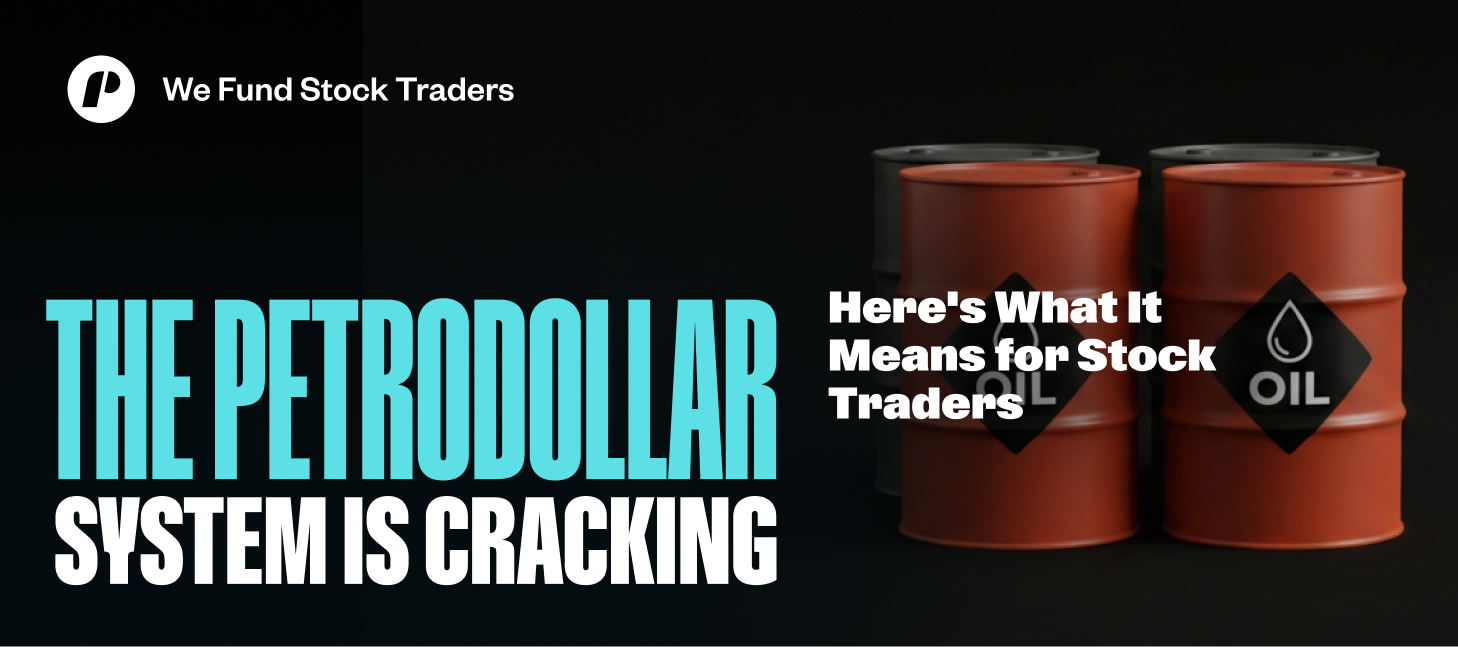
A rumor keeps resurfacing online: that a secret 50-year pact between Washington and Riyadh “expired” in 2024, taking the petrodollar system down with it. Search volume spiked, and none of it checked out. But dismissing the story misses something real: the petrodollar system is quietly rebalancing, and that rebalancing is already priced into equities.
Gold miners are outrunning materials, defense contractors are catching a geopolitical bid, and Chinese solar makers are pulling capital from legacy energy. For anyone building positions on a stock trading platform, knowing where fact ends and myth begins is the difference between chasing headlines and reading which sectors actually move.
Here’s What This Breakdown Covers:
- What the 1974 Saudi deal actually said versus the viral myth
- What shrinking dollar reserves mean for gold stocks
- How each currency bloc hedges, and where it shows up in markets
- Why oil still moves energy, chemical, and industrial names
- How China’s clean-energy lead and Gulf equity buying reprice sectors
- Which payment rail wins, and what to track through 2027
Separating the Petrodollar Legend from the Documented Deal
Start with what happened, not the version circulating on social media. Nixon severed the dollar’s link to gold in August 1971, ending Bretton Woods and triggering inflation that left the currency needing a new foundation.
Three years later, Treasury Secretary William Simon negotiated an agreement in Saudi Arabia far narrower than legend suggests: the kingdom agreed to funnel oil revenue into US government debt in return for military hardware and security guarantees. The arrangement stayed classified for decades, surfacing only when Bloomberg obtained records through a 2016 FOIA request.
Here’s the part the viral posts skip: there was never a written obligation forcing Saudi Arabia to sell oil solely in dollars. A 1979 GAO audit found no such clause, and historians note Riyadh still accepted British pounds for oil into 1974. The dollar became the default settlement currency because it was already the world’s dominant trade currency; causation runs opposite to what most people assume.
Petrodollar Claims: Fact vs Fiction
| Historical Claim | Verdict |
|---|---|
| Nixon ends gold convertibility (1971) | Confirmed |
| Simon’s Saudi mission (oil-for-security) | Confirmed |
| Decades-secret Treasury recycling | Confirmed (2016 FOIA) |
| Binding dollar-only oil contract | Debunked (No clause) |
| “50-year deal” expired in 2024 | Fabricated |
Bottom line: the petrodollar system has no expiration date; it weakens as incentives change. No single headline ends the trade; the rotations worth catching are the slow ones, not the viral ones.

What Petrodollar Reserve Data Means for Gold Stocks
By the close of 2025, the dollar’s slice of allocated global reserves had slipped to 56.77%, down from ~71% at the turn of the millennium. The IMF notes much of that drop reflects valuation swings rather than deliberate selling, and Fed research shows the share barely moved from 2022 to 2024 despite Russia sanctions. It’s the clearest gauge of how the petrodollar system is rebalancing.
Dollar and Gold Reserve Indicators
| Metric | Current Level |
|---|---|
| Dollar Share (FX Reserves) | ~57.1% |
| Dollar Share (Trade Invoicing) | ~54% |
| Dollar Share (FX Turnover) | ~89% |
| Yuan Share (Reserves) | ~2.0% |
| Gold (Official Reserves) | Rising Trend (>23%) |
Gold tells a louder story. Central bank purchases have averaged ~1,000 tonnes a year since 2022, double the prior decade’s rate, with bullion’s reserve share more than doubling since 2015, helped by a record $5,589/oz print in January 2026.
That accumulation has fed stronger multi-year performance for gold-mining and royalty equities relative to broader materials miners, which have leveraged bullion’s move, not just tracked it.
A 2026 World Gold Council poll found nearly three-quarters of reserve managers expect further dollar erosion over five years, with gold, not the euro or renminbi, absorbing most of it.
Bottom line: de-dollarization is real but slow, and gold, not a rival currency, is the beneficiary. The trade isn’t “sell the dollar,” it’s “own the miners,” and that thesis strengthens the longer central-bank buying continues.
🔗 Gold Stocks
Who’s Hedging Away From the Dollar — and What It Costs Each Currency Bloc
Years of US sanctions, frozen accounts, and asset seizures have convinced foreign governments that holding dollars carries political strings. Every bloc now runs its own hedge, and each hedge shows up somewhere on a chart.
How Each Bloc Hedges the Dollar
| Player | Historical Gain | Current Worry | Market Visibility |
|---|---|---|---|
| United States | Low-cost deficit funding | Sanctions impact/USD appeal | DXY, Treasury demand |
| Gulf States | Military protection | Asset concentration/Freeze risk | Direct equity investments |
| China | Export market access | Asset seizure risk | Yuan-rail/Clean-tech sector |
| EMs | USD trade rails | Debt crises via USD rates | Local bond/EM equity flows |
CFR economist Brad Setser pushes back, arguing the petrodollar system’s real influence faded years ago; the US is a net oil exporter today, and dollar liquidity now owes more to Asian surpluses than Gulf recycling. Useful check against overtrading a single currency headline as a stock catalyst; these shifts play out over quarters, not days.
Oil’s Grip on Industrial and Energy Equities Hasn’t Loosened
OPEC members control roughly 80% of proven crude reserves; folding in OPEC+ partners like Russia pushes that to ~88%. Last year OPEC shipped nearly 19.85 million barrels a day, with almost three-quarters headed to Asia, now setting the marginal price of demand. The US remains the largest single producer on the planet, yet exports barely 30% of its output, keeping the rest inside domestic refineries.
That crude doesn’t stop at gasoline. Refining separates out naphtha and gas liquids, and cracking units turn those into olefins and aromatics, feeding plastics, fibers, and pharmaceutical precursors. That’s why energy exposure isn’t limited to drillers; chemicals and industrial names ride the same cycle.
It’s also why early 2026 saw money rotate out of AI and mega-cap tech into energy, materials, and industrials, driven by sticky inflation and rising geopolitical friction. Traders following that shift through a funded stock account have had to treat oil-market and petrodollar system news as core inputs, not background noise.
Bottom line: whoever controls oil settlement controls a chunk of the industrial supply chain; energy majors, chemical producers, and industrial names tend to re-rate together whenever this story resurfaces, not just crude itself.
🔗 Energy Stocks
China’s Patent Dominance Is Repricing the Energy Sector
The bigger risk to the petrodollar system isn’t a competing currency; it’s declining oil demand, and China is engineering that decline. Chinese companies now file roughly 75% of global clean-energy patents, up from just 5% in 2000, including ~90% in solar/wind and ~85% in battery storage. Beijing poured $625 billion into clean energy in 2024 alone, close to a third of the global $2,033 billion.
China’s Clean-Energy Patent and Spending Lead
| Category | China’s Share | Rest of West |
|---|---|---|
| Clean-Energy Patents (Total) | ~75% | Small fraction |
| Solar & Wind Patents | ~90% | Minimal |
| Energy-Storage Patents | ~85% | Minimal |
| 2024 Clean-Tech Spending | $625B | $835B (US + EU) |
World Bank analysts caveat that most filings stay domestic, with little cross-border collaboration, and China still trails on the highest-value patents. Still, the trajectory is clear: every panel and battery China exports widens the valuation gap between legacy energy majors and the clean-tech supply chain a spread that’s shown up in relative sector performance since 2024, not just in patent filings.
🔗 Clean Energy Stocks
Gulf Wealth Funds Are Becoming Direct Stockholders
Gulf sovereign wealth funds now oversee ~$4.9 trillion, about 40% of global sovereign fund assets, projected to approach $7 trillion by 2030. Six of the world’s ten largest funds sit in the region, and where they once quietly bought Western bonds, they now actively buy equity stakes in technology, infrastructure, and industry a sign the petrodollar system’s recycling loop is evolving into direct market ownership.
Saudi Arabia’s Public Investment Fund, managing close to $1 trillion, illustrates the shift best. Vision 2030 has moved from a domestic spending push to a disciplined strategy built on income-producing foreign holdings, with annual deployment targets climbing toward $70 billion. The security guarantee behind the original 1974 arrangement US protection for oil recycling still links defense stocks to the same calculus, part of why defense names have carried a persistent geopolitical premium through 2026.
Bottom line: capital once parked quietly in Treasuries now shows up as visible equity ownership in tech, infrastructure, and defense a shift that matters to stock pickers, not just bond desks watching auction demand.
🔗 Defense Stocks
The Payment Rails Fight: What It Means for Fintech and Bank Stocks
Project mBridge, a cross-border settlement platform built on CBDCs, reached working-prototype status in June 2024, with Saudi Arabia joining as a full member. In October 2024, the BIS walked away, leaving China, Hong Kong, Thailand, the UAE, and Saudi Arabia to run it themselves. Since then, mBridge has cleared more than $55.5 billion across 4,000+ transactions, ~95% settling in digital yuan, a renminbi-based wholesale channel for China-Gulf trade that bypasses correspondent banking. The BIS responded with Project Agorá, alongside G7 banks and SWIFT, results due in H1 2026.
mBridge vs Project Agorá
| Feature | mBridge | Project Agorá |
|---|---|---|
| Members | China, HK, Thailand, UAE, Saudi Arabia | US, EU, Japan, UK-aligned |
| Dominant Currency | Digital Yuan (~95%) | Dollar-centric design |
| Volume | ~$55.5B | Still in testing |
Bottom line: whichever rail scales carries direct stock implications; correspondent-banking revenue is the exposed side, while payments infrastructure and fintech names on either rail stand to gain volume regardless of which standard wins.
🔗 Fintech Stocks
Why the Petrodollar Trade Won’t Resolve Overnight
Deep liquidity is hard to replace; the dollar still touches 88% of FX transactions, which is why “dollar collapse” trades tend to overshoot and mean-revert fast. No obvious replacement exists; the yuan sits at 2.1% of reserves under capital controls. mBridge is still tiny next to daily dollar-channel volume, and much of the reserve “decline” is valuation, not selling. Washington has threatened tariffs on BRICS currency projects, raising the cost of defection. Crises still favor the dollar: the early-2026 Gulf conflict and Hormuz disruption, before the mid-year ceasefire, sent capital into dollar assets and defensive stocks rather than out of them a slow grind trade, not a crisis trade.
What to Track in the Petrodollar System Through 2026 and 2027
The petrodollar system was never going to end with a headline; it wasn’t a contract that could expire. But the forces underneath it keep moving: central banks favoring gold over Treasuries, a growing yuan-based rail between China and the Gulf, clean-energy patents undercutting future oil demand, and sovereign funds buying equities directly instead of bonds.
Coexistence, not collapse, is the realistic scenario. Four figures are worth watching into 2027: the dollar’s COFER share, annual gold purchases, mBridge’s settlement volume, and how Gulf exporters invoice their crude, each with a direct equity read-through, from gold miners to energy and industrial names to defense and clean-tech supply chains. For traders looking to translate that macro picture into positions, trading real US equities and ETFs with funded capital is a direct way to act on the theme rather than watch it from the sidelines.
🔗 Funded Stock Account
NFA. DYOR. This analysis is for informational purposes only and is not investment advice. Sources: IMF COFER, Federal Reserve, BIS, CFR, Ember, IRENA, OPEC, World Gold Council, Bloomberg, Stanford Center for Sustainable Development.
If you liked this post make sure to share it!