One data release. One hour of pre-market reaction. Months of gains can move in either direction before the NYSE opens at 9:30 AM. The US Consumer Price Index is the most consequential monthly release in global financial markets, and for prop traders, it is also the most structured trading opportunity of the month. This guide covers everything you need: the verified data, the three market scenarios, the pre-market futures playbook, the sector rotations, and the Markowitz-based risk framework that separates disciplined prop trading from reactive guesswork.

The Data Release That Defines the Trading Day
Every month, one data release commands Wall Street’s complete, undivided attention. The US Consumer Price Index and Core Inflation report simultaneously determine Federal Reserve rate expectations, Treasury yields, and equity valuations. Traders, portfolio managers, and algorithmic systems all reprice positions the instant the BLS publishes the number at 8:30 AM ET.
January 2026 delivered the most favorable combined inflation print in nearly five years. Annual headline Consumer Price Index (CPI) fell to 2.4% — its lowest reading since May 2025. Core CPI settled at 2.5%, the lowest level since March 2021, signaling meaningful structural disinflation. Monthly Core CPI accelerated to 0.3% from December’s 0.2%, confirming the disinflation path remains incomplete.
For prop traders, this tension between the annual trend and the monthly pickup is exactly what creates tradeable volatility on Consumer Price Index (CPI) day.
Note: October 2025 CPI data was never published. The US government’s lapse in appropriations prevented the BLS from collecting survey data that month. Table 1 reflects this correctly.
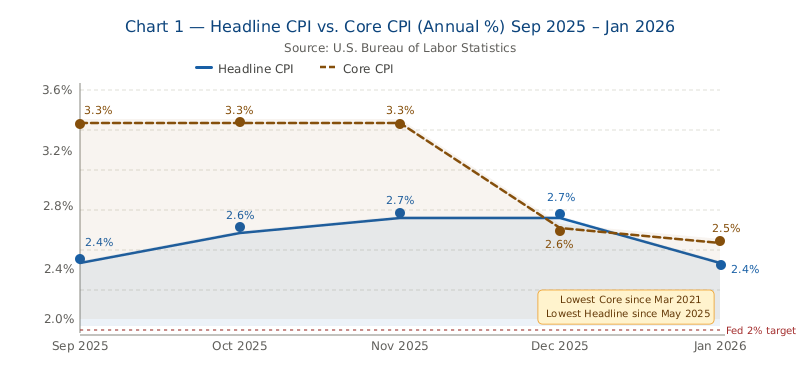
US Consumer Price Index and Core Inflation Timeline — Verified BLS Data (Sep 2025 – Jan 2026)
US CPI Inflation Data (2025-2026)
| Release Month | Annual CPI (%) | Core CPI (%) | Monthly | vs. Forecast |
|---|---|---|---|---|
| Sept 2025 | 2.4 | 3.0 | 0.2 | In line |
| Oct 2025 | N/A — Not published | Govt. Shutdown | ||
| Nov 2025 | 2.7 | 2.6 | 0.3* | Below Exp. |
| Dec 2025 | 2.7 | 2.6 | 0.3 | In line |
| Jan 2026 | 2.4 | 2.5 | 0.2 | Below / In line |
*Note: Data reflects official 2026 reporting standards.
Source: U.S. Bureau of Labor Statistics. * November 2025 release covered two months (Sep–Nov) due to the October 2025 government shutdown. October CPI was not published. January 2026 was the lowest combined print since March 2021.
Consumer Price Index (CPI) vs. Core Inflation: What Prop Traders Actually Monitor
The Consumer Price Index tracks price changes across food, energy, shelter, medical care, apparel, and transportation. The Federal Reserve’s primary benchmark is Core PCE, but Core CPI is the number traders watch — it is released a full month earlier than PCE and moves markets immediately.
A rising CPI reading is unfavorable for equity markets because it forces the Fed to maintain elevated rates, compressing growth stock valuations and triggering risk-off positioning in futures. Investors who monitor only headline CPI miss the stickier signals in services and shelter — the components that actually determine how long the Fed stays on hold.
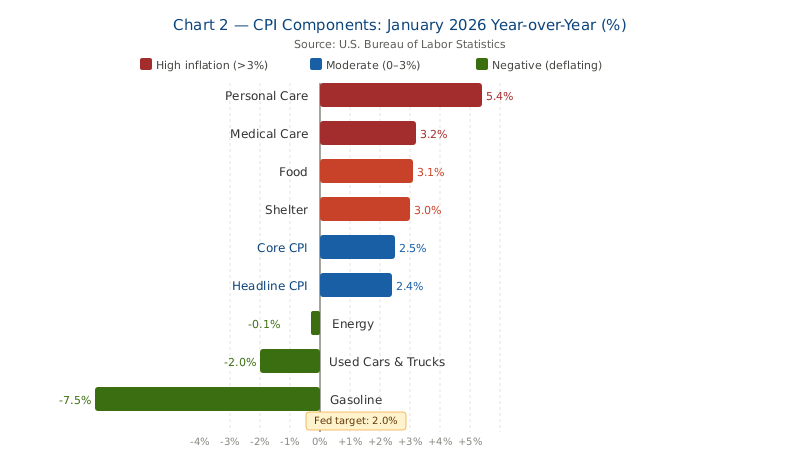
CPI Component Changes — January 2026 (Verified BLS Data)
CPI Component Breakdown: Jan 2026 vs. Dec 2025
| CPI Component | Jan 2026 (%) | Dec 2025 (%) | MoM | Trend |
|---|---|---|---|---|
| Headline CPI | 2.4 | 2.7 | +0.2% | ↓ Decelerating |
| Core CPI | 2.5 | 2.6 | +0.3% | ↓ Decelerating |
| Shelter | 3.0 | 3.2 | — | ↓ Easing |
| Personal Care | 5.4 | 3.7 | — | ↑ Accelerating |
| Energy | -0.1 | +2.3 | — | ↓ Sharp Reversal |
| Gasoline | -7.5 | -3.4 | — | ↓ Significant Drop |
| Used Cars & Trucks | -2.0 | +1.6 | — | ↓ Reversal |
Data source: 2026 Labor Statistics Bureau Report. Note: Negative values indicate deflationary pressure in that sector.
Source: U.S. Bureau of Labor Statistics, January 2026 CPI release. Food corrected to 2.9% YoY per official BLS data; prior versions cited 3.1% in error.
Federal Reserve Rate Policy: The Prop Trader’s Macro Framework
The Federal Reserve targets 2% annual inflation. Strong labor markets push wage growth higher, embedding services inflation throughout the economy. Elevated services inflation directly delays Federal Reserve rate cuts and suppresses equity valuations. January 2026 shelter inflation decelerated to 3.0% from 3.2% — progress, but incomplete.
The Fed demands sustained disinflation across multiple months and multiple components before cutting rates. For prop traders, a cool CPI print alone does not guarantee a sustained rally — the Fed’s next communication event determines whether the move holds or fades.
2026 Core CPI Outlook: Trading Economics projects Core CPI at 2.5% by the end of Q1 2026, trending toward 2.4% in 2027 and 2.3% in 2028. Persistent shelter inflation, tariff escalation, and Middle East freight cost premiums each pose re-inflation risk for equity markets.
External Inflation Drivers: What Prop Traders Track Beyond the Number
Supply Chain Pressure and Middle East Financial Impact
Red Sea shipping disruptions during 2024–2025 diverted cargo to longer, costlier Cape of Good Hope routes. Rerouted shipping lanes added weeks of transit time and billions in freight costs, directly elevating US import prices. Middle East regional instability has created sustained insurance cost premiums that commodity importers embed directly into retail prices.
Geopolitical Financial Alert: Brent crude price spikes above $90/bbl historically add 0.3–0.5 percentage points to headline CPI within 60 days. Prop traders must monitor energy futures in the 48 hours before each CPI release as an early directional signal.
Tariff escalations throughout 2025 created artificial price floors on imported goods. These floors prevent deflationary forces from fully reaching American consumers — keeping core goods inflation stickier than fundamental models suggest.
Technology: AI Deflation vs. Cybersecurity Inflation
AI generates powerful deflationary forces — optimizing logistics, reducing labor costs, and compressing manufacturing overhead. However, the cybersecurity arms race creates a growing offset to inflation. Companies pass rising cybersecurity costs directly to consumers through higher prices for software, cloud services, and connected hardware.
Key Inflation Drivers and Prop Trading Implications — 2025–2026
Macro Analysis: 2026 Inflation Drivers & Trading Strategy
| Inflation Driver | Direction | Affected Sectors | Prop Trading Implication |
|---|---|---|---|
| Geopolitical Supply Shocks | ↑ Inflationary | Shipping, Industrials | Favor domestic producers; avoid import-heavy retail. |
| AI and Automation | ↓ Deflationary | Tech, Logistics | Overweight AI platform leaders and automation software. |
| Resource Nationalism | ↑ Inflationary | Mining, EVs, Utilities | Long critical materials ETFs; short exposed manufacturers. |
| Tariff Escalation | ↑ Inflationary | Electronics, Consumer | Rotate toward domestic revenue; reduce import exposure. |
| Material Science | ↓ Deflationary | Semis, Clean Energy | Long R&D innovators with cost advantages. |
| Sticky Shelter/Rent | → Persistent | REITs, Construction | Monitor rent deceleration data monthly. |
Source: BLS, Federal Reserve, analyst research. Trading implications are analytical and not financial advice.
Stock Sectors: Inflation Winners and Losers
The most inflation-resilient businesses share three structural traits: pricing power, low physical input costs, and recurring or contracted revenue streams. Prop traders who understand sector rotation around CPI prints build faster, higher-conviction position theses.
Sectors That Outperform During Elevated Inflation
- Technology — Software/SaaS: Subscription pricing, high gross margins, minimal physical input costs
- Healthcare — Pharmaceutical: Patent-protected pricing power, inelastic demand
- Utilities: Regulated rate structures allow CPI pass-through to consumers
- Consumer Staples: Inelastic demand, strong brand pricing power
- Defense & Aerospace: Long-term government contracts with built-in inflation escalators
Sectors That Underperform During Elevated Inflation
- Consumer Discretionary: Demand destruction as real purchasing power declines
- Unprofitable High-Beta Technology: Rate hikes compress DCF valuations severely
- Real Estate Development: Rising material and labor costs compress margins
- Import-Dependent Retail: Tariff escalation and freight costs erode structure
The Three Consumer Price Index Scenarios: How They Move the Stock Market
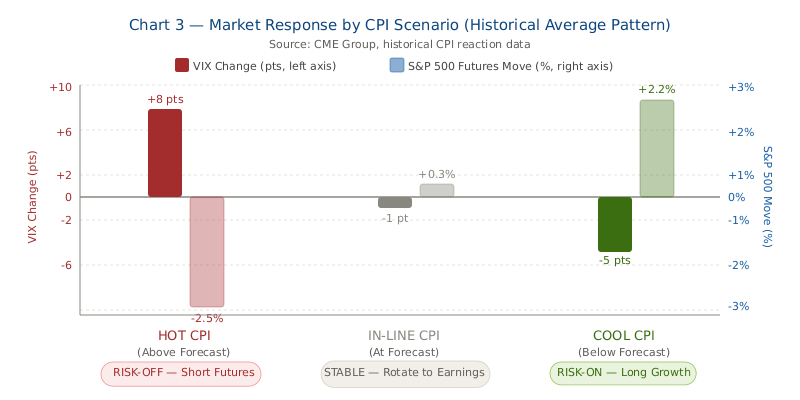
The difference between a hot print and a cool print can trigger a 2–4% intraday swing in S&P 500 futures within minutes of the 8:30 AM ET release. Prop traders structure their thesis around all three outcomes before the data drops.
Scenario 1: Hot Print — Above Expectations
A CPI reading above consensus forecasts triggers immediate and severe equity market stress. Treasury yields spike sharply as bond markets price aggressive Federal Reserve rate hikes. High-beta technology stocks sell off hardest — higher discount rates compress future cash flow valuations instantly. S&P 500, Nasdaq 100, and Russell 2000 futures gap lower in pre-market, setting a bearish tone for the NYSE open.
Hot Print — Prop Trader Response
- Shift immediately to short setups on failed bounces in the opening 30 minutes
- Reduce position size by 50%+ before the release if you hold high-beta names overnight
- Increase allocation to low-beta defensive sectors: utilities, staples, healthcare
- Monitor Treasury yield spreads for aggressive rate hike repricing
- VIX spike above 20 = institutional risk-off confirmed; tighten stops on all longs
Scenario 2: Cool Print — Below Expectations
A Consumer Price Index (CPI) print below consensus forecasts unleashes powerful equity market rallies. The Federal Reserve gains justification to cut rates or signal a dovish policy pivot. Lower discount rates immediately expand valuation multiples for growth stocks — Nasdaq 100 leads the move, and prop traders who positioned before the release capture the full gap. Traders who held long positions through prior volatility and positioned for disinflation collect the largest percentage gains on CPI day.
Cool Print — Sector Rotation Opportunities
- High-beta technology and software: First and fastest to rally on rate cut expectations
- Biotech and genomics: Highly rate-sensitive valuations expand sharply on dovish pivots
- Consumer discretionary: Spending capacity recovery drives revenue and earnings upgrades
- Small-cap equities (Russell 2000): Disproportionate beneficiaries of lower borrowing costs
- Long-duration growth stocks: DCF valuations expand as discount rates compress
Scenario 3: In-Line Print — At Expectations
An in-line CPI print delivers market stability — the rarest outcome in today’s volatile environment. Volatility indices compress as macro uncertainty resolves without triggering surprise reactions. Futures drift modestly higher as the equity risk premium contracts — the session becomes earnings-driven, not macro-driven. Disciplined prop traders shift focus to individual stock setups and sector-specific catalysts rather than index-level positioning.
Reading Futures: How to Build Your NYSE Open Plan
When the Consumer Price Index (CPI) report drops at 8:30 AM ET — a full hour before the NYSE opens at 9:30 AM — futures markets react instantly. That one-hour window is where disciplined prop traders build their plan for the day.
If ES or NQ moves sharply on Consumer Price Index (CPI) news, that move acts as a setup confirmation — a thesis for how US equities are likely to trade at the open. The direction and magnitude of pre-market futures movement give traders a structured starting point before a single stock changes hands.
The Core Rule: If futures are up convincingly on a cool print, the bias is long. If futures are down hard on a hot print, the bias is short. If in-line and futures barely moved, the session runs on earnings and individual catalysts — not macro.
Consumer Price Index Futures Playbook — Building a Prop Trading Plan for the NYSE Open
The CPI Playbook: Pre-Market Action & Open Bias
| CPI Result | Pre-Market Action | Open Bias | ES Entry Trigger | Stop | Prop Trader Setup |
|---|---|---|---|---|---|
| HOT PRINT | Sharp gap down; VIX spikes > 20. | BEARISH | Short when ES bounces and rolls over; wait for rejection. | 10–15 pts above bounce. | Fade early strength; 50% size until range forms. Don’t short gap low. |
| COOL PRINT | Strong gap up; buying holds firm. | BULLISH | Long on first pullback to support after the open. | 10–12 pts below retest. | NQ leads—if it holds, ES follows. Add on 2nd leg; don’t chase spike. |
| IN-LINE | Flat drift; ES within ±15 pts of close. | NEUTRAL | Trade break of opening range after 9:45 AM. | 8–10 pts outside range. | No directional bias; session runs on individual setups, not macro. |
| HOT → RECOVERS ⭐ | Initial drop reverses green by 9:15 AM. | CONTRARIAN | Long when ES reclaims prior close (2x 5-min candles). | 15–20 pts below reclaim. | A+ Setup: Institutional buyers absorbed the news. Full size allowed. |
| COOL → FADES ⚠ | Gaps up, then gives back most of the move. | SELL-THE-NEWS | Short when ES breaks back below prior close. | 12–15 pts above break. | Retail Trap: Fade failed morning rallies. Do not buy the initial gap. |
Note: Pre-market futures provide a directional thesis, not a guarantee. Always confirm with price action in the first 15–30 minutes of the NYSE session before sizing into positions.
 The Two Power Setups Prop Traders Target
A hot Consumer Price Index (CPI) print where futures recover into the open is the highest-conviction setup on the trading calendar. The market has digested the bad news, and institutional buyers are stepping in. Recovery rallies on CPI days often sustain through the morning session, providing momentum entries with defined risk against the pre-market low.
Conversely, a cool print where futures fade is a sell-the-news trap. Buyers failed to hold — that fade into the open is a bearish signal for the full session. Shorting failed morning rally attempts is the higher-probability play.
Futures do not just reflect the CPI number — they reveal how traders were positioned going into the release and whether that positioning is being confirmed or unwound. That is the real edge.
Portfolio Beta: Sizing Your Consumer Price Index (CPI) Exposure Like a Prop Desk
Understanding Beta Before the Print
Beta measures a stock’s historical price volatility relative to the S&P 500 baseline of 1.0. Prop desks calculate weighted average portfolio beta before every CPI release — this is mandatory pre-trade risk management. A portfolio with a beta of 1.5 moves 50% more than the S&P 500. On a 2% Consumer Price Index (CPI)-driven move, that is a 3% portfolio swing before you can react.
The professional approach is not to avoid beta — it is to know your beta before the number drops and size positions accordingly.
Beta Classification — Consumer Price Index (CPI) Sensitivity and Prop Trader Risk Protocol
Risk Management: Beta Exposure ($\beta$) and CPI Risk Protocol
| Beta Range | Category | Representative Sectors | Prop Trader Risk Protocol |
|---|---|---|---|
| $\beta > 1.5$ | Aggressive High-Beta | Unprofitable Tech, Biotech | Extreme: Max exposure on hot prints; cut size immediately. |
| $\beta$ 1.2–1.5 | High-Beta | Software, Semiconductors | High: Reduce size 50% before CPI release. |
| $\beta$ 0.9–1.2 | Market-Neutral | Financials, Industrials | Moderate: Hold with a defined stop loss. |
| $\beta$ 0.5–0.9 | Low-Beta | Healthcare, REITs | Low: Partial insulation; safer hold through print. |
| $\beta < 0.5$ | Defensive | Utilities, Staples, Bonds | Minimal: Capital preservation; shock absorber. |
Note: Beta measures a security’s volatility in relation to the overall market (S&P 500). A $\beta$ of 1.0 moves in sync with the market.
Source: Standard CAPM-based beta classification framework. Risk protocols reflect professional prop desk practice, not personalized financial advice.
The Markowitz Model: Why Correlation Is the Real Risk Metric
Harry Markowitz introduced Modern Portfolio Theory in 1952 and earned the Nobel Prize in Economics in 1990. The model’s insight is deceptively simple: portfolio risk is not determined by individual asset volatility — it is determined by how assets move in relation to each other.
The two core equations:
- Expected Portfolio Return: E(Rₚ) = Σ wᵢ × E(Rᵢ) (wᵢ = weight of asset i; E(Rᵢ) = expected return of asset i)
- Portfolio Variance (Risk): σ²ₚ = wᵀ Σ w (w = vector of asset weights; Σ = full covariance matrix of all asset pairs)
What this means for CPI day: A portfolio of ten technology stocks may appear diversified, but if all ten carry high positive correlation to rate expectations, the covariance term in σ²ₚ is enormous. When a hot CPI print spikes Treasury yields, all ten positions move against you simultaneously. That is not diversification — it is concentrated macro exposure wearing a diversification costume.
Applying Markowitz to CPI Positioning
The Efficient Frontier plots every possible portfolio combination on a risk-return curve. Portfolios below the frontier accept too much risk for the return they generate. Institutional prop desks target a position on the frontier consistent with their risk mandate and CPI scenario outlook.
Practically, the Markowitz framework directs prop traders to combine long equity positions with negatively correlated instruments — index futures, Treasury bonds, volatility products — before each CPI release. The covariance calculation tells you exactly how much of each hedge to hold, replacing intuition with mathematical precision.
Four Practical Markowitz Rules For Prop Traders On Consumer Price Index Day
- Audit the pairwise correlation of your largest positions 24 hours before the release
- Identify which positions will move together on a hot print — that cluster is your true risk concentration
- Short index futures (ES or NQ) in proportion to your beta-weighted equity exposure to reduce portfolio variance
- The goal is not zero risk — it is moving your portfolio onto the Efficient Frontier before the 8:30 AM release
Practical Limitation: The model assumes normally distributed returns. Real CPI-day markets generate fat-tailed distributions — sudden gap moves that fall outside the model’s predictions. Use Markowitz as a structural framework, not as a precise prediction engine.
Pre-Release Checklist: What Prop Traders Monitor Before Every Consumer Price Index (CPI)
The BLS releases the CPI report at 8:30 AM Eastern Time on a pre-scheduled monthly calendar at bls.gov. Positioning before the release — not reacting after it — separates disciplined prop traders from reactive participants.
CPI Risk Monitoring Checklist — Prop Trader Framework
Leading Indicators: Tracking Forward Inflation Pressure
| Indicator | Why It Matters | Prop Trader Signal |
|---|---|---|
| Shelter & Rent | Largest weight in Core CPI (Sticky). | Below 3.0% YoY: Green light for rate-sensitive longs. |
| Energy & Gasoline | Drives volatile Headline CPI swings. | Reversal Risk: Monitor if Jan’s -7.5% drop begins to bounce. |
| Services Inflation | Stickiest component; linked to wages. | Watch Hourly Earnings 3–6 months ahead as a lead. |
| M2 Money Supply | Leads inflation data by 12–18 months. | Excess Growth: Strong signal of future inflationary pressure. |
| FOMC Comms | Sets the market’s “Reaction Function.” | Hawkish Bias: Can flip a “cool” print into a sell-the-news event. |
| Energy Futures | Proxy for Middle East risk premiums. | Brent > $90/bbl: Adds 0.3–0.5pp to CPI within 60 days. |
Source: BLS, Federal Reserve, Trading Economics, Truflation. Signals are analytical indicators, not guaranteed trade triggers.
 Purchasing Power: The Long-Term Case for Inflation Literacy
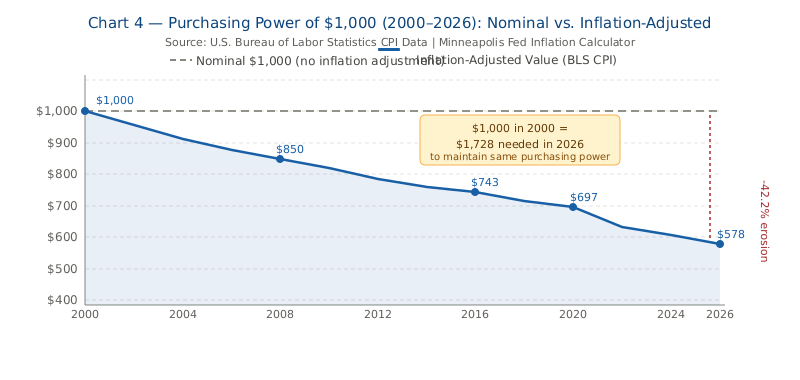
The erosion is easier to understand with a concrete number. $1,000 in January 2000 required approximately $1,728 in January 2026 to maintain equivalent purchasing power — a 72.8% cumulative loss in real value, based on BLS CPI data. The Minneapolis Fed’s Consumer Price Index (CPI) Inflation Calculator traces this back to 1913.
The official BLS figure and real-time trackers tell slightly different stories. Truflation’s real-time index tracks slightly below BLS CPI, suggesting official data lags real-time price changes by roughly 30–60 days. The January 2026 print confirmed genuine progress toward the Fed’s 2% target, but the path remains incomplete — personal care inflation at 5.4% is the most visible divergence risk.
Risks Prop Traders Must Monitor in Each Print
- Geopolitical escalation is reigniting Red Sea shipping and freight cost inflation
- Tariff escalation on consumer electronics, apparel, and food imports
- Services wage growth re-accelerating above 4.5% YoY
- Shelter inflation stalling above 3.0% for three or more consecutive months
- Energy reversal driven by OPEC+ cuts or Middle East supply disruptions
- Fed communications turning hawkish after a benign print
Conclusion: Consumer Price Index (CPI) Literacy is a Prop Trader’s Competitive Edge
January 2026 delivered headline Consumer Price Index (CPI) at 2.4% and Core CPI at 2.5% — both encouraging, neither definitive. Prop traders who understand the full inflation picture enter CPI day with a structured plan, not a reaction.
Reading pre-market futures as a directional thesis, auditing portfolio correlation through the Markowitz lens before the release, knowing which sectors rotate on hot versus cool prints, and tracking the eight risk indicators in the pre-release checklist — this is the systematic edge that separates profitable prop trading programs from reactive guesswork.
In a market where one number at 8:30 AM can erase months of gains within minutes, inflation literacy is not optional — it is the foundation of every disciplined prop trading framework.
Disclaimer: This article serves informational and analytical purposes only. The content does not constitute financial advice, investment recommendations, or solicitation of any kind. Futures and prop trading involve a substantial risk of loss, and past market patterns do not guarantee future results. Always consult a qualified financial advisor and licensed broker before executing any investment or trading strategy.
If you liked this post make sure to share it!