Stocks prop trading has grown significantly. Retail traders increasingly seek access to larger capital bases without risking their own savings. A stock prop firm provides traders with simulated or institutional capital to trade equities, ETFs, and related instruments. In return, the firm takes a share of the profits generated. Rather than depositing personal funds into a brokerage account, traders pay a one-time or recurring evaluation fee. They prove their skill during a structured challenge and then trade a funded account if they pass. This model shifts the barrier to entry from capital ownership to demonstrated trading competence. However, funded trading is not risk-free. Strict drawdown rules, profit targets, and platform requirements all demand consistent discipline. This guide covers how stock prop firms operate and how to qualify for funding. It also explains what to expect from payouts, profit splits, and platform access.
Fundamentals of Stocks Prop Firms: What They Are and How They Work
Understanding the model begins with a direct definition. A stock prop firm — short for proprietary trading firm — provides traders access to the firm’s simulated or live capital. Traders use that capital to trade stock instruments such as equities and ETFs. Traders participate in an evaluation and, if successful, share the profits generated in a funded account. The firm retains a percentage of profits in exchange for providing the capital, technology, and risk infrastructure. This differs fundamentally from brokerage or advisory roles. Prop trading involves taking market risk with the firm’s own capital. Trader compensation ties directly to account management and trading performance. Furthermore, prop trading is distinct from managing your own brokerage account. The firm sets the rules, defines the risk limits, and ultimately decides whether a trader’s activity meets its standards for continued funding.
How Do Stocks Prop Firms Work in Practice?
The mechanics follow a structured path. Traders pay a fee for an evaluation. They must meet a profit target and adhere to strict risk limits. If they pass, they receive a funded account, grow it, and keep a percentage of the profits. Most firms use a one-step or two-step evaluation model. One-step evaluations require a single phase; two-step models add a verification phase before funding. Some firms offer instant funding. This means direct account access for a higher upfront fee, typically with tighter drawdown rules. Meanwhile, no-time-limit challenges are growing in popularity. They encourage patient, disciplined trading rather than rushed decision-making near a deadline. Therefore, the structure of a challenge directly shapes the trading behavior it rewards.
Stocks Prop Firm Evaluation Models — Types, Fees, and Funding Paths
Four main evaluation structures used by stock prop firms; no-time-limit challenges are gaining adoption as they promote disciplined, rules-based trading habits.
Risks and Realities for Stock Traders
Prop trading carries meaningful risk even without personal capital on the line. The evaluation fee is not refundable in most cases. A failed challenge means losing the fee and starting over. Leverage amplifies both gains and losses. In stock prop firms, leverage is expressed as increased buying power. This means traders can control and scale to a larger position size, including leveraged ETFs. However, retail stock traders transitioning to stock prop firms must not violate the firm’s drawdown limits. Furthermore, volatility around earnings announcements, macroeconomic data releases, and sector-specific news events creates extreme price action. Even technically sound trades can hit risk limits before reversing.
Furthermore, the profit target, scaling target if applicable, and drawdown limit all operate simultaneously. A trader must grow the account while never crossing the loss threshold. As a result, consistent risk management is not optional. It is the primary determinant of whether a trader passes, fails, or withdraws profit. Realistic expectations require accepting that most traders fail their first challenge.
Evaluation and Funding: How the Stocks Challenge Works
Not all stock prop firms require a formal evaluation. Most require an assessment. Some offer instant funding or a direct funding path for a higher upfront fee — often with tighter risk rules and a lower maximum drawdown. The standard evaluation fee varies from tens to hundreds to thousands of dollars, depending on account size. A $25,000 funded account typically costs less than a $200,000 funded account. The fee covers real-time market data, professional platform access, and administrative screening. Some firms refund the evaluation fee alongside the trader’s first profit payout. This applies after the trader passes and generates real profits in the funded account. However, this policy varies by firm and is not universal. Traders should confirm the refund terms before registering for any challenge.
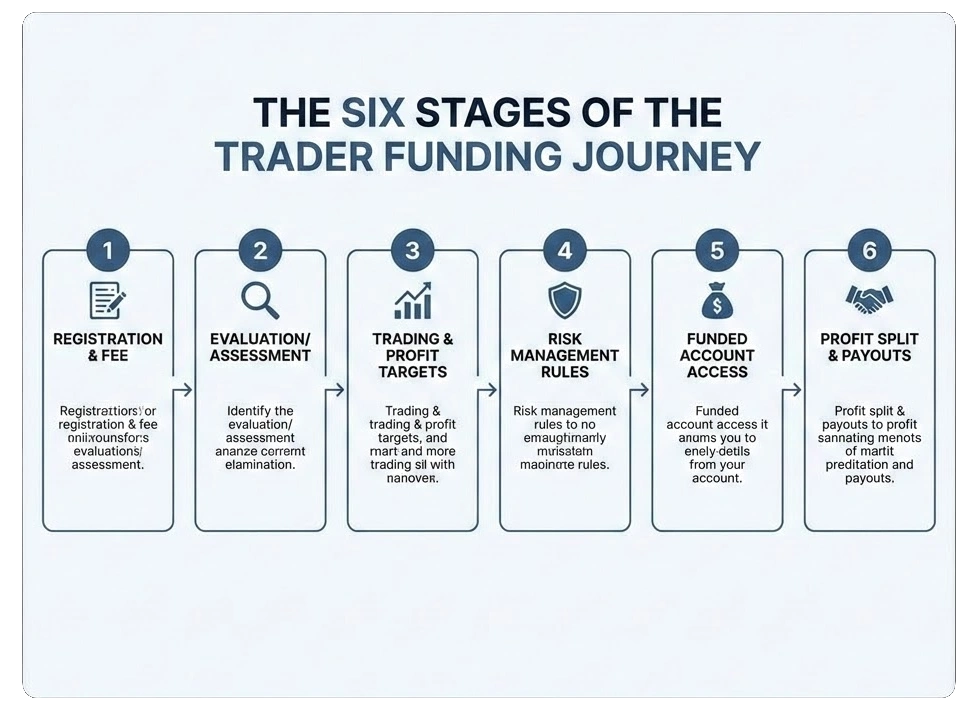
The six-stage stocks prop firm evaluation process: from registration and fee payment through funded account access, profit generation, and payout requests; a single rule violation at any stage results in account termination.
Rules, Drawdowns, and What Happens When a Trader Fails
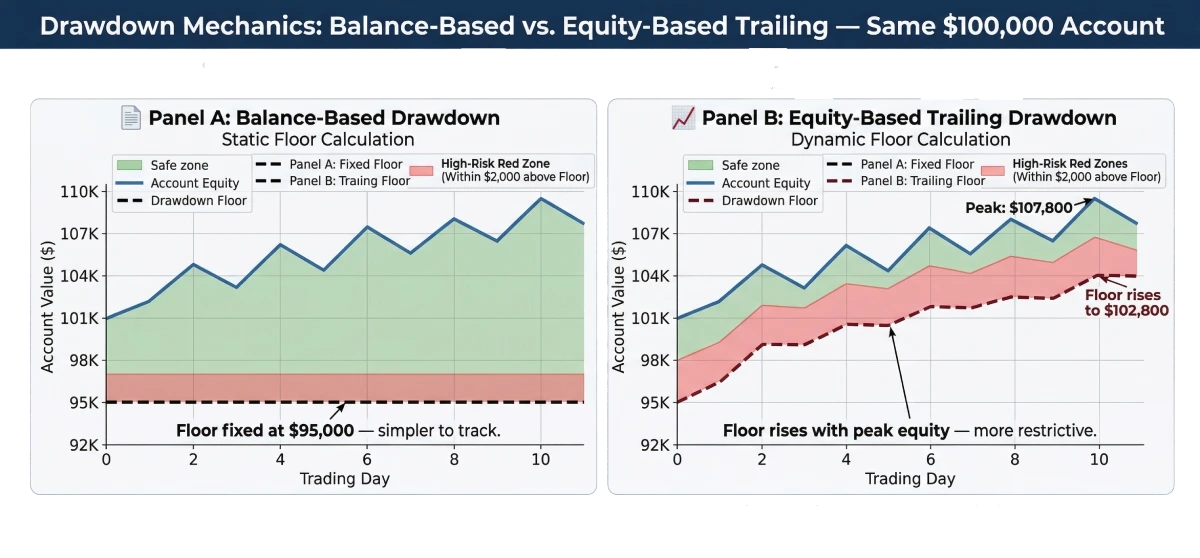
Standard evaluation rules include meeting a set profit target and respecting a maximum daily loss limit. Traders must also adhere to an overall maximum drawdown and sometimes complete a minimum number of trading days. A drawdown is the peak-to-trough decline in a trading account’s balance or equity. The maximum drawdown is the absolute limit a trader can lose before the account terminates. Balance-based drawdown is fixed from the starting or previous day’s closing balance, making it simpler to track. Equity-based trailing drawdown rises with peak equity, including open positions, making it more restrictive. For example, a trader builds equity to $105,000 on a $100,000 account with a $5,000 trailing drawdown. The floor then moves to $100,000, leaving no buffer. Violating the drawdown terminates the account immediately. The trader loses the evaluation fee and must purchase a reset or a new account to try again.
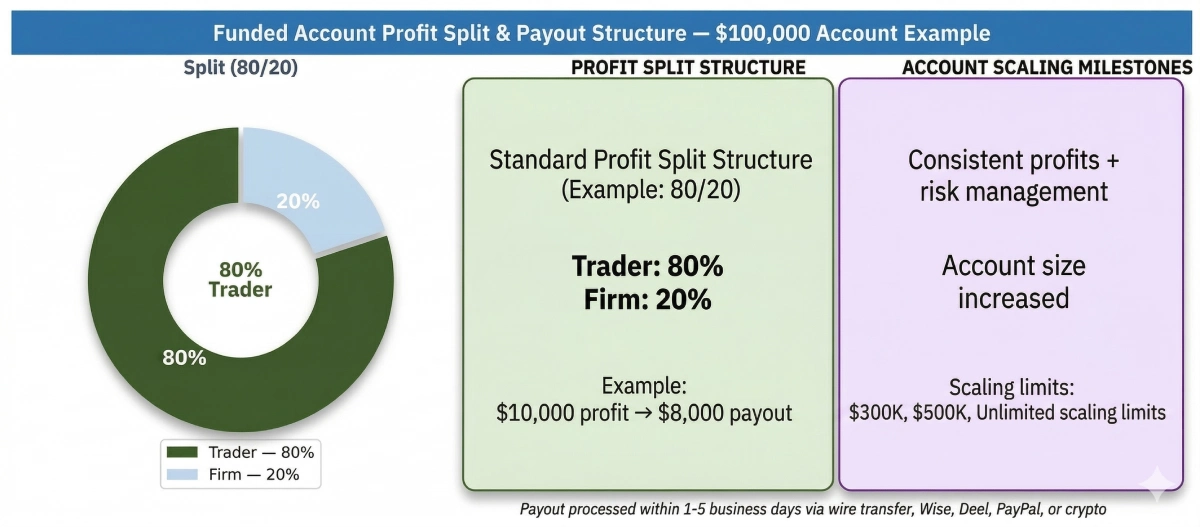
Funded account profit split structure: the standard 80/20 split (left), a tiered system with 100% trader retention up to an initial threshold, and account scaling milestones that increase buying power to $300,000 or more based on consistent performance.
Copy Trading, Time Limits, and Consistency Requirements
Time limits are a significant variable across firms. Many impose a 30 or 60-day window to complete the challenge. A growing number now offer no-time-limit challenges. No-time-limit challenges are generally recommended. They allow traders to focus solely on high-probability setups and strict risk adherence, without forcing trades under deadline pressure. Firms universally forbid copy trading between accounts held by different individuals. Any violation results in immediate termination. Some firms permit copy trading between a trader’s own accounts, but most restrict it. The challenge phase itself carries no financial reward — it is purely a demonstration of skill, consistency, and rule compliance. Therefore, traders who treat the evaluation as a genuine trading test produce better outcomes. Gaming the process rarely translates to funded account success.
The Funded Stocks Account, Payouts, and Profit
Funded account sizes at stock prop firms typically range from $25,000 to $200,000 or more in buying power. The profit split is the division of trading profits between the trader and the firm; a typical percentage is 70% for the trader and 20% for the firm, though some firms offer higher or tiered splits. Earnings are entirely performance-dependent. trader’s net profit multiplied by the split percentage determines the payout. Some firms use a tiered system in which traders keep 100% of profits up to an initial threshold (for example, the first $5,000), reverting to the standard split thereafter. Scaling programs increase account size after a trader meets set profit targets and demonstrates consistent risk management over a defined period — some programs scale accounts to $500,000 or beyond. However, scaling requirements vary significantly between firms.
Withdrawals, Payout Methods, and Tax Obligations
Withdrawals are typically processed within one to five business days of the trader’s request. The minimum withdrawal limit varies by firm but is commonly set between $100 and $500. Standard payout methods include bank wire transfers, third-party electronic payment services such as Wise, Deel, or PayPal, and cryptocurrency, depending on firm policy and regional support. Consistency rules at some firms require that no single trading day’s profit exceed a fixed percentage — commonly 30–50% — of the total payout amount to prevent one-day windfall withdrawals. Furthermore, traders must confirm that any initial drawdown has been recovered and a small safety buffer maintained before funds are released. Profits from prop trading are generally considered taxable income; traders are responsible for reporting earnings to the relevant tax authorities in their jurisdiction.
Choosing and Comparing Stocks Prop Firms
Regulation is a nuanced consideration in the prop firm space. Evaluation accounts are not regulated — they are simulated trading environments. Capital for funded accounts is often provided through a regulated broker-dealer, but the prop firm itself may not hold a specific trading license. Traders should verify the firm’s broker-dealer relationships and check for independent reviews before depositing any fees. Hidden costs represent a common problem: monthly data or platform fees that continue after the evaluation, high reset fees if a challenge is failed, and excessive commissions or withdrawal fees that reduce net profit. However, some firms remove hidden costs completely.
One edge a stock prop firm gives because of the simulated account environment is the ability to short any penny stock without paying locate fees or hard-to-borrow. Therefore, comparing firms on total cost of ownership — including fees, commissions, platform costs, and payout terms- produces a more accurate comparison than headline profit split percentages alone.
Trading Platforms and Tools for Stocks Prop Firms
Trade The Pool operates exclusively on TraderEvolution — a professional-grade equity trading terminal built for direct market access and high-speed intraday execution. The platform includes Depth of Market (DOM), Level 2 order flow data, a scalper view, fully customizable layouts, and advanced charting with multi-style data aggregations. Real-time market data and execution speed are optimized for both day traders and swing traders. TraderEvolution is not a general-purpose retail platform — it was selected by TTP specifically for its capacity to handle fast-moving equity setups across more than 12,000 U.S. stocks and ETFs. Traders should confirm platform availability and test the interface before paying any evaluation fee; TTP provides a 14-day free trial via the Hub.
What Sets TTP’s Ecosystem Apart: The Partner Tool Stack
Where Trade The Pool differentiates itself beyond execution is its curated partner tool ecosystem — included with account purchase. Most stock prop firms provide a platform and nothing more. TTP traders gain 30-day free trials to a suite of institutional-grade tools spanning AI-driven trade ideas, technical analysis automation, order flow visualization, and trade journaling. These tools address each stage of a trader’s workflow: idea generation, analysis, execution review, and performance tracking. The partner stack includes Trade Ideas Pro, TrendSpider, Bookmap, TraderSync, Stock Traders Daily, and Tradervue.
Trade The Pool Partner Tool Ecosystem vs. Competitors
Trade The Pool’s partner ecosystem compared to two leading futures-focused prop firms; TTP is the only stock-specific firm of the three and the only one bundling AI scanning, order flow visualization, and multiple journaling tools with account purchase.
Why the Partner Stack Matters for Evaluation Performance
Each tool in TTP’s partner stack addresses a specific weakness that causes funded account failures. Trade Ideas Pro uses machine learning to surface real-time equity setups — reducing the time a trader spends manually scanning thousands of symbols. TrendSpider automates trendline detection and multi-timeframe alerts, reducing chart interpretation errors under time pressure. Bookmap’s heatmap visualization of live order book data gives traders a structural view of where liquidity is building or pulling — information that is not visible on a standard candlestick chart. TraderSync and Tradervue provide post-session performance analytics and trade journaling, which are essential for identifying patterns in both winning and losing trades.
Stock Traders Daily delivers algorithmic entry and exit signals across U.S., Canadian, and LSE equities using technical frameworks adopted by institutional managers. Complementing this, BlueOcean provides traders with 24/5 access to U.S. stocks, extending trading hours beyond traditional market sessions and giving traders around the world the flexibility to act on opportunities whenever they strike, regardless of their time zone. Collectively, these tools close the gap between retail habit and professional process, which is precisely why TTP positions them as part of the core offering rather than optional add-ons.
Closing Thoughts: Approaching Stocks Prop Trading Responsibly
Stocks prop firms offer a structured path to trading larger capital without committing personal savings to the market, but the model demands discipline, realistic expectations, and careful firm selection. The evaluation fee is the only capital a trader risks directly; however, time, effort, and repeated challenge fees compound quickly if risk management fundamentals are not in place before attempting a challenge. Three principles apply universally across every firm and account size: respect the drawdown limit as the highest-priority rule at all times; treat the evaluation as a genuine trading test rather than a target to chase; and compare firms on total cost, payout terms, and platform quality before registering.
Furthermore, leveraged ETFs amplify outcomes in both directions. Using full intraday buying power without position-size discipline is the fastest route to a terminated account. Therefore, traders who approach stocks prop firms with the same rigor they would apply to a professional trading role give themselves the best foundation for long-term funded success.
Key takeaways from this guide:
- Evaluation fees cover platform access and screening — confirm refund terms before registering
- Trailing equity drawdowns are more restrictive than balance-based ones — understand which applies
- No-time-limit challenges promote better trading habits than deadline-driven evaluations
- Profit split of 70%+ is standard — compare total payout terms, not just headline percentages
- Trading tools add value — prioritize the prop firm with the strongest partner ecosystem and performance-boosting features
- Compare firms on hidden fees, reset costs, payout minimums, and broker-dealer relationships
If you liked this post make sure to share it!