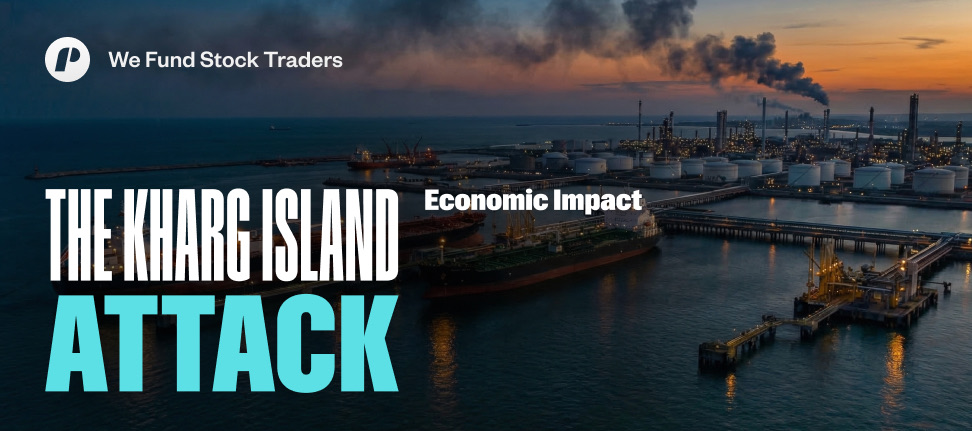
On the night of March 13–14, 2026, US forces struck Kharg Island. More than 90 military targets were destroyed in a matter of hours. The island’s oil export terminal was deliberately spared. Yet the economic impact of the Kharg Island attack reverberated instantly — across oil benchmarks, equity indices, bond markets, currency pairs, and commodity exchanges worldwide.
Kharg Island handles approximately 90% of Iran’s crude oil exports. Its deep-water jetties, subsea pipeline network, and 30-million-barrel storage capacity make it structurally irreplaceable within Iran’s energy system. The island also houses the Kharg Petrochemical Company — a major producer of sulfur, LPG, methanol, and naphtha for regional and global markets.
The Kharg Island attack did not destroy a single barrel of storage or a single pipeline. But the perceived risk of escalation — and the implicit threat of future strikes on oil infrastructure — was enough to drive Brent crude to nearly $120 intraday. This article examines the full economic impact of the Kharg Island energy conflict on oil supply, financial markets, and global economic stability.
Strategic Significance: Why Kharg Island Moves Global Markets
The Chokepoint Behind the Chokepoint
Kharg Island is Iran’s economic engine and its most vulnerable strategic asset. The island exports approximately 950 million barrels of crude oil annually. Its infrastructure aggregates output from Iran’s largest southwestern oilfields — including Ahvaz, Marun, Gachsaran, Faridun, Darius, and Ardashir — via subsea pipeline.
The island also hosts the Kharg Petrochemical Company, which processes sour gas and petroleum byproducts into sulfur, LPG (propane and butane), methanol, and naphtha. Falat Iran Oil Company operates directly on the island, contributing approximately 500,000 barrels per day of local crude production to terminal throughput. Any disruption to Kharg Island, therefore, affects not only crude oil but also downstream petrochemical supply chains across the region.
Kharg Island: Strategic Profile and Economic Exposure
(Swipe left to view full strategic dimensions and global significance data on mobile)
The island sits 25 kilometers off Iran’s coast and 483 kilometers northwest of the Strait of Hormuz. Nearly 20% of the global oil supply transits through that strait every day. The Kharg Island energy conflict, therefore, carries systemic risk: any escalation threatens both Iran’s export terminal and the world’s most critical oil shipping lane simultaneously.
The Kharg Island Attack: What Happened and What Was Spared
Military Precision — and a Deliberate Economic Choice
US CENTCOM confirmed that the March 13–14 strikes targeted military infrastructure exclusively. Destroyed assets included naval mine storage facilities, ballistic missile bunkers, coastal radar systems, and drone facilities. The oil terminal, loading jetties, pipeline connections, and Kharg Petrochemical facilities were all deliberately preserved.
President Trump described this restraint on Truth Social as a matter of ‘decency.’ Former US Army Brigadier General Mark Kimmitt offered a more strategic interpretation. He stated that the US is effectively ‘holding the island hostage.’ By preserving the oil infrastructure, the US retains the most powerful economic lever available — the implicit threat of destroying Iran’s entire revenue base in a single strike.
Kharg Island Attack: Military Targets vs. Preserved Infrastructure
(Swipe left to view full target categories and economic rationale on mobile)
The Kharg Island attack followed Iran’s blockade of the Strait of Hormuz, which began on February 28, 2026. The IEA described the resulting supply disruption as the largest in history. Iran had pre-positioned for this scenario: it drew down Kharg storage from 27 full tanks to 9, and surged loading rates to nearly 4 million barrels per day — triple the normal pace — in the weeks before the conflict began.
Immediate Economic Impact: Oil Prices and Market Reactions
How the Kharg Island Energy Conflict Repriced Global Energy
The immediate economic impact of the Kharg Island attack was most visible in crude oil markets. Brent crude surged to nearly $120 per barrel intraday on March 14, 2026, before settling at $103.14. US benchmark WTI traded just above $98. National average gasoline prices reached $3.68 per gallon in the United States.
The price move was driven by perceived risk, not physical damage. Kharg’s terminal remained operational throughout. Market participants assigned a significant probability to further escalation — particularly Trump’s explicit Truth Social threat to strike Kharg’s oil facilities if Iran continued blocking the Strait. That threat alone sustained the $100+ price level through mid-March.
Immediate Oil Market Response: Kharg Island Attack (March 2026)
(Swipe left to view full market indicators and strategic source data on mobile)
More than 30 IEA member countries responded by releasing a combined 400 million barrels from strategic petroleum reserves. At a global consumption of 105 million barrels per day, this covers approximately four days. Rystad Energy warned that Brent could reach $135 if the conflict continues for four months, while JPMorgan’s Natasha Kaneva confirmed that a full Kharg infrastructure strike would immediately remove 1.5 million barrels per day from global supply.
Impact on Iran’s Domestic Economy
Revenue Shock, Currency Risk, and the Kharg Petrochemical Dependency
Iran’s fiscal health depends directly on Kharg Island’s operational continuity. The island generates approximately $53 billion in annual oil export revenue — roughly 11% of Iran’s GDP. Under the 2025 national budget, the IRGC receives approximately 51% of oil and gas export revenues. A full terminal shutdown would constitute an immediate existential fiscal crisis.
The Kharg Petrochemical Company compounds this dependency. Beyond crude, Kharg exports sulfur, LPG, methanol, and naphtha — all generating additional foreign exchange. Disruption to Kharg petrochemical operations compounds Iran’s revenue shock while cutting off regional petrochemical supply chains that depend on the island’s sour gas processing capacity. Iran’s rial has already depreciated sharply throughout the sanctions era — any further revenue disruption accelerates currency collapse.
Economic Impact on Iran: Kharg Island Energy Conflict
(Swipe left to view full economic dimensions and conflict impact data on mobile)
Iran attempted pre-conflict mitigation by front-loading exports. Satellite imagery confirmed that Kharg storage fell from 27 full tanks to just 9 before February 28. This deliberate draw-down reflects Tehran’s acute awareness that Kharg Island is both its greatest asset and its most dangerous vulnerability — a single facility whose loss would destabilize the entire Islamic Republic.
Global Financial Market Reactions
Equities, Bonds, Currencies, Commodities, and Digital Assets
The economic impact of the Kharg Island attack cascaded across every major asset class. The pattern follows established geopolitical crisis dynamics — but the scale and speed of transmission reflect how tightly integrated global energy supply chains have become. Each market responded to a different dimension of the same underlying risk.
Equity Markets
Energy company stocks rose sharply on higher crude prices. XOM gained approximately 28% year-to-date in 2026, while XLE — the Energy Select Sector SPDR ETF — delivered a YTD total return of approximately 29% as of March 13, 2026. Airlines, logistics firms, manufacturing companies, and consumer-facing industries sensitive to fuel costs fell simultaneously — creating a sector bifurcation driven entirely by energy exposure. Emerging markets reliant on imported energy faced additional pressure, with indices reflecting inflation concerns and reduced growth visibility.
Bond Markets and Safe-Haven Assets
Investors reallocated capital toward safe-haven assets as geopolitical risk spiked. US Treasury demand rose, compressing yields. Emerging-market bonds experienced outflows, consistent with historical crisis patterns in which risk aversion drives capital toward stable, low-yield sovereign debt. Gold moved higher — reaching approximately $5,170 per ounce as of March 13, 2026 — as investors sought portfolio insurance against further escalation.
Currency Markets
Oil-exporting countries — including Norway, Canada, and Gulf states — saw their currencies appreciate modestly. Oil-importing nations in Asia and Europe faced currency depreciation driven by rising energy costs. The US dollar strengthened as global investors sought liquidity and stability — reinforcing the dollar’s role as the world’s primary crisis-period reserve currency.
Commodity Markets Beyond Oil
LNG prices rose as shipping disruptions spread beyond crude tankers. Kharg Petrochemical output reductions — specifically sulfur, methanol, and naphtha — added pressure to regional petrochemical feedstock markets. These secondary effects demonstrate the full breadth of Kharg Island’s economic footprint, extending beyond crude oil into downstream industrial supply chains.
Cryptocurrency Markets
Bitcoin and major cryptocurrencies exhibited a mixed and volatile response. Initial risk-off sentiment drove prices lower before a recovery. According to Elliptic, outgoing transactions from Iranian exchange Nobitex surged approximately 700% within minutes of the initial strikes — a clear signal of capital flight and self-custody demand from within the conflict zone. Bitcoin traded at approximately $72,770 on March 13, 2026, reflecting its growing but still inconsistent role as a geopolitical hedge compared with gold or Treasuries.
Global Financial Market Reactions: Kharg Island Attack (March 2026)
(Swipe left to view full asset class reactions and source-verified implications on mobile)
Maritime Disruption and Trade Cost Escalation
The Strait of Hormuz, the Dark Fleet, and Surging Insurance Premiums
The Kharg Island attack contributed to a severe slowdown in shipping activity through the Strait of Hormuz. War-risk insurance premiums for tankers operating in the Persian Gulf surged sharply. Mainstream operators rerouted vessels or suspended Gulf operations entirely. This created a bifurcated freight market that directly benefits high-risk operators willing to accept premium rates.
Iran’s ‘Dark Fleet’ — approximately 430 aging tankers using AIS spoofing, flag-hopping, and ship-to-ship transfers — plays a critical role in sustaining crude flow under conflict conditions. These shadow logistics maintained a partial financial lifeline for Tehran even as mainstream maritime operators exited, demonstrating the resilience of Iran’s illicit supply chain infrastructure. Jeff Currie of Carlyle noted that war-risk insurance premiums will remain elevated long after the conflict ends — permanently repricing global energy supply chains.
The maritime disruption also directly affected Kharg Petrochemical’s export logistics. Sulfur, methanol, naphtha, and LPG cargoes require specialized chemical tankers. As mainstream chemical tanker operators avoided the Gulf, Kharg Petrochemical’s export capacity was constrained even without direct physical damage to its facilities. This indirect disruption illustrates how the economic impact of the Kharg Island attack extends far beyond crude oil price movements.
Inflationary Pressures and Macroeconomic Consequences
Energy Costs, Consumer Spending, and the Central Bank Dilemma
Higher oil prices translate directly into increased transportation, production, and heating costs across the global economy. Countries dependent on imported energy — particularly in Asia and Europe — experienced immediate inflationary pressure following the Kharg Island attack. Central banks already navigating post-pandemic recovery dynamics faced renewed challenges.
The inflationary transmission operates through multiple channels simultaneously. Transport costs rise, increasing the price of every good that moves by truck, ship, or plane. Petrochemical feedstock costs rise as Kharg’s sulfur, methanol, and naphtha output is constrained — increasing prices for plastics, chemicals, and industrial inputs across downstream manufacturing. Consumer energy bills rise directly, compressing household discretionary spending across energy-importing economies.
Inflationary Transmission: How Kharg Island Affects the Real Economy
(Swipe left to view full transmission channels and global economic consequences on mobile)
If elevated oil prices persist for four months or more — the Rystad Energy $135 scenario — the macroeconomic consequences deepen significantly. The economic impact of the Kharg Island attack, therefore, carries implications not only for financial markets but for global growth trajectories and the pace of post-conflict recovery.
Long-Term Structural Implications
Energy Security, Geopolitical Risk Premiums, and Portfolio Realignment
The Kharg Island energy conflict exposes structural vulnerabilities in global energy supply chains that predate the 2026 crisis. The concentration of Iran’s entire export capacity — and its primary petrochemical processing hub — on a single island represents a systemic fragility. No other major oil-producing country carries this level of single-facility exposure.
Financial markets will now incorporate higher risk premiums for assets exposed to Persian Gulf instability. This repricing affects the cost of capital for energy-dependent industries, the valuation of Middle Eastern energy infrastructure, and the strategic calculus of energy importers seeking supply diversification. The crisis accelerates three structural trends: expansion of strategic petroleum reserve capacity, acceleration of alternative supply routes, and increased investment in energy security technology.
The Kharg Island attack also normalizes ‘infrastructure warfare’ as a component of modern conflict. Deliberate restraint — striking military assets while preserving economic infrastructure as leverage — sets a precedent. Future conflicts involving energy chokepoints will be interpreted through this framework, permanently altering how markets price geopolitical risk in commodity-dependent regions.
Best Oil Stocks 2026: Investment Implications of the Kharg Island Attack
Portfolio Strategy in a Conflict-Driven Energy Market
The economic impact of the Kharg Island attack creates a specific and actionable investment environment. Companies with domestic production exposure and minimal Persian Gulf logistics risk capture the full upside of elevated Brent benchmarks — without direct exposure to vessel seizures, insurance surges, or infrastructure strikes.
ExxonMobil (XOM) reported $28.8 billion in full-year 2025 earnings and committed to $20 billion in 2026 share buybacks. Wells Fargo raised its XOM price target to $183, citing Permian Basin and Guyana production ramps that are entirely insulated from Persian Gulf physical risk. Chevron (CVX) — with a current dividend yield of approximately 3.7% (MacroTrends, March 2026) and a breakeven below $50 per barrel Brent — generates strong free cash flow at $103 Brent.
Investment Framework: Best Oil Stocks 2026 in the Kharg Island Conflict
(Swipe left to view full ticker data, 2026 performance, and risk assessments on mobile)
For speculative positioning, Frontline PLC (FRO) captures premium freight rates as mainstream operators exit the Gulf. CrowdStrike (CRWD) addresses the cyber warfare dimension — protecting Industrial Control Systems from ‘wiper’ malware campaigns targeting Western energy infrastructure. XLE — up approximately 29% YTD as of March 13, 2026 — allows investors to express the broad Kharg Island energy conflict thesis without single-name event risk.
Risk Management Checklist for 2026
Active Monitoring Framework for Kharg Island Energy Conflict Developments
Managing positions during the Kharg Island energy conflict requires systematic, signal-based discipline. The following checklist translates geopolitical developments into portfolio responses. Each item targets a specific risk dimension of the 2026 conflict.
- Monitor Kharg Island crude loading rates. A surge above 3 million bpd signals renewed Iranian front-loading. Use Kpler or TankerTrackers for real-time data.
- Track Strait of Hormuz tanker traffic. Commercial vessel movement through the Strait is the single most sensitive real-time supply signal.
- Watch Trump communications on Truth Social. Statements about Kharg oil infrastructure have moved Brent crude in real time throughout the 2026 conflict.
- Monitor IEA strategic reserve announcements. Further coordinated releases signal demand management and may suppress short-term crude price spikes.
- Evaluate Abqaiq escalation risk. Iranian retaliation against Saudi energy infrastructure triggers the $135–$150 Brent scenario.
- Screen energy holdings for cybersecurity protocols. Wiper malware targeting ICS systems represents a structural operational risk for the entire sector.
- Adjust position sizes on ceasefire or peace signals. A ceasefire announcement could trigger a sharp Brent correction within 24–48 hours of confirmation.
- Track Kharg Petrochemical export flows. Disruptions to sulfur, methanol, naphtha, and LPG exports signal secondary economic impact beyond crude oil.
Conclusion: The Full Economic Weight of the Forbidden Island
The economic impact of the Kharg Island attack is simultaneously narrower and broader than it first appears. Narrower — because no oil infrastructure was physically damaged on Marc</strong>h 13–14. Broader — because the mere threat of further escalation was sufficient to move every major asset class on Earth within hours.
Kharg Island is not simply an oil terminal. It is the financial backbone of the Iranian state, the primary funding mechanism for the IRGC, and the single facility whose loss would deliver an existential economic shock to the Islamic Republic. The Kharg Petrochemical Company’s sulfur, LPG, methanol, and naphtha operations — alongside the subsea pipeline network, the 30-million-barrel storage system, and the deep-water loading jetties — constitute one of the highest-density concentrations of economic value in any square kilometer on the planet.
For global markets, the lesson of the 2026 Kharg Island energy conflict is structural. As long as 20% of global oil supply transits the Strait of Hormuz, and as long as Kharg Island handles 90% of Iranian crude exports, the global economy carries a permanent vulnerability that no amount of strategic reserve release can fully offset. Investors, policymakers, and energy security analysts ignore this vulnerability at considerable cost.
Disclaimer: This article is for informational and educational purposes only. It does not constitute financial or investment advice. All investments carry risk, including the possible loss of principal. Past performance does not guarantee future results. Consult a qualified financial advisor before making any investment decisions.
If you liked this post make sure to share it!